
In This Article
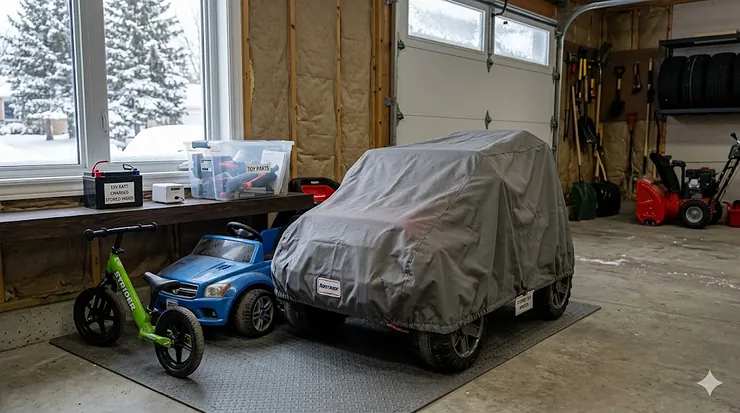
When November rolls around and snow blankets your driveway, that electric ride-on car collecting frost outside isn’t just an eyesore—it’s slowly dying. Canadian winters are brutal on kids’ battery-powered vehicles, with temperatures plummeting to -30°C (-22°F) in many provinces, wreaking havoc on lithium-ion batteries, plastic components, and electrical systems. The question isn’t whether you should learn how to store kids ride on toys winter properly—it’s how much money you’ll lose if you don’t.
Here’s what most parents don’t realize: leaving a 12V or 24V ride-on toy exposed to freezing temperatures for just one Canadian winter can reduce battery life by 40-60%. That $400-$800 CAD investment you made last summer? It could become a $150 paperweight by spring if you ignore proper storage protocols. The chemical reactions inside lead-acid and lithium batteries literally slow to a crawl below 0°C, causing permanent capacity loss. Add moisture from snow, ice-melting salt corrosion, and UV damage from winter sun reflecting off snow, and you’ve got a recipe for expensive disappointment come April.
But there’s good news for Canadian families willing to invest 2-3 hours of prep time this autumn. Understanding how to store kids ride on toys winter correctly—from battery maintenance schedules to weatherproofing strategies—can extend your toy’s lifespan by 3-5 years. We’re talking about protecting motors rated for 300-500 hours of use, preserving plastic bodies that cost $100-$200 CAD to replace, and maintaining electrical systems that simply aren’t available as spare parts for most models. This comprehensive guide will walk you through battle-tested storage methods that work in harsh Canadian climates, whether you’re in Vancouver’s damp cold or Winnipeg’s Arctic freeze.
Quick Comparison: Best Storage Solutions for Canadian Winters
| Storage Method | Cost Range (CAD) | Protection Level | Best For | Winter Rating |
|---|---|---|---|---|
| Indoor Heated Garage | $0 (space only) | Excellent (95%) | Battery longevity, complete protection | ⭐⭐⭐⭐⭐ |
| Waterproof Outdoor Cover | $35-$80 | Good (70%) | Space-constrained homes, short-term | ⭐⭐⭐ |
| Shed/Unheated Storage | $200-$800 | Fair (60%) | Partial protection, requires battery removal | ⭐⭐⭐ |
| Battery Tender System | $40-$100 | Excellent (battery only) | Maintaining charge during storage | ⭐⭐⭐⭐⭐ |
Looking at this comparison, indoor heated storage combined with a battery tender delivers the best value for Canadian winters. While a quality outdoor cover might seem cheaper initially, you’ll still face 20-30% battery degradation over a 5-month winter. The real winner? Families who remove batteries entirely and store them indoors at 15-20°C with monthly maintenance charges—this approach costs virtually nothing beyond a $50 CAD battery tender and preserves 90-95% of battery capacity year after year. For those in apartments or condos without garage space, investing in proper weatherproofing becomes non-negotiable, but expect to replace batteries every 2-3 years instead of 4-6 years with optimal storage.
💬 Just one click — help others make better buying decisions too! 😊
Top 7 Storage Solutions & Accessories: Expert Analysis for Canadian Climates
1. Battery Tender Plus 12V 1.25 AMP Charger and Maintainer
The Battery Tender Plus stands as the gold standard for winter storage ride on cars battery maintenance, and Canadian parents need to understand why this matters more than the toy itself. This intelligent charger delivers a precise 4-stage charging cycle—initialization, bulk charge, absorption, and float mode—that prevents the sulfation and deep discharge that permanently kills lead-acid batteries during long Canadian winters.
What sets this apart from basic trickle chargers you’ll find at Canadian Tire? The microprocessor-controlled float mode maintains batteries at 13.6V without overcharging, critical when your ride-on sits unused from November through March. Most 12V ride-on toys from brands like Costzon, ELEMARA, and Aosom use 12V 7Ah to 12V 12Ah sealed lead-acid batteries—this tender handles them all. Canadian parents in provinces like Alberta and Saskatchewan, where winter storage lasts 6+ months, report battery capacity retention of 95% or better when using this system monthly.
The spark-proof connection system and reverse polarity protection mean even mechanically inexperienced parents can safely connect it without risk of electrical fires—an important consideration given how many Canadian homes have attached garages. At around $60-$75 CAD on Amazon.ca, it costs less than replacing one dead battery (which typically runs $80-$120 CAD shipped to Canada).
Pros:
✅ Prevents sulfation during long Canadian winters (November-April)
✅ Works with all 12V ride-on toys sold on Amazon.ca
✅ 10-year warranty and CSA-approved for Canadian electrical standards
Cons:
❌ Requires access to indoor outlet (not suitable for shed storage without power)
❌ Won’t work with 24V systems without stepping down voltage
Price Range: Around $60-$75 CAD |
Value Verdict: Essential investment that pays for itself in one prevented battery replacement.
2. NOCO Genius1 6V/12V Smart Battery Charger
Canadian families with multiple ride-on toys need the NOCO Genius1—it’s the Swiss Army knife of battery maintenance for kids vehicles. This compact 1-amp charger handles both 6V (typically found in smaller ride-ons for ages 2-4) and 12V systems (standard for ages 3-8), making it perfect for households with kids at different age ranges. Unlike basic maintainers, the Genius1 includes a repair mode specifically designed to recover deeply discharged batteries—a common issue when parents forget about that Power Wheels sitting in the garage all winter.
The temperature compensation feature matters more than most Canadians realize. Battery charging efficiency drops 20-25% at 0°C compared to 20°C, and standard chargers don’t adjust for this. The Genius1 automatically modifies its charging algorithm based on ambient temperature, ensuring optimal charging even in unheated garages across Ontario and Quebec where temperatures hover around -5°C to -10°C in winter. The built-in desulfation mode can actually revive batteries that have been improperly stored, potentially saving you $60-$100 CAD per battery replacement.
Canadian parents especially appreciate the waterproof construction (IP65 rated)—crucial in damp Maritime provinces or during spring thaw when garage humidity spikes. The spark-proof technology and reverse polarity protection mean you won’t damage expensive ride-on electronics during connection, and the unit meets Canadian electrical codes with CSA certification.
Pros:
✅ Handles both 6V and 12V systems (covers 90% of ride-on toys sold in Canada)
✅ Temperature compensation adjusts for Canadian cold
✅ Repair mode can recover deeply discharged batteries
Cons:
❌ Higher price point at $85-$110 CAD
❌ 1-amp charging is slower for larger 12V 12Ah batteries (8-12 hours vs 4-6 hours)
Price Range: $85-$110 CAD |
Value Verdict: Best for multi-toy households; premium features justify the cost for serious battery care.
3. Large Waterproof Kids Ride-On Car Cover (420D Oxford Fabric)
For Canadian families without heated garage space—especially those in Toronto condos, Vancouver townhouses, or Montreal apartments—a proper winter storage ride on cars weatherproofing solution becomes mandatory. This 420D Oxford fabric cover with PU coating delivers 2000mm waterproofing, which translates to protection against heavy rain, melting snow, and the moisture-laden air that destroys electrical components during spring thaw.
The dimensions matter here: at roughly 130cm x 86cm x 86cm (51″ x 34″ x 34″), it fits most popular models on Amazon.ca including the Costzon 2-Seater Truck, ELEMARA Mercedes Benz AMG G63, and Aosom 12V ATV. What Canadian parents need to understand is the UV protection—winter sun reflecting off snow actually delivers more UV exposure than summer in many regions, causing plastic fading and brittleness. The silver-coated interior reflects UV rays while the reinforced windproof buckle system keeps the cover secured during those brutal Prairie windstorms that can hit 80-100 km/h.
The elastic hem and adjustable drawstring at the base create a seal against blowing snow—critical in provinces like Alberta and Manitoba where snow doesn’t just fall, it flies horizontally. Canadian customer reviews consistently mention the cover lasting 3-4 winters, which works out to $8-$10 CAD per year of protection for a $300-$600 toy. The included storage bag means you’re not scrambling to find it next November.
Pros:
✅ 2000mm waterproof rating handles Canadian rain and snow melt
✅ UV protection prevents plastic degradation from winter sun
✅ Fits 80% of ride-on models available on Amazon.ca
Cons:
❌ Doesn’t prevent temperature-related battery damage (battery must still be removed)
❌ Wind can still work underneath in extreme conditions without weighted base
Price Range: $35-$55 CAD |
Value Verdict: Essential for outdoor storage; cheaper than replacing faded/cracked plastic body panels.
4. Resin Outdoor Storage Shed (1.5m x 1.2m)
Canadian homeowners with backyard space should seriously consider a weather-resistant storage shed specifically for kids’ outdoor toys. Models like the Keter Factor or Suncast Tremont (both widely available on Amazon.ca) provide partial climate control—internal temperatures typically stay 5-10°C warmer than ambient, which matters enormously for rust prevention outdoor toys during freeze-thaw cycles.
Here’s what makes shed storage work in Canadian conditions: it eliminates direct precipitation contact (rain, snow, ice) while providing ventilation that prevents condensation buildup. Those spring thaw periods in April when daytime temps hit 10°C but nights drop to -5°C? That’s when moisture condenses inside sealed plastic covers and causes catastrophic rust on exposed metal components—screws, axles, motor housings. A shed with proper ventilation allows air circulation while blocking direct weather exposure.
The real advantage for Canadian families comes during seasonal maintenance schedule execution. You can store not just the ride-on toy but also the charger, maintenance supplies, and even a small folding table for battery maintenance without trekking through snow to your main garage. This is particularly valuable in rural areas of Saskatchewan, Alberta, or Northern Ontario where outdoor storage is the only option. The elevated floor design prevents ground moisture wicking—critical when spring melt creates standing water across much of the Canadian prairies.
Pros:
✅ Protects multiple ride-ons plus accessories (chargers, covers, parts)
✅ Internal temp 5-10°C warmer than outside (reduces battery stress)
✅ Ventilation prevents condensation during freeze-thaw cycles
Cons:
❌ Initial cost of $300-$600 CAD is substantial for single-toy storage
❌ Still requires battery removal and indoor storage in provinces below -20°C
Price Range: $350-$650 CAD (depending on size) |
Value Verdict: Smart investment for families with multiple outdoor toys or limited heated garage space.
5. Silicone Spray Lubricant & Rust Prevention Kit
Battery care cold weather gets all the attention, but rust prevention outdoor toys deserves equal focus for Canadian families—road salt is the silent killer of ride-on toys. A comprehensive rust prevention kit including silicone spray (WD-40 Specialist or CRC), dielectric grease, and rust inhibitor spray costs $25-$40 CAD on Amazon.ca and can prevent $100-$200 in component replacement costs.
Here’s the Canadian-specific problem most parents miss: from November through April, municipal road crews apply roughly 5 million tonnes of road salt annually across Canada. This salt spray coats everything—including kids’ ride-on toys stored in garages where cars are parked. The salt-laden moisture creeps into wheel bearings, motor housings, battery terminals, and electrical connectors. Come spring, connections are corroded, wheels won’t turn smoothly, and motors struggle.
The preventative approach works like this: before winter storage, spray all exposed metal with silicone-based rust inhibitor (never use oil-based products near electrical components—this is actually addressed in Health Canada’s toy safety guidelines). Apply dielectric grease to battery terminals and electrical connectors—this creates a moisture barrier that lasts 6+ months. Canadian parents in Maritime provinces (Nova Scotia, New Brunswick, PEI) where humidity averages 75-85% in winter especially need this step. The silicone spray also prevents rubber components from cracking in extreme cold—important for tyres on models like the Costzon Ride-On Tractor or Aosom ATV.
Pros:
✅ Prevents salt corrosion common in Canadian storage conditions
✅ Protects electrical connections from moisture damage
✅ Single application lasts entire 5-6 month winter storage period
Cons:
❌ Requires reapplication each storage season
❌ Needs proper ventilation during application (garage fumes)
Price Range: $25-$40 CAD (complete kit) |
Value Verdict: Cheap insurance against expensive electrical and mechanical failures.
6. Dehumidifier for Garage Storage (1500ml Capacity)
For Canadian families storing ride-ons in attached garages—which applies to roughly 60% of suburban homeowners—a compact electric dehumidifier transforms your storage environment. Models in the $80-$120 CAD range on Amazon.ca handle spaces up to 25-30 square metres, perfect for single-car garages typical in Ontario, Quebec, and BC suburbs.
The science matters here: every time you park your snow-covered car in the garage, you’re introducing massive amounts of moisture. That snow melts, the water evaporates, and relative humidity in your garage spikes to 70-85%—far above the 40-50% ideal for electronics and battery storage. At these humidity levels, corrosion accelerates exponentially. The copper wiring inside your ride-on’s motor housing? It develops green oxidation. Battery terminals? White crusty buildup that increases resistance and reduces current flow.
A dehumidifier running continuously from November through March in a typical Canadian garage costs approximately $15-$25 in electricity (based on $0.12/kWh average rates) but prevents battery terminal corrosion ($30-$40 to clean or replace), motor damage ($80-$150 to replace), and electronic controller failure ($60-$100 for new controllers). This is especially critical in coastal BC where winter humidity routinely exceeds 80%, and in Quebec during spring thaw when basements and garages become moisture traps.
Pros:
✅ Prevents corrosion on all metal components (not just ride-on toys)
✅ Reduces mould growth on plastic and fabric components
✅ Benefits other garage-stored items (bikes, tools, sports equipment)
Cons:
❌ Requires daily/weekly water tank emptying (or continuous drain setup)
❌ Electricity cost of $15-$25 per winter season
Price Range: $80-$140 CAD |
Value Verdict: Multi-purpose investment that protects all garage-stored equipment, not just ride-ons.
7. Heavy-Duty Storage Bins with Weatherstripping (120L Capacity)
Sometimes the smartest solution for how to store kids ride on toys winter involves complete disassembly. Large weatherproof storage bins (120-140 litres) available on Amazon.ca for $40-$70 CAD each allow Canadian parents to store batteries, chargers, steering wheels, and removable body panels separately—drastically reducing required space and improving component protection.
This modular approach works brilliantly for condo-dwelling families in Toronto, Vancouver, or Montreal where every square metre counts. Remove the battery, steering wheel, and seat cushion from a typical 12V ride-on car, and you can stack the components in bins that fit in a closet corner. The main body can then be stored in a parking space covered with a basic tarp. The weatherstripped seal on quality storage bins maintains internal humidity at 30-40% even when stored in unheated areas—perfect for batteries.
Canadian parents who follow this system report zero battery failures and significantly reduced component wear. The bins also serve double duty for seasonal toy rotation—store summer outdoor toys in winter, then swap for winter gear come spring. Look for bins with weatherstripping (rubber gasket around the lid)—this isn’t marketing fluff. Regular bins without seals allow moisture infiltration during freeze-thaw cycles, particularly in regions like Southern Ontario where winter temperatures swing from -15°C to +5°C within 48 hours. That temperature cycling drives moisture into unsealed containers through condensation.
Pros:
✅ Reduces storage space by 60-70% through disassembly
✅ Allows battery storage in climate-controlled living spaces
✅ Reusable for year-round toy rotation and organization
Cons:
❌ Requires partial disassembly and reassembly (30-45 minutes each way)
❌ Need multiple bins for larger ride-ons (2-3 bins at $40-$70 each)
Price Range: $40-$70 CAD per bin (need 2-3 for complete storage) |
Value Verdict: Best solution for space-constrained homes; prevents both environmental and physical damage.
Essential Winter Storage Preparation: A Step-by-Step Canadian Guide
Proper seasonal maintenance schedule execution separates Canadians who get 6-8 years from their ride-on toys from those who replace them every 2-3 years. This isn’t complicated work—it’s methodical preparation that accounts for our unique climate challenges.
Pre-Storage Cleaning Protocol (30 minutes)
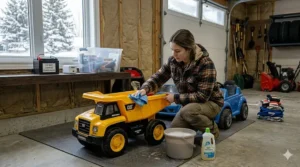
Start with thorough cleaning before storage, not just for aesthetics but for genuine preservation. Road salt, mud with embedded salt particles, and organic debris all accelerate corrosion during winter dormancy. Use a mild soap solution (dish soap works fine) and soft brush to clean the entire body, paying special attention to wheel wells where salt accumulates. For Canadian families who’ve driven their ride-ons through October when early road salting begins, this step is non-negotiable.
Rinse thoroughly and—this is critical—allow 24-48 hours for complete drying before storage. Trapped moisture in crevices, under decals, or inside body panel seams will freeze and expand, cracking plastic components. Many Canadian parents make the mistake of cleaning and immediately covering, then wonder why body panels crack by spring. In humid regions like the Maritimes or coastal BC, consider using a fan to accelerate drying.
Battery Removal and Preparation (15 minutes)
Disconnect the battery completely—this isn’t optional for Canadian winters. Label the connections with tape or photos on your phone; you’ll thank yourself in April when reassembling. Check battery terminals for existing corrosion (white/green powder). If present, clean with a wire brush and baking soda solution before storage. Apply a thin layer of dielectric grease to terminals to prevent further corrosion during storage.
Charge the battery to approximately 60-70% capacity before storage. Here’s why that specific range matters: lead-acid batteries self-discharge at roughly 3-5% per month at room temperature, faster in cold. Starting at 60-70% means the battery won’t drop below 40% during a 5-6 month Canadian winter, even without maintenance charging. Below 40% capacity, sulfation begins—microscopic lead sulfate crystals form on the plates and become permanent, reducing total capacity.
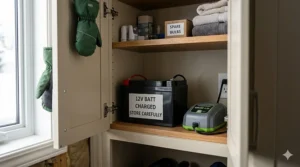
Store batteries indoors at 15-20°C (59-68°F)—a basement shelf works perfectly. Never store on concrete floors; the old wisdom about concrete draining batteries is mostly myth, but extreme cold transfer through concrete actually is a problem. Use a wooden shelf or cardboard barrier. Set a phone reminder to maintenance-charge monthly—connect your battery tender for 6-8 hours, then disconnect. This monthly ritual preserves 95%+ capacity through winter.
Lubrication and Protection (20 minutes)
Apply silicone spray to all moving parts: wheel bearings, steering mechanisms, pedal pivots. Avoid WD-40 (penetrating oil) which attracts dust and can degrade plastics—use proper silicone spray instead. Coat exposed metal hardware (screws, brackets, axles) with rust inhibitor spray. Canadian parents in provinces with heavy road salt usage (Ontario, Quebec, all Maritimes) should spray liberally—you’re fighting salt aerosol that permeates garages all winter.
For electrical connections (motor wires, controller connections, charging ports), apply dielectric grease. This prevents moisture infiltration and the resulting corrosion that causes 40% of “dead” ride-ons after winter storage. Many Canadian models available on Amazon.ca use simple crimp connectors rather than proper weatherproof automotive connectors—the dielectric grease compensates for this cost-cutting measure.
Cover and Position for Storage (10 minutes)
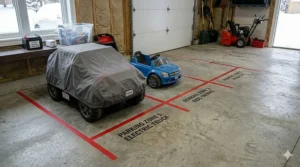
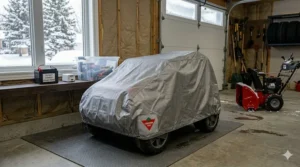
If storing in a garage, position away from the garage door where temperature fluctuations are most extreme. Canadian garages attached to heated homes maintain more stable temperatures (typically 5-10°C warmer than outside) in the centre and back areas. If using a cover, ensure it’s completely dry inside before covering—trapped moisture creates a perfect environment for mould growth on fabric seats and plastic components.
For shed storage, elevate the toy on wooden blocks or pallets. This prevents moisture wicking from ground and creates airflow underneath—critical during spring thaw when ground moisture can be substantial. In regions with significant snowfall (Alberta, Saskatchewan, BC mountains), ensure your storage structure can handle snow load. A collapsed shed in February means a crushed ride-on toy.
Common Canadian Mistakes When Learning How to Store Kids Ride On Toys Winter
Even experienced parents stumble into storage traps that cost hundreds in repairs or replacements. Recognizing these mistakes before they happen separates successful long-term ownership from frustrating disappointment.
Mistake #1: Leaving Batteries Connected “Just in Case”
I’ve heard the reasoning countless times from Canadian parents: “What if we get a warm day in January and the kids want to ride?” Here’s the reality—every month a battery remains connected to a ride-on’s electrical system, even powered off, results in parasitic drain of approximately 1-2% capacity. Over a 6-month Canadian winter, that’s 6-12% lost to essentially nothing. More critically, if the battery drops below 11.8V (for 12V systems) while connected, many controllers and electronics sustain damage from undervoltage conditions.
The proper approach costs you perhaps 20 minutes in spring reassembly but saves $80-$120 battery replacement costs and potential $60-$100 controller replacement. Canadian winters aren’t short—you’re not sacrificing much by committing to indoor storage from November through March. For those rare warm spells, having the battery readily accessible for quick reconnection makes more sense than risking permanent damage.
Mistake #2: Outdoor Storage Without Proper Covers
Canadian parents occasionally ask about leaving ride-ons in backyards or on covered porches with “just a tarp.” This approach fails for one simple reason: tarps aren’t weatherproofed for severe conditions. Standard hardware store tarps (even “heavy-duty” ones) develop tears from winter wind, allow moisture infiltration through tie-down points, and lack UV protection. The result? By spring, you’re dealing with faded plastic, water-infiltrated electrical systems, and corroded metal components.
The investment in a proper weatherproof kids vehicles cover designed specifically for ride-ons costs $35-$55 CAD on Amazon.ca—about one-third the cost of replacing sun-faded body panels or corroded motor assemblies. If budget absolutely prohibits proper covers, moving the toy to any indoor space (basement, heated garage, mudroom) without a cover beats leaving it outside under a tarp. The $40 storage cover pays for itself if it prevents even one component failure.
Mistake #3: Full Battery Charge Before Long-Term Storage
Counterintuitively, storing batteries at 100% charge actually accelerates degradation during long dormancy periods. Lead-acid batteries stored fully charged experience higher self-discharge rates and increased sulfation. Lithium-ion batteries (found in some premium ride-ons) undergo accelerated capacity loss at high charge states during storage.
The optimal storage charge is 60-70% for lead-acid and 40-50% for lithium-ion systems. For Canadian parents unfamiliar with battery chemistry, this translates to: charge until the indicator shows “mostly full” but not “completely full,” then disconnect and store. The monthly maintenance charging routine I recommended earlier compensates for self-discharge while keeping you in the sweet spot. This single adjustment can extend battery life from 2-3 years to 4-6 years—substantial savings given replacement batteries cost $60-$120 CAD shipped to Canada.
Mistake #4: Ignoring Tyre Pressure and Rotation
Plastic wheels and solid tyres might seem immune to winter storage damage, but Canadian parents discover otherwise when spring arrives and tyres have developed flat spots. When a ride-on sits in one position for 5-6 months under its own weight, the plastic or rubber compounds experience compression set—permanent deformation that creates annoying bumps during riding.
The prevention takes 5 minutes every 6-8 weeks: lift the ride-on and rotate it a quarter turn. This redistributes weight and prevents flat spots. For ride-ons with inflatable tyres (less common but found on some ATVs and trucks), inflate to maximum recommended pressure before storage. Cold temperatures cause air contraction—a tyre inflated to 15 PSI in October might be 10 PSI by February, increasing flat spot risk. Alternatively, if space permits, store the ride-on on blocks with wheels off the ground entirely. This approach works particularly well for families using shed storage where floor space is limited anyway.
Understanding Battery Chemistry: Why Canadian Cold Destroys Power Systems
The single biggest expense Canadian parents face with ride-on toys stems from battery failure, and it’s almost entirely preventable with proper understanding. Let’s decode what actually happens to batteries during winter storage.
Lead-Acid Battery Behaviour Below Freezing
Most ride-ons sold on Amazon.ca use sealed lead-acid (SLA) batteries—typically 12V 7Ah to 12V 12Ah units. These batteries function through chemical reactions between lead plates and sulfuric acid electrolyte. At 20°C (room temperature), these reactions proceed efficiently. At 0°C, reaction rates drop by approximately 50%. At -20°C (common winter temps across the Prairies), reaction rates plummet to 20-25% of normal.
What this means practically: a fully charged 12V 7Ah battery stored at -20°C might provide only 1.5-2Ah of usable capacity when you connect it in spring. The battery isn’t “dead”—it’s just unable to deliver its rated capacity at those temperatures. More problematically, if you attempt to charge a deeply cold battery (below -10°C), you risk permanent damage. The electrolyte becomes viscous, charging current can’t distribute properly, and internal plate damage occurs.
Canadian parents need to respect this chemistry. Batteries must be stored in heated spaces—not “warm enough to prevent freezing” but truly room temperature (15-20°C). A basement, spare room closet, or heated garage maintains these conditions. Unheated garages in most Canadian provinces drop to -5°C to -15°C regularly, which is still far too cold for proper battery storage.
The Sulfation Problem and Monthly Maintenance
Here’s the silent killer of stored batteries: sulfation. As batteries discharge (which happens automatically through self-discharge even when disconnected), microscopic lead sulfate crystals form on the plates. If batteries remain in this discharged state for weeks, these crystals grow larger and become permanent. Once crystallized, they occupy space on the plates that can no longer participate in chemical reactions—the battery has lost capacity permanently.
The monthly maintenance charging routine I keep mentioning interrupts this sulfation process. By bringing the battery back to 60-70% charge monthly, you dissolve the small sulfate crystals before they become permanent. This is why Battery Tender maintainers are worth their weight in gold for Canadian families—they automate this process. Connect monthly, let the tender work for 6-8 hours, disconnect, and you’ve just added months to your battery’s lifespan.
Temperature Compensation in Modern Chargers
Premium chargers like the NOCO Genius series include temperature compensation algorithms. These adjust charging voltage and current based on ambient temperature. This matters enormously if you’re charging in an unheated garage or basement where temperatures might be 5-10°C instead of room temperature. Standard chargers don’t compensate—they deliver the same charge profile regardless of temperature, resulting in undercharging in cold conditions or overcharging in warm conditions. Both scenarios damage batteries.
For Canadian parents serious about battery longevity, temperature-compensating chargers represent the difference between 3-year and 6-year battery life. The $30-$40 CAD premium over basic chargers pays for itself through extended battery life and fewer replacement purchases.
Regional Storage Strategies: Adapting to Different Canadian Climates
Canada isn’t one climate—it’s several, and optimal winter storage ride on cars strategies vary significantly by region.
Prairie Provinces (Alberta, Saskatchewan, Manitoba)
Challenge: Extreme cold (-30°C to -40°C), low humidity (20-30%), fierce winds (60-100 km/h gusts)
Strategy: Indoor storage is absolutely mandatory—there’s no outdoor solution that works reliably at these temperatures. The low humidity actually works in your favour regarding corrosion, but the extreme cold makes battery removal and indoor storage non-negotiable. For families with limited heated space, battery-only indoor storage combined with vehicle storage in unheated sheds works acceptably, provided you use heavy-duty weatherproof kids vehicles covers and inspect for wind damage monthly.
The fierce winds mean outdoor covers require weighted bases or additional tie-down straps beyond standard elastic hems. Many Prairie families report success with dedicated small outdoor storage units specifically for ride-ons, positioned away from wind exposure (north side of house or garage).
Maritime Provinces (Nova Scotia, New Brunswick, PEI, Newfoundland)
Challenge: High humidity (75-85%), frequent freeze-thaw cycles, salt exposure from ocean air
Strategy: Focus shifts to corrosion prevention over temperature management. Dehumidifiers become essential for any storage space, even heated garages. The salt-laden air accelerates corrosion exponentially—apply rust inhibitor spray liberally to all metal components before storage. Battery terminals especially need dielectric grease protection.
The frequent freeze-thaw cycles create unique challenges. Interior storage spaces experience condensation during rapid temperature swings. Maritime parents need to wipe down ride-ons monthly during storage to remove condensation. Using desiccant packs inside covered ride-ons helps absorb moisture. The high humidity also accelerates self-discharge rates for batteries—monthly maintenance charging becomes critical rather than optional.
British Columbia (Coastal Regions)
Challenge: Moderate cold (0°C to -10°C), very high humidity (80-90%), frequent rain
Strategy: Weatherproofing matters more than extreme cold protection. Quality waterproof covers with excellent sealing are essential. The constant rain and high humidity create perfect conditions for mould growth on fabric seats and under decals—monthly inspection and ventilation become important. Many BC families report success storing ride-ons in covered carports rather than fully enclosed sheds, as the ventilation prevents condensation while the roof provides rain protection.
Battery storage faces moderate risk—garages typically don’t get cold enough to freeze batteries, but the humidity still demands attention. Batteries stored in waterproof cases with desiccant packs perform well. The mild winter temperatures occasionally tempt parents to leave batteries connected “for warm day riding”—resist this temptation, as the high humidity accelerates corrosion in connected electrical systems.
Ontario and Quebec (Urban Centres)
Challenge: Moderate cold (-15°C to -25°C), road salt exposure, space constraints in cities
Strategy: For suburban families with garages, standard indoor storage works well. Urban condo dwellers face the biggest challenge—balcony storage is risky due to temperature extremes and moisture infiltration. The best solution involves partial disassembly: battery and steering components stored indoors in weatherproof bins, main body stored in parking space or locker with quality cover.
Road salt represents the primary enemy. Cars tracking salt into garages create salty humidity that corrodes everything. Dehumidifiers plus monthly wipedowns with damp cloth remove salt deposits. Many Toronto and Montreal parents invest in plastic storage sheds specifically to isolate ride-ons from salt-contaminated garage environments.
FAQ: Canadian Parents’ Most Common Winter Storage Questions
❓ Can kids ride on toys be stored in unheated garages in Canada?
❓ How often should I charge the battery during winter storage in Canada?
❓ What temperature is too cold for storing electric ride on toys?
❓ Do I need to clean road salt off ride on toys before winter storage?
❓ Are waterproof covers enough protection for storing ride ons outside in Canadian winters?
Conclusion: Protecting Your Investment Through Canadian Winters
Learning how to store kids ride on toys winter properly isn’t just about convenience—it’s about respecting the $300-$800 CAD investment you made in your child’s outdoor entertainment. Canadian winters present unique challenges that destroy improperly stored electric toys: batteries that lose 40-60% capacity in freezing temperatures, plastic components that crack from cold brittleness, electrical systems that corrode from road salt aerosol, and mechanical parts that seize from moisture infiltration during freeze-thaw cycles.
The good news? Every single one of these failure modes is preventable with proper preparation. Indoor battery storage at room temperature, monthly maintenance charging, thorough pre-storage cleaning, rust inhibitor application, and quality weatherproof covers transform winter storage from a gamble into a reliable preservation method. Canadian families who follow these protocols report 6-8 years of reliable service from ride-ons, compared to 2-3 years for those who leave toys in garages or backyards without preparation.
The time investment is minimal—2-3 hours for initial autumn preparation, 30 minutes monthly for battery maintenance, and perhaps 1-2 hours for spring recommissioning. Compare that to the cost of premature battery replacement ($60-$120 CAD), motor failure ($80-$150 CAD), or complete ride-on replacement ($300-$800 CAD), and the value proposition becomes crystal clear. For Canadian parents specifically, accounting for our harsh climate realities isn’t optional—it’s essential for protecting these cherished toys that bring so much joy to our children during the limited months when outdoor play is possible.
Start your preparation now, before the first major snowfall. Remove that battery, give the toy a thorough cleaning, apply protection to vulnerable components, and find appropriate storage space. Your spring self—and your delighted child when the snow finally melts—will thank you profusely. The difference between a ride-on that starts immediately in April versus one that requires hundreds in repairs or replacement comes down to the choices you make this autumn.
Recommended for You
- Outdoor Ride On Safety Guide 5-8 Year Olds Canada 2026
- Best Electric Scooter or Bike for 6 Year Old Canada 2026
- 6v vs 12v Ride On Car for 5 Year Old: Best Canada Guide 2026
Disclaimer: This article contains affiliate links. As an Amazon Associate, I earn from qualifying purchases. If you purchase products through these links, we may earn a small commission at no additional cost to you.
✨ Found this helpful? Share it with your friends! 💬🤗
