
In This Article
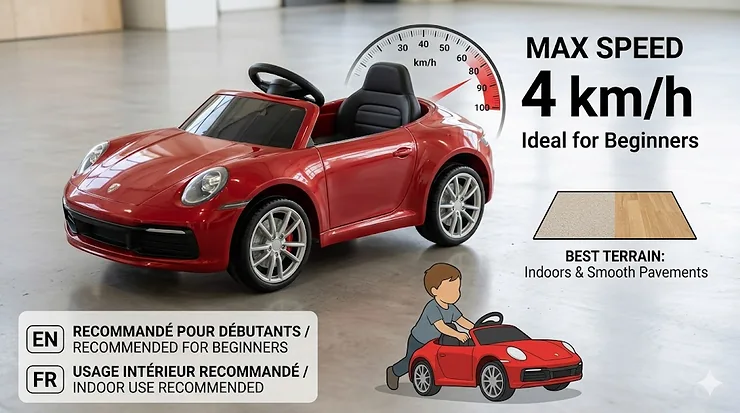
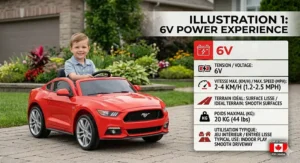
When shopping for your 5-year-old’s first electric ride-on car on Amazon.ca, the voltage question hits you immediately: should you buy 6v or 12v? Here’s what most Canadian parents don’t realize until after they’ve made the purchase—a 5-year-old who receives a 6v ride-on car will likely outgrow it within months, not years. The gentle 3 km/h maximum speed that seemed perfectly safe in the store feels painfully slow once your child has driven it twice around the driveway.
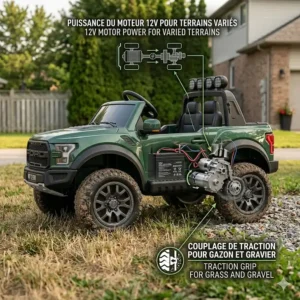
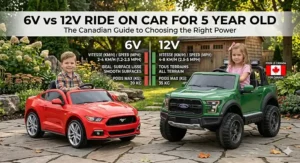
The short answer: for a 5-year-old, a 12v ride-on car is almost always the better investment. At this age, children have developed the coordination and spatial awareness to handle speeds of 5-8 km/h safely, and the additional power means the car can tackle Canadian terrain—from spring grass wet with morning dew to gentle backyard inclines that would stop a 6v model in its tracks. What’s more, a 12v vehicle typically serves children aged 3-7 years, giving you several summers of use before they outgrow it completely.
But voltage isn’t just about speed. It affects terrain capability, battery life, weight capacity, and whether your child will still be excited about their ride-on car next summer when their friends are zooming past on their more powerful models. In this guide, I’ll break down exactly what voltage differences mean for Canadian families, which specific models perform best in our climate, and how to match the right ride-on car to your 5-year-old’s skill level and your family’s budget.
Quick Comparison: 6v vs 12v at a Glance
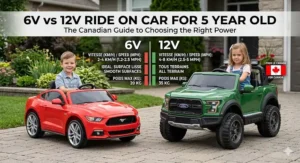
| Feature | 6v Ride-On Car | 12v Ride-On Car |
|---|---|---|
| Best Age Range | 1-3 years | 3-7 years |
| Maximum Speed | 2-3 mph (3-5 km/h) | 3.5-5 mph (5-8 km/h) |
| Typical Price (CAD) | $120-$200 | $180-$350 |
| Battery Life | 45-90 minutes | 60-120 minutes |
| Terrain Capability | Smooth pavement, indoor | Grass, gravel, gentle inclines |
| Weight Capacity | 20-25 kg (44-55 lbs) | 25-30 kg (55-66 lbs) |
| Best For | Toddlers, first-time drivers | Active preschoolers, experienced drivers |
| Canadian Winter Storage | Easier (lighter, smaller) | Requires more space |
Looking at this comparison, you can see why industry experts consistently recommend 12v models for 5-year-olds. The speed difference alone—from 3 km/h to 8 km/h—transforms the riding experience from “baby toy” to “actual adventure” in your child’s mind. But perhaps more importantly for Canadian families, the 12v’s ability to handle real grass (not just perfectly manicured lawns) and tackle the slight slope from your driveway to the street means your child can actually use it in typical backyard conditions, not just on your garage floor during winter months.
💬 Just one click — help others make better buying decisions too!😊
Top 7 Ride-On Cars for 5-Year-Olds: Expert Analysis
1. Best Choice Products 12v Kids Ride-On Truck
This is the model I see most frequently in Canadian driveways for good reason—it hits the sweet spot between features and value. The 12v dual-motor system delivers enough torque to climb the gradual inclines common in suburban neighbourhoods, while the spring suspension system smooths out the bumps that come with riding over tree roots and uneven pavement.
Key specs with real-world context: The 4.5 km/h maximum speed feels thrilling without being genuinely dangerous for a 5-year-old. The 30 kg weight capacity means you’ll get use from this until age 7 or 8. Most importantly for Canadian buyers, the sealed battery compartment protects against moisture during those June thunderstorms that seem to hit right when your kids are outside playing.
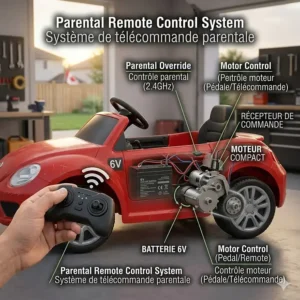
Expert opinion: What sets this model apart is the 2.4GHz parental remote with emergency stop function—genuinely useful when your child inevitably steers toward the garden beds. The remote range of approximately 20 metres gives you enough distance to stay on the porch while they explore the yard. Canadian parents specifically appreciate that the plastic wheels work on both wet and dry pavement without slipping, crucial during spring when conditions alternate between the two.
Customer feedback: Reviews on Amazon.ca consistently mention that assembly takes 20-30 minutes with basic tools, and the battery charges fully in 8-10 hours. Several Toronto-area buyers noted it handles their sloped driveways without power loss, which speaks to genuine 12v torque.
Pros:
- ✅ Dual motors provide consistent power on Canadian terrain
- ✅ Spring suspension handles rough surfaces
- ✅ Remote control with emergency brake feature
Cons:
- ❌ Battery takes 8-10 hours to fully charge
- ❌ Larger size requires garage storage in winter
Price range: Around $200-$250 CAD with occasional sales bringing it under $200. At this price point, you’re getting legitimate 12v performance that will last multiple summers.
2. Costzon 12v Licensed Mercedes-Benz Ride-On
Licensed ride-ons carry a premium, but this Mercedes model available on Amazon.ca justifies the extra cost with build quality that weathers Canadian seasons better than generic alternatives. The official Mercedes-Benz licensing means attention to detail: the dashboard layout mimics real Mercedes controls, the doors open and close with satisfying clicks, and the LED headlights are positioned like the real thing.
Key specs with real-world context: The 12v 7Ah battery delivers 90-120 minutes of runtime—longer than most competitors because the efficient motor draws less current. For Canadian families, this matters during summer when you don’t want to cut outdoor play short for a charging session. The EVA rubber tyres (not standard plastic) provide superior traction on damp grass, common after morning dew or evening sprinkler use.
Expert opinion: The built-in MP3 connection and Bluetooth speakers might seem like frivolous additions, but they actually solve a common problem: keeping 5-year-olds engaged in outdoor play. Kids at this age want the “cool factor,” and being able to play their favourite songs while driving makes them choose the ride-on over their tablet. The spring suspension wheels absorb bumps that would otherwise make riding on anything but perfect pavement uncomfortable.
Customer feedback: Canadian reviewers on Amazon.ca mention this model maintains power better than cheaper alternatives when battery charge drops below 50%, meaning the car doesn’t slow to a crawl in the final 20 minutes of use like budget models do. Several BC buyers noted it handles their rainy climate well with no rust or electrical issues after a season of use.
Pros:
- ✅ EVA rubber tyres for superior Canadian terrain grip
- ✅ Extended 90-120 minute battery life
- ✅ Licensed Mercedes quality construction
Cons:
- ❌ Higher price point at $280-$350 CAD range
- ❌ Heavier unit makes it harder for one parent to move solo
Price range: Typically $280-$350 CAD. The premium over generic 12v models is approximately $80-$100 CAD, which translates to better battery life and construction that survives multiple Canadian winters in garage storage.
3. Best Choice Products 6v Mini Truck (Budget-Friendly Alternative)
Let me be direct: if your 5-year-old is average-sized or larger, they’ll be disappointed with this 6v model within weeks. However, I’m including it because there are specific scenarios where it makes sense—if your child is small for their age (under 18 kg), extremely cautious, or has motor skill delays that make a slower vehicle genuinely safer. It’s also the smart choice if you’re buying for siblings: a 3-year-old and a 5-year-old can both use this model, whereas a 12v might be too fast for the younger child.
Key specs with real-world context: The 3 km/h maximum speed and 20 kg weight limit mean this is really designed for children 3-4 years old, not 5. The 6v 4.5Ah battery provides 60-90 minutes of runtime, which sounds decent until you realize that at 3 km/h, your child covers far less distance than they would at 12v speeds, so they circle the same small area repeatedly.
Expert opinion: The compact 34.5″ length makes this the only ride-on that genuinely works as an indoor toy during Canadian winters. If you live in a condo or townhouse with limited outdoor space and want something for basement use when snow covers your yard October through April, this size makes sense. The parental remote control works well, and at this slow speed, you can easily walk alongside on the sidewalk without breaking a stride.
Customer feedback: Amazon.ca reviews reveal a pattern: parents who buy this for 5-year-olds mention their child loses interest quickly, while those who buy it for 2-3-year-olds report satisfaction. Montreal buyers specifically note it works well on indoor concrete floors during long winters, which is legitimately where this model shines.
Pros:
- ✅ Most affordable option at $120-$160 CAD
- ✅ Compact size perfect for indoor winter use
- ✅ Slower speed ideal for very young or cautious children
Cons:
- ❌ Most 5-year-olds will outgrow it immediately
- ❌ Struggles on any incline or rough terrain
Price range: $120-$180 CAD. The budget savings compared to 12v models is $50-$100 CAD, but you sacrifice 2-3 years of age-appropriate use.
4. INFANS 12v Licensed G63 AMG Kids Ride-On
This is the ride-on car that other 5-year-olds will notice and envy. The Mercedes G63 AMG design is unmistakable even in miniature form, and the attention to detail—functioning doors, realistic dashboard, chrome accents—makes it stand out at the park or on your driveway. But beyond aesthetics, this model delivers legitimate performance advantages for Canadian conditions.
Key specs with real-world context: Dual 35-watt motors provide the power to tackle genuine challenges: climbing from your yard onto the sidewalk, pushing through thick spring grass still damp from rain, maintaining speed when your child and a friend (up to 30 kg combined) decide to ride together. The four-wheel suspension system isn’t just marketing—you’ll notice it absorbs the bumps from cracked pavement common in Canadian neighbourhoods where frost heave damages roads annually.
Expert opinion: What most Amazon product listings won’t tell you is that G63-style ride-ons with higher ground clearance handle Canadian driveways better than low-slung sports car models. If your driveway has that transition bump where it meets the street—standard in most subdivisions—this elevated design clears it without scraping. The remote control includes a gradual acceleration feature that prevents the jarring starts common with cheaper remotes, meaning fewer instances of your child being startled and letting go of the wheel.
Customer feedback: Canadian reviewers on Amazon.ca consistently praise the Bluetooth connectivity as actually functional (not always the case with ride-ons), and several parents mention successfully connecting it to their phone to play music or audiobooks, turning ride time into story time. Calgary buyers noted the larger wheels handle gravel driveways better than standard plastic wheels.
Pros:
- ✅ High ground clearance handles Canadian driveway transitions
- ✅ Four-wheel suspension for rough terrain
- ✅ Realistic G63 design that holds children’s interest longer
Cons:
- ❌ Premium price at $300-$400 CAD range
- ❌ Larger footprint requires more storage space
Price range: Typically $300-$380 CAD on Amazon.ca. The premium over standard 12v models buys you licensed design quality and suspension that actually matters on Canadian terrain.
5. Costzon 12v Two-Seater Ride-On Truck
Two-seater models solve a problem every Canadian parent with multiple children faces: sibling conflict over who gets to drive. But beyond preventing arguments, this model offers genuine utility—a 5-year-old can drive while their younger sibling (3-4 years) rides along, teaching the older child responsibility while giving the younger one ride-on experience before they’re ready to drive solo.
Key specs with real-world context: The combined 60 kg weight capacity means two average 5-year-olds (approximately 20 kg each) plus a small amount of cargo—their helmets, a water bottle, maybe a stuffed animal—fit comfortably. The dual 35-watt motors provide enough torque that adding a second child doesn’t dramatically reduce speed, unlike single-motor models where a passenger drops performance by 30-40%. For Canadian buyers, the higher seating position gives better ground clearance for spring slush and autumn leaves.
Expert opinion: The two-seater design fundamentally changes how children interact with ride-ons. Instead of solo laps around the driveway, I observe 5-year-olds using these for imaginative play—grocery store trips, rescue missions, construction projects. This social element extends the toy’s lifespan because it remains interesting even as they grow older. The bench-style seating includes two seat belts, meeting Canadian safety expectations that many single-seater models ignore.
Customer feedback: Reviews on Amazon.ca mention that assembly requires two adults (or 1-2 hours solo) due to the larger frame, but once assembled, it’s notably stable even during sharp turns. Ottawa parents specifically mention it handles their neighbourhood’s tree-root-damaged sidewalks without tipping, which speaks to a low centre of gravity despite the higher seating.
Pros:
- ✅ Solves sibling sharing conflicts
- ✅ Higher weight capacity extends useable years
- ✅ Social play element maintains interest longer
Cons:
- ❌ Larger size makes winter storage challenging
- ❌ Price premium at $280-$350 CAD
Price range: Around $280-$350 CAD. The cost per child effectively makes it economical if you have two children within the 3-7 age range.
6. Qaba 12v Single-Seater with Rear Suspension
This model prioritizes performance over aesthetics, and for Canadian families with genuinely rough terrain—gravel driveways, uneven yards, rural properties—it’s the most capable option in the 12v category. The rear suspension isn’t decorative; it features actual coil springs that absorb the impacts from bumps that would stop other ride-ons or make them uncomfortable.
Key specs with real-world context: The 8Ah battery (larger than standard 7Ah) provides approximately 20% more runtime, translating to 100-140 minutes versus the typical 80-100. For Canadian families where “outdoor play time” means the entire sunny Saturday afternoon, this matters. The treaded rubber tyres provide genuine off-road capability—not trail-riding, but certainly better than standard plastic wheels on gravel or grass with hidden divots.
Expert opinion: What distinguishes this model is engineering focus on core performance rather than luxury features. There’s no MP3 connection or elaborate dashboard, but the motor delivers consistent power even at low battery charge, the suspension genuinely smooths rough surfaces, and the steering mechanism feels more responsive than cheaper alternatives. If you live in a newer subdivision where landscaping is incomplete and your yard is more mud and grass clumps than manicured lawn, this is your model.
Customer feedback: Amazon.ca reviews reveal this performs surprisingly well on gentle slopes (8-10 degree inclines) where other 12v models lose speed or require a running start. BC Interior buyers mention it handles their gravel driveways without the skidding and wheel-spinning common with plastic-wheeled alternatives.
Pros:
- ✅ Actual functional suspension system
- ✅ Larger 8Ah battery for extended runtime
- ✅ Treaded tyres for legitimate off-road use
Cons:
- ❌ Utilitarian design lacks the “wow factor” of licensed models
- ❌ Basic feature set (no Bluetooth, minimal dashboard elements)
Price range: Typically $220-$280 CAD. The price sits between basic and premium 12v models, reflecting genuine performance engineering without luxury branding costs.
7. Best Choice Products 12v ATV Quad
ATV-style ride-ons appeal to 5-year-olds who find traditional car designs too “baby-ish.” The exposed handlebar steering and aggressive stance make these feel more adventurous, and the wider wheelbase provides better stability for children who drive more enthusiastically than carefully. For Canadian families with yard space and children who want to feel like they’re on a real off-road vehicle, this delivers.
Key specs with real-world context: The 12v motor drives a single rear axle (not independent rear motors like some car models), which actually provides advantages on loose surfaces—grass, gravel, patches of dirt—because the locked axle prevents one wheel from spinning while the other doesn’t move. The wide 3.5 kg wheelbase makes tipping nearly impossible during turns, important for 5-year-olds whose cornering judgment sometimes exceeds their ability.
Expert opinion: ATVs work particularly well for children who are athletic and coordinated beyond their age. The handlebar steering requires more core strength and balance than steering-wheel models, providing genuine physical activity rather than just sitting and pressing a pedal. For Canadian families concerned about screen time and sedentary play, this design encourages active engagement. The exposed design also means easier winter cleaning when road salt and slush inevitably get splashed onto it.
Customer feedback: Reviews on Amazon.ca mention that children transition more easily from this ATV to real pedal bikes, suggesting the handlebar steering builds transferable skills. Prairie buyers note the exposed design means less mud and grass clumps getting trapped in body panels, making post-ride cleaning significantly faster.
Pros:
- ✅ Wide wheelbase prevents tipping during aggressive turns
- ✅ Handlebar steering builds balance and coordination
- ✅ Exposed design makes cleaning easier
Cons:
- ❌ Lacks weather protection (no roof or windscreen)
- ❌ Single rear axle means less precise slow-speed maneuvering
Price range: Around $180-$240 CAD. The lower price compared to car-style models reflects simpler bodywork, but the chassis and motor quality remain solid.
Real-World Canadian Family Scenarios: Matching Voltage to Your Situation
The Toronto Condo Family: Limited Outdoor Space
You have a 5-year-old, a small backyard (15′ x 20′), and your building’s underground parking for winter storage. Your child plays outdoors primarily on the building’s shared courtyard (smooth pavement) and occasionally at nearby parks.
Best choice: Best Choice Products 6v Mini Truck ($120-$180 CAD)
Why it works: The compact size means you can store it in your parking locker without sacrificing storage space you need for bicycles and winter equipment. At 3 km/h maximum speed, it’s appropriate for shared courtyard areas where elderly neighbours walk and toddlers play. The slower speed means your 5-year-old can self-drive without you needing to chase after them constantly. Most importantly, this model works indoors in your building’s common room during November-March when outdoor play isn’t feasible.
What you’re giving up: Your child will outgrow this quickly. By age 6, they’ll find it too slow. But for one year of use in limited space, it’s practical. Consider this a stepping stone to a real bicycle at age 6-7 rather than a long-term ride-on investment.
The Suburban Calgary Family: Large Yard, Two Kids
You have a 5-year-old and a 3-year-old, a standard suburban lot with grass and a sloped driveway, and garage space for winter storage. Your children play outdoors regularly March through October.
Best choice: Costzon 12v Two-Seater Truck ($280-$350 CAD)
Why it works: The two-seater design solves your immediate problem—both children can ride simultaneously, eliminating arguments and allowing them to play together. The 12v power handles your sloped driveway (typical Calgary subdivisions have 5-8 degree slopes for drainage). Most importantly for Calgary’s climate, the 90-120 minute battery life means your children get a full afternoon of outdoor play before you need to recharge, maximizing those precious warm-weather days between chinooks.
Long-term value: This model serves both children for the next 3-4 years. Your 3-year-old starts as a passenger, learns by watching their older sibling, then becomes the driver when they turn 4-5. By the time your older child outgrows it at age 8, your younger child has 2-3 years of solo use remaining. Total cost per child per year: approximately $35-$45 CAD.
The Rural Manitoba Family: Gravel Driveway, Large Property
You have a 5-year-old, a 200-metre gravel driveway, fields around your property, and a machine shed for winter storage. Your child is adventurous and physically capable.
Best choice: Qaba 12v with Rear Suspension ($220-$280 CAD)
Why it works: Standard plastic wheels spin uselessly on gravel, but this model’s treaded rubber tyres and actual suspension system handle your rural terrain. The 100-140 minute battery life means your child can drive from your house to the end of your driveway and back multiple times without running out of power mid-adventure. The robust construction survives the bumps and impacts from uneven rural surfaces that would crack the body panels on cheaper models.
Manitoba-specific consideration: Rural Manitoba summers bring mosquitoes and longer daylight hours, meaning your child plays outdoors from 6 PM to 9 PM when pavement has cooled. The extended battery life accommodates these longer evening play sessions that urban families don’t experience.
How to Choose Between 6v and 12v: Five Critical Decision Factors
Factor 1: Your Child’s Physical Size and Coordination Level
The age guidelines on ride-on packaging—”ages 3-5″ for 6v, “ages 3-7” for 12v—are starting points, not definitive rules. Your child’s actual weight, height, and coordination matter more than their birthday.
Size assessment: Measure your child’s weight. If they’re under 18 kg (40 lbs), a 6v model rated for 20-25 kg capacity gives them comfortable room to grow. If they’re already 20 kg or more, they’re approaching the 6v weight limit, meaning reduced performance and shorter useable lifespan. Most 5-year-olds fall into the 18-23 kg range, making 12v models (typically rated for 25-30 kg) the better fit.
Coordination assessment: Can your child ride a balance bike or pedal bike with training wheels? If yes, they have sufficient coordination for 12v speeds (5-8 km/h). The cognitive and physical skills required for bicycle riding translate directly to steering, braking, and spatial awareness in a ride-on car. If your child still struggles with balance bikes or seems unusually cautious with wheeled toys, a 6v model’s slower speed provides a confidence-building stepping stone.
Canadian climate consideration: Winter clothing adds bulk and restricts movement. If your child will use the ride-on during shoulder seasons (October, April-May) when they’re wearing jackets, ensure the seat and controls accommodate bundled-up dimensions. This rarely matters for 6v models (toddler-sized) but can make 12v steering wheels feel cramped if the seat doesn’t adjust.
Factor 2: Your Property’s Terrain and Surface Conditions
Canadian properties vary dramatically in terrain, and voltage determines whether a ride-on car will actually function in your specific environment.
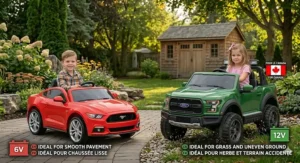
Flat pavement (condo courtyards, urban driveways): Both 6v and 12v work perfectly. Choose based on speed preference and age appropriateness. The 6v saves you $80-$120 CAD with no functional disadvantage on perfectly smooth surfaces.
Maintained lawn (typical suburban yards): 12v required. Even well-maintained grass creates resistance that bogs down 6v motors, reducing speed to an unusable crawl and draining the battery in 30-40 minutes. A 12v model maintains reasonable speed and provides 60-90 minutes of lawn use.
Rough grass, gravel, or sloped surfaces: 12v with upgraded tyres (rubber rather than plastic) becomes mandatory. Standard 12v with plastic wheels might struggle; models with EVA rubber or treaded tyres like the Qaba or INFANS make the difference between frustrating and functional.
Canadian seasonal reality: Your “terrain” changes seasonally. August lawn is different from April lawn (wet, patches of mud, longer grass). October brings fallen leaves that create slippery surfaces. A ride-on that works in summer might be unusable in spring and fall. The 12v’s power advantage compensates for these seasonal challenges; 6v models become garage-bound except during peak summer conditions.
Factor 3: Budget and Cost-Per-Year Analysis
Initial purchase price tells only part of the financial story. Calculate the cost per year of useable ownership to understand true value.
6v model example:
- Purchase price: $150 CAD
- Useable age range for a 5-year-old: 1 year (outgrown by age 6)
- Cost per year: $150 CAD
- Replacement battery at year 2: N/A (already outgrown)
12v model example:
- Purchase price: $250 CAD
- Useable age range for a 5-year-old: 3 years (useable until age 8)
- Cost per year: $83 CAD
- Replacement battery at year 3: $60-$80 CAD (extends use another 1-2 years)
The 12v model costs $100 CAD more initially but delivers three years of use versus one, making it $67 CAD cheaper annually. If you replace the battery at year 3 for $70 CAD, you extend use through age 9-10, dropping the annual cost to approximately $64 CAD for 5 years of total ownership.
Sibling consideration for Canadian families: If you have or plan to have a second child 2-4 years younger, the 12v model serves both. First child uses it from ages 5-8, second child from ages 3-6. Total cost per child: approximately $125 CAD for 6 years of combined use. This calculation matters in Canadian markets where ride-on cars cost 20-30% more than US equivalents due to import duties and exchange rates.
Factor 4: Canadian Seasonal Storage and Climate Impact
Unlike families in warmer climates who can leave ride-ons outside year-round, Canadian families face winter storage requirements that affect which voltage makes practical sense.
Storage space requirements:
- 6v models: Approximately 0.9 metres long × 0.6 metres wide
- 12v models: Approximately 1.2 metres long × 0.75 metres wide
- Two-seater 12v: Approximately 1.4 metres long × 0.8 metres wide
Canadian garage reality: Winter storage means sharing space with snow blowers, winter tyres, holiday decorations, and sometimes a car that normally sits in the driveway but moves inside November-March. A 6v model’s smaller footprint (about 40% less space than a 12v) might be the deciding factor if your garage is already crowded.
Battery maintenance in cold climates: Canadian winters require removing the battery and storing it indoors at room temperature. Freezing temperatures permanently damage lead-acid batteries, reducing capacity by 30-50%. This maintenance requirement is identical for 6v and 12v, but the 12v’s larger battery (7-8Ah vs. 4.5Ah) means more weight to carry inside. Not a major factor, but worth noting if your garage is detached and 30 metres from your house.
Factor 5: Resale Value and Hand-Me-Down Potential
The secondary market for ride-on cars on Canadian platforms (Facebook Marketplace, Kijiji) reveals which investments hold value.
6v resale values: Typically sell for 30-40% of original price after one season of use. The limited age range means most buyers are parents of 2-3-year-olds specifically seeking a first ride-on, a smaller market than the broader 3-7-year-old demographic for 12v models. Example: $150 CAD purchase typically resells for $50-$70 CAD after one year.
12v resale values: Hold 50-60% of original value after 2-3 years of use if maintained well. The wider age range means more potential buyers, and families purchasing used often want something their child can use for multiple years. Example: $250 CAD purchase typically resells for $125-$150 CAD after 2-3 years, or $80-$100 CAD after 4-5 years if still functional.
Canadian market specifics: Spring (April-May) is peak selling season when families prepare for summer. Posting before this season maximizes resale value. Licensed models (Mercedes, Jeep, etc.) hold value better than generic designs because buyers perceive them as higher quality—often true, but also psychological. On Kijiji searches in major Canadian cities, licensed 12v models sell 2-3x faster than generic equivalents at similar price points.
Common Mistakes Canadian Parents Make When Buying Ride-On Cars
Mistake 1: Choosing Voltage Based on Price, Not Longevity
The $80-$120 CAD price difference between 6v and 12v models tempts budget-conscious parents to buy the cheaper option. But as we’ve established, the cheaper model for a 5-year-old actually costs more annually because it’s outgrown immediately.
Why this happens: The purchase feels expensive in the moment—$250 CAD for a toy triggers sticker shock. But spreading that cost over three years ($83 annually) versus one year ($150 annually) makes the 12v the economical choice. Canadian parents often don’t calculate cost-per-year-of-use at the time of purchase.
How to avoid this: Before shopping, decide your target years of use (ideally 3-4 years for a 5-year-old). Then calculate backwards: if you want four years of use and your budget is $300 CAD maximum, you need a model that functions for ages 5-9, which requires 12v power and higher weight capacity. This framework prevents impulse purchases of inadequate models just because they’re on sale.
Mistake 2: Ignoring Canadian Terrain in Favour of Online Reviews from Warmer Climates
Amazon.com reviews dominate search results and include far more data than Amazon.ca reviews. But US reviewers in Florida, California, or Texas evaluate ride-ons under different conditions than Canadian buyers face. A model that works perfectly on dry, flat surfaces might fail entirely on damp spring grass or gravel driveways common in Canada.
Why this happens: Amazon.ca review sections are smaller (hundreds rather than thousands of reviews), so Canadian buyers supplement with .com reviews. But climate and terrain don’t translate—what works in Arizona might not work in Alberta.
How to avoid this: Filter specifically for Canadian reviews by searching keywords: “Canada,” “Canadian,” “Ontario,” “BC,” “Alberta,” or French-language reviews on Amazon.ca (usually from Quebec buyers). These reviews mention winter storage, cold-weather battery performance, and how the car handles typical Canadian surfaces. Also note geographic tags in reviewer profiles when available.
Mistake 3: Underestimating Assembly Time and Complexity
Product descriptions claim “easy assembly” and “minimal tools required,” creating expectations of 15-20 minute setup. The reality for most 12v models: 45-90 minutes for one person, 30-60 minutes with a partner, assuming you have the right tools and encounter no issues.
Why this happens: Manufacturers optimize for “most customers” who have full tool sets, experience with assembly, and ideal conditions (warm garage, good lighting, clear instructions). Canadian buyers often attempt winter garage assembly (cold, poor lighting) or apartment assembly (limited tools, hard floor makes dropped screws disappear), increasing difficulty.
How to avoid this: Treat the ride-on car as a project requiring dedicated time. Schedule assembly for a day when you have 2-3 hours available (allows for complications), ensure you have all required tools (Phillips and flathead screwdrivers, adjustable wrench, pliers, and scissors for packaging), and ideally a second adult. Watch YouTube assembly videos for your specific model before starting—crowd-sourced videos often reveal steps the written instructions omit or explain poorly.
Mistake 4: Buying for Current Size Instead of Next Year’s Size
Parents naturally assess their child’s current dimensions and coordination level, then purchase a ride-on that fits today. But children grow rapidly between ages 5-7, and a model that fits perfectly at purchase will feel cramped by next summer.
Why this happens: It’s psychologically difficult to purchase something that seems slightly too large in the store. The 5-year-old looks small in the 12v seat during the test drive, making the 6v (where they fit snugly) seem more appropriate. But six months later, that snug fit becomes uncomfortably tight.
How to avoid this: When evaluating fit, imagine your child wearing winter clothing (jacket, boots) and account for 10-15 cm of growth over the next two years. The ride-on should feel slightly roomy at purchase. Check the weight capacity and compare it to your child’s current weight plus projected growth. A 20 kg child in a model rated for 25 kg maximum has limited growth runway; the same child in a 30 kg capacity model has years of comfortable use remaining.
Mistake 5: Overlooking Battery Replacement Costs and Availability
Batteries typically last 1-3 years depending on usage and maintenance, then require replacement. But many Canadian parents don’t discover the replacement cost or availability until the battery fails, sometimes discovering their specific model uses a proprietary battery that costs $100+ CAD or isn’t available on Amazon.ca.
Why this happens: Initial purchase focus is on features and price, not long-term maintenance. Battery specifications seem like technical details that can be worried about later. But when “later” arrives during summer when your child wants to use the toy, you’re forced to pay premium prices for rush shipping or explain why their ride-on is broken.
How to avoid this: Before purchasing, check Amazon.ca for replacement batteries for your specific model. Confirm the battery is a standard size (6v 4.5Ah, 12v 7Ah, or 12v 8Ah) available from multiple suppliers, not a proprietary design. Budget $60-$90 CAD for a replacement battery in 2-3 years as part of your total ownership cost. Consider purchasing a spare battery immediately if the model uses an uncommon specification—having two batteries also allows continuous play (one charging while using the other).
FAQ
❓ Can a 5 year old use a 6v ride on car in Canada?
❓ How fast does a 12v ride on car go compared to 6v for Canadian conditions?
❓ Are ride on cars safe on Canadian driveways and sidewalks?
❓ How long do ride on car batteries last in Canadian winters?
❓ What's the best voltage ride on car for a 5 year old in Canada?
Conclusion: The Smart Voltage Choice for Your Canadian 5-Year-Old
After examining the evidence—speed differences, terrain capability, cost-per-year analysis, and real-world Canadian usage scenarios—the verdict for most 5-year-olds is clear: invest in a 12v ride-on car. The additional $80-$120 CAD over a 6v model purchases three times the useable lifespan, twice the speed, and the ability to actually handle Canadian backyards where grass, gentle slopes, and seasonal conditions make 6v models frustratingly slow or completely unusable.
But the “best” choice depends on your specific situation. If you live in a small condo with limited storage and your child plays primarily on smooth pavement in controlled areas, a 6v model serves your needs adequately for one year at lower cost. If you have multiple children ages 3-7, a two-seater 12v model eliminates sibling conflicts and serves both children for 4-6 combined years. If you have a rural property with gravel and rough terrain, prioritize 12v models with upgraded suspension and rubber tyres over aesthetic features.
The most expensive mistake Canadian parents make is buying based solely on immediate price rather than cost per year of appropriate use. A $150 CAD 6v ride-on that’s outgrown by next summer costs more annually than a $250 CAD 12v that serves your child for three summers. Factor in Canadian realities—winter storage requirements, battery performance in cold weather, terrain conditions during spring and fall—and make your choice based on total value, not sticker price.
Shop for your 5-year-old’s ride-on car on Amazon.ca where you’ll find the widest selection of both 6v and 12v models with Prime shipping to most Canadian addresses. Read Canadian-specific reviews, confirm battery replacement parts are available, and choose a model your child won’t outgrow by next summer. The right ride-on car provides three summers of outdoor adventure, building independence and coordination while getting your child away from screens and into active play—a worthwhile investment for any Canadian family.
Recommended for You
- Best 2 Seater Pedal Go Kart Kids: 7 Top Picks Canada 2026
- Best Pedal Go Kart for 6-8 Year Old Canada 2026 (Top 7 Picks)
- 7 Best Quality Kids Bike Training Wheels Canada 2026
Disclaimer: This article contains affiliate links. As an Amazon Associate, I earn from qualifying purchases. If you purchase products through these links, we may earn a small commission at no additional cost to you.
✨ Found this helpful? Share it with your friends! 💬🤗
