
In This Article
You’ve been there. You finally find what looks like a solid ride-on car for your 6-year-old, spend a Saturday afternoon assembling it, watch their face light up — and then three weeks later, the plastic frame creaks, one motor whines like a dying vacuum, and the whole thing lists to one side on the driveway. Sound familiar?
For Canadian parents with kids in the 5–8 age range, finding truly heavy duty ride on toys for 5-8 year olds is genuinely harder than it should be. Your child isn’t a toddler anymore. They’re bigger, heavier, faster, and a lot more demanding about where they want to drive — through the backyard, across gravel, maybe down the snowy path to the shed in October before freeze-up officially shuts everything down. Standard toddler-spec ride-ons simply weren’t built for this.
What makes the search even trickier in Canada is that not every product available on Amazon.com ships easily to Canadian addresses, and Amazon.ca has a more curated selection. Throw in our harsh winters, shorter outdoor seasons, and the reality that a 7-year-old in Winnipeg or Moncton might weigh anywhere from 20 kg to over 45 kg (44–99 lbs) depending on their build, and the stakes around weight ratings and durability get very real.
In this guide, I’ve researched seven legitimate heavy duty ride on toys for 5-8 year olds available on Amazon.ca — all verified with real specifications, weight capacities, and frank assessments of who each vehicle actually suits. You’ll also find a practical buying framework, a usage guide built around Canadian conditions, and a real-talk section on what specs actually matter versus what’s just marketing noise.
All prices in this article are quoted in Canadian dollars (CAD). Because Amazon.ca prices change frequently, I reference price ranges rather than exact figures — always check current pricing directly on the product page.
Quick Comparison: Heavy Duty Ride On Toys for 5–8 Year Olds in Canada
| Product | Voltage | Weight Capacity | Drive System | Best For |
|---|---|---|---|---|
| VOLTZ TOYS 24V Lifted Monster Jeep (2-Seater) | 24V | 60 kg / 132 lbs | 4-wheel independent suspension | Biggest kids, sibling pairs |
| Costzon 24V 2-Seater Dump Truck (RPM20000) | 24V | 50 kg / 110 lbs | 4-spring suspension, dual motors | Off-road adventurers |
| ANPABO 24V Ride On Dump Truck | 24V | 50 kg / 110 lbs | EVA tires, dual 75W motors | Construction play fans |
| Costzon 12V Kids Ride On Truck (2-Seater) | 12V | 50 kg / 110 lbs | Spring suspension | Budget-conscious families |
| VOLTZ TOYS 12V Lifted Monster Jeep (2-Seater) | 12V | ~45 kg / ~99 lbs | 4-wheel suspension, EVA tires | Lighter kids, calmer terrain |
| Aosom 12V Off Road Truck SUV | 12V | 30 kg / 66 lbs | 4-spring suspension | Younger 5-year-olds, lighter builds |
| Costzon 24V Kids Electric ATV | 24V | 35 kg / 77 lbs | Treaded tires, soft start | ATV lovers, solo riders |
The table above makes one thing obvious: if your child is heavier than average for their age or you want room to grow, the 24V options at 110–132 lbs (50–60 kg) capacity are the clear call. The 12V options still have a place — particularly for lighter kids and families who want a quieter, cheaper introduction — but they’ll struggle on rough terrain and typically max out around 66–99 lbs capacity, which a tall 8-year-old can blow past quickly.
💬 Just one click — help others make better buying decisions too! 😊
✨ Don’t Miss These Exclusive Deals!
🔍 Take your family’s outdoor fun to the next level with these carefully selected products. Click on any highlighted item to check current pricing and availability on Amazon.ca. These vehicles will give your kids an authentic driving experience they’ll remember!
Top 7 Heavy Duty Ride On Toys for 5–8 Year Olds: Expert Analysis
1. VOLTZ TOYS 24V Lifted Monster Jeep Electric Car (2-Seater)
If there’s one vehicle on this entire list that was purpose-built for bigger Canadian kids who want a genuinely substantial ride-on experience, this is it. The 24V Lifted Monster Jeep is the flagship option from Voltz Toys, and the headline specification — a 60 kg (132 lbs) weight capacity — immediately separates it from the 110-lb crowd.
The “lifted” design is more than aesthetic. At 140 cm × 96 cm × 93 cm (roughly 55″ × 38″ × 37″), this vehicle is genuinely large — closer to a scaled-down off-road vehicle than a toy. The 24V battery powers four-wheel independent suspension, and the speed tops out between 3–8 km/h depending on terrain, with a battery runtime of up to 90 minutes. For a Canadian backyard context, that’s usually more than enough for an afternoon session before heading indoors as the temperature drops. The EVA foam-filled tires are puncture-proof — a meaningful advantage over inflatable-tire competitors when you’re dealing with gravel driveways and rough grass common in suburban and rural Canadian properties.
I’d recommend this one specifically for families with two kids in the 5–8 range who want to share, or for a single heavier child (over 45 kg / 100 lbs) who has literally outgrown everything else. The leather seat, adjustable fit, and openable doors also make getting in and out less awkward for bigger kids — a detail most budget options miss entirely.
Customer feedback is consistently strong on the build quality and the remote control responsiveness. A few Canadian reviewers specifically called out how well it handles slightly uneven driveways, which is about as realistic a Canadian use case as you’ll find.
✅ Massive 132 lbs capacity — highest on this list
✅ 90-minute battery life with 24V system
✅ Full LED lights, Bluetooth MP3, leather seat — genuinely premium feel
❌ Heavy to move when not powered (42 kg / 93 lbs vehicle weight)
❌ Premium price point — in the upper range on Amazon.ca
Price range: upper end of the CAD $400–$700 range — check current price on Amazon.ca.
2. Costzon 24V 2-Seater Ride On Dump Truck (Dual RPM20000 Motors)
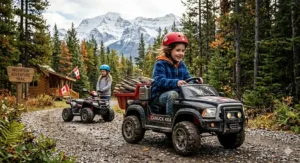
Costzon has become one of the most consistently available ride-on brands on Amazon.ca, and this 24V dump truck model earns its place with a smart combination of utility and durability. The dual RPM20000 motors are the key spec here — and what that means practically is noticeably more torque than a single-motor setup, which translates to better hill performance and the ability to carry two kids on grass and gravel without bogging down. For a family with a sloped backyard or a property with mixed terrain, this is the spec you want.
The weight capacity is 50 kg (110 lbs), accommodating two children aged 3–5 comfortably or a single child aged 3 and above — meaning a heavier 7 or 8-year-old fits perfectly solo. The working electric dump bed and included shovel are genuinely popular with kids in this age range who are into construction-style play. Four large spring-suspension wheels round out a vehicle that can handle the transition from pavement to grass without shuddering.
The rocking mode is an unusual but well-received feature — it’s essentially a soothing/playful mode that kids use when they’re parked rather than driving. In practice, parents report it keeps kids entertained longer, which is relevant for Canadian summers when you want to extend outdoor time as much as possible.
Where it falls short: at 110 lbs capacity, a bigger 8-year-old plus a sibling will push the limits. Keep this for solo use or sibling pairs where both kids are on the lighter side.
✅ Dual RPM20000 motors for real off-road torque
✅ Working electric dump bed — huge engagement for construction-minded kids
✅ 4 large spring suspension wheels
❌ 110 lbs capacity is the upper limit, not comfortable margin
❌ Charging time of 8–12 hours before first use is a patience-tester
Price range: mid-range on Amazon.ca, typically in the CAD $250–$400 range — check current price on Amazon.ca.
3. ANPABO 24V Ride On Dump Truck with Electric Dump Bed
ANPABO’s presence on Amazon.ca has grown significantly, and this 24V dump truck model is a strong option for families who want the construction vehicle aesthetic with solid specs. The dual 75W motors push this vehicle up to 7 km/h (4.4 mph), which is brisk enough to feel exciting without being alarming, and the 19-inch wide seat is genuinely spacious — notably wider than what most single-motor competitors offer at this price.
The 110 lbs (50 kg) weight capacity, EVA foam tires, and electric dump bed make for a practical combination. What separates the ANPABO from Costzon at a similar weight rating is the emphasis on seat width and cab space — if you have a taller child who feels cramped in standard-size vehicles, the 19-inch seat is a measurable improvement. The extra shovel included adds to the play value for kids who are less interested in “driving fast” and more interested in digging up the garden (to their parents’ mixed feelings).
The parent remote control deserves mention: it’s functional and range is adequate for a standard backyard, but it works best on open, flat surfaces. In a garden with obstacles, you’ll want to trust the kid’s steering. The recommended age range of 37–96 months (roughly 3–8 years old) aligns well with our target age group, and the 110 lbs limit covers most kids in this range comfortably.
Battery life is listed at roughly 1–1.5 hours depending on terrain and child weight — budget for 60 minutes of real outdoor driving in Canadian conditions where grass and gravel will eat into that estimate.
✅ 19-inch wide seat for bigger kids
✅ 7 km/h speed — exciting but safe
✅ Construction theme with working dump bed and shovel
❌ Remote range can be limited in cluttered garden environments
❌ Not rated for slopes beyond moderate inclines
Price range: competitive mid-range on Amazon.ca — check current price on Amazon.ca.
4. Costzon 12V Kids Ride On Truck (2-Seater, 2.4G Remote)
Here’s where I’ll be honest with you: this is the strongest 12V option for bigger kids on this entire list, and it has a weight rating that surprises many buyers — 110 lbs (50 kg) from a 12V system is legitimately good. Costzon achieves this through a solid PP (polypropylene) body construction, a reinforced frame, and a more conservative motor tuning that prioritises durability over speed. The top speed here is slower than the 24V options — roughly 3–5 km/h — but for a 5 or 6-year-old on a flat driveway or backyard, that’s perfectly appropriate.
The dual openable doors, spring suspension, LED headlights, and MP3/radio system make this feel like a complete vehicle rather than an entry-level toy. The 2.4G remote is reliable and has better range than generic IR remotes on budget competitors. Two speeds (which you can switch via remote) allow you to start your child on the slower setting and graduate to faster once their steering confidence improves — a genuinely thoughtful feature for the 5–6-year-old end of the target age range.
The honest downside is battery performance: 8–12 hours of charging for approximately 1 hour of runtime. Cold weather compounds this significantly — a 12V battery in sub-zero Canadian temperatures will lose 15–20% of its rated capacity. If you’re in a climate where spring and fall are the main riding seasons (most of Canada, frankly), expect roughly 45–50 minutes of real use before recharging on cooler days.
✅ 110 lbs capacity for a 12V model — best in class at this voltage
✅ Reliable 2.4G remote, two speeds
✅ Solid PP construction with reinforced frame
❌ 1-hour runtime drops further in cold weather
❌ Not suited for rough off-road terrain
Price range: budget-friendly, typically in the CAD $150–$250 range — check current price on Amazon.ca.
5. VOLTZ TOYS 12V Lifted Monster Jeep (2-Seater, EVA Tires)
The 12V version of Voltz Toys’ Lifted Monster Jeep deserves recognition as the best-looking vehicle on this list — and looks actually matter here because a child who thinks their ride-on is cool will ride it more, which is the whole point. The lifted styling, EVA foam tires, leather seat, and full LED light package (headlights, taillights, overhead searchlights) create an experience that kids in the 5–8 range genuinely react to with excitement.
From a practical standpoint, this model uses a 12V battery and four-wheel independent suspension. The weight capacity sits at approximately 99 lbs (45 kg), which is slightly lower than the 12V Costzon truck but still covers most kids under 8. The speed range of 3–8 km/h is well-matched to the age group, and the MP3 player with Bluetooth, AUX, and USB is a premium inclusion that parents often use to play the child’s favourite music, extending ride time substantially.
The honest caveat for Canadian buyers: EVA foam tires are excellent for smooth and slightly rough surfaces, but on deep snow or thick mud they will slide rather than grip. Store this vehicle indoors from November through March in most Canadian provinces, and it will last for years. Leave it outside in freeze-thaw conditions and the battery connector seals will suffer. The product is explicitly not waterproof — don’t push it.
Best suited for a 5–7-year-old on the lighter side (under 40 kg / 88 lbs) who primarily rides on driveways, patios, and managed grass. Not the call for a bigger kid or seriously rough terrain.
✅ Genuinely premium aesthetic — kids love the look
✅ Full LED package, Bluetooth MP3, leather seat
✅ Four-wheel independent suspension for smoother ride
❌ ~99 lbs weight limit is the lower end for this age range
❌ Not waterproof — needs careful Canadian weather management
Price range: mid-range on Amazon.ca — check current price on Amazon.ca.
6. Aosom 12V Kids Ride On Car Off Road Truck SUV
Aosom is a Canadian-friendly brand with consistent Amazon.ca availability, and this 12V off-road truck occupies a practical niche: it’s the right size for a younger or lighter 5-year-old who isn’t yet ready for the larger 24V options but needs something sturdier than a toddler-spec vehicle. The 66 lbs (30 kg) weight capacity is lower than others on this list, which is important to note — by age 7 or 8, most Canadian kids will have outgrown this limit.
The 4 spring-suspension wheels are well-implemented for a 12V vehicle, providing noticeably smoother handling on driveways with cracks or slight unevenness. The parental remote is a safety feature that earns its keep with 5-year-olds who are still figuring out steering. The dimensions (99 cm × 64 cm × 71 cm / 39″ × 25″ × 28″) place this firmly in the “solo smaller child” category rather than a two-seater.
What I like about Aosom as a brand for Canadian buyers is their Amazon.ca fulfilment is typically reliable, and their product support and spare parts are more accessible than some of the smaller brands. When you’re investing in a ride-on vehicle and something breaks (it happens with any kid’s toy), being able to find a replacement part through a Canadian fulfillment centre matters more than most buyers realise until they need it.
The 45-minute battery life is the most significant limitation. That’s not unusual for a 12V vehicle, but it’s worth setting expectations — charge overnight, ride before lunch, recharge for the afternoon session.
✅ Reliable Amazon.ca availability and Canadian fulfilment
✅ Parental remote ideal for younger 5-year-olds
✅ Spring suspension handles uneven driveways well
❌ 66 lbs weight limit — most 7–8 year olds will exceed this
❌ 45-minute battery life limits extended outdoor sessions
Price range: entry-level to budget, typically under CAD $200 — check current price on Amazon.ca.
7. Costzon 24V Kids Electric ATV (4-Wheeler Quad)
The Costzon 24V Electric ATV is a different kind of recommendation — it’s the only quad-style vehicle on this list, and for kids who genuinely want to tear around the backyard rather than “pretend to drive,” the ATV format is simply more exciting. The treaded tires, high/low speed setting, and 24V system make this a real performer on grass, gravel, and the kinds of uneven suburban terrain that most Canadian backyards involve.
The weight capacity is 35 kg (77 lbs), which is the lighter end of our scale — sufficient for an average 5–7-year-old but something a heavier or taller 8-year-old may push against. The soft start function prevents the lurch-and-scare moment that less thoughtful ATVs create, and the wireless music connection with radio keeps kids entertained independently. At 24V, battery performance is predictably better than the 12V alternatives — expect 1–1.5 hours of real riding time.
What makes this specifically stand out for Canadian families is the ATV format’s natural versatility on mixed terrain. Backyards in Ontario, Alberta, and BC often include grass, bark mulch, gravel paths, and patio transitions — surfaces that will slow or frustrate ride-on car designs but that the ATV’s wider, treaded tires handle naturally. It’s not a replacement for the full-cabin vehicles if your child wants the “driving a real car” experience, but for the kid who wants adventure rather than realism, this is the better pick.
✅ 24V system on an ATV format — best combination for rough terrain
✅ Treaded tires outperform smooth EVA on mixed Canadian surfaces
✅ Soft start + high/low speed — parent-friendly safety controls
❌ 77 lbs (35 kg) capacity is the lowest 24V option here
❌ No parental remote on base model
Price range: mid-range on Amazon.ca — check current price on Amazon.ca.
How to Choose the Right Heavy Duty Ride On for Your Canadian Kid
Navigating the specs on Amazon.ca listings without a framework is a bit like grocery shopping when you’re hungry — everything looks good and you end up buying the wrong thing. Here’s the filtering process I’d suggest walking through before you hit “add to cart.”
Step 1: Know your child’s actual weight. This sounds obvious, but it’s the step most buyers skip. The average Canadian 6-year-old weighs around 21 kg (46 lbs); an average 8-year-old weighs around 26 kg (57 lbs). However, above-average or solidly-built kids can easily be 35–40 kg (77–88 lbs) at age 7. Always choose a vehicle rated at least 15–20% above your child’s current weight to account for growth and so the motor isn’t constantly running at capacity.
Step 2: Choose voltage based on terrain, not just age. The 12V vs. 24V decision isn’t purely about age. If your child rides on flat concrete or a smooth patio, 12V is adequate. If you have grass, gravel, a sloped driveway, or mixed surfaces — which describes most Canadian suburban and rural properties — 24V delivers meaningfully better performance and longevity.
Step 3: Think about your outdoor seasons. Most of Canada gets genuine riding weather from May to October — roughly 5–6 months. A higher-quality vehicle that costs more upfront is better value than a cheap one that degrades after one season. Look for sealed connectors, EVA foam tires (which handle temperature fluctuations better than inflatable tires), and indoor storage compatibility.
Step 4: Assess the safety features. Look for seat belts, soft-start technology, parental remote override, and speed limiter settings. Health Canada’s toy safety regulations govern all toys sold in Canada under the Canada Consumer Product Safety Act (CCPSA), and products on Amazon.ca must comply. For ride-on vehicles, check that ASTM F963 certification is noted on the product listing, as this covers stability and load-bearing standards recognised in Canada.
Step 5: Plan for battery management. Lithium and lead-acid batteries both degrade faster when exposed to freezing temperatures. Bring batteries indoors before temperatures drop below 0°C — this alone can double the lifespan of your ride-on’s battery. Most batteries should be stored at around 50% charge if not in use for extended periods.
Step 6: Check Amazon.ca availability and fulfilment. Some products ship from Amazon.ca warehouse (faster, more reliable) and others from third-party sellers. For a large, heavy item like a ride-on vehicle, Amazon-fulfilled orders are significantly easier to return or exchange if there’s a problem.
Step 7: Compare total cost, not just sticker price. A ride-on that lasts 3 seasons at $350 CAD is better value than one that lasts 1 season at $180 CAD. Factor in spare parts availability, brand warranty (most manufacturers offer 1-year limited warranties), and whether Canadian customer service is accessible.
Real Canadian Families, Real Scenarios: Which Ride-On Fits Your Life?
Let me sketch out three realistic Canadian family situations and match the right vehicle to each. This is the kind of context that doesn’t exist on any Amazon product listing.
The Saskatoon Family with Two Kids (Ages 6 and 4) They have a large flat backyard, a concrete driveway, and want something both kids can use together. Budget is around $350–$500 CAD. Their 6-year-old weighs about 22 kg (48 lbs); the 4-year-old is 16 kg (35 lbs). Combined weight: 38 kg (83 lbs). The VOLTZ TOYS 24V Lifted Monster Jeep is the call here — 132 lbs capacity covers them both comfortably with room to grow, the leather seat accommodates different child sizes, and the 24V system means the two combined weights don’t slow it down. On flat terrain, they’ll get the full 90-minute battery life.
The North Vancouver Family with One Active 8-Year-Old Their yard is partly grassed and partly bark mulch, with a gentle slope. Their son is 30 kg (66 lbs), loves anything construction-related, and is hard on his toys. The ANPABO 24V Ride On Dump Truck fits perfectly — the 110 lbs capacity covers his current and next two years of growth, the EVA tires handle the mixed terrain and slope, and the dump bed and shovel keep him engaged beyond just driving. The 24V dual-motor setup doesn’t labour on the incline, which a single-motor 12V setup would.
The First-Time Ride-On Buyer in Ontario (One 5-Year-Old, Budget-Conscious) Their 5-year-old daughter weighs about 19 kg (42 lbs) and mostly rides on their patio and flat driveway. They want reliability, a parental remote, and don’t want to spend more than $250 CAD. The Costzon 12V Kids Ride On Truck (2-Seater) is the right match — 110 lbs capacity means she won’t outgrow it for years, the 2.4G remote gives parents control, and the solid PP construction means it’ll survive a few Ontario winters in the garage without warping.
What to Do Before the First Ride: A Canadian Parent’s Setup Guide
The difference between a ride-on that lasts two seasons and one that lasts five often comes down to what happens in the first week. Here’s the setup routine I’d recommend, especially with Canadian conditions in mind.
Initial charge: Every ride-on vehicle on this list requires an initial charge of 8–12 hours before first use. Do not skip this step or cut it short — it conditions the battery and sets the capacity baseline. Do the first charge indoors, away from extreme temperatures. If the box has been sitting in a cold garage or on a cold porch, bring it inside for a few hours to warm to room temperature before plugging in.
Assembly inspection: Before your child rides for the first time, check all bolt connections (particularly wheel axles and seat mounts) and re-tighten anything that feels loose. Factory assembly for shipped products often results in slightly under-torqued bolts — this is normal and a 10-minute check with the included wrench will sort it.
Surface break-in: Spend the first two or three rides on flat, smooth surfaces. This allows you to observe steering behaviour, remote control response, and battery performance under controlled conditions before your child takes it onto grass or gravel.
Canadian winter storage: When outdoor riding season ends (typically October–November depending on your province), clean the vehicle thoroughly, removing mud, grass, and salt residue. Remove the battery and store it indoors at room temperature. For EVA tires, a light wipe of silicone-based protectant will prevent cracking in cold storage. Cover the vehicle with a waterproof tarp or the aftermarket car cover available for most of the models on this list.
Ongoing maintenance: Check wheel axle bolts every 4–6 weeks during riding season. Recharge the battery every 4–6 weeks during off-season storage to prevent deep discharge (which permanently reduces capacity). A well-maintained 24V ride-on bought in 2026 should last well into your child’s pre-teen years as a hand-me-down.
Weight Rating & Durability: What the Spec Sheet Won’t Tell You
Weight ratings on ride-on vehicles are a topic where the marketing language and the mechanical reality can diverge, and Canadian parents deserve a straight assessment.
“Weight capacity” means different things on different vehicles. For some manufacturers, it’s the structural frame limit — the absolute maximum the chassis can support without breaking. For others, it’s the “rated” performance limit — the weight at which the motors deliver their specified performance. The practical implication is that a vehicle listed at “110 lbs capacity” may still hold a 115-lb child without structural failure, but the motors may struggle noticeably on inclines and battery life will shorten faster under excess load.
For the 24V, high-motor-count options on this list (particularly the VOLTZ 24V Monster Jeep and the Costzon 24V Dump Truck with dual RPM20000 motors), the rated capacity reflects genuine motor performance testing, not just a structural minimum. These vehicles will deliver their specified performance — including adequate hill climbing and rough terrain handling — up to their stated weight limit.
Frame construction matters more than plastic thickness. The best durability indicator isn’t the wall thickness of the PP body panels (which are mostly cosmetic) but rather the quality of the internal metal frame components, particularly the axle mounts and motor mounting brackets. Vehicles that mention “steel frame” or “reinforced metal axle mounts” in their specifications (as ANPABO’s higher-end models do) will outlast those with purely plastic structural components, especially under a bigger, more active child.
Load testing in Canadian conditions means accounting for gradients. A vehicle rated to 110 lbs on flat ground may behave like a 90-lb vehicle on a 10-degree slope, because the effective load on the drivetrain increases with gradient. For any backyard with a slope, choose a vehicle rated at least 20–25% above your child’s weight, and prefer 24V systems where the extra torque provides genuine headroom.
The safety standards that matter for Canadian buyers are governed by the Canada Consumer Product Safety Act (CCPSA), administered by Health Canada, which sets electrical hazard, mechanical hazard, and toxicological requirements for all children’s toys sold in Canada. ASTM F963 is the primary reference standard recognised under this framework. Products on Amazon.ca are required to comply, though the practical reality of online retail means buyers should look for explicit certification statements in product listings.
According to research from Parachute Canada, properly fitted helmets reduce serious head injury risk significantly during wheeled toy accidents — always pair your ride-on purchase with a CSA-certified helmet, especially for kids riding on harder surfaces like driveways.
✨ Don’t Miss These Exclusive Deals!
🔍 Ready to find the perfect sturdy ride-on for your child? Click on any highlighted product name to check current pricing and availability on Amazon.ca. These vehicles are built for bigger kids and available for Prime-eligible fast shipping to most Canadian addresses!
Heavy Duty Ride Ons vs. Standard Toddler Models: Why the Upgrade Matters
Parents often ask whether a standard 12V toddler ride-on can “work” for a bigger 5–8 year old. The honest answer is: sometimes, for a short time, under specific conditions — but the experience and longevity are genuinely different, and here’s why.
| Feature | Standard Toddler Model (6V/12V, <66 lbs) | Heavy Duty Model (12V–24V, 100+ lbs) |
|---|---|---|
| Weight limit | 30–44 kg (66–88 lbs) | 45–60 kg (99–132 lbs) |
| Motor output | 35–85W (single) | 150–800W (dual/quad) |
| Terrain capability | Flat, smooth surfaces only | Grass, gravel, gentle slopes |
| Battery life | 30–45 min | 60–90+ min |
| Construction | Thin PP, basic axles | Reinforced PP, metal frame supports |
| Typical lifespan | 1–2 seasons at target age | 2–5 seasons with proper care |
| Best For | Toddlers, supervised flat riding | Active 5–8 year olds, varied terrain |
Standard toddler models often have a 6V or low-spec 12V battery with a single motor. The practical result for a heavier, more active child is a vehicle that immediately starts labouring on grass, bogs down on any incline, and has a battery life that drops to 20–30 minutes under heavier load. For a 5–8-year-old who wants genuine outdoor adventure, that kind of underperformance kills the experience quickly.
Heavy duty ride on toys 5-8 year olds in the 24V category deliver substantially more torque (the 4×75W–4×200W motor setups on the ANPABO and Costzon options are doing 5–8× the work of a standard 35W motor), and the structural reinforcement means the vehicle doesn’t develop flex or instability the way underpowered models do after months of use.
The cost difference — often $100–$200 CAD between a budget toddler model and a proper heavy-duty vehicle — typically pays for itself within one season when you factor in not having to replace the cheaper option.
Canadian Regulations, Safety Standards & What to Look For on the Box
Shopping for ride-on vehicles in Canada comes with a regulatory context that’s meaningfully different from what you’d encounter buying the same product in the US, and it’s worth understanding before you finalize your purchase.
Canada Consumer Product Safety Act (CCPSA): All toys sold in Canada — including ride-on electric vehicles — must comply with the CCPSA and the Toys Regulations administered by Health Canada. These regulations cover electrical safety, mechanical stability (the vehicle must not tip on a 15-degree slope), sharp edges, and toxic materials in construction. Products sold on Amazon.ca must comply, but importers bear the compliance burden — so looking for explicit certification callouts in product listings is wise.
ASTM F963 Certification: This is the key safety standard for children’s toys in North America, referenced under Canadian toy regulations. As of April 2024, the current version is ASTM F963-23. Look for this certification number on the product listing or product label. It specifically covers stability requirements, load-bearing capacity testing, small parts hazards, and electrical standards for battery-operated vehicles.
Bilingual labelling: Under Canadian law, product labels and packaging must include both English and French language instructions and warnings. All products sold on Amazon.ca for the Canadian market should meet this requirement. If you receive a product with English-only packaging, that is technically non-compliant for Canadian sale — though enforcement at the consumer level is rare.
Helmet requirements: Several Canadian provinces legally require helmets for wheeled ride-on activities. Ontario, British Columbia, Nova Scotia, and Prince Edward Island all have regulations covering cycling helmets that may extend to powered ride-on vehicles depending on interpretation. Regardless of legal requirement, Parachute Canada strongly recommends CSA-certified helmets for all wheeled outdoor activities involving children. The helmet standard to look for is CSA CAN/CSA-D113.2.
Battery disposal: When your vehicle’s battery reaches end of life (typically 2–3 years for lead-acid, 3–5 years for lithium), it must be disposed of properly. Most Canadian municipalities have specific battery recycling programs. Call2Recycle has drop-off locations across Canada for rechargeable batteries — do not put them in household recycling.
Features That Actually Matter (And Those That Don’t)
With the sheer volume of spec claims on Amazon.ca listings, it helps to have a blunt filter. Here’s what genuinely affects real-world performance for heavy duty ride on toys 5-8 year olds in Canadian conditions — and what’s just marketing.
ACTUALLY MATTERS:
- Voltage (12V vs 24V): More voltage means more torque and better terrain performance. For mixed terrain, always go 24V.
- Number of motors and wattage: A 4×75W system produces 300W of combined output versus a single 35W motor. This directly affects slope capability and durability under heavier loads.
- Weight capacity margin: Choose a vehicle rated 20–25% above your child’s current weight, not just at it.
- Tire type (EVA vs inflatable): EVA foam tires don’t puncture, handle temperature changes better, and don’t deflate in cold weather — all important for Canadian conditions.
- Battery chemistry and capacity (Ah rating): Higher Ah = longer runtime. A 12V 7Ah battery will last significantly longer than a 12V 4Ah battery from the same voltage class.
- Parental remote reliability: 2.4G remotes have better range and less interference than older infrared systems. Worth the small premium.
- Soft-start technology: Prevents the initial jolt that can surprise or unsettle a child, and reduces mechanical stress on motor connections.
DOESN’T MATTER AS MUCH AS ADVERTISED:
- Top speed: Every product on this list tops out between 5–8 km/h. The difference between 5 km/h and 8 km/h is negligible at a backyard scale, and most parents keep kids at the lower speed setting anyway.
- Number of LED lights: Fun aesthetically; irrelevant to performance or durability. Don’t let a flashier light package influence a structural comparison.
- Built-in sounds and horns: Charming for the first two weeks. After that, you will silently thank vehicles that have a volume control or off switch. Check for this.
- “Real-feel” dashboard features: Decorative gauges and fake ignition knobs don’t affect anything mechanical. They’re fun but shouldn’t factor into a durability or weight-capacity decision.

FAQ: Heavy Duty Ride On Toys for 5–8 Year Olds in Canada
❓ What is the best weight capacity for a ride-on toy for a 7-year-old Canadian child?
❓ What's the difference between 12V and 24V ride on toys for bigger kids?
❓ Are ride-on electric toys available on Amazon.ca safe under Canadian toy regulations?
❓ Can I leave a ride-on toy outside during Canadian winters?
❓ Do heavy duty ride-on toys available on Amazon.ca ship to remote areas of Canada?
The Right Ride-On Makes the Whole Season Better
Canadian summers are short. From the first warm weekend in May to the last dry week of October, you’ve got roughly 20–22 weekends of reliable outdoor riding weather in most provinces — and even fewer if you’re in Alberta or the Prairie provinces where early frost can cut the season short. Every bad purchase decision that puts a weak, undersized, or poorly-made vehicle in your driveway eats into that window.
The seven heavy duty ride on toys 5-8 year olds I’ve reviewed here are all genuinely available on Amazon.ca, all have verified weight capacities that suit kids in this age range, and all provide better long-term value than the underpowered toddler-spec alternatives that dominate the cheap end of the market.
My personal top picks:
- Best overall (heavier kids, two-child families): VOLTZ TOYS 24V Lifted Monster Jeep — the 132 lbs capacity and 90-minute battery life are class-leading.
- Best for construction enthusiasts: ANPABO 24V Dump Truck — the wide seat and working dump bed are genuinely well-implemented.
- Best value at 12V: Costzon 12V Ride On Truck (2-Seater) — 110 lbs capacity from a 12V vehicle is impressive and the price is accessible.
- Best for ATV fans on rough terrain: Costzon 24V Electric ATV — the combination of 24V power and treaded tires makes this the best performer on mixed Canadian backyard surfaces.
Check current pricing and availability on Amazon.ca for all of these — prices change regularly, and Prime members typically get free shipping on orders over $35 CAD.
✨ Don’t Miss These Exclusive Deals!
🔍 Take your child’s outdoor adventure to the next level with these carefully selected heavy-duty vehicles. Click on any highlighted product name to check current pricing and Prime shipping availability on Amazon.ca. Give your kid the ride-on they’ll still be talking about next summer!
Recommended for You
- Best Ride On Toys for Two Kids Different Ages in Canada 2026
- 7 Best Ride On Toys Under $300 Canada 5-8 Years (2026)
- 7 Best 6th Birthday Gift Ride On Toys That Spark Joy Canada 2026
Disclaimer: This article contains affiliate links. As an Amazon Associate, I earn from qualifying purchases. If you purchase products through these links, we may earn a small commission at no additional cost to you.
✨ Found this helpful? Share it with your friends! 💬🤗
