In This Article
There’s something magical about watching your child ride a bike independently for the first time. That wobbly moment when they realize they’re balancing on two wheels—no training wheels, no parent holding the seat—becomes a memory both of you carry forever. But knowing exactly when to remove training wheels can feel like guesswork, especially when you’re navigating Canadian weather conditions and want to time it perfectly before our short summer ends.
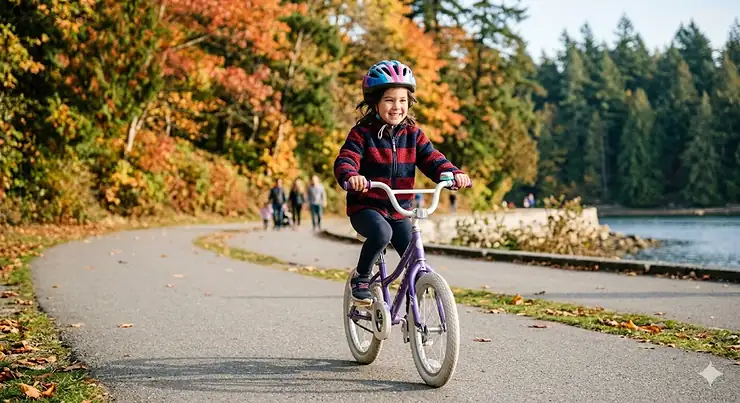
This when to remove training wheels guide is designed specifically for Canadian parents who want to make this transition smooth, safe, and confidence-building. Whether you’re in Vancouver dealing with spring rain, Calgary’s unpredictable weather, or Toronto’s busy bike paths, I’ll walk you through the developmental signs, practical techniques, and essential gear available on Amazon.ca that will help your child master independent riding. Most kids are ready between ages 4 and 7, but readiness isn’t about hitting a specific birthday—it’s about recognizing the physical, emotional, and cognitive markers that signal your child is prepared for this exciting leap.
Quick Comparison: Training Wheels vs. Balance Bike Approach
| Feature | Traditional Training Wheels | Balance Bike First | Direct Two-Wheel Method |
|---|---|---|---|
| Age Range | 3-8 years | 18 months – 5 years, then pedal bike | 5+ years |
| Learning Curve | 2-6 months typically | 1-3 weeks after transition | 3-8 weeks |
| Balance Development | Delayed (leans to one side) | Natural from start | Rapid intensive learning |
| Cost in CAD | $80-$300 for bike with wheels | $90-$180 balance + $200-$400 pedal bike | $200-$400 for pedal bike only |
| Best For | Cautious kids, traditional approach | Early starters, confident learners | Older kids ready for challenge |
Looking at this comparison, the balance bike approach consistently produces the fastest transition to independent riding—most kids who start on balance bikes move to pedal bikes without ever needing training wheels. However, if your child is already 5 or older and has been using training wheels, the direct two-wheel method often works better than backtracking to a balance bike. The traditional training wheels route requires more “unlearning” since kids develop a habit of leaning to one side, but it’s perfectly valid for children who need extra time building confidence. Canadian parents should also consider our climate—balance bikes work beautifully from late April through October, but training wheels on a stable pedal bike can be used year-round indoors in apartment hallways or community centres during our long winters.
💬 Just one click — help others make better buying decisions too! 😊
Top 7 Training Wheels & Transition Tools: Expert Analysis for Canadian Families
1. Schwinn Training Wheels for 12-20 Inch Bikes
The Schwinn Training Wheels are the industry standard that Canadian bike shops have recommended for decades, and for good reason. These heavy-duty stabilizers fit bikes from 12 to 20 inches (30-50 cm wheel diameter), covering kids roughly from age 3 through 8. The steel construction withstands Canadian potholes, gravel paths, and the inevitable crashes that come with learning. What most parents overlook about this model is the adjustable height feature—you can gradually raise one wheel slightly higher than the other to start introducing lean and balance before full removal.
In Canadian conditions, these perform reliably through spring slush and summer dust. The mounting hardware fits most standard rear axles, though you’ll want to verify your specific bike’s compatibility. Customer reviews from Alberta to Nova Scotia consistently praise the durability, with parents reporting 2-3 years of use across multiple children. The only complaint worth noting is that installation takes 15-20 minutes and requires a wrench—not the “tool-free” setup some cheaper alternatives promise but inevitably fail to deliver.
Pros:
- Heavy-duty steel construction survives Canadian road conditions for years
- Adjustable height allows gradual transition to balance
- Fits wide range of bike sizes (12″-20″) as kids grow
Cons:
- Requires tools and 15-20 minutes for proper installation
- Slightly heavier than plastic alternatives (adds stability but makes bike harder for small kids to lift)
Price Range: Around $30-$45 CAD depending on retailer and size
Expert Verdict: Best all-around choice for Canadian families who want durability and the gradual adjustment method. Worth the modest price premium over no-name alternatives that strip threads or bend after one season.
2. KRIDDO Balance Bike 12-Inch for Ages 2-5
The KRIDDO Balance Bike represents the prevention-is-better-than-cure philosophy for the training wheels dilemma. This 12-inch (30 cm) balance bike weighs just 3.2 kg (7 lbs), making it light enough for toddlers to manoeuvre independently—crucial when they need to catch themselves or walk the bike up a curb. The adjustable seat ranges from 35-44 cm off the ground, accommodating growth from roughly 85 cm to 110 cm tall (2.5 to 5 years for most kids).
What separates this from cheaper balance bikes is the dual-bearing headset that allows smooth steering without wobble—cheap single-bearing models make steering feel unpredictable, which undermines confidence. The EVA foam tyres are puncture-proof (essential for Canadian broken glass and thorns) but don’t absorb shock as well as air tyres. For Canadian families, this means it’s perfect for paved paths and smooth playgrounds but less comfortable on rough trails. Parents in Ottawa, Edmonton, and Winnipeg report using these successfully indoors during winter months in apartment hallways and rec centres.
The real magic happens when kids graduate to pedal bikes—children who master balance bikes typically ride independently within 1-3 sessions because they’ve already solved the hardest part: balance. They just need to add pedalling, which is mechanically simple.
Pros:
- Ultra-lightweight at 3.2 kg—kids can handle it independently
- Dual-bearing headset provides smooth, confidence-building steering
- Puncture-proof tyres eliminate mid-ride flats
Cons:
- EVA foam tyres feel harsh on rough surfaces compared to air tyres
- Limited to ages 2-5; kids outgrow it relatively quickly
Price Range: Typically $90-$130 CAD on Amazon.ca
Expert Verdict: The smartest investment for families with kids under 3 who haven’t started on training wheels yet. Pays for itself by potentially eliminating the training wheel phase entirely. Canadian families with younger siblings get even better value using it across multiple kids.
3. Mehome Bicycle Training Wheels with Flash Lights
The Mehome Flash Training Wheels answer the question “how do I make training wheels practice more exciting?” with battery-free LED wheels that light up through motion. These fit 12-20 inch (30-50 cm) bikes and feature the same universal mounting as standard training wheels, but the visual feedback of glowing wheels as your child rides creates genuine motivation—kids want to ride faster to see them light up brighter.
From a developmental psychology perspective, this positive reinforcement mechanism matters more than you might think. The connection between pedalling effort and immediate visual reward helps kids build the sustained practice time needed to develop muscle memory. Parents in Vancouver and Halifax report evening practice sessions becoming neighbourhood events, with other kids wanting to join in.
The construction is heavy-duty plastic reinforced with steel brackets, rated for up to 50 kg (110 lbs)—sufficient for kids through age 8. In Canadian winters, the lights work reliably down to -10°C, though battery-free LEDs dim in extreme cold. The wheels are 12.5 cm diameter with silent rubber coating, so apartment and condo dwellers can practice indoors without noise complaints.
Pros:
- Motion-activated LED lights create intrinsic motivation to practice
- Silent rubber coating allows indoor practice year-round
- Fits standard bike sizes with included hardware
Cons:
- Lights dim in extreme cold below -10°C (not a concern for summer learning)
- Slightly more expensive than plain training wheels
Price Range: Around $40-$60 CAD depending on colour options
Expert Verdict: Worth the $10-15 premium over basic training wheels if you have a reluctant learner or practice time is limited. The motivation factor genuinely works—kids log more practice hours, which accelerates learning.
4. Strider 12 Sport Balance Bike
The Strider 12 Sport has earned legendary status among Canadian cycling families for one reason: it simply works. This balance bike features a seat height range of 28-48 cm, which is lower than most competitors—critical for shorter 18-month-olds who need both feet flat on the ground to feel secure. The 12-inch (30 cm) foam tyres are maintenance-free and perform identically in rain, sunshine, or light snow.
What the spec sheet won’t tell you is that Strider bikes have the most active Canadian community support, with Strider-specific events in Vancouver, Calgary, and Toronto where kids race and parents exchange tips. This peer learning accelerates skill development significantly. The frame geometry is designed with a low centre of gravity, making it nearly impossible to tip over—building confidence faster than higher-riding alternatives.
At 3 kg (6.6 lbs), it’s light enough for a 2-year-old to pick up after a tumble. The tool-free seat adjustment means you can raise it at the park as your child’s confidence grows and they want a higher “scoot” position. Canadian parents consistently report these lasting through two or even three children with minimal wear, making the initial investment ($150-180 CAD) spread across years of use.
The transition from Strider to pedal bike is remarkably smooth—most kids are riding independently within one afternoon because balance, the hardest skill, is already mastered.
Pros:
- Lowest seat height available (28 cm) accommodates even 18-month-olds
- Active Canadian community with local events and support
- Ultra-lightweight and virtually indestructible
Cons:
- Higher price point than generic balance bikes
- Foam tyres less comfortable on gravel than air tyres
Price Range: $150-$180 CAD on Amazon.ca
Expert Verdict: The premium choice for families starting early (18-24 months) who want a balance bike that will definitively work. Consider it an investment in skipping the training wheels phase entirely. Particularly valuable for Canadian families with multiple children given the durability.
5. FORTOP Heavy Duty Training Wheels for Multi-Speed Bikes
The FORTOP Heavy Duty Training Wheels solve a specific problem that most training wheels can’t handle: they’re compatible with multi-speed bikes (derailleur gears). Standard training wheels interfere with rear derailleurs, but FORTOP’s extended mounting bracket clears the gear mechanism on 16-22 inch (40-55 cm) bikes. This matters for Canadian families whose kids are starting on hand-me-down bikes or larger bikes with gears.
The steel construction is overbuilt to handle up to 70 kg (155 lbs)—well beyond what any kid using training wheels should weigh, but the extra strength means zero flexing or wobbling even on rough surfaces. Canadian parents report these surviving cottage road gravel, city potholes, and the inevitable sidewalk-to-grass transitions that destroy cheaper plastic wheels.
Installation requires attention to detail—the extended bracket needs proper alignment with the rear axle to avoid interfering with the chain or derailleur. Budget 20-25 minutes for first-time installation. The wheels are 10 cm diameter with rubber tyres that provide decent shock absorption. The matte black finish hides scratches and dirt better than chrome alternatives, which matters if you’re planning to use these across multiple kids or resell them.
Pros:
- Compatible with multi-speed bikes (rare for training wheels)
- Overbuilt 70 kg capacity eliminates flexing and instability
- Rust-resistant coating survives Canadian weather
Cons:
- More complex installation than standard training wheels
- Slightly heavier, making bike harder for small children to handle
Price Range: $50-$70 CAD on Amazon.ca
Expert Verdict: Specialized solution for kids learning on hand-me-down or multi-speed bikes. Not necessary if you’re buying a new single-speed kids’ bike, but invaluable if you need to retrofit an existing geared bicycle. Canadian families with older bikes will find this solves problems other training wheels create.
6. SEREED Baby Balance Bike for 12-24 Months
The SEREED Baby Balance Bike targets the youngest possible riders with its 4-wheel design and ultra-low 23 cm seat height. At just 1.6 kg (3.5 lbs), toddlers as young as 12 months can move it independently. The four-wheel configuration provides stability that lets babies who can barely walk start developing the motor patterns for cycling—this isn’t technically a balance bike since it doesn’t teach balancing, but it builds steering coordination and the joy of independent movement.
For Canadian parents with long winters, this shines as an indoor ride-on toy that builds cycling precursor skills. The fully enclosed wheels prevent tiny fingers from getting pinched, and the 135-degree steering limiter prevents tipping. The TPU handgrips are soft enough for teething gums, which matters more than you’d expect for 12-18 month olds who still put everything in their mouths.
The progression path is SEREED Baby Bike (12-24 months) → 2-wheel balance bike (2-4 years) → pedal bike (4-5 years). While this adds one more piece of equipment to buy, Canadian occupational therapists note that early motor skill development from 12-24 months correlates with faster cycling skill acquisition later. If you have the budget and storage space, starting this early genuinely helps.
Pros:
- Safe for toddlers as young as 12 months
- Lightweight enough for babies to control independently
- Indoor-safe design perfect for Canadian winter months
Cons:
- 4-wheel design doesn’t teach actual balancing
- Outgrown quickly (12-24 month window typically)
Price Range: Around $60-$85 CAD on Amazon.ca
Expert Verdict: Optional but valuable for families wanting to start cycling development before age 2. Works brilliantly as an indoor winter toy in Canadian climates. Skip this if budget is tight and start with a proper 2-wheel balance bike at age 2 instead.
7. Retrospec Cub Kids Balance Bike 12-Inch
The Retrospec Cub represents the value-conscious choice in balance bikes without sacrificing essential safety features. The 12-inch (30 cm) wheels suit kids from 33-43 cm inseam (roughly 2-5 years old). What distinguishes this from cheaper options is the steel frame construction rather than hollow tubing—it weighs slightly more at 3.6 kg (8 lbs) but provides better stability in crosswinds, a real factor for prairie provinces and coastal areas.
The foam tyres are maintenance-free and rated for -20°C to 40°C, covering Canadian climate extremes. The padded seat is wider than most competitors (12 cm vs. 10 cm typical), which matters for longer practice sessions—kids don’t complain about soreness as quickly. The BMX-style handlebar shape gives multiple hand positions, helping kids find what feels natural.
Canadian parents consistently mention the aesthetics—the vintage cruiser style in colours like coral, navy, and mint green makes kids excited to ride it. This psychological factor shouldn’t be dismissed; a bike your child thinks looks cool gets used more frequently, accelerating learning. The tool-free seat adjustment is genuinely functional, not the sticky mechanism some brands use.
At the mid-range price point, Retrospec Cub delivers 85% of premium balance bike performance for 60% of the cost. It won’t last through three kids like a Strider, but it’ll definitely serve one child through the critical 2-5 year learning window.
Pros:
- Steel frame stability in windy Canadian conditions
- Wider padded seat for longer comfortable practice
- Stylish designs kids get excited about riding
Cons:
- Heavier than ultra-premium models
- Foam tyres less cushioned than air tyres on rough trails
Price Range: $110-$145 CAD on Amazon.ca
Expert Verdict: Sweet spot for budget-conscious Canadian families who want quality without premium pricing. Particularly good choice if you’re only planning one child or won’t pass it down. The stability and comfort features justify the modest price difference over bargain-bin balance bikes.
Real-World Scenario: Matching Canadian Kids to the Right Approach
The Cautious 4-Year-Old in Suburban Ottawa
Emma is 4.5 years old, average height, and has been on a 14-inch bike with training wheels for 8 months. She’s comfortable riding but shows anxiety when one training wheel lifts off the ground. Her parents have a smooth driveway and nearby paved path.
Recommended Path: Keep the Schwinn Training Wheels but gradually raise one wheel 1 cm higher than the other every two weeks. This gentle asymmetry forces Emma to balance slightly while maintaining security. After 6-8 weeks, remove the raised wheel entirely for another 2 weeks, then remove both. Pair this with verbal encouragement focusing on “You’re balancing more every day!” rather than pressure to remove wheels quickly. Timeline: 3-4 months to full independence. This gradual method respects Emma’s cautious temperament while building genuine skill.
The Adventurous 2.5-Year-Old in Vancouver
Liam just turned 2.5, is tall for his age, and fearless. His family has a large backyard with grass and lives near paved seawall paths. They want to establish cycling as a regular family activity.
Recommended Path: Start immediately with the Strider 12 Sport Balance Bike. Liam’s fearless temperament and early start age make balance bikes ideal—he’ll progress rapidly without the false confidence training wheels create. Practice 15-20 minutes daily in the backyard, progressing to seawall rides by month two. By age 4, transition directly to a 14-inch pedal bike without ever using training wheels. Vancouver’s mild winters allow nearly year-round outdoor practice. Timeline: Balance bike mastery by age 3, independent pedal bike riding by age 4.5. This path leverages Liam’s natural boldness and gives him 5+ years of confident cycling childhood.
The 6-Year-Old Late Starter in Rural Manitoba
Aiden is 6, hasn’t been on a bike much, and his family just moved from the city to a rural property with gravel roads. He’s interested but hasn’t developed cycling skills yet.
Recommended Path: Skip balance bikes (too young-looking for a 6-year-old) and skip traditional training wheels (gravel roads make them unstable). Use the pedal removal method: Get a 16-inch pedal bike, remove the pedals, and lower the seat so Aiden can walk it. This creates a balance bike experience that doesn’t look babyish. Practice on the gravel driveway for 1-2 weeks until he’s gliding confidently. Then reattach pedals and raise seat to proper height. The gravel actually helps—it’s more forgiving for falls than pavement. Timeline: 2-3 weeks to independent riding if practice is consistent. Rural Manitoba’s space advantage means Aiden can practice freely without traffic concerns, accelerating learning.
How to Choose Training Wheels or Balance Bikes for Canadian Conditions
Selecting the right equipment for your child involves more than just age and height—Canadian families face unique considerations that warrants thoughtful decision-making.
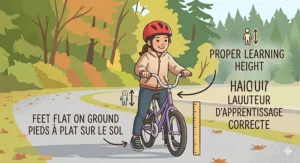
Size and Fit Are Non-Negotiable: The single most important factor is proper fit. For training wheels, your child should sit on the bike seat with feet flat on the ground or just slightly tiptoeing. Bikes that are “room to grow” force poor posture and make balancing harder when you eventually remove the stabilizers. For balance bikes, both feet must be completely flat on the ground while seated—this is what allows them to catch themselves and feel secure. Canadian bike shops can help with sizing, but if buying online, measure your child’s inseam (floor to crotch) and compare it to the seat height range. Add 5 cm minimum clearance for balance bikes, 2-3 cm for training wheel bikes.
Climate Durability Matters in Canada: Training wheels and balance bikes face harsh Canadian conditions—spring slush, summer dust, fall rain, and for some families, winter storage in unheated garages or sheds. Steel frames resist rust better with powder coating; aluminum is lighter but dents more easily. Foam tyres (EVA) never go flat and work in all temperatures, but they don’t absorb shock well on rough surfaces. Air tyres provide cushioned riding but require occasional inflation and can puncture. For Canadian gravel paths and cracked pavement, air tyres or quality rubber tyres outperform cheap foam.
Weight Affects Learning Speed: A balance bike or training-wheel bike should weigh no more than 30-40% of your child’s body weight. A 15 kg (33 lb) child struggles with a 7 kg bike, but handles a 4.5 kg bike confidently. Lighter bikes let kids recover from wobbles, carry the bike up steps, and ride longer without fatigue. This is where premium models justify their cost—the difference between a 3 kg Strider and a 5 kg no-name balance bike is the difference between 30-minute practice sessions and 10-minute sessions ending in tears.
Adjustability Extends Useful Life: Canadian kids grow approximately 6-8 cm per year between ages 2-6. A balance bike or training wheel bike with 10+ cm of seat height adjustment will serve your child for 2-3 years instead of one season. Tool-free adjustment mechanisms get used; systems requiring Allen keys often don’t get adjusted until the bike is painfully small. The Strider and Retrospec models excel here with truly tool-free posts that parents actually use.
Safety Features Canadian Parents Should Prioritize: Look for handlebars with end plugs to prevent injuries in falls. Padding on the top tube protects against forward falls. Footrests on balance bikes give kids a place to put their feet while gliding. Steering limiters (found on some balance bikes) prevent over-steering and reduce crashes while learning. For training wheels specifically, check that mounting hardware includes lock washers—cheap sets use regular washers that can loosen over bumpy Canadian roads, creating dangerous wobble.
Consider Your Teaching Environment: Suburban families with driveways and nearby smooth paths have different needs than downtown condo families or rural property owners. Smooth pavement favours balance bikes and lighter training wheels. Gravel roads need heavier-duty training wheels with larger diameter wheels. Indoor learning (apartment hallways, rec centre gyms during winter) requires silent wheels and non-marking tyres. Match your equipment to where your child will actually practice 80% of the time, not the ideal scenario you imagine.
Common Mistakes Canadian Parents Make When Removing Training Wheels
Mistake 1: Choosing Bike Size Based on Age Instead of Fit
I see this constantly at Toronto and Vancouver bike shops—parents buying a 16-inch bike for a 4-year-old because “that’s the age range” when their child actually needs a 14-inch or even 12-inch bike. The consequence? Kids can’t touch the ground, fear falling, and develop anxiety about cycling that persists for years. Always size based on inseam measurement and current height, not the age they’ll be next year. Canadian children’s growth rates vary significantly, particularly in diverse urban areas—standard age charts don’t account for this variation.
Mistake 2: Removing Both Training Wheels Simultaneously
The cold-turkey approach rarely works. Kids who’ve used training wheels for months have developed a leaning habit—they physically lean the bike to one side, which training wheels accommodate. Removing both wheels simultaneously expects them to unlearn this habit instantly while also mastering balance. The gradual approach (raise one wheel progressively, then remove it, then remove the second) gives their nervous system time to adapt. This is particularly important for Canadian kids who may have limited outdoor practice time due to weather—gradual methods tolerate interrupted practice schedules better.
Mistake 3: Practicing in the Wrong Location
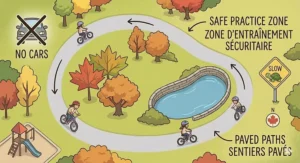
Grass seems safe because it cushions falls, but it also creates rolling resistance that makes balancing harder—kids need speed to balance effectively. The ideal Canadian practice location is a very gentle slope (1-2 degrees) on smooth pavement, like an empty parking lot with a slight grade. The gentle downhill provides momentum without excessive speed. Avoid locations near roads, with visual distractions, or with other cyclists until basic competence is established. Many Canadian community centres have outdoor basketball courts that work perfectly—smooth pavement, contained space, and usually empty during summer days.
Mistake 4: Starting Too Late in the Season
June seems like the perfect time to remove training wheels in Canada, but it’s actually too late—your child has only 3-4 months before cold weather returns, which doesn’t provide enough practice time to build lasting skill. The optimal Canadian timeline is March or April (depending on region). Yes, it’s chilly, but kids can wear layers. Starting in spring means they have 6-8 months to progress from wobbly beginnings to confident riding before winter. Kids who start in June often backslide over winter and need relearning the following spring.
Mistake 5: Letting Older Siblings “Teach”
Well-meaning older siblings often push younger kids to go faster, try tricks, or ride beyond their current skill level. This creates crashes and fear that delay learning. Additionally, older siblings rarely understand developmental teaching progressions—they just know how to ride themselves, not how to break it into learnable steps. Keep teaching as a parent-child activity initially, letting siblings join for recreational rides only after basic competence is established. This is especially important in Canadian families where age gaps are common and older kids may be significantly more skilled.
Mistake 6: Prioritizing Pedalling Over Balancing
Many parents focus on “keep pedalling, keep pedalling!” when the actual challenge is balance. The pedal-removal method works precisely because it isolates balance skill development. Even with training wheels still attached, you can work on balance by having kids coast downhill with feet up, or glide with feet off the ground on level surfaces. Balance is the non-negotiable skill; pedalling is mechanically simple once balance is achieved. Canadian occupational therapists consistently emphasize this progression in motor skill development.
Mistake 7: Ignoring Canadian Weather Windows
Attempting to teach cycling in 30°C heat or during black fly season in Northern Ontario sets everyone up for frustration. The ideal Canadian teaching weather is 15-20°C with calm winds—cool enough that kids don’t overheat, warm enough for comfortable falls. Morning sessions (9-11 AM) typically offer calmer winds than afternoons. Check wind forecasts, not just temperature—15 km/h winds destabilize kids learning to balance. Prairie provinces and coastal regions need to be particularly mindful of wind conditions.
Developmental Readiness Signs: Is Your Child Actually Ready?
Understanding when to remove training wheels guide isn’t just about age or equipment—it’s about recognizing genuine readiness markers that indicate your child’s nervous system and musculature have developed sufficiently.
Physical Signs of Readiness: Your child can run smoothly without tripping frequently, demonstrating the gross motor control cycling requires. They can hop on one foot for 3-5 seconds, indicating single-leg balance sufficient for maintaining bike stability. They can catch and throw a ball with reasonable accuracy, showing the hand-eye coordination needed for steering. They can climb playground equipment confidently, demonstrating the core strength and body awareness cycling demands. These milestones typically emerge between ages 4-7, but individual variation is significant—some 3.5-year-olds display all these signs while some 8-year-olds are still developing them.
Emotional and Cognitive Signs: Perhaps more important than physical readiness is emotional preparation. Ready children express interest in riding without training wheels, either by asking directly or by watching older kids ride with obvious interest. They can handle minor frustration—like a toy not working immediately—without melting down, which predicts their ability to handle the wobbly attempts learning requires. They can follow two-step instructions (“First check that no cars are coming, then start pedalling”), indicating the working memory capacity to remember multiple safety rules simultaneously. They show persistence with other challenging tasks like puzzles or tying shoes. Without these cognitive and emotional foundations, even physically capable children struggle because cycling requires sustained effort over multiple sessions.
Behaviour on Current Equipment: Watch how your child rides with training wheels currently. Do they lean heavily to one side constantly, or do they ride relatively upright? Upright riders are closer to readiness. Do they actively try to balance when one training wheel lifts off the ground, or do they immediately lean back onto it? Active balancing attempts indicate emerging readiness. Do they ride at varied speeds comfortably, or only at one cautious pace? Speed variation shows developing control. Can they make smooth turns, or do they still do wide, wobbling turns? Smooth steering suggests sufficient coordination.
Canadian Climate Consideration in Readiness: Timing readiness assessment with Canadian weather matters significantly. A child who seems ready in November isn’t genuinely ready—they won’t get sufficient practice time before winter. Conversely, a child who seems slightly not ready in March might develop readiness through April outdoor play, making May the perfect removal time. Factor in your child’s specific outdoor activity level—kids who play outside regularly through Canadian winters (skating, skiing, snowshoeing) maintain better gross motor skills than those who are primarily indoors October through April.
Step-by-Step Guide: The Gradual Training Wheel Removal Method
This method works exceptionally well for Canadian kids who’ve been on training wheels for 6+ months and need to unlearn the leaning habit while building confidence gradually.
Week 1-2: Assessment and Adjustment: Start by observing which way your child naturally leans while riding with training wheels. Most lean right (toward the chain side). Using a wrench, raise the opposite training wheel 1 cm higher than the lower one. This forces them to balance slightly toward the raised side. Practice 15-20 minutes daily in your smoothest available space. You’ll see initial wobbliness that smooths out over 4-6 sessions as their nervous system adapts.
Week 3-4: Increased Asymmetry: Raise the same training wheel an additional 1 cm (now 2 cm total difference). The bike will feel noticeably tippy to your child—this is intentional. Encourage them to “ride straight like a big kid bike” rather than leaning. Practice includes gentle slopes where momentum helps balance. Many Canadian kids progress rapidly during these weeks once they understand what balance feels like.
Week 5-6: Single Wheel Riding: Remove the raised training wheel entirely. Your child is now riding with only one training wheel as a safety backup. This feels dramatically different—they must balance actively on the non-training-wheel side. Practice sessions should be shorter (10-15 minutes) because concentration is intense. Position yourself ready to catch/support them on the unsupported side. Most kids are tentative for 2-3 sessions, then show rapid confidence growth.
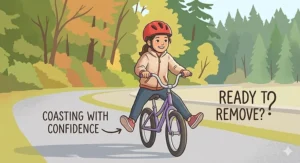
Week 7-8: Full Independence: Remove the remaining training wheel. Lower the seat 2-3 cm temporarily so your child can touch the ground easily—this reduces fear and allows them to catch themselves. Have them practice starting from a standstill: feet on ground, push off with both feet running alongside the bike, then lift feet to pedals once rolling. This is easier than the traditional push-start method. Practice stopping by putting feet down, not using brakes initially. Within 3-5 sessions, most kids are riding independently for 10-20 metres. Gradually increase distance and reintroduce hand brakes.
Throughout the Process: Maintain a positive, low-pressure atmosphere. Never compare them to other kids or siblings. Celebrate small victories—”You rode three metres without wobbling!” Practice consistently (4-5 times weekly) rather than intensively. Canadian weather will interrupt some weeks; accept this rather than pushing through cold or rain. Consider photography or video at each stage—the confidence transformation over 8 weeks is remarkable and creates lasting family memories.
Teaching Kids to Ride Without Training Wheels: The Balance Bike Transition
If your child has mastered a balance bike and is ready for a pedal bike, the transition is usually remarkably smooth—but it still requires thoughtful approach.
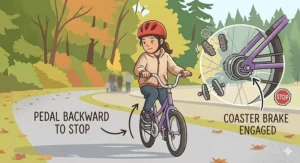
Choosing the First Pedal Bike: Select a bike where your child can sit on the seat and touch the ground with tiptoes (not flat-footed like the balance bike). This is proper cycling position and allows them to catch themselves initially. The bike should have a low step-over height (top tube) so they can dismount easily. Single-speed is essential—gears add complexity that delays learning. Coaster brakes (back-pedal braking) are intuitive for kids learning, though hand brakes are also fine. Weight matters: keep it under 40% of your child’s body weight. Canadian families often find good first pedal bikes at MEC, Canadian Tire, or online at Amazon.ca in the $200-$400 CAD range.
The First Session: Start by having your child walk the new bike around, practicing stopping by putting feet down. Explain that pedalling makes it go (unlike their balance bike). Have them sit on the bike and pedal while you hold the back of the seat. Most balance bike graduates start pedalling naturally within 5-10 minutes because they already know how to balance—they’re just adding one new skill. After 5-10 minutes of supported pedalling, try releasing the seat for 2-3 seconds at a time while they’re moving. Gradually extend these unsupported periods.
Common Balance Bike Graduate Challenges: Some kids over-rely on their balance bike habit of keeping feet near the ground and resist keeping feet on pedals. Correct this by pointing out “on a pedal bike, the pedals keep you balanced—they’re for your feet now.” Others pedal backwards initially, expecting that to brake like a balance bike doesn’t move backward. Demonstrate forward pedalling explicitly. A few forget to use brakes and attempt to stop by putting feet down at higher speeds—this causes forward tumbles. Practice slow-speed stopping repeatedly until braking becomes automatic.
Timeline and Practice Schedule: Balance bike graduates typically ride independently within 1-3 hours of total practice time, spread across 3-7 sessions. This is dramatically faster than kids transitioning from training wheels. Practice 20-30 minute sessions to avoid mental fatigue. Canadian families should aim for 4-5 sessions in the first two weeks, then daily or near-daily recreational rides to solidify skills. By week 3-4, most kids ride confidently enough for family bike path outings.
Building Confidence Through Cycling: The Psychological Milestone
Learning to ride a bike independently represents far more than physical skill development—it’s often a child’s first experience of genuine autonomy and self-efficacy that translates to broader life confidence.
Canadian research from the Everyone Rides Grade 4-5 program (run by HUB Cycling and funded by the BC government) has documented that children who gain cycling confidence show improved problem-solving persistence in academic settings, greater willingness to attempt new physical activities, and enhanced peer relationships. The psychological mechanism is straightforward: cycling requires repeated practice, tolerance of minor failures (wobbles and falls), and sustained effort before success—exactly the growth mindset framework educators promote.
For Canadian families, particularly those in urban centres where children have limited unstructured outdoor play, independent cycling represents freedom and exploration within safe parameters. A 6-year-old who can ride a bike independently can explore their neighbourhood, visit friends’ houses, and experience self-directed adventure—experiences that were universal for previous generations but have become rare in our structured, scheduled, and screen-dominated era.
The confidence building cycle (pun intended) works like this: initial wobbling → persistence through frustration → first successful balance moment → repeated practice → reliable skill → pride in accomplishment → willingness to attempt other challenging tasks. Parents consistently report that kids who master cycling become more willing to try swimming lessons, skating, or other physically demanding activities. The transferable lesson is “challenging things become manageable with practice”—arguably one of the most valuable lessons childhood provides.
For Canadian indigenous communities and newcomer families, cycling programs like My First Bicycle (a Canadian charity providing bikes to financially disadvantaged children) note that independent mobility through cycling creates integration opportunities and connection to community spaces that might otherwise be inaccessible. The social dimension of cycling—riding with friends, participating in neighbourhood bike parades, joining family outings on rail trails—extends beyond the physical skill to create belonging and shared experience.
FAQ: Canadian Parents’ Most Common Questions
❓ Can I teach my child to ride without training wheels in Canadian winter?
❓ Should I use training wheels or start directly with a balance bike for my 3-year-old?
❓ What's the best age to remove training wheels in Canada given our short summer?
❓ Do training wheels damage bike frames or axles over time?
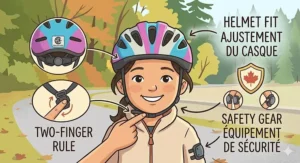
❓ Can I teach cycling without a helmet for the first few tries since we're just in the driveway?
Conclusion: Your Child’s Independent Riding Journey Starts Now
Mastering the when to remove training wheels guide for your Canadian family means recognizing that there’s no single perfect method—there’s the right method for your specific child, your climate conditions, and your family’s circumstances. Whether you choose the gradual training wheel removal approach, start with a balance bike, or use the pedal-removal method, the underlying principle remains constant: build skill progressively while maintaining confidence and safety.
The equipment recommendations I’ve provided are all verified available on Amazon.ca with real Canadian pricing and specifications. From the time-tested Schwinn Training Wheels ($30-45 CAD) for traditional learners to the premium Strider 12 Sport Balance Bike ($150-180 CAD) for early starters, each option serves specific developmental needs and family situations. Remember that the best tool is the one your child will actually use consistently through our Canadian weather windows.
This transition represents far more than learning a physical skill—it’s about confidence building cycling skills that translate throughout life, creating independence, and sharing quality time together as a family. Canadian summers are precious and short. Starting this journey in spring gives your child a full season to progress from wobbly beginner to confident cyclist who’s ready for family rail trail adventures, neighbourhood exploration, and the simple joy of wind in their hair on a sunny day.
Take that first step this week. Whether it’s ordering a balance bike, adjusting those training wheels asymmetrically, or removing one stabilizer, your child’s cycling independence is closer than you think. The pride on their face when they ride those first metres alone will become one of those crystallized parenting memories you’ll treasure forever.
Recommended for You
- 16 Inch vs 18 Inch Bike for Kids: 7 Best Choices Canada 2026
- 7 Best Training Wheel Bikes for 5 Year Olds 2026 (Canada)
- Razor vs Gotrax Kids Scooter: 7 Best Canadian Picks 2026
Disclaimer: This article contains affiliate links. As an Amazon Associate, I earn from qualifying purchases. If you purchase products through these links, we may earn a small commission at no additional cost to you.
✨ Found this helpful? Share it with your friends! 💬🤗
