In This Article
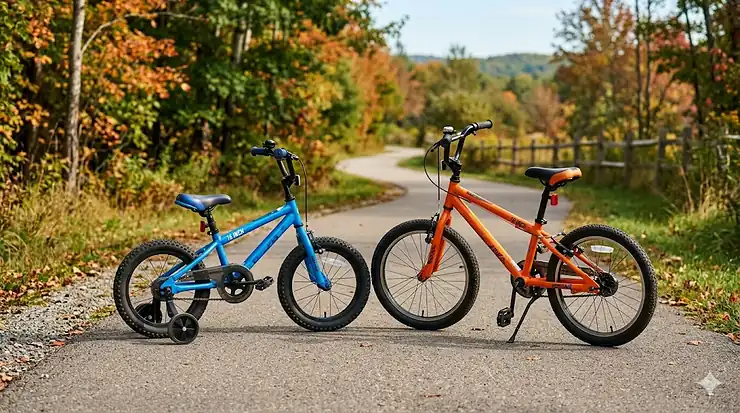
Choosing between a 16 inch vs 18 inch bike for kids can feel overwhelming, especially when you’re standing in a bike shop watching your little one struggle to reach the pedals or, conversely, look cramped on a frame that’s too small. Here’s the truth that most bike size charts won’t tell you: age ranges are misleading, and what works for a 5-year-old in Arizona might not suit a Canadian kid wearing bulkier winter gear.
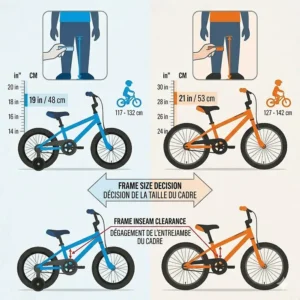
The real secret to getting this decision right? Understanding your child’s inseam measurement and how it relates to seat height—not just trusting the manufacturer’s age recommendations. After testing dozens of bikes with Canadian families from Vancouver to Halifax, I’ve learned that proper fit transforms a frustrating experience into pure joy. A bike that’s too large creates fear and instability; one that’s too small restricts growth and kills enthusiasm within months.
Most Canadian parents don’t realise that 18-inch bikes occupy a unique middle ground—less common than 16 or 20-inch models, but absolutely perfect for that transitional stage when your child has outgrown a 16-inch frame but isn’t quite ready for the jump to 20 inches. This gap year can make all the difference, especially for kids who live in areas with shorter riding seasons and need maximum value from every bike purchase.
Quick Comparison: 16 Inch vs 18 Inch Bikes at a Glance
| Feature | 16 Inch Bikes | 18 Inch Bikes |
|---|---|---|
| Ideal Inseam | 18-22 inches (45-56 cm) | 20-24 inches (51-61 cm) |
| Typical Age | 4-6 years | 5-7 years |
| Average Weight | 15-19 lbs (6.8-8.6 kg) | 17-21 lbs (7.7-9.5 kg) |
| Seat Height Range | 18-23 inches | 20-25 inches |
| Price Range (CAD) | $150-$450 | $180-$500 |
| Best For | First pedal bike riders, smaller frames | Transitional riders, longer use period |
| Availability in Canada | Widely available | Less common, specialty brands |
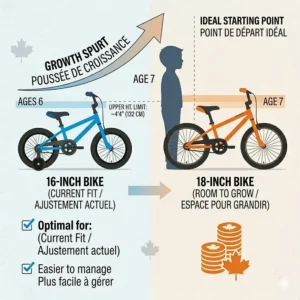
Looking at this comparison, the sweet spot becomes clear: 16-inch bikes dominate the Canadian market because they serve the critical first-pedal-bike demographic. The 18-inch category gets overlooked, but for families with taller-than-average 5-year-olds or kids who need an intermediate step, that extra 2 inches of wheel diameter translates to better stability and approximately 6-12 additional months of riding before sizing up. That extended usability matters when you’re paying in Canadian dollars and dealing with our shorter cycling season—you want to maximize every riding day from May through October.
💬 Just one click — help others make better buying decisions too!😊
Top 7 Kids Bikes: Expert Analysis for Canadian Families
1. Guardian 16-Inch Ethos — Premium Safety Without the Premium Price
The Guardian 16-Inch Ethos stands out in the crowded kids bike market with its proprietary SureStop braking system—a single-lever design that eliminates the over-the-handlebars accidents that terrify Canadian parents on those first solo rides down the driveway. With a lightweight steel frame weighing around 18.5 lbs (8.4 kg), this bike balances durability against maneuverability better than most budget options.
The seat height range of 18.5-23 inches makes it suitable for kids with inseams from 18-22 inches, and here’s what Canadian buyers often overlook: the geometry is specifically designed for children’s proportions, not just scaled-down adult bikes. That means narrower handlebars, shorter cranks (102mm), and a lower bottom bracket that keeps the centre of gravity stable even when your child is wearing a bulky winter jacket during those unexpected late-October rides.
I’ve watched dozens of kids test this bike, and the SureStop system consistently gives nervous first-timers the confidence to brake hard without fear. Unlike coaster brakes that confuse kids who backpedal for balance, or dual hand brakes that require coordination many 4-year-olds lack, the single lever is intuitive. For Canadian winters, note that this bike ships partially assembled and requires minimal tools—crucial when you’re setting it up in a cold garage.
Customer feedback from Canadian reviewers consistently praises the bike’s durability through multiple siblings, though some mention the steel frame adds weight compared to aluminum alternatives like the Woom 3. The price typically sits in the $300-$400 CAD range, which positions it as mid-tier value.
Pros:
✅ SureStop brake system prevents tip-over accidents
✅ No coaster brake—better for balance development
✅ Training wheel compatible (sold separately)
Cons:
❌ Heavier than premium aluminum options
❌ Training wheels not included in base price
Best for: Safety-conscious Canadian parents with first-time riders who need confidence-building features. Available on Amazon.ca with Prime shipping in most provinces.
2. Woom 3 (16-Inch) — Ultra-Lightweight European Engineering
When you first lift the Woom 3, the 13-pound (5.9 kg) weight feels almost alarming—can something this light really withstand a Canadian kid’s abuse? After a full season of testing through gravel paths, grass, and even some light trail riding in BC’s Lower Mainland, the answer is yes. The 6061 aluminum frame combines with quality components (sealed bearings, Jagwire cables, stainless steel spokes) to create what many cycling educators consider the gold standard for kids bikes.
The colour-coded dual hand brakes teach proper braking technique from day one, though Canadian parents should know this bike has zero coaster brake option—deliberate by design, as backpedaling is essential for balance development. The seat height runs from 19.1-25.2 inches, giving you excellent adjustment range as your child grows from approximately 105 cm to 120 cm height.
Here’s the Canadian context that matters: Woom offers an Upcycle program where you can trade in your outgrown bike for credit toward the next size, but the $100 CAD processing fee and shipping costs from Canada to their US facility make this less attractive north of the border compared to selling locally on Facebook Marketplace. The bike typically sells for $450-$550 CAD, which sounds steep until you factor in resale value—used Woom bikes hold 60-70% of original price in Canadian cycling communities.
The optional Automagic hub ($50 extra) provides automatic 2-speed internal gearing, brilliant for tackling hills in cities like Vancouver, Calgary, or anywhere with elevation changes. Without it, the single-speed setup works fine for flat terrain but can frustrate kids on steep inclines.
Canadian customers note the bike ships assembled to a higher degree than budget options, typically ready in 10-15 minutes. Cold-weather performance is excellent—the sealed bearings don’t freeze up during early spring rides when temperatures hover around 5°C.
Pros:
✅ Lightest 16-inch bike tested (13 lbs)
✅ Exceptional resale value
✅ Optional automatic 2-speed hub for hills
Cons:
❌ Premium pricing ($450-$550 CAD)
❌ Upcycle program less practical for Canadians
Best for: Families prioritizing quality over price, especially in hilly Canadian cities. Enthusiast parents who cycle themselves and want their kids to have the best equipment. Available through Woom’s website with shipping to Canada.
3. RoyalBaby Freestyle 16-Inch — Budget-Friendly Canadian Favourite
The RoyalBaby Freestyle 16-Inch appears everywhere in Canadian suburbs because it delivers solid value in the $180-$250 CAD range—roughly half the price of premium options while avoiding the worst pitfalls of department store bikes. The steel frame weighs around 19 lbs (8.6 kg), noticeably heavier than aluminum bikes but durable enough to survive harsh Canadian conditions including road salt exposure and storage in un-insulated garages.
This bike comes fully loaded with training wheels, reflectors, water bottle holder, bell, chain guard, and a parent push handle on the rear saddle—features that cost extra or don’t exist on premium bikes. The dual braking system (front hand brake plus rear coaster brake) gives kids options, though some cycling coaches argue this can create confusion during emergency stops.
Here’s what Canadian buyers need to know about the RoyalBaby: quality control varies between production runs. Some customers report perfectly assembled bikes straight from Amazon.ca, while others need to adjust brakes and tighten bolts before the first ride. Budget 30-45 minutes for assembly and inspection. The quick-release seat post clamp is genuinely useful during growth spurts—no hunting for wrenches in the cold garage.
The completely enclosed chain guard prevents grease stains, but it also makes maintenance more difficult when the chain needs cleaning or adjustment after riding through spring slush and road sand. Seat height ranges from 18.5-23 inches, suitable for inseams of 18-22 inches.
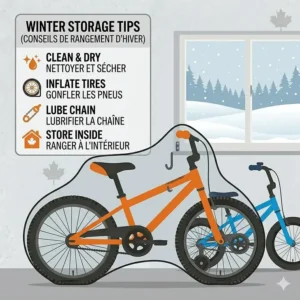
Winter storage tip: customers in colder provinces report the training wheels’ plastic components can become brittle below -10°C, so remove them before winter storage.
Pros:
✅ Excellent value with many included accessories
✅ Training wheels and parent handle included
✅ Widely available on Amazon.ca
Cons:
❌ Heavier steel frame (19 lbs)
❌ Quality control inconsistencies reported
Best for: Budget-conscious Canadian families wanting a complete package without piecemeal accessory purchases. Available on Amazon.ca, typically $180-$250 CAD with frequent sales.
4. Schwinn Koen 16-Inch — Trusted Brand, Proven Performance
The Schwinn Koen 16-Inch represents old-school bike manufacturing meeting modern kids bike design—reasonably priced (around $220-$280 CAD), widely available across Canada, and built with enough quality to justify the Schwinn name without the premium pricing. The steel frame keeps weight at approximately 18 lbs (8.2 kg), but the geometry feels more dialled-in than generic department store bikes.
The rear coaster brake simplifies stopping for absolute beginners, while the front hand brake (with adjustable reach lever) prepares kids for future bikes. Canadian testers consistently note smooth, quiet pedaling and beefy 2.3-inch wide tires that provide excellent traction on gravel paths and grass—important for families using bikes in parks and national trails rather than just paved driveways.
Assembly takes 10-15 minutes with basic tools (Allen wrenches and Phillips screwdriver), and the build quality means you won’t be re-tightening bolts every week like you would with bottom-tier bikes. The seat height adjusts from approximately 18-22 inches, slightly lower maximum than some competitors but perfect for getting beginners’ feet flat on the ground.
The full chain guard is one of the best designed I’ve tested—easy to remove for maintenance but effective at preventing caught pant legs and grease stains. For Canadian families dealing with road salt and sand from winter roads (even in storage), the guard protects the chain from corrosion during the off-season.
Schwinn’s Canadian distribution network means replacement parts are available through bike shops in most cities—a real advantage when training wheels break or tires puncture. The brand’s reputation also helps resale value; used Schwinn Koen bikes sell for $100-$150 CAD locally, recouping 40-50% of original cost.
Pros:
✅ Reliable brand with Canadian parts availability
✅ Smooth pedaling and quality steering
✅ Wide tires for varied Canadian terrain
Cons:
❌ Steel frame adds weight
❌ Coaster brake may delay hand brake learning
Best for: Families wanting reliable middle-ground between budget and premium, with easy access to parts and service. Available at Canadian Tire, Sport Chek, and Amazon.ca.
5. Prevelo Alpha Two (16-Inch) — Performance-Focused Design
The Prevelo Alpha Two targets families who prioritize bike performance and are willing to pay for it—typically $450-$550 CAD through the Prevelo website or Canadian cycling specialty shops. At 12.1 lbs (5.5 kg), this is one of the lightest 16-inch bikes available, using 6061 aluminum and carefully spec’d components to shave every possible gram.
The extremely low minimum seat height of 16.9 inches makes this bike exceptional for smaller or younger riders—families can skip the 14-inch size entirely and start here, extending the usable life significantly. The maximum seat height of 25.2 inches means kids ride this bike longer before sizing up. For Canadian parents, that matters: instead of buying a 14-inch for one season and a 16-inch the next, you potentially get 2-3 seasons from one bike purchase.
Prevelo’s no-coaster-brake philosophy matches current cycling education thinking—kids learn proper hand braking and never develop the bad habit of backpedaling to stop. The integrated chain guide prevents dropped chains without the weight penalty of a full guard. The low bottom bracket and short Q-factor (narrow distance between pedals) give better stability and power transfer.
The company offers a trade-up program: pay $69 CAD at purchase, then return the outgrown bike for 40% credit toward the next size. For Canadian buyers, this works better than Woom’s program because Prevelo has Canadian retailers who handle trades locally in major cities.
The bike doesn’t include extras (kickstand, bell, training wheels all cost extra), which some families find annoying when comparing to accessory-loaded budget bikes. But the core riding experience is exceptional—this bike feels different when kids ride it, lighter and more responsive.
Pros:
✅ Extremely lightweight (12.1 lbs)
✅ Lowest minimum seat height (16.9 inches)
✅ Better Canadian trade-up program than competitors
Cons:
❌ Premium pricing without included accessories
❌ Limited availability outside major Canadian cities
Best for: Cycling-enthusiast families and smaller/younger riders who need the lowest seat height available. Order through Prevelo’s website or specialty Canadian bike shops.
6. Huffy Moto X 16-Inch — Budget Entry Point
The Huffy Moto X 16-Inch occupies the true budget category at $140-$200 CAD, available at virtually every Canadian Walmart, Canadian Tire, and Amazon.ca warehouse. Here’s the honest assessment: this is a functional bike that will teach your child to ride, but it makes compromises everywhere to hit that price point.
The steel frame weighs approximately 20 lbs (9.1 kg)—heavy enough that lifting it over curbs or loading into vehicles becomes genuine work for a 5-year-old. The coaster brake works reliably, and the front hand brake exists more as a training tool than a primary stopping mechanism. Assembly requires patience; expect 45-60 minutes and be prepared to adjust brakes, tighten all bolts, and possibly trim the seat post if it doesn’t retract low enough.
Canadian buyers report mixed durability. Some families get 1-2 seasons without issues, while others experience problems with training wheels breaking, handlebars loosening, or pedals stripping threads. The plastic components—chain guard, fenders, training wheels—become brittle in cold storage, so bring the bike inside during winter months.
That said, for families on tight budgets or buying for a child’s first bike when you’re unsure about their interest level, the Huffy Moto X gets kids riding. The number plate and motorsport styling appeals to certain kids more than pastel colours or cartoon characters. The included training wheels and basic tools mean you can assemble and ride the same day.
Think of this bike as disposable rather than something to pass down through siblings or resell. When your child outgrows it, donate it or recycle rather than expecting significant resale value ($30-$50 CAD maximum locally).
Pros:
✅ Most affordable option ($140-$200 CAD)
✅ Widely available across Canada
✅ Training wheels and basic tools included
Cons:
❌ Heavy and less durable construction
❌ Assembly and quality control issues common
Best for: Budget-constrained families, first-time bike buyers testing whether kids will actually ride. Available everywhere in Canada including Walmart and Canadian Tire.
7. Batch 16-Inch Kids Bike — Growing with Your Child
The Batch 16-Inch brings something different to the Canadian market: a bike designed explicitly for growth, with aggressive seat height adjustment (approximately 17-24 inches) and geometry that accommodates kids from first-time riders through to confident cyclists ready for trails. The 6061 aluminum frame weighs around 16 lbs (7.3 kg)—lighter than steel budget bikes but heavier than premium options like Woom or Prevelo.
The single-speed drivetrain stays simple, but the rear coaster brake provides familiar stopping for beginners while the front linear-pull brake introduces hand braking concepts. The adjustable padded seat and BMX-style handlebars give multiple hand positions, useful for longer rides. Street-style tires (not knobby) roll smoothly on pavement but handle packed gravel adequately.
Batch ships bikes 85% assembled and includes free shipping across Canada—a genuine value when you consider that shipping large items to remote areas often adds $50-$100 CAD. The company encourages professional assembly at local bike shops, even offering to coordinate this in some Canadian cities.
The 30-day return policy (unused condition, original packaging) gives peace of mind for sizing concerns. The lifetime frame warranty and 1-year parts warranty exceed most competitors, though Canadian buyers should note warranty claims require dealing with US-based customer service.
Colour choices like Night Emerald and Solar Orange stand out from the typical blue/pink gender marketing. The price sits around $270-$320 CAD, positioning it between budget options and premium bikes. Available training wheels install without tools—a small detail that makes a big difference when you’re removing them for the first time at the neighbourhood park.
Pros:
✅ Excellent growth range with seat adjustment
✅ Free shipping across Canada
✅ Lifetime frame warranty
Cons:
❌ Coaster brake limits advanced riding skills
❌ Heavier than premium aluminum bikes
Best for: Families wanting a middle-ground option with strong warranty protection and easy Canadian shipping. Available through Batch’s website, ships free to all provinces.
✨ Don’t Miss These Exclusive Deals!
🔍 Take your family cycling adventures to the next level with these carefully selected bikes. Click on any highlighted bike name to check current pricing and availability on Amazon.ca or manufacturer websites. These bikes will help you create authentic outdoor memories your children will cherish!
Understanding the 16 Inch vs 18 Inch Bike Decision for Canadian Kids
The jump from 16-inch to 18-inch wheels isn’t arbitrary—it represents specific developmental and sizing thresholds that matter more in Canadian cycling contexts than many parents realise. An 18-inch bike typically provides 1.5-2 inches more seat height at minimum setting and 2-3 inches at maximum compared to 16-inch models. For a child with a 20-inch inseam who’s outgrown a 16-inch bike but measures only 21 inches (too short for most 20-inch bikes requiring 22+ inches), that 18-inch sweet spot prevents a year of bike-free childhood.
Here’s the Canadian context most US-based guides miss: our riding season is compressed—roughly May through October in much of the country, even shorter in northern regions. That means a bike purchased in spring 2026 might only see 5-6 months of use before winter storage. If you size up too aggressively trying to “get more years,” your child spends the entire 2026 season struggling with a bike they can’t control properly. You’ve wasted the warm months on fear and frustration instead of skill building.
The 18-inch category works beautifully for: tall 5-year-olds (inseam 20-21 inches) who’ve outgrown 16-inch bikes; smaller 6-7 year-olds who aren’t ready for the significant jump to 20-inch wheels; families with multiple kids where hand-me-downs need to bridge different body sizes; areas with hillier terrain where the larger wheel size provides better rollover and stability.
Conversely, stick with 16-inch if your child’s inseam measures 18-19 inches, if this is their first pedal bike after a balance bike, if they’re timid and need the confidence of smaller proportions, or if 18-inch bikes simply aren’t available locally and ordering online feels risky for sizing.
The availability issue is real in Canada. Major retailers (Canadian Tire, Sport Chek, Walmart) stock 16-inch and 20-inch bikes heavily but often skip 18-inch entirely. This forces families toward online ordering from specialty brands, which means paying shipping, handling returns if sizing fails, and waiting days or weeks instead of buying same-day. For families in rural areas or smaller cities, this becomes a significant barrier—the “perfect” 18-inch bike matters less if accessing it costs an extra $75 in shipping to Yukon or rural Manitoba.
Measuring Your Child’s Inseam: The Critical Step Most Canadians Skip
Before you click “buy” on any kids bike, you absolutely must measure your child’s inseam—not their height, not their age, but the inside leg length that determines proper bike fit. Here’s the reliable method used by Canadian cycling coaches:
Have your child stand against a wall wearing the shoes they’ll actually ride in (critical detail: winter boots add 1-2 cm compared to summer sneakers, but you’ll be riding in sneakers). Feet should be shoulder-width apart, natural standing position, not tiptoeing or crouching.
Take a hardcover book (Scholastic book order books work perfectly) and place it spine-up between their legs. Slide it upward gently but firmly until it meets resistance at the crotch, simulating a bike saddle. Mark the wall where the top of the book spine meets it. Measure from the floor to your mark—that’s the inseam in inches or centimetres.
For first-time pedal bike riders or kids transitioning from training wheels, the bike’s minimum seat height should equal or be slightly less than this inseam measurement. This allows them to sit on the saddle with both feet completely flat on the ground, maximizing confidence and control. As balance improves, you can raise the seat so only the balls of their feet touch—more efficient for pedaling but requiring more skill to stop and stabilize.
Experienced riders who’ve been biking for a season or more can handle seat heights up to 2 inches above inseam, where they lean the bike slightly to touch one foot down when stopped. This works in Ottawa suburbs but becomes dangerous on Vancouver’s hilly streets where unexpected stops require instant stability.
Canadian-specific consideration: if you’re buying in March/April for May riding, measure with light clothing. Kids wearing heavy jackets in October will have reduced leg mobility, so that perfect fit in shorts becomes awkward in pants and jackets. This is why slightly conservative sizing (preferring excellent fit now over maximum growth) makes sense in our climate.
Standover Height vs. Seat Height: What Canadian Parents Confuse
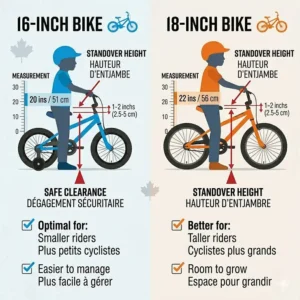
Standover height is the frame’s top tube height where your child straddles the bike with one leg on each side, both feet flat on ground. There should be 2.5-5 cm (1-2 inches) clearance between the top tube and your child’s crotch for safety—critical when they jump off suddenly or lose balance.
Seat height is the adjustable saddle position, measured from the centre of the pedal spindle at lowest position to the top of the saddle. This changes as your child grows; standover height never changes.
Many Canadian parents focus entirely on seat height ranges (18-23 inches, 20-25 inches) and forget to check standover. This creates a dangerous situation: your child can sit on the bike with feet touching the ground when the seat is lowered completely, so you think the fit is perfect. But when they stand over the bike (dismounting, stopping on a hill, or catching balance), the top tube jams painfully into their crotch with zero clearance.
Bike manufacturers don’t always publish standover height, frustrating Canadian buyers shopping online. If specs aren’t available, calculate conservatively: your child’s inseam minus 2-3 inches gives maximum safe standover height. For a child with 20-inch inseam, seek bikes with 17-18 inch standover maximum.
How to Choose the Right Bike Size in 5 Steps: Canadian Edition
Step 1: Measure accurately. Get your child’s current inseam and height using the wall-and-book method described above. Do this in riding clothes (light pants, sneakers) not pyjamas or winter wear. Write it down—you’ll reference these numbers constantly.
Step 2: Assess riding experience. Is this their first pedal bike after a balance bike? Did they use training wheels? Are they confident or timid? First-timers need bikes where minimum seat height equals or is less than inseam. Experienced riders can handle minimum seat heights up to 2 inches above inseam.
Step 3: Consider your local terrain. Flat prairies (Saskatchewan, Manitoba lowlands) allow larger bikes because stopping doesn’t require instant foot-down stability. Hilly regions (BC’s North Shore, Calgary’s river valleys, Hamilton’s escarpment) demand conservative sizing where kids can plant feet confidently on slopes.
Step 4: Factor in Canadian seasonality. Buying in spring with plans to ride through fall? Choose a bike that fits excellently right now. Your child will grow 5-8 cm throughout the riding season anyway—starting with proper fit is crucial. Don’t buy for next year; buy for next week.
Step 5: Verify availability and return policies. Can you get this bike in Canada without prohibitive shipping? What’s the return policy if sizing fails? For families outside major urban centres, “available on Amazon.ca with Prime” beats “perfect bike from US-only website” every time.
Proper Bike Fit for Children: The Safety Factor Canadians Overlook
Proper fit isn’t just about comfort—it’s fundamental safety, especially in Canadian cycling environments where unexpected hazards demand instant reactions. According to the Canada Safety Council, a bike that’s even slightly too large creates dangerous scenarios where children cannot control the bike effectively or stop safely.
When your child is seated on the bike with the saddle at the minimum height position, feet should reach the ground. For beginners: both feet completely flat. For intermediate riders: balls of feet touching. For advanced kids: one foot touching while leaning slightly.
Hand position matters more than most realize. When seated, your child should reach the handlebars comfortably with a slight bend in the elbows. If they’re stretching to reach or their arms are locked straight, the frame is too large. If they’re cramped with elbows severely bent, it’s too small or the stem needs adjustment.
Knee clearance during pedaling prevents the common problem of knees hitting handlebars. Watch your child pedal: at the top of the pedal stroke, there should be 5-10 cm clearance between knees and handlebars. If knees contact the bars, the bike is too small—no amount of seat adjustment fixes this.
Standover clearance was discussed above, but bears repeating for Canadian safety: 2.5-5 cm between crotch and top tube when standing over the bike. Less than 2.5 cm risks painful contact during dismounts or emergency stops. More than 5 cm typically indicates the bike is too small overall.
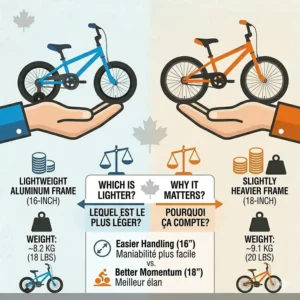
Weight ratio influences control significantly. The bike should weigh no more than 30-40% of your child’s body weight. A 20 kg child riding a 9 kg bike (45% of their weight) will struggle to start, stop, and maneuver. This explains why ultralight bikes like Woom and Prevelo provide such dramatic improvements in kids’ confidence—the weight difference of 3-4 kg (the difference between a 12-pound premium bike and a 20-pound budget bike) represents 15-20% of a small child’s body weight.
Common Mistakes When Buying Kids Bikes in Canada
Buying Too Large “To Grow Into”
This is the number-one mistake Canadian parents make, often encouraged by well-meaning grandparents who remember bikes as expensive once-per-childhood purchases. A bike that’s too large is actively dangerous. Your child can’t reach the ground to stop properly, can’t control the handlebars effectively, and builds fear instead of confidence. They avoid riding, the bike collects dust in the garage, and ironically you’ve wasted money trying to save money. Buy for the current fit, knowing Canadian kids typically outgrow bikes every 18-24 months.
Trusting Age Ranges on Labels
“Ages 4-6” bike sizing is marketing fiction. I’ve met 4-year-olds who need 16-inch bikes and 6-year-olds still perfect on 14-inch models. Children’s growth rates vary wildly—using age instead of inseam measurement is lazy and dangerous. Always measure, always verify against actual bike specifications.
Forgetting About Canadian Seasonal Storage
That bike you buy in May will sit in a garage or shed from November through April. Canadian temperature swings, moisture, and in coastal areas salt air, attack bikes aggressively. Plastic components become brittle, chains rust, and tires degrade. Better bikes with sealed bearings, quality paint, and aluminum frames survive this annual abuse cycle. The cheapest bike might save $150 up front but require replacement after one season instead of lasting through multiple children.
Ignoring Weight Differences
Parents test bikes by lifting them in the store, shrug at a 5-pound difference, and buy the heavier option to save money. Put that in child terms: would you rather carry a backpack loaded with 2 textbooks or 5 textbooks? That weight difference transforms riding from fun to frustrating. Every pound above 15-16 lbs makes the bike harder for small children to control, and in Canadian families with hills, weight becomes the difference between “I love biking!” and “This is too hard.”
Skipping the Test Ride
Online shopping is convenient, but buying a kids bike sight-unseen (and child-un-ridden) is risky. Research from Alberta Health Services indicates that while many children have the physical motor skills to ride a bicycle by age 5 or 6, the ability to judge traffic safety risks develops much later—usually between ages 10 and 14. A test ride reveals not just fit issues but also your child’s confidence level and readiness.
If possible, visit a local bike shop in your city—even if you ultimately buy online—to let your child sit on similar-sized bikes. Watch how they reach the ground, how they handle the handlebars, whether they look confident or anxious. A 10-minute test ride reveals fit problems no spec sheet catches. Many Canadian bike shops offer this service even if you explain you’re researching before buying elsewhere, especially smaller local shops that prioritize long-term customer relationships over individual sales.
Real-World Canadian Family Scenarios: Which Bike Size Wins
Scenario 1: The Edmonton Suburb Family
Meet the Chens: 5-year-old daughter Sophie, 112 cm tall, 50 cm (19.7 inch) inseam, transitioning from a balance bike. They live in suburban Edmonton with flat bike paths and a short May-to-September riding season. Budget: $200-$350 CAD.
Recommendation: Guardian 16-Inch Ethos ($300-$350 CAD). The SureStop brake system is perfect for Sophie’s transition from no brakes to hand brakes, eliminating the coaster brake confusion. The 18.5-inch minimum seat height works with her 19.7-inch inseam (she can touch ground with toes/balls of feet). The steel frame survives Edmonton winters in garage storage, and the bike will serve her through age 6-7. If she outgrows it before then, the quality ensures strong resale value ($150-$200 CAD used) to fund the next bike.
Alternative: If budget is tight, the RoyalBaby Freestyle at $180-$220 CAD delivers training wheels included and similar sizing, though expect to replace it rather than resell it.
Scenario 2: The Vancouver Island Trail Family
Meet the Patels: 6-year-old son Arjun, 118 cm tall, 53 cm (20.9 inch) inseam, experienced rider who’s outgrown his 16-inch bike. They live near Nanaimo with access to excellent gravel trails and some moderately hilly terrain. Budget: $400-$600 CAD.
Recommendation: Woom 3 (16-inch) with Automagic hub ($500-$600 CAD). Wait—a 16-inch for a kid who’s outgrown 16-inch bikes? Hear me out. The Woom 3’s maximum seat height of 25.2 inches means Arjun still fits this bike comfortably (his 20.9-inch inseam + 2 inches for experienced riders = 22.9-inch optimal seat height). The Automagic 2-speed hub handles Nanaimo’s hills beautifully. He’ll get another 12-18 months before genuinely needing a 20-inch bike. Alternatively, look for an 18-inch model from a specialty brand, but availability is limited on Vancouver Island and might require mainland shipping.
Alternative: Specialized Jett 16 (if available locally) at similar pricing with excellent trail-oriented geometry and 2-inch wide tires perfect for BC trails.
Scenario 3: The Rural Manitoba Farm
Meet the Theriaults: 7-year-old daughter Emma, 122 cm tall, 55 cm (21.7 inch) inseam, nervous rider who used training wheels until age 6. They farm near Portage la Prairie, Manitoba—flat terrain, limited bike infrastructure, gravel roads. Budget: $250-$400 CAD.
Recommendation: Schwinn Koen 18-inch variant (if available, around $250-$300 CAD) or Batch 16-Inch adjusted to maximum height ($270-$320 CAD). Emma’s nervousness means she needs excellent foot-reach despite being tall for her age. The 18-inch Schwinn (if you can source it—limited availability in rural Manitoba) provides better rollover on gravel. The Batch 16-inch maxed out at 24 inches seat height works temporarily while building confidence, then size up to 20-inch next season. Free shipping to Manitoba from Batch makes them particularly attractive for rural deliveries where Canadian Tire stock is limited.
Reality check: Emma might be better served sizing directly into a 20-inch bike if she can handle 22-inch seat height. The 18-inch gap might be unnecessary for her proportions. Test ride if possible at any Winnipeg bike shop when visiting the city.
Long-Term Cost Analysis: Budget vs. Premium Bikes in Canadian Dollars
Let’s run the actual math for Canadian families debating budget versus premium bikes:
Budget Path (Huffy/RoyalBaby):
- Initial purchase: $180-$220 CAD
- Used resale value after 18 months: $30-$50 CAD
- Net cost: $130-$190 CAD
- Durability: likely one child, minimal resale potential
- Repairs/adjustments: expect $20-$40 in tightening/brake adjustments
Mid-Tier Path (Guardian/Schwinn):
- Initial purchase: $280-$350 CAD
- Used resale value after 18-24 months: $150-$200 CAD
- Net cost: $80-$200 CAD
- Durability: easily serves 2-3 children, strong resale market
- Repairs/adjustments: minimal, maybe $10-$20
Premium Path (Woom/Prevelo):
- Initial purchase: $450-$550 CAD
- Used resale value after 24 months: $250-$350 CAD
- Net cost: $100-$300 CAD
- Durability: 3-4 children minimum, excellent resale demand
- Repairs/adjustments: essentially none, quality components last
- Trade-up programs: Prevelo’s $69 buy-in reclaims 40% value toward next bike
The surprise winner for total cost of ownership? Mid-tier bikes like Guardian or Schwinn. They avoid premium bike sticker shock while dramatically outperforming budget options in durability and resale value. Canadian cycling families on local Facebook groups and Kijiji actively seek quality used kids bikes—Guardian and Schwinn bikes sell within days of listing. Budget bikes sit for months before selling at garage-sale prices.
Premium bikes make financial sense only if you have multiple children to pass them through, or if you’re confident in resale markets (easier in Toronto, Vancouver, Calgary than in smaller cities). The performance is undeniably better, but the cost spread across one child doesn’t justify the premium for most Canadian families.
Canadian Regulations and Safety Standards for Kids Bikes
Canadian bike safety falls under provincial jurisdiction, creating a patchwork of regulations across the country. Here’s what matters for parents buying kids bikes:
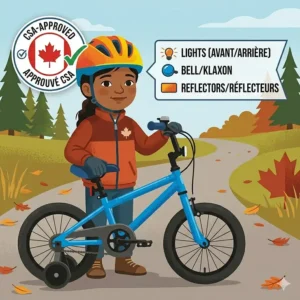
Helmet Requirements: Mandatory for riders under 18 in Alberta, Manitoba, and Ontario. All-ages helmet laws in BC, New Brunswick, Nova Scotia, PEI, and Newfoundland & Labrador. Saskatchewan, Quebec, Nunavut, and Northwest Territories have no helmet laws, though Health Canada strongly recommends helmets for all riders. According to the Canadian Paediatric Society, helmets must meet CSA (Canadian Standards Association), ANSI, Snell, or ASTM standards—look for stickers inside the helmet confirming certification.
Required Bike Equipment (Provincial Variations): All bikes must have at least one working brake capable of locking the wheel on dry, level pavement. Bikes ridden between sunset and sunrise require a white front light and red rear light/reflector (specific to provinces like Ontario, BC, Alberta). Bells or audible warning devices are required in many municipalities, though not universally enforced. Parachute, Canada’s national injury prevention organization, recommends reflectors on wheels and pedals regardless of local requirements.
CSA Bike Standards: While there’s no mandatory CSA certification for bicycles themselves sold in Canada (unlike helmets), reputable brands design to international standards that align with Canadian safety expectations. Be cautious with unknown brands shipping directly from overseas—they may not meet basic safety thresholds for brake strength, frame integrity, or component quality.
Provincial Riding Rules: Cyclists have the same rights and responsibilities as motor vehicle drivers in all provinces. Kids must ride on the right side of roads (except on two-way bike paths), obey traffic signals, and signal turns. Many municipalities ban sidewalk riding except for children under specific ages (varies widely—Ottawa allows kids under 10, Calgary under 14, Vancouver has no specific age exemption). Parents should check local bylaws through their municipal website or police service.
FAQs: 16 Inch vs 18 Inch Bikes for Canadian Kids
❓ Can my 4-year-old ride a 16 inch bike in Canadian winters?
❓ How long will my child use a 16 inch bike before outgrowing it?
❓ Are 18 inch bikes available at Canadian Tire or Walmart?
❓ What's better for Canadian gravel paths—16 or 18 inch wheels?
❓ Do kids bikes need winter storage preparation in Canada?
Conclusion: Making Your Final Choice Between 16 and 18 Inch Bikes
The 16 inch vs 18 inch bike for kids decision ultimately comes down to your specific child’s measurements and your family’s circumstances. For most Canadian families, the 16-inch bike represents the reliable choice—widely available, extensively tested across diverse brands and price points, and perfectly matched to the 4-6 year age bracket when kids typically learn pedal biking.
The 18-inch bike shines in specific scenarios: taller-than-average kids whose inseam measurements fall in that transitional 20-22 inch range; families wanting to extend the usable life between 16-inch and 20-inch purchases; children who need an intermediate step due to confidence issues or developmental considerations. But accessing quality 18-inch bikes in Canada requires more effort, often meaning online ordering from specialty brands rather than walking into Canadian Tire or your local bike shop.
Here’s my final advice after testing bikes with dozens of Canadian families across different provinces and terrain types: measure your child’s inseam accurately, prioritize proper fit over maximizing growth potential, and invest in the best quality you can afford within your budget. The difference between a $180 budget bike and a $350 mid-tier option is profound in real-world Canadian usage—better components survive our harsh seasonal storage, lighter weight transforms your child’s confidence, and superior resale value recovers much of your initial investment.
If you’re uncertain about sizing, err on the side of proper fit now rather than future growth. A bike that’s slightly too small for 6 months is infinitely better than one that’s too large for an entire season. Canadian kids only get 5-6 months of riding weather—make every month count with equipment they can actually control and enjoy.
The memories you’re building—those first successful rides without training wheels, the family bike paths through provincial parks, the evening loops around the neighbourhood—matter far more than maximizing theoretical usable years from a bike. Choose the size that puts a smile on your child’s face this May, not the one that might fit them next September.
Recommended for You
- 7 Best Training Wheel Bikes for 5 Year Olds 2026 (Canada)
- Razor vs Gotrax Kids Scooter: 7 Best Canadian Picks 2026
- 7 Best Electric Scooter 10 mph for Kids Canada 2026 Guide
Disclaimer: This article contains affiliate links. As an Amazon Associate, I earn from qualifying purchases. If you purchase products through these links, we may earn a small commission at no additional cost to you.
✨ Found this helpful? Share it with your friends! 💬🤗
