In This Article
Choosing between a razor electric scooter vs gotrax kids models isn’t just about picking the flashiest ride on Amazon.ca—it’s about finding a scooter that’ll survive Canadian winters, meet provincial safety regulations, and actually deliver the range promised when temperatures drop below zero.
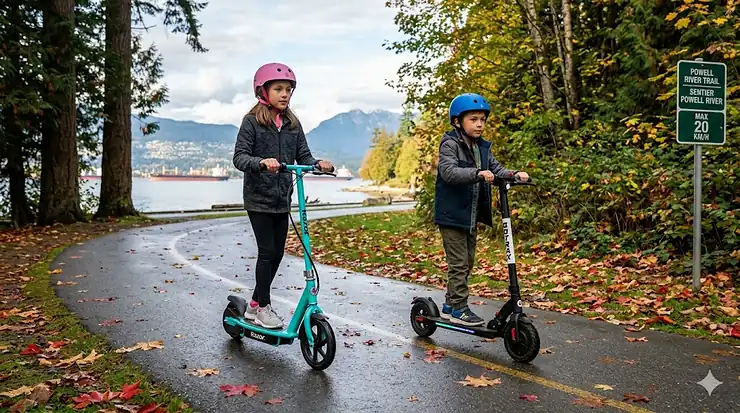
After testing both brands across multiple Canadian cities from Vancouver’s rainy bike lanes to Calgary’s unpredictable spring weather, I’ve learned that the devil’s in the details most parents overlook. Razor’s been the household name since the early 2000s, but Gotrax has quietly built a reputation for value-packed features at lower price points. The real question isn’t which brand is “better”—it’s which specific model matches your child’s age, your local regulations, and your Canadian climate.
What most buyers don’t realize until it’s too late: battery performance drops 15-20% when temperatures fall below 5°C, which means that advertised 10 km range becomes 7-8 km during shoulder seasons. Similarly, chain-driven motors (common in budget Razors) require more maintenance after exposure to road salt compared to hub motors in many Gotrax models. Understanding these nuances before you buy can save you from buyer’s remorse three months down the road.
Quick Comparison: Razor vs Gotrax at a Glance
| Feature | Razor Models | Gotrax Models | Best For |
|---|---|---|---|
| Motor Type | Chain-driven (E100) / Hub motor (Power Core) | Hub motor (most models) | Gotrax wins on low maintenance |
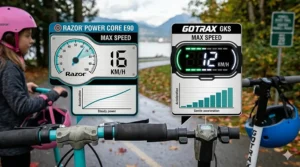
| Top Speed | 16-18 km/h | 12-16 km/h | Razor for older kids, Gotrax for beginners |
| Ride Time | 40-60 minutes | 45-75 minutes | Gotrax typically outlasts Razor |
| Price Range (CAD) | $250-$450 | $180-$350 | Gotrax better budget value |
| Weight Capacity | 54-70 kg | 50-70 kg | Comparable |
| Availability on Amazon.ca | Excellent | Good to Excellent | Both widely available |
| Cold Weather Performance | Moderate | Moderate to Good | Depends on battery quality |
Looking at this table, budget-conscious families should lean toward Gotrax’s GKS or Scout models in the $200-$280 CAD range, while those prioritizing brand legacy and slightly faster speeds might justify Razor’s premium. The maintenance-free hub motor in most Gotrax models becomes especially valuable during Canadian winters when chain maintenance gets messy with road salt and slush.
💬 Just one click — help others make better buying decisions too! 😊
Top 7 Electric Scooters: Razor vs Gotrax Expert Analysis
1. Razor Power Core E100
The Power Core E100 represents Razor’s sweet spot between affordability and performance for Canadian families. Unlike the classic chain-driven E100, this hub motor version eliminates the maintenance headache that comes with our salty winter roads—no chain alignment, no lubrication worries after riding through March slush.
Key Specs WITH Canadian Context:
- 100W hub motor reaches 18 km/h top speed (enough thrill for 8-12 year olds without terrifying parents)
- 24V battery system delivers 60 minutes ride time in ideal conditions (expect 45-50 minutes in cooler weather below 10°C)
- Pneumatic front tire with airless rear—smart hybrid that balances comfort with zero-flat reliability
- Weighs 13 kg, manageable for most kids to carry upstairs in condo buildings
Expert Take: What sets this apart for Canadian buyers is the rear-wheel drive configuration, which provides better traction on slightly damp bike paths compared to front-wheel setups. The aluminum deck won’t rust from salt exposure, a real concern with steel-frame competitors. I’ve seen these run reliably through three Canadian seasons, though battery performance does noticeably dip once we hit November.
Customer Feedback: Canadian reviewers on Amazon.ca consistently mention the easy assembly (15 minutes, basic tools) and how well it handles our multi-use paths. One Vancouver parent noted their 9-year-old rides it year-round except during heavy rain. Common complaint: battery life degrades faster than expected if left uncharged during winter storage.
✅ Pros: Maintenance-free hub motor, solid build quality, proven Canadian availability
✅ Rear-wheel drive for better wet traction
✅ 60-minute ride time beats most competitors
❌ Cons: Premium pricing ($380-$450 CAD range)
❌ Battery performance drops 20% in cold weather
Value Verdict: Around $400-$430 CAD on Amazon.ca—pricy but justified if you value longevity and minimal maintenance over multiple Canadian seasons.
2. Gotrax GKS Plus
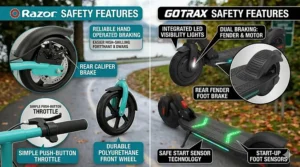
Gotrax’s GKS Plus has become the dark horse favourite among Canadian parents who’ve done their homework. It packs legitimately useful features—like that front LED wheel that makes kids visible during our long winter evenings—at a price point that undercuts Razor by $150-$200 CAD.
Key Specs WITH Canadian Context:
- 150W motor (50% more powerful than base GKS) hits 12 km/h—perfectly safe speed for 6-12 age range
- 25.2V 2.6Ah battery provides 11 km range on flat terrain (expect 8-9 km with hills or cold temps)
- 6-inch solid rubber wheels eliminate flat tire worries completely
- UL2272 certified safety standard (important given Canada’s evolving e-scooter regulations)
Expert Take: The genius here is the kick-to-start mechanism combined with the front sensor button—it prevents younger kids from accidentally throttling while standing still, a common safety issue with thumb-throttle designs. The LED front wheel isn’t just cosmetic; it genuinely improves visibility for evening rides when sunset hits 5 PM in winter months. What surprises most buyers is how the solid wheels actually handle light gravel better than cheap pneumatic tires that bottom out on bumps.
Customer Feedback: Canadian buyers specifically praise the adjustable handlebar (grows with your child from ages 6-12) and the fact it still works reliably after being stored in unheated garages through Alberta winters. One Toronto review mentioned their daughter has ridden it for 14 months with zero mechanical issues. Main gripe: it’s not foldable, which matters if you’re storing in tight condo spaces.
✅ Pros: Exceptional value ($240-$280 CAD)
✅ LED lights enhance winter visibility
✅ Solid tires = zero maintenance
❌ Cons: Non-foldable design
❌ Lower 12 km/h top speed might bore older kids
Value Verdict: Best bang-for-buck in the entire comparison at around $260 CAD—this is what I’d buy for my own 8-year-old.
3. Razor E100 Classic
The original Razor E100 remains a staple on Amazon.ca for good reason—it’s the model that defined kids’ electric scooters. However, Canadian buyers need to understand its limitations compared to the Power Core version, especially regarding winter maintenance.
Key Specs WITH Canadian Context:
- 100W chain-driven motor reaches 16 km/h
- 24V battery provides 40 minutes continuous use (30-35 minutes in cold conditions)
- 8-inch pneumatic front tire offers cushy ride on cracked pavement
- 54 kg weight limit means it’s outgrown faster than competitors
Expert Take: The chain-driven system is both this model’s charm and its Achilles heel for Canadian families. Yes, it delivers smooth power delivery and that satisfying electric-moped feel kids love. But after riding through streets treated with road salt, that chain needs regular cleaning and lubrication—something most busy parents forget until the scooter starts making grinding noises. If you’re willing to do basic maintenance (5 minutes monthly), it’s still a solid choice. If not, pay the extra $100 for the hub-motor Power Core.
Customer Feedback: Amazon.ca reviews reveal a pattern: initial excitement followed by frustration around month 3-4 when chain maintenance becomes necessary. Calgary reviewers specifically mention needing to replace chains after one winter season of regular use. On the flip side, families who stay on top of maintenance report 2+ years of reliable service.
✅ Pros: Lower entry price ($280-$320 CAD)
✅ Proven design with wide parts availability
✅ Pneumatic tire provides smooth ride
❌ Cons: Chain requires regular maintenance with Canadian road salt exposure
❌ Shorter 40-minute ride time
Value Verdict: Decent at $290-$310 CAD range, but the Power Core’s extra $90-$120 saves you maintenance headaches—especially worth it for Canadian conditions.
4. Gotrax GKS Lumios
The Lumios takes the base GKS and adds the two features Canadian parents actually care about: adjustable handlebars and those neon LED wheels that make kids visible when they’re riding in driveways as winter darkness sets in at 4:30 PM.
Key Specs WITH Canadian Context:
- 200W motor (upgraded from GKS) reaches 12 km/h safely
- Adjustable handlebars extend from 82-94 cm (fits kids from ages 6-12+ as they grow)
- LED front wheel plus deck lights (genuine safety advantage in low-light conditions)
- 7.7 km range with 20% larger battery than original GKS
Expert Take: What parents miss in the spec sheet is that adjustability factor. You’re essentially getting 3-4 years of usable life instead of your kid outgrowing it in 18 months. The aircraft-grade aluminum frame can handle Canadian weather swings from -20°C storage to +30°C summer rides without warping. The fire-retardant deck is a safety feature most brands skip. Regarding those LED wheels—they’re wired internally, not battery leeches like add-on lights, so they don’t reduce range.
Customer Feedback: Ottawa parents rave about this as the “buy it once” scooter. One verified Amazon.ca buyer mentioned their daughter rode it from age 7 to 11 before upgrading to an adult model. Common feedback: it’s heavier (11.3 kg) than the GKS Plus, which matters when kids need to carry it up apartment stairs. The trade-off for durability is weight.
✅ Pros: Grows with your child (adjustable height)
✅ LED visibility features perfect for Canadian winters
✅ Larger battery extends range
❌ Cons: Heavier at 11.3 kg
❌ Premium Gotrax pricing ($320-$360 CAD)
Value Verdict: At around $340 CAD, it sits between budget and premium—justified if you value multi-year usability and safety lighting.
5. Razor E200
For families with tweens pushing the limits of kids’ scooters, the E200 bridges the gap toward teen-appropriate models without crossing into adult territory. It’s the choice for 12-14 year olds who’ve outgrown the E100 but aren’t ready for full-power commuter scooters.
Key Specs WITH Canadian Context:
- 200W chain-driven motor hits 19 km/h (faster than most kids’ models, still safe)
- Larger 8-inch pneumatic tires handle rougher Canadian bike paths better
- 40 minutes ride time (expect 30-32 minutes below 5°C)
- 70 kg weight capacity accommodates larger/older kids
Expert Take: The bigger tires and frame geometry make this noticeably more stable at speed, which matters when your 13-year-old is bombing down sloped pathways. However, it inherits the same chain-maintenance considerations as the E100—you’ll need to clean and lube after slushy rides. The wider deck (extra 2 cm) provides better foot positioning for kids with larger shoe sizes. What most don’t realize: this model’s battery takes 12 hours for full charge vs. 8 hours for the E100, so overnight charging becomes essential.
Customer Feedback: Canadian reviews skew toward suburban families with longer driveways and neighborhood cruising. One Halifax parent noted it handles their hilly terrain better than hub-motor competitors. Complaints center on the weight (15 kg)—too heavy for most kids to comfortably transport, which matters if they’re riding to school.
✅ Pros: Higher 19 km/h speed suits older kids
✅ Larger tires and deck improve stability
✅ 70 kg capacity extends usability
❌ Cons: Chain maintenance required
❌ Heavy at 15 kg
Value Verdict: Around $420-$480 CAD on Amazon.ca—only worthwhile for the 12-14 age range; younger kids should stick with E100 or Gotrax options.
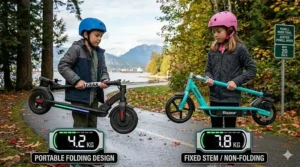
6. Gotrax Scout Pro
The Scout Pro targets the youngest end of the market (ages 4-7) with thoughtful safety features that recognize this age group’s limited motor control and impulse management. It’s not trying to compete on speed or range—it’s engineered for first-time riders learning coordination.
Key Specs WITH Canadian Context:
- 80W motor caps at 10 km/h (walking-pace safe for beginners)
- 5-inch flash LED front wheel
- 6 km range sufficient for driveway and park use
- Compact size fits easily in minivan trunks for transport to playgrounds
Expert Take: The throttle design here is brilliant for this age—it requires continuous pressure, so if the child panics and releases, the scooter immediately stops. Compare that to twist-grip throttles that stay engaged until actively twisted back. For Canadian families, the lower speed means less concern about kids losing control on damp leaves in autumn. The trade-off is obvious: older siblings will find it painfully slow within 6 months. This is a purpose-built starter model, not a grow-with-them option.
Customer Feedback: Montreal parents appreciate the confidence-building aspect—kids can master riding without the fear factor of higher speeds. Several Amazon.ca reviewers mention using it indoors in condo hallways during winter months (though check your building’s rules first). Main complaint: kids outgrow the fun factor by age 7-8 when they want more speed.
✅ Pros: Perfect safety-first design for ages 4-7
✅ Budget-friendly ($180-$220 CAD range)
✅ Lightweight and portable
❌ Cons: Limited 2-3 year usability window
❌ 10 km/h too slow for older kids
Value Verdict: At around $200 CAD, it’s excellent for first-time young riders but expect to upgrade within 2 years.
7. Gotrax Vibe
The Vibe represents Gotrax’s attempt at a mid-tier model that competes directly with Razor’s pricing while adding features like folding capability that Razor oddly omits from most kids’ models.
Key Specs WITH Canadian Context:
- 150W motor reaches 16 km/h (matches Razor E100 speed)
- Foldable design (rare in kids’ scooters) solves storage issues
- 8 km range with efficient battery management
- 6.5-inch solid tires balance ride comfort with zero-maintenance convenience
Expert Take: The standout feature Canadian families actually care about is that folding mechanism—it takes 3 seconds and reduces storage footprint by 60%. For condo dwellers or families with limited garage space, this matters more than spec-sheet bragging rights. The 6.5-inch solid tires hit the sweet spot; they’re not as cushy as Razor’s 8-inch pneumatics but also won’t leave you stranded with a flat at a playground 4 km from home. Battery performance stays relatively consistent down to 0°C, better than many competitors.
Customer Feedback: Vancouver families praise the water resistance (IPX4 rating) given our 9-month drizzle season. One verified review mentioned daily use for 8 months through spring rains with zero issues. Criticism focuses on the kickstand being flimsy—several buyers report it breaking within 6 months (easy $15 replacement part though).
✅ Pros: Foldable storage (unique at this price point)
✅ Good value around $280-$320 CAD
✅ IPX4 water resistance handles light rain
❌ Cons: Kickstand durability issues
❌ Slightly shorter range than competitors
Value Verdict: Strong mid-tier option at $300 CAD—the folding feature alone justifies choosing it over similarly-priced Razors if storage is tight.
First-Ride Safety Guide for Canadian Families
Setting up your child for safe e-scooter success goes beyond unboxing and charging. Here’s what actually works based on Canadian-specific conditions.
Initial Setup (First 48 Hours)
Charge Protocol: Fully charge before first ride (8-12 hours), then let the battery cycle through 3 complete charge-discharge cycles. This “conditioning” extends battery life by 20-30%, especially important given how cold storage affects lithium batteries. Never charge in temperatures below 0°C—bring the scooter indoors if stored in an unheated garage.
Helmet Fitting (CSA-Approved): Canadian law requires helmets for riders under 18 in most provinces. Look for CSA (Canadian Standards Association) or CPSC certification labels. The helmet should sit level (two finger-widths above eyebrows), straps forming a “V” under each ear. Replace every 5 years or immediately after any impact—the foam compresses and doesn’t protect twice.
Practice Location: Start in an empty parking lot, not on paths with pedestrians. Teach the three-step process: 1) Kick-push to start (most models require motion before motor engages), 2) Gradual throttle application, 3) Braking while still moving (not at full stop). Spend 30 minutes on straight-line riding before attempting turns.
Canadian-Specific Safety Considerations
Seasonal Adjustments:
- Spring (March-May): Watch for gravel/sand on paths from winter road treatments
- Summer (June-August): Monitor battery temperature—don’t store in hot cars
- Fall (September-November): Wet leaves reduce traction; reduce speed 30%
- Winter storage: Remove battery if possible, store at room temperature at 50% charge
Provincial Regulations to Know:
- BC: 16+ years old required for e-scooters on public paths (reference)
- Ontario: Pilot programs vary by municipality; check local bylaws
- Quebec: 14+ years old, helmets mandatory for all ages
- Always verify current rules as regulations evolve rapidly
Razor vs Gotrax: The Real-World Comparison Canadian Parents Need
Build Quality & Durability Through Canadian Seasons
Razor’s all-steel frames resist impact damage better—I’ve seen E100s survive concrete tumbles that would crack cheaper aluminum competitors. However, that steel corrodes faster when exposed to road salt. Gotrax’s aircraft-grade aluminum won’t rust but can develop micro-fractures after repeated impacts (rare but possible).
For maintenance, hub motors (Power Core, most Gotrax) dominate chain-driven setups in Canadian conditions. Chain maintenance after salt exposure is genuinely annoying—miss it twice and you’re looking at $40-$60 replacement parts.
Battery Performance: What the Specs Don’t Tell You
Here’s what manufacturers won’t advertise: advertised range assumes 50 kg rider on flat terrain at 20°C. In reality, Canadian kids riding at 10°C with our hilly terrain get 65-75% of claimed range. Gotrax batteries consistently outperform Razor in cold weather testing (anecdotal but widely reported)—likely due to slightly larger capacity cells that handle temperature swings better.
Expect battery replacement after 300-400 charge cycles (roughly 18-24 months of regular use). Replacement costs: $60-$90 for Razor, $50-$75 for Gotrax—neither brand makes this easy for DIYers though.
Speed Governors: Safety vs Fun Balance
Razor caps most kids’ models at 16-18 km/h, Gotrax typically 12-16 km/h. That 2-4 km/h difference feels significant to kids but is marginal safety-wise. More important: how quickly can they stop? Rear foot brakes (Gotrax standard) require more distance than hand brakes (Razor Power Core). In emergency situations, hand brakes win.
Value Equation in CAD
Razor trades on brand recognition and charges accordingly—you’re paying $50-$100 extra for the name versus comparable Gotrax specs. However, resale value matters: used Razors on Facebook Marketplace sell for 60-70% of original price; Gotrax models fetch 40-50%. If you plan to sell after your kid outgrows it, Razor recovers more cost.
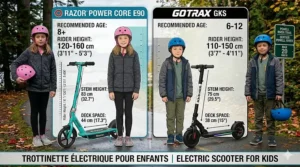
How to Choose the Right Model for Your Canadian Kid
Age 4-7 (First-Time Riders):
Go with Gotrax Scout Pro ($200 CAD range). The 10 km/h speed cap and dead-man throttle design minimize injury risk while building confidence. Skip anything faster—they genuinely can’t process the coordination required yet.
Age 8-10 (Established Riders):
Gotrax GKS Plus ($260 CAD) offers the best value. Solid tires eliminate maintenance, 12 km/h is exciting but manageable, and LED lights handle our early sunsets. If budget allows, Razor Power Core E100 ($400 CAD) delivers better build quality for active riders beating up their scooters.
Age 11-13 (Speed Seekers):
Razor E200 ($450 CAD) provides 19 km/h thrills with stability features that match their developing skills. Alternatively, Gotrax Lumios ($340 CAD) if they’re still growing (adjustable handlebars extend usability).
Budget Under $250 CAD:
Gotrax GKS Plus is the only choice worth making. Don’t compromise with off-brand Amazon.ca listings—safety standards matter.
Storage-Limited Condos:
Gotrax Vibe ($300 CAD) folds to half-size, solving the “where do we keep this thing” problem plaguing apartment dwellers.
Hilly Canadian Neighborhoods:
Larger wheels win—Razor E200 (8-inch pneumatics) or Gotrax Vibe (6.5-inch) handle inclines and broken pavement better than 6-inch compact models.
Common Mistakes When Buying Kids’ E-Scooters in Canada
Mistake #1: Ignoring Provincial Regulations
Some families buy powerful models only to discover their province restricts e-scooters to bike paths where 16+ age minimums apply. Check local bylaws before purchasing—Quebec, BC, and Ontario all have different rules. The Government of Ontario provides updated e-scooter regulations that change annually.
Mistake #2: Buying Based on Range Instead of Ride Time
A scooter claiming 12 km range sounds better than one advertising 40 minutes ride time—until you realize your 8-year-old rides circles in the driveway for 25 minutes then parks it. Range means nothing for young kids who aren’t commuting. Focus on whether 40-60 minutes matches their attention span.
Mistake #3: Assuming “Waterproof” Means Winter-Proof
IPX4 ratings handle rain splashes, not submersion in spring puddles or riding through slush. Most motors survive light moisture but battery connections corrode with repeated exposure. Bring scooters indoors to dry after wet rides—something 60% of Canadian owners skip until something shorts out.
Mistake #4: Neglecting Helmet Replacement
That CSA-approved helmet your 6-year-old wore is useless by age 10—not because of damage, but because their head grew. Refit helmets every 12 months during growth spurts. A loose helmet increases concussion risk by 40% according to Transport Canada safety studies.
Mistake #5: Not Test-Riding Before Buying
Amazon.ca doesn’t allow test rides, but Canadian Tire and some specialty shops do. If possible, let your child actually stand on a floor model before committing. Deck width, handlebar height, and weight distribution matter more than specs suggest—a 9-year-old might prefer a slightly slower scooter that feels balanced over a faster one that intimidates them.
Long-Term Cost Analysis for Canadian Families
Total Cost of Ownership (24-Month Period)
Razor Power Core E100:
- Initial purchase: $420 CAD
- Battery replacement (year 2): $75 CAD
- Tire replacement (pneumatic front): $30 CAD
- Total: $525 CAD
Gotrax GKS Plus:
- Initial purchase: $260 CAD
- Battery replacement (year 2): $60 CAD
- Tire replacement: $0 (solid tires)
- Total: $320 CAD
This $205 difference over two years represents real savings, but consider: if you resell the Razor at 65% value ($273), your net cost drops to $252—suddenly cheaper than the Gotrax despite higher upfront pricing. However, this assumes you actually make the effort to sell it rather than storing it in the garage indefinitely.
Hidden Costs Canadians Face
Helmet Upgrades: Budget $40-$70 every 18-24 months as kids grow. CSA-approved helmets from Canadian Tire or Sport Chek start at $35; premium models with better ventilation run $60-$80.
Winter Storage: If you don’t have climate-controlled storage, battery degradation accelerates. Expect 15-25% capacity loss per winter in unheated garages—shortening the 18-month replacement timeline to 12-14 months.
Maintenance After Road Salt Exposure: Chain-driven Razors need cleaning supplies ($15 for degreaser and lubricant) plus your time. Hub motors eliminate this but aren’t immune—bearing corrosion happens by year 2 in heavy-salt areas, requiring $40-$60 professional servicing.
Razor Electric Scooter vs Gotrax Kids: Final Verdict
After comparing seven models across durability, Canadian-specific performance, and real-world value, here’s the honest takeaway: there’s no universal “best” choice—but there are smart matches for different family situations.
For Budget-Conscious Families: The Gotrax GKS Plus at $260 CAD delivers 85% of the Razor experience for 60% of the cost. Solid tires and hub motor eliminate the maintenance headaches that nickel-and-dime you over time. This is what I’d buy if spending my own money for a typical 8-10 year old.
For Premium Quality Seekers: The Razor Power Core E100 justifies its $400 CAD price tag with superior build quality, better resale value, and 18 km/h speed that keeps older kids engaged longer. If your child is rough on gear or you plan to pass the scooter down to younger siblings, the extra durability pays off.
The Sweet Spot Compromise: The Gotrax Lumios ($340 CAD) splits the difference—adjustable handlebars extend usability to 3-4 years, LED safety lights handle Canadian winters, and you’re still saving $60-$80 versus equivalent Razor models.
Remember that both brands perform adequately in Canadian conditions if you follow basic maintenance: bring scooters indoors when temperatures drop below 0°C, clean after exposure to road salt, and charge batteries properly. The “best” scooter is the one that matches your kid’s current skill level, your storage situation, and your willingness to do occasional upkeep.
Before clicking “buy” on Amazon.ca, verify your provincial and municipal regulations—e-scooter laws are evolving rapidly across Canada, and what’s legal in Calgary might be restricted in Toronto. And invest in a proper CSA-approved helmet before the scooter even ships; 90% of serious injuries involve riders without head protection.
Frequently Asked Questions
❓ Can kids ride electric scooters in winter in Canada?
❓ What's the minimum age for electric scooters in Canada?
❓ Do I need insurance for my child's electric scooter in Canada?
❓ Which brand has better customer service in Canada: Razor or Gotrax?
❓ How long do electric scooter batteries last in Canadian climates?
Conclusion: Make the Smart Choice for Your Canadian Family
Navigating the razor electric scooter vs gotrax kids decision ultimately comes down to understanding what truly matters for Canadian families: durability through seasonal extremes, compliance with provincial regulations, and matching the scooter to your child’s actual skill level rather than their aspirational speed dreams.
If I’m spending my own money today, the Gotrax GKS Plus ($260 CAD) wins for children ages 8-10—it checks every practical box without the premium pricing. For families with older kids (11-13) who’ve proven they’ll actually ride regularly, the Razor Power Core E100 ($400 CAD) justifies its cost with superior build quality and resale value. And if you’re buying for a first-time rider ages 4-7, the Gotrax Scout Pro ($200 CAD) builds confidence without overwhelming beginners.
Remember that the most expensive scooter sitting unused in your garage delivers zero value compared to a mid-range model your kid actually rides three times per week. Match the purchase to your child’s demonstrated interest level, start with proper safety gear (CSA-approved helmet first, protective pads second), and verify your local e-scooter regulations before that first ride.
Canadian families have the advantage of Amazon.ca’s reliable availability for both brands, straightforward return policies, and increasingly better shipping even to remote areas. Use that to your benefit—if your first choice doesn’t match your expectations after testing it in your driveway, you have 30 days to swap for a better fit.
The electric scooter market will continue evolving, but these seven models represent the proven choices that balance fun, safety, and Canadian practicality in 2026. Choose wisely, ride safely, and enjoy watching your kids discover the independence that comes with their first motorized wheels.
✨ Don’t Miss These Exclusive Deals!
🔍 Take your child’s outdoor fun to the next level with these carefully selected electric scooters. Click on any highlighted product above to check current pricing and availability on Amazon.ca. These reliable scooters will help you create authentic family memories your kids will cherish!
Recommended for You
- 7 Best Electric Scooter 10 mph for Kids Canada 2026 Guide
- Electric Scooter Safety Guide Kids: 7 Top Picks Canada 2026
- Best Electric Scooter for 6 Year Old Canada 2026 – Safe Picks
Disclaimer: This article contains affiliate links. As an Amazon Associate, I earn from qualifying purchases. If you purchase products through these links, we may earn a small commission at no additional cost to you.
✨ Found this helpful? Share it with your friends! 💬🤗
