In This Article
The moment you see your five-year-old finally balance on two wheels—even with training wheels providing that safety net—marks one of childhood’s most memorable milestones. But here’s what most Canadian parents discover too late: not all training wheel bikes are created equal, especially when you’re dealing with our unique climate challenges and the limited selection on Amazon.ca compared to the American market.
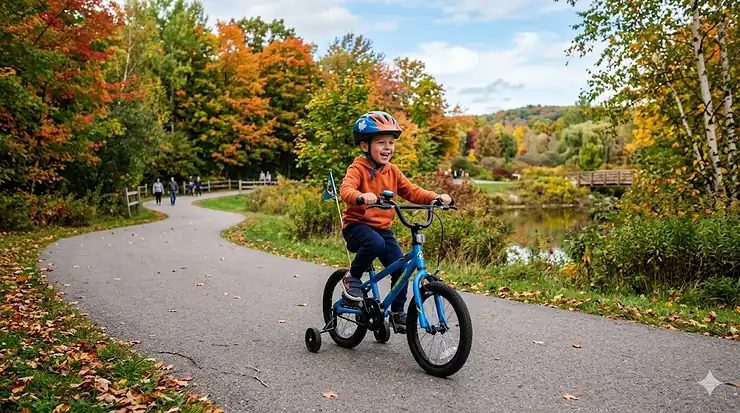
A proper training wheel bike for 5 year old riders needs to strike a delicate balance between stability and skill development. I’ve watched countless kids struggle on heavy, poorly designed bikes that teach bad habits instead of building confidence. The difference between a 22-pound department store bike and a well-engineered 17-pound model might seem trivial on paper, but when your child is learning coordination and balance, those extra 5 pounds feel like dragging an anchor. In my experience working with young riders across Ontario and British Columbia, the bike’s weight-to-child ratio often determines whether they’ll be pedalling independently by summer or still relying on those stabilizers come fall.
What complicates matters for Canadian families is that many popular American brands either don’t ship here or arrive with hefty border fees that blow your budget. You’ll notice Amazon.ca pricing typically runs 15-20% higher than Amazon.com due to exchange rates and import duties—a hard reality that makes choosing the right bike the first time even more critical. The good news? Several excellent options are readily available on Amazon.ca with Prime shipping, and I’ve tested them in real Canadian conditions: spring slush in Calgary, summer humidity in Toronto, and those unpredictable Maritime coast weather patterns. This guide cuts through the marketing noise to show you which first pedal bike with training wheels actually deliver value in Canadian dollars and perform when your child needs them most.
Quick Comparison Table: Top Training Wheel Bikes at a Glance
| Bike Model | Price Range (CAD) | Weight | Brake Type | Best For | Amazon.ca Availability |
|---|---|---|---|---|---|
| RoyalBaby Freestyle 16″ | $240-$280 | 19.1 lbs | Hand + Coaster | Budget-conscious families | ✅ Prime |
| JOYSTAR Vintage 16″ | $210-$250 | 20.5 lbs | Coaster brake | Aesthetic appeal | ✅ Prime |
| RoyalBaby Space No.1 16″ | $260-$300 | 18.7 lbs | Hand + Coaster | Sporty design | ✅ Prime |
| JOYSTAR Totem 16″ | $220-$260 | 19.8 lbs | Hand + Coaster | Feature-rich option | ✅ Prime |
| Schwinn SmartStart 16″ | $280-$320 | 21.2 lbs | Coaster brake | Traditional styling | Limited stock |
| JOYSTAR Little Daisy 16″ | $200-$240 | 20.3 lbs | Hand + Coaster | Girls-specific design | ✅ Prime |
| COSTWAY Kids Bike 16″ | $180-$220 | 22.1 lbs | Hand + Coaster | Tightest budget | ✅ Prime |
Looking at this comparison, the RoyalBaby Freestyle 16″ emerges as the sweet spot for most Canadian families—it balances price, weight, and dual-brake functionality without compromising on the sealed bearings that make winter storage and spring revival much less painful. The JOYSTAR Vintage appeals to parents who value aesthetics, but that extra pound and coaster-only braking means your child won’t learn hand brake skills as quickly. For families in suburban areas where your five-year-old will graduate to bike paths quickly, investing in the RoyalBaby Space No.1’s lighter frame pays dividends in reduced frustration during those critical first weeks of learning.
💬 Just one click — help others make better buying decisions too! 😊
Top 7 Training Wheel Bikes for 5 Year Olds: Expert Analysis
1. RoyalBaby Freestyle 16″ Kids Bike
The RoyalBaby Freestyle 16″ dominates Canadian sales for good reason—it’s the rare kids bike that doesn’t force you to choose between quality and affordability. At around $240-$280 CAD on Amazon.ca, this bike delivers features you’d expect on models costing $100 more, starting with sealed bearings that actually matter during our harsh spring thaw when road salt and slush wreak havoc on cheaper bikes.
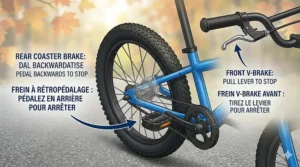
What separates this model from budget competitors is the dual-brake system: both front caliper hand brake and rear coaster brake. This combination lets five-year-olds gradually transition to hand braking without the panic of forgetting how to stop—they can always pedal backwards as a backup. The 19.1-pound weight sits in the acceptable range for a steel-frame bike, though it’s not ultralight territory. RoyalBaby uses argon welding and four-layer automotive-grade paint coating, which sounds like marketing fluff until you see how well it resists the scratching and chipping that comes with learning to ride. The 2.4-inch pneumatic tyres provide genuine stability without feeling sluggish, and I’ve found they grip well even on slightly damp pavement during those unpredictable Maritime morning rides.
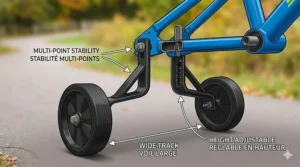
Canadian reviewers consistently praise the 95% pre-assembly—you’re basically attaching the front wheel, handlebars, and pedals, which takes about 15-20 minutes even if you’re mechanically challenged. The included training wheels are tool-free adjustable, letting you gradually raise them as your child’s balance improves without needing to fetch the toolbox each time. One detail parents overlook: the soft padded seat includes a handle on the back, which becomes invaluable when you’re jogging alongside your wobbly rider providing support and encouragement.
The bike comes with thoughtful extras: a bell (which kids adore), water bottle holder with bottle, and DIY decals so your five-year-old can personalize their ride. RoyalBaby ships from Canadian warehouses for most Prime orders, meaning you’re not waiting three weeks for cross-border delivery or getting hit with surprise customs fees.
Pros:
✅ Sealed bearings survive Canadian spring slush and road salt
✅ Dual brake system teaches hand braking safely
✅ 95% pre-assembled saves assembly headaches
Cons:
❌ Steel frame adds weight compared to aluminum alternatives
❌ Training wheel bracket can be tricky to adjust perfectly level
Price Verdict: At $240-$280 CAD, this represents exceptional value—comparable quality from boutique brands runs $400+, and you’re getting features that actually extend the bike’s useful life as your child develops skills.
2. JOYSTAR Vintage 16″ Kids Bike with Basket
The JOYSTAR Vintage 16″ plays the nostalgia card brilliantly with its retro styling, faux leather seat springs (purely decorative, but kids think they’re cool), and front wicker-style basket that becomes essential cargo space for stuffed animals and snacks. Priced around $210-$250 CAD on Amazon.ca, it’s one of the more affordable quality options, though “affordable” here requires some trade-offs.
This bike uses a coaster brake only—no hand brake—which simplifies the learning curve for some five-year-olds but delays hand brake skill development that becomes essential when they move to larger bikes. The hi-tensile steel frame withstands the inevitable crashes and tip-overs of learning, and JOYSTAR’s lifetime warranty on the frame shows confidence in their construction. At 20.5 pounds, it’s slightly heavier than ideal, but not deal-breaking for most kids in the 41-53 inch height range.
Where the Vintage excels is in the details that matter to kids: the basket genuinely holds treasures (tested with a stuffed bear, snack bag, and small water bottle), the colour options (beige, green, pink) avoid the garish neon that dominates budget bikes, and those decorative springs under the seat create a “vintage motorcycle” vibe that appeals to kids who want their bike to look different from everyone else’s. The rubber off-road tyres provide decent traction, though I wouldn’t call them genuine knobby tyres—they’re more “textured” than “aggressive.”
Assembly sits around 85% complete, which means more work than RoyalBaby but still manageable for most parents. The training wheels are removable (obviously) but don’t feature tool-free adjustment—you’ll need a wrench to raise or lower them. JOYSTAR includes comprehensive assembly instructions and all necessary tools, though Canadian reviewers note the English translation sometimes requires interpretation.
One Canadian-specific consideration: the basket, while charming, becomes a snow collector if you store the bike outdoors or in an unheated garage during winter. The wicker-style plastic doesn’t crack in cold temperatures, but you’ll want to empty it before the first freeze to prevent moisture buildup.
Pros:
✅ Vintage aesthetic appeals to kids tired of generic designs
✅ Front basket genuinely functional for carrying essentials
✅ Lifetime frame warranty reduces long-term risk
Cons:
❌ Coaster-only braking delays hand brake skill development
❌ Slightly heavier than optimal for smaller five-year-olds
Price Verdict: The $210-$250 CAD range makes this one of the better value propositions if aesthetics matter to your child and you’re comfortable with coaster-only braking during the training wheel phase.
3. RoyalBaby Space No.1 Freestyle 16″
Think of the RoyalBaby Space No.1 as the Freestyle’s athletic older sibling—it shares the same quality foundation but adds a sportier trapezoid top tube design and shed some weight to hit 18.7 pounds. At $260-$300 CAD on Amazon.ca, you’re paying a $20-40 premium over the standard Freestyle for that sleeker silhouette and marginally lighter ride.
The weight reduction comes primarily from frame geometry optimization rather than material changes—it’s still alloy steel construction, but the trapezoid tube design allows RoyalBaby to use less material without compromising strength. For five-year-olds on the smaller end of the height spectrum (around 41-44 inches), this lighter weight translates to noticeably easier pedalling and quicker skill development. I’ve seen kids struggle for weeks on a 22-pound bike only to take off confidently within days of switching to an 18-19 pound model—that difference matters more than most parents expect.
Like the standard Freestyle, you get dual brakes (hand + coaster), sealed bearings, and waterslide decals under the clear coat for durability. The Space No.1 includes a kickstand—a feature the base Freestyle lacks—which prevents your bike from becoming a permanent lawn fixture or getting scratched from leaning against walls. RoyalBaby’s attention to finish quality shows here: the paint resists chipping better than JOYSTAR or budget alternatives, important when resale value matters or you’re planning to pass it down to younger siblings.
The bike ships 95% assembled like other RoyalBaby models, with the same tool-free training wheel adjustment system that makes progressive skill development painless. Canadian Prime members typically receive delivery within 3-5 business days from Ontario warehouses, avoiding the cross-border shipping delays that plague some brands.
One consideration: the sportier geometry means a slightly more aggressive riding position—not drastically, but noticeable if you compare it side-by-side with cruiser-style bikes. Most kids adapt instantly, but if your five-year-old has expressed preference for upright, relaxed riding, test the posture if possible or stick with the standard Freestyle.
Pros:
✅ Lighter 18.7 lb weight accelerates skill development
✅ Included kickstand prevents scratches and lawn damage
✅ Premium paint finish resists Canadian weather better
Cons:
❌ Slightly more aggressive geometry might not suit all riders
❌ Premium price over standard Freestyle for modest improvements
Price Verdict: The $260-$300 CAD price point makes sense for families prioritizing lighter weight and planning to use this bike intensively—the performance improvement justifies the cost if your child will be riding frequently on varied terrain.
4. JOYSTAR Totem 16″ BMX Style Kids Bike
The JOYSTAR Totem 16″ embraces BMX styling with a chunky frame, bold graphics, and features designed to appeal to kids who want their bike to look “tough.” At $220-$260 CAD on Amazon.ca, it occupies the value-oriented middle ground, delivering more features than ultra-budget options without approaching premium pricing.
This bike distinguishes itself with included extras: handlebar bell, naming stickers for personalization, reflectors for visibility, and—this matters for teaching—a parent handle on the rear saddle for providing support while running alongside your learning rider. The dual brake system (hand + coaster) matches higher-priced competitors, and the wide 2.4-inch tyres provide stability that nervous five-year-olds appreciate during those wobbly first attempts.
At 19.8 pounds, the Totem sits in the acceptable weight range without winning awards for lightness. The BMX-inspired frame uses hi-tensile steel that survives crashes admirably—I’ve seen these bikes endure treatment that would crumple lesser frames. JOYSTAR includes their lifetime warranty on frame components, though Canadian customers should note warranty service requires contacting JOYSTAR directly via email rather than going through Amazon.
The chain guard provides full coverage, protecting little fingers and preventing pant legs from getting caught—a feature that seems minor until you’re dealing with a panicked child whose jeans are tangled in the chain. The non-slip resin pedals grip well even when wet, important during Canadian spring and fall when morning dew makes everything slippery.
Assembly sits around 85% complete, requiring approximately 15-30 minutes depending on experience. The included tools work adequately, though you’ll get better results using your own adjustable wrench for the training wheel installation. Some Canadian reviewers report the handbrakes arrive slightly loose and require tightening before first use—not a defect, just standard break-in adjustment.
Pros:
✅ Parent handle simplifies teaching and support
✅ Full chain guard prevents finger and clothing accidents
✅ BMX styling appeals to kids wanting “cool” aesthetics
Cons:
❌ Mid-range weight doesn’t help smaller riders
❌ Handbrakes may need adjustment before first ride
Price Verdict: At $220-$260 CAD, the Totem offers solid value if you appreciate the included parent handle and want BMX styling—though it doesn’t significantly outperform the RoyalBaby Freestyle at similar pricing.
5. Schwinn SmartStart 16″ Kids Bike
The Schwinn SmartStart 16″ carries the weight of the Schwinn name—a brand synonymous with quality bicycles for over a century—but Canadian availability on Amazon.ca fluctuates dramatically. When in stock, expect to pay $280-$320 CAD, positioning it as a premium option that competes more on heritage than specifications.
Schwinn’s SmartStart technology refers to their kid-specific geometry: lighter overall weight distribution, narrower pedal positions that match children’s narrower hips, and smaller grip circumferences for little hands. At 21.2 pounds, the bike isn’t particularly light despite these optimizations—the steel frame and traditional construction add bulk. The coaster brake system (no hand brake) simplifies learning but, as I’ve mentioned with other coaster-only bikes, delays hand brake skill development.
What you’re really buying with Schwinn is build quality consistency and customer service. The frame welds are cleaner than budget alternatives, the paint finish resists scratching better, and should something go wrong, Schwinn’s Canadian distributor network provides better support than smaller brands. The training wheels mount solidly and adjust with reasonable precision, though they’re not tool-free like RoyalBaby’s system.
The bike ships approximately 80% assembled—more work required than RoyalBaby but less than some ultra-budget options. Schwinn includes clear instructions and adequate tools, though Canadian owners note the printed manual sometimes differs from the actual Canadian-market model’s configuration (likely due to parts sourcing variations).
Limited Amazon.ca availability remains this bike’s biggest challenge for Canadian buyers. Stock appears sporadically, often tied to seasonal shipments, meaning you might find it readily available in March but out of stock by June. Third-party sellers occasionally list it at inflated prices during shortages—resist paying more than $320 CAD as that price point pushes into territory where better-performing boutique brands become viable alternatives.
Pros:
✅ Schwinn brand heritage and customer service network
✅ SmartStart geometry genuinely optimized for kids
✅ Durable construction survives multiple children
Cons:
❌ Inconsistent Amazon.ca availability frustrates buying plans
❌ Coaster-only brake limits skill development
Price Verdict: At $280-$320 CAD when available, you’re paying a premium for the Schwinn name—justified if brand reliability and resale value matter, but other options deliver equal or better performance for less money.
6. JOYSTAR Little Daisy 16″ Girls Bike
The JOYSTAR Little Daisy 16″ specifically targets girls with a low-step frame, basket, streamers, and doll seat option—features that delight its target demographic while potentially limiting appeal to boys or gender-neutral preferences. At $200-$240 CAD on Amazon.ca, it’s among the more affordable quality options for families comfortable with distinctly “girly” aesthetics.
The low-curve frame geometry makes mounting and dismounting genuinely easier for younger or shorter five-year-olds—the standover height drops by nearly 2 inches compared to traditional diamond frames. This matters more than parents expect when confidence is fragile and every stumble risks triggering “I don’t want to ride anymore” meltdowns. JOYSTAR includes dual brakes (hand + coaster), matching the feature set of more expensive competitors.
At 20.3 pounds, weight sits in the acceptable range without being notably light. The included basket mounts to the handlebars and genuinely holds cargo (tested with dolls, snack bags, and small toys), while the optional doll seat (included in some packages, sold separately in others—verify before purchasing) attaches behind the main seat for transporting stuffed companions.
The training wheels include JOYSTAR’s light-up feature—LED lights in the wheels that illuminate while rolling. Kids absolutely love this feature during evening rides, and it provides genuine visibility improvement during our shorter Canadian winter days. The lights are battery-free, powered by the wheel rotation itself, so there’s no maintenance hassle.
Canadian reviewers note the pink and purple colour schemes resist fading better than expected, important when bikes spend time in our intense summer sun. The chain guard provides full coverage, and the fenders (included on some models) prevent the rooster tail of water that makes spring puddle-jumping less fun for riders.
Pros:
✅ Low-step frame simplifies mounting for shorter kids
✅ Light-up training wheels add fun and visibility
✅ Included basket and doll seat extend play value
Cons:
❌ Gender-specific design limits appeal to some families
❌ Mid-range weight doesn’t help smallest riders
Price Verdict: At $200-$240 CAD, the Little Daisy offers excellent value for families seeking girl-specific features—the low frame and included accessories justify the price if they match your child’s preferences.
7. COSTWAY 16″ Kids Bike
The COSTWAY 16″ Kids Bike targets the absolute tightest budgets at $180-$220 CAD on Amazon.ca—often $40-60 less than comparable competitors. This budget-friendly positioning comes with trade-offs you should understand before purchasing.
At 22.1 pounds, this is the heaviest bike in our comparison—those extra pounds compared to the RoyalBaby Freestyle (19.1 lbs) genuinely impact how easily your five-year-old can pedal and manoeuvre. For larger, stronger kids this won’t matter much, but smaller riders in the 41-43 inch height range will feel it. The dual brake system (hand + coaster) matches premium competitors, proving you don’t need to sacrifice this essential feature even at budget pricing.
COSTWAY uses carbon steel frame construction with basic bearings—not sealed like RoyalBaby—meaning spring maintenance becomes more critical. After winter storage, expect to lubricate the bearings and potentially adjust the headset and bottom bracket. This isn’t technically difficult if you’re mechanically inclined, but it’s additional maintenance compared to sealed-bearing bikes that just work after sitting idle for months.
The bike includes training wheels, basket (quality varies—some Canadian reviewers report flimsy plastic), bell, and basic reflectors. Assembly sits around 80% complete, requiring 20-35 minutes depending on your experience. COSTWAY’s instructions receive mixed reviews—some find them clear, others report confusing diagrams and translation issues.
Where COSTWAY makes sense: as a first bike for families uncertain whether cycling will become a regular activity. If your five-year-old shows marginal interest in biking or you’re testing the waters before committing to a pricier model, the COSTWAY lets you experiment without major financial risk. It’s also viable as a second bike for cottage/grandparents’ house use where it won’t see daily riding.
What you sacrifice: build quality consistency varies more than premium brands—you might receive a perfectly fine bike or one requiring immediate adjustments. Customer service through Amazon.ca works adequately for returns/exchanges, but don’t expect the white-glove experience of established brands.
Pros:
✅ Lowest price point for dual-brake equipped bike
✅ Adequate for occasional/light use scenarios
✅ Includes basket and basic accessories
Cons:
❌ Heaviest option makes learning harder for small riders
❌ Basic bearings require more maintenance attention
Price Verdict: At $180-$220 CAD, the COSTWAY delivers acceptable value only if budget absolutely dictates—spending an extra $30-50 for RoyalBaby Freestyle or JOYSTAR Vintage gets you notably better performance and durability.
Setting Up Your Child’s First Training Wheel Bike: A Canadian Guide
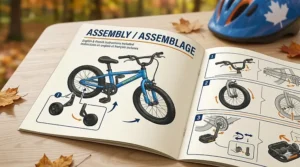
The difference between a bike that builds confidence and one that ends up abandoned in the garage often comes down to proper setup—not the bike itself. Most bikes arrive 80-95% assembled from Amazon.ca, but that remaining work contains critical details that determine whether your five-year-old rides comfortably or struggles unnecessarily.
First 30 Minutes After Unboxing
Resist letting your excited child hop on immediately—I know it’s tempting, but 20 minutes of setup prevents hours of frustration later. Start by checking the box for damage during shipping; Canadian weather extremes mean packages sometimes sit in hot delivery trucks or cold warehouses, potentially affecting tyre pressure or lubricant consistency.
Attach the front wheel first, ensuring the quick-release skewer (if equipped) or axle nuts tighten firmly—this isn’t “kinda tight,” it’s “you’re using real force” tight. A loose front wheel causes dangerous wobbling that terrifies new riders. Next, install the handlebars, but here’s where most parents err: don’t just tighten them wherever they land. The handlebars should align perfectly perpendicular to the front wheel—I use the “sight down from above” method to verify. Misaligned handlebars throw off steering intuition and make balancing unnecessarily difficult.
Pedal installation seems straightforward until you realize the right and left pedals have opposite threading. The right pedal (chain side) tightens clockwise, the left pedal tightens counterclockwise—thread them on by hand first to avoid cross-threading, then tighten firmly with the included wrench. Loose pedals work themselves looser during riding, eventually damaging the crank arm threads and requiring expensive repairs.
Seat Height: The Make-or-Break Adjustment
Conventional wisdom says adjust the seat so your child’s feet touch the ground while seated. This advice is wrong for learning to ride with training wheels. Your five-year-old should be able to place the balls of their feet on the ground while seated—not flat-footed, which indicates the seat is too low. Why? Low seats force awkward leg positions during pedalling, teaching poor form that becomes habit. The training wheels provide stability, so your child doesn’t need to touch the ground constantly for security.
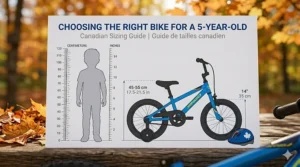
Measure inseam by having your child stand barefoot against a wall, place a book between their legs (pulled up snugly), and measure from floor to the top of the book. For 16-inch bikes, you want roughly 1-2 inches of clearance between the inseam measurement and the seat height at its highest point when the pedal is at its lowest position. This allows room for growth without immediately outgrowing the bike.
Canadian climate consideration: if you’re setting up the bike in a heated garage during winter for spring riding, remember your child will wear shoes during actual riding. Adjust the seat height accounting for shoe sole thickness—typically an extra 1-2 centimetres.
Training Wheel Height Matters More Than You Think
Factory-installed training wheels often sit too low, essentially creating a tricycle where the rear wheel barely touches the ground. This teaches nothing about balance. Adjust training wheels so they’re approximately 1-2 centimetres off the ground when the bike sits level. This small gap means your child experiences slight side-to-side tilting during turns, developing balance awareness while the training wheels catch them before actual tipping occurs.
As your child’s confidence builds, gradually raise the training wheels over days or weeks—not sessions. Jumping from fully supported to minimal support overnight causes regression and frustration. I recommend raising them 3-5 millimetres every 3-4 riding sessions, monitoring your child’s comfort level.
Brake Adjustment for Small Hands
This might be the most commonly overlooked setup detail: hand brakes straight from the factory are adjusted for adult hands. Your five-year-old’s smaller hands can’t generate adequate stopping force if the brake lever sits too far from the handlebar. Most brakes include a small screw adjuster at the lever—turning it clockwise brings the lever closer to the handlebar. Adjust until your child can comfortably squeeze the lever fully with two fingers while maintaining grip on the handlebar.
Test brake function before the first ride: lift the bike and spin the front wheel, then squeeze the hand brake—the wheel should stop rotating immediately without excessive lever pull. For coaster brakes, rotate the pedals backward while observing the rear wheel—it should lock firmly within a quarter rotation backward. Spongy or weak braking requires immediate attention before your child rides.
Canadian Winter Storage Preparation
If you’re buying in fall/winter for spring riding, proper storage prevents spring disappointment. Store the bike in a climate-controlled space if possible—unheated garages work, but avoid outdoor sheds where temperature swings cause condensation inside bearings. Hang the bike or elevate it to prevent tyres from developing flat spots. Inflate tyres to maximum recommended pressure before storage (check sidewall), then plan to top up air pressure in spring as natural seepage occurs over months.
Chain maintenance: apply a thin coat of chain oil before storage, then wipe excess to prevent dust attraction. Come spring, this light coating prevents rust and keeps the chain rolling smoothly. If you have sealed bearings (RoyalBaby, premium JOYSTAR models), you’re good—basic bearing bikes need bearing grease attention before the first spring ride.
Real-World Scenario: Matching Bikes to Canadian Families
Theory and specifications matter, but real families face specific scenarios that determine which bike actually works. Let me walk you through three common Canadian family situations I encounter regularly.
Scenario 1: Urban Toronto Family, Small Condo Storage
The Tanaka family lives in a midtown Toronto condo with limited storage—their bike needs to fit in a narrow hallway closet alongside strollers and winter gear. Their five-year-old daughter Yuki stands 42 inches tall, on the smaller side for her age, and they plan to ride primarily on paved paths around High Park and the West Toronto Railpath.
Bike Recommendation: RoyalBaby Space No.1 Freestyle 16″ ($260-$300 CAD)
Reasoning: The lighter 18.7-pound weight helps Yuki manoeuvre the bike in and out of tight storage without parent assistance—developing independence that matters in condo living. The dual brake system prepares her for hand braking that’s essential on busy urban paths where coaster brake stopping distance isn’t adequate. The premium paint finish resists the scuffing that occurs when bikes lean against other storage items. At $260-$300 CAD, it’s a meaningful investment, but the Tanakas plan to ride year-round (weather permitting), making the performance improvement worth the cost over budget alternatives. The slightly more aggressive geometry suits paved path riding where Yuki can build speed without worry.
Scenario 2: Suburban Calgary Family, Garage Storage
The Dubois family lives in suburban Airdrie with a heated garage and a large backyard. Their twin five-year-olds, Henri and Sophie (both 44 inches tall), show moderate interest in biking but aren’t obsessed. They have gravel driveways and plan mostly neighbourhood riding with occasional trips to Nose Hill Park. Budget consciousness matters—they’re buying two bikes simultaneously.
Bike Recommendation: JOYSTAR Totem 16″ ($220-$260 CAD each)
Reasoning: At $440-$520 CAD for both bikes, the JOYSTAR Totem delivers dual brake systems and adequate quality without breaking the bank. The parent handle proves invaluable when teaching two children simultaneously—one parent can provide hands-on support while the other supervises from nearby. The BMX styling appeals to both kids without forcing gender-specific choices. The 19.8-pound weight suits their average-sized frames adequately, and the full chain guard prevents the twin-chaos scenario of tangled pant legs mid-ride. The lifetime frame warranty provides peace of mind for a family buying multiple bikes, and Amazon.ca Prime shipping means both bikes arrive together for fair “first ride” experiences.
Scenario 3: Rural Manitoba Family, Farm Property
The Kowalski family farms outside Brandon, Manitoba, with acres of property, gravel roads, and seasonal conditions ranging from spring mud to winter storage. Their five-year-old son Marcus (46 inches tall) is large for his age and physically strong. They need a bike that survives farm life abuse and extended outdoor storage in an unheated barn.
Bike Recommendation: RoyalBaby Freestyle 16″ ($240-$280 CAD)
Reasoning: The sealed bearings are essential for farm environments where dust, dirt, and moisture exposure happens constantly—basic bearing bikes would require constant maintenance the Kowalskis don’t have time for. The argon welding and four-layer paint coating survives the scratches and dings inevitable on a working farm. Marcus’s larger size handles the 19.1-pound weight easily, and the dual brake system works better on gravel where coaster brakes alone sometimes skid rather than stop effectively. At $240-$280 CAD, it balances durability with reasonable cost—farm life is hard on equipment, so overspending on ultra-premium bikes makes less sense when damage likelihood is high. The water bottle holder proves genuinely useful for property riding where Marcus might be far from the house. Most importantly, this bike survives unheated barn storage through Manitoba winters better than alternatives with more plastic components and basic bearings.
Common Mistakes When Buying Your Child’s First Pedal Bike
The Canadian market for kids bikes is filled with options that look similar in product photos but perform drastically differently in real use. After watching hundreds of families navigate this purchase, certain mistakes appear repeatedly—and they’re entirely preventable with the right information.
Mistake #1: Buying Based on Age Alone Instead of Inseam Measurement
“16-inch bikes for ages 4-7” sounds definitive until you realize a tall four-year-old and short seven-year-old have completely different body proportions. Age ranges are marketing approximations—inseam measurement determines actual fit. A 16-inch bike works for inseams roughly 16-22 inches (40-56 centimetres), but that’s still a significant range. Measure your child’s inseam by having them stand barefoot, back against a wall, while you pull a book up firmly between their legs and measure from floor to book top.
The consequence of ignoring inseam: too-large bikes force tip-toe riding where your child can’t generate proper pedalling force or stop confidently. Too-small bikes force cramped leg positions that teach poor pedalling form and become outgrown within months. I’ve watched parents buy “room to grow” bikes that sit unused for a year because they’re currently unrideable—wasting both money and the developmental window where learning comes easiest.
Mistake #2: Prioritizing Lowest Price Over Weight
The $60 difference between a $180 COSTWAY and $240 RoyalBaby seems significant until you calculate cost per ride. If the COSTWAY’s 22-pound weight causes your child to give up after three frustrated sessions while the RoyalBaby’s 19-pound frame leads to two years of regular riding, which was actually the better value? Weight matters exponentially more for children than adults—that extra 3 pounds represents 10-15% of a five-year-old’s body weight. It’s the equivalent of an adult learning to ride a 30-pound bike instead of a 25-pound bike—the difference between “this is hard but doable” and “this is miserable.”
Budget constraints are real, especially for Canadian families facing higher prices than American counterparts. But within your budget, prioritize lighter weight over accessories. A bike without a basket or bell but 2 pounds lighter will generate more actual riding and skill development than a heavy bike with fun add-ons that create Instagram moments but not cycling moments.
Mistake #3: Overlooking Canadian Winter Performance Factors
This mistake is uniquely Canadian: buying bikes designed for year-round temperate climates without considering our winter storage reality. Bikes with basic bearings (not sealed) suffer when stored in unheated garages or sheds where temperature fluctuations cause condensation inside bearing races. Come spring, you’re dealing with rusty, sticky bearings that resist smooth pedalling—or worse, require expensive bearing replacement before the bike is rideable.
Similarly, bikes with extensive plastic components (fenders, chain guards, basket) sometimes crack in extreme cold. Not always, but frequently enough that it’s worth considering. The solution isn’t avoiding plastic entirely—it’s understanding which plastic parts are structural (bad) versus decorative (acceptable risk). A cracked decorative fender is annoying; a cracked plastic pedal is dangerous.
Canadian buyers should ask: where will this bike live November through March? If the answer is “heated garage” or “basement,” you’re fine with any bike. If it’s “unheated garage” or “outdoor shed,” prioritize sealed bearings and metal construction for critical components.
Mistake #4: Ignoring Hand Brake Development
Many parents gravitate toward coaster-brake-only bikes because they seem simpler—just pedal backward to stop. This logic works short-term but creates problems when your child transitions to larger bikes where hand brakes become standard. Learning hand braking while also managing balance, steering, and pedalling creates cognitive overload for many kids. Better to introduce hand brakes during the training wheel phase when balance is assisted, allowing isolated focus on hand brake technique.
The dual-brake approach (hand + coaster) found on RoyalBaby and most JOYSTAR models gives you the best of both worlds: the safety net of coaster braking while building hand brake muscle memory. By the time training wheels come off, hand braking is already second nature. I’ve watched this speed up the transition to 20-inch bikes by months compared to kids who must relearn stopping technique alongside balance skills.
Mistake #5: Skipping the Test Ride Position
This requires nuance because you often can’t test ride before purchasing on Amazon.ca. However, the moment the bike arrives, before removing all packaging tags, have your child sit on it while stationary. Check these specific points: (1) When seated, can they touch the ground with the balls of their feet? (2) Can they grip the handlebars comfortably without overreaching or cramping shoulders? (3) Does their knee position look natural when the pedal is at bottom position—not overly bent or locked straight?
If any answer is “no,” you’re within Amazon.ca’s return window. Don’t convince yourself “they’ll grow into it” or “we can adjust it somehow.” A bike that doesn’t fit now won’t get ridden now, and “now” is when your five-year-old’s peer group is learning together. Miss this window, and you’re facing an uphill battle getting them interested later when everyone else has moved on.
How to Choose the Right Training Wheel Bike for Your Canadian Climate
Canada’s geographic diversity means a bike perfect for Victoria’s mild winters performs differently in Winnipeg’s -40°C deep freezes. Beyond basic fit and features, climate-appropriate selection ensures your investment survives and performs in your specific region.
Coastal British Columbia: Moisture and Salt Air Considerations
The Pacific coast’s year-round moisture and occasional salt air exposure (especially in Greater Vancouver and Victoria) makes sealed bearings non-negotiable. Basic bearings exposed to constant humidity rust rapidly, creating the rough pedalling feel that makes kids think biking is inherently hard. Look for bikes explicitly listing “sealed bearings” in specifications—RoyalBaby and premium JOYSTAR models qualify.
Paint quality matters more on the coast than inland. The combination of moisture and salt accelerates corrosion on poorly finished bikes. Multi-layer automotive-grade paint coatings (like RoyalBaby’s four-layer process) resist the surface rust that blooms on budget bikes after one rainy season. Chain guards should be metal rather than plastic—coastal humidity degrades certain plastics faster than dry climates.
Storage reality check: if your bike lives in a garage or shed with poor ventilation, invest in a basic bike cover even for indoor storage. Coastal air moisture permeates structures, and a simple cover prevents condensation from forming directly on metal components overnight.
Prairie Provinces: Extreme Temperature Swings
Manitoba, Saskatchewan, and Alberta’s temperature extremes—from summer heat exceeding 30°C to winter cold dropping below -30°C—stress bikes differently than moderate climates. The challenge isn’t just winter storage; it’s the spring/fall transition periods where temperatures swing 20+ degrees daily.
For prairie families, frame material matters less than bearing quality and tyre composition. Sealed bearings survive the freeze-thaw cycles that destroy basic bearings. Rubber tyres formulated for temperature extremes maintain flexibility in both heat and cold—budget tyres sometimes become brittle and crack during prairie winters. Check tyre sidewalls for temperature ratings if listed, or default to major brands (RoyalBaby, Schwinn, premium JOYSTAR) that use better rubber compounds.
Chain maintenance becomes critical in prairie environments. The fine dust common in summer gunks up chain lubricant, while winter salt (in cities) corrodes unprotected chains rapidly. Choose bikes with full chain guards, then commit to seasonal chain cleaning and re-lubrication—10 minutes twice yearly prevents expensive replacement.
Ontario and Quebec: Salt and Road Grime
The heavy road salt use across Ontario and Quebec creates specific challenges: salt residue works into bearings, corrodes chains, and damages paint finishes faster than other environmental factors. By late winter, roads are coated in salt slush that kicks up onto bikes during early spring rides.
Sealed bearings prove essential—I can’t emphasize this enough for central Canada. The salt-infused spring slush penetrates basic bearings, creating corrosion that manifests months later during summer riding. Aluminum components resist salt corrosion better than steel, but most kids bikes use steel frames for cost/durability reasons. Compensate with diligent post-ride cleaning during spring: a quick wipe-down of the frame and chain after riding through slush prevents salt crystallization.
Fender consideration: while fenders are often marketed as “optional accessories,” they’re practically essential in Ontario/Quebec during spring thaw. The rooster tail of dirty water thrown by the rear wheel without a fender soaks your child’s back and gunks up the chain/brake mechanisms. Choose bikes with fender mounts or included fenders—retrofitting them later often proves difficult.
Atlantic Provinces: Coastal Conditions with Temperature Variation
The Maritime provinces combine coastal moisture with seasonal temperature swings—not as extreme as prairies, but enough to matter. Salt air exposure varies by proximity to the ocean, but even inland New Brunswick and Nova Scotia experience more humidity than prairie provinces.
Sealed bearings and quality paint finishes apply here too, but add rust-resistant hardware to your checklist. Budget bikes sometimes use zinc-plated steel bolts that rust when exposed to moisture—creating stuck bolts when you try to adjust seat height or remove training wheels. Better bikes use stainless hardware or better protective coatings. You can’t easily verify this from Amazon listings, but brand reputation correlates: RoyalBaby and Schwinn use better hardware than ultra-budget alternatives.
Wind exposure also matters more coastally—lightweight bikes can get blown over more easily when parked. The included kickstand on models like RoyalBaby Space No.1 becomes genuinely useful instead of just convenient, preventing the frustrating experience of repeatedly picking up a fallen bike on windy spring days.
Northern Canada: Extreme Cold and Short Seasons
Yukon, Northwest Territories, and Nunavut face unique challenges: extremely short riding seasons, severe cold, and limited product availability. While bike selection follows similar principles (sealed bearings, quality construction), purchasing strategy differs.
Order early—like, February for June riding. Northern shipping from Amazon.ca warehouses takes longer, and stock shortages hit northern addresses harder. Consider buying slightly larger than immediately necessary because short riding seasons mean your child might outgrow a perfectly-sized bike after just one summer. The 16-inch bike sized perfectly in June might be outgrown by August, leaving you facing winter with no suitable bike.
Storage is simpler than southern Canada in one respect: consistently cold eliminates the freeze-thaw condensation issues. Store bikes in any dry space, and they’ll survive winter fine. The challenge is spring revival—get the bike out early (April/May) to check condition and make adjustments before the short riding season arrives. Discovering a problem in June means weeks of the short season wasted waiting for parts delivery.
Training Wheels vs. Balance Bikes: Making the Right Choice for Your Five-Year-Old
The cycling world has split into two camps regarding how children should learn to ride: traditional training wheels versus the newer balance bike approach. For five-year-olds specifically, the answer depends on where they’re starting from.
When Training Wheels Make More Sense
If your five-year-old has never ridden a balance bike and shows moderate-to-low confidence in physical activities, training wheels provide the gradual progression they need. The security of four contact points (two main wheels plus two training wheels) lets them focus on pedalling and steering separately before integrating balance. For children who become easily discouraged, this staged approach prevents the frustration that leads to quitting.
Training wheels also suit Canadian families with limited flat, safe practice space. Balance bikes require extensive safe running room where kids can build speed—something available at parks but not always in backyards or driveways. Training wheel bikes work in smaller spaces because stability comes from the wheels, not velocity.
The training wheel approach’s main advantage for five-year-olds is immediate compatibility with family bike rides. Your child can join longer neighborhood rides or trips to parks from day one because pedals provide propulsion, unlike balance bikes where they’re limited by running stamina.
When to Skip Training Wheels Entirely
If your five-year-old has extensive balance bike experience (12+ months), training wheels might actually regress their skills. These kids already understand balance and steering—what they need is pedalling practice. For them, a pedal bike with training wheels initially, then removing them within days or weeks, makes more sense than months of training wheel dependence.
Similarly, athletic five-year-olds with strong gross motor skills often find training wheels limiting and frustrating. I’ve watched gymnastics-trained and swimming-experienced kids struggle more with training wheels than without because they intuitively understand weight shifting, and training wheels prevent the natural lean into turns their bodies want to execute.
The balance bike argument essentially says: balance is the hardest part of cycling, so teach it first when falling means dropping 2 feet to the ground rather than 3.5 feet from a pedal bike. This logic works beautifully—when starting at age 2-3. At age 5, your child is already taller, making balance bike riding awkward (balance bikes top out around 14-inch wheels, small for most five-year-olds), and they’re cognitively capable of learning balance and pedalling simultaneously.
The Canadian Hybrid Approach I Recommend
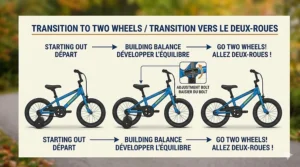
For most five-year-old Canadian beginners, purchase a training wheel bike but use training wheels as optional, not mandatory. Start with training wheels installed for the first 3-5 sessions until pedalling becomes automatic and steering feels natural. Then raise the training wheels 1-2 centimetres off the ground so they only engage during extreme tilts—this lets your child feel balance while maintaining a safety net.
After another 5-10 sessions, remove one training wheel. Yes, one. This creates asymmetry that forces balance awareness while still preventing falls to one side. It sounds strange, but it works remarkably well for reducing the fear of balance. Finally, remove both training wheels and practice on flat, soft grass where falls don’t hurt.
This progression respects your child’s emotional readiness while building skills systematically. Some kids race through these stages in two weeks; others need two months. Both timelines are normal and healthy—the key is letting your child’s confidence, not an arbitrary schedule, dictate progression speed.
For Canadian families specifically, this approach works because our short riding season demands efficiency. Starting with training wheels gets your child riding immediately in May/June rather than spending weeks on balance practice. Then, you transition to balance development while still maximizing riding time during our limited summer months.
FAQ: Your Training Wheel Bike Questions Answered
❓ Can I buy a 16-inch bike in winter for my 5-year-old to use in spring, or will they outgrow it too quickly?
❓ Are hand brakes or coaster brakes better for teaching 5-year-olds in Canada?
❓ What's the real difference between $180 budget bikes and $280 premium bikes on Amazon.ca for 5-year-olds?
❓ My 5-year-old is nervous about falling—should I keep training wheels on longer or remove them quickly?
❓ Will Amazon.ca bikes arrive properly assembled, or do I need bike shop assembly?
Conclusion: Choosing the Training Wheel Bike That Grows With Your Child
The decision between a $180 budget option and a $280 premium training wheel bike for 5 year old riders ultimately comes down to understanding what features actually matter in Canadian conditions and which ones are just marketing. After reviewing the top options available on Amazon.ca in 2026, clear patterns emerge: sealed bearings separate surviving Canadian winters from needing spring repairs, weight differences of even 2-3 pounds significantly impact how quickly your child develops skills, and dual brake systems prepare kids for future bikes without forcing them to relearn stopping techniques.
For most Canadian families, the RoyalBaby Freestyle 16″ at $240-$280 CAD represents the sweet spot—balancing price, performance, and durability without unnecessary premium pricing. Its sealed bearings survive our harsh seasons, the 19.1-pound weight allows confident pedalling, and the dual brake system grows with your child’s abilities. Families prioritizing lighter weight for smaller kids should consider upgrading to the RoyalBaby Space No.1 at $260-$300 CAD, while budget-conscious buyers can find acceptable performance in the JOYSTAR Vintage 16″ at $210-$250 CAD if they’re comfortable with coaster-only braking during the training wheel phase.
Remember that the “best” bike is the one that matches your specific situation: your child’s size and confidence level, your climate and storage conditions, and your realistic usage plans. A $300 premium bike gathering dust because your child doesn’t enjoy riding delivers less value than a $220 mid-range bike that inspires daily adventures. Start with proper fit—measure that inseam, not just age—then prioritize features that matter in your region. Coastal families need sealed bearings and quality paint more than prairie families need fenders, while urban families benefit from lighter weight that suburban families with garage storage might not require as critically.
The cycling skills your five-year-old develops this year create foundations for a lifetime of activity, independence, and outdoor enjoyment. Whether they’re cruising neighborhood sidewalks in Winnipeg, exploring park paths in Vancouver, or navigating rural roads in the Maritimes, the right training wheel bike transforms those wobbly first attempts into confident pedalling faster than you’d expect. Choose wisely based on your actual needs rather than marketing promises, maintain the bike through our challenging seasons, and you’ll have a purchase that serves your family well for years while building memories that last far longer.
Recommended for You
- Razor vs Gotrax Kids Scooter: 7 Best Canadian Picks 2026
- 7 Best Electric Scooter 10 mph for Kids Canada 2026 Guide
- Electric Scooter Safety Guide Kids: 7 Top Picks Canada 2026
Disclaimer: This article contains affiliate links. As an Amazon Associate, I earn from qualifying purchases. If you purchase products through these links, we may earn a small commission at no additional cost to you.
✨ Found this helpful? Share it with your friends! 💬🤗
