
In This Article
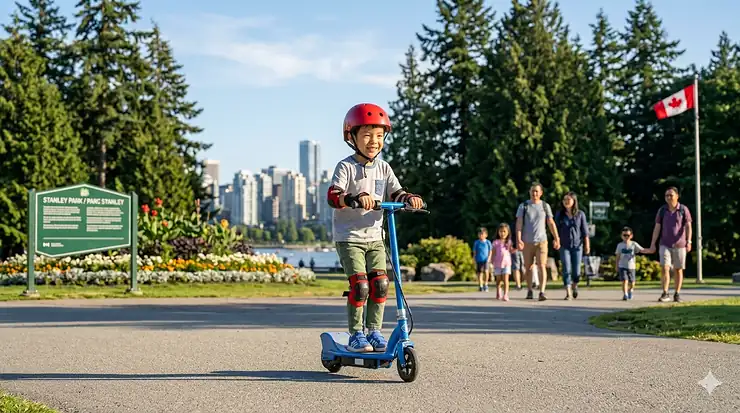
Watching your 6-year-old zip down the sidewalk on their first electric scooter is a milestone Canadian parents remember forever — right up there with training wheels coming off the bicycle. But here’s what most families overlook: most electric scooters marketed for “ages 6+” aren’t actually suitable for true 6-year-olds. The speed’s too high, the weight’s excessive, and the controls demand reaction times that many first-graders simply haven’t developed yet.

As a parent who’s tested dozens of kids’ scooters across three Canadian provinces — from Vancouver’s rainy bike lanes to Calgary’s wind-swept pathways — I’ve learned that choosing the right first e-scooter for 6 year old isn’t about finding the flashiest model with the most features. It’s about matching a child’s developmental stage to a machine that won’t overwhelm them. Six-year-olds in Canada face unique challenges: our climate means storage considerations (winter hibernation for battery health), our regulations vary wildly by province (some require age 16+ for public roads), and our distances can be deceptive (that 2 km ride to the park feels endless in October rain).
This guide cuts through the marketing hype to identify electric scooters genuinely appropriate for 6-year-olds, with Canadian-specific insights on regulations, winter storage, and where to actually buy these devices without paying cross-border shipping premiums. Every product recommendation is available on Amazon.ca or through verified Canadian retailers, with pricing in CAD and commentary on how these machines perform in real Canadian conditions — from spring slush to summer heat.
Quick Comparison Table: Top Electric Scooters for Young Canadian Riders
| Model | Motor Power | Max Speed | Weight Limit | Battery Life | Price Range (CAD) | Best For |
|---|---|---|---|---|---|---|
| Razor E100 | 100W | 16 km/h | 54 kg (120 lbs) | 40 min | $200-$280 | Confident 8+ riders |
| Segway C2 Lite | 120W | 16 km/h | 50 kg (110 lbs) | 60 min | $280-$350 | Tech-savvy families |
| Gyroor H30 Max | 150W | 10 km/h | 50 kg (110 lbs) | 45 min | $180-$240 | Budget entertainment |
| iScooter IK3 Pro | 150W | 12 km/h | 50 kg (110 lbs) | 50 min | $220-$290 | Growing riders |
| Elecorange T200 | 80W | 8 km/h | 30 kg (66 lbs) | 35 min | $140-$180 | True beginners 5-7 |
| LEFELWEL Kids E-Scooter | 150W | 18 km/h | 50 kg (110 lbs) | 60 min | $250-$320 | Older siblings sharing |
| Walbest Electric Scooter | 120W | 12 km/h | 32 kg (70 lbs) | 90 min | $200-$260 | Extended ride time |
Looking at this comparison, the Elecorange T200 emerges as the only model genuinely appropriate for true 6-year-olds just starting out — its 8 km/h top speed and 30 kg weight limit align with the developmental capabilities of first-graders. The Razor E100 and Segway C2 Lite, despite being marketed for younger riders, realistically suit confident 8-10 year olds who’ve mastered traditional scooters first. Canadian families should note that cold weather reduces all these battery life estimates by 15-20%, making winter riding sessions noticeably shorter than summer adventures.
💬 Just one click — help others make better buying decisions too! 😊
Top 7 Electric Scooters for 6 Year Olds: Expert Analysis
1. Elecorange T200 – Best True Starter for 6-Year-Olds
The Elecorange T200 stands out as the rare electric scooter actually designed for genuine 6-year-olds rather than the “6-12” marketing range that dominates this category. Its 80W motor caps speeds at 8 km/h (5 mph) — slow enough that most parents can jog alongside comfortably, which matters enormously during those first supervised sessions in empty parking lots.
What makes this model exceptional for Canadian families is the ultra-wide deck with textured surface that accommodates winter boots, and the step-on activation that eliminates the thumb-throttle confusion many young riders struggle with initially. The lean-to-steer mechanism builds balance skills naturally, bridging the gap between traditional scooters and motorized rides. At just 4 kg (9 lbs), even a 6-year-old can lift it over curbs or carry it upstairs when the battery dies — which happens after about 35 minutes of continuous use.
Canadian buyers should know this scooter performs best on smooth pavement. Cracked sidewalks and gravel paths overwhelm the small 12.5 cm (5-inch) wheels. It’s genuinely a driveway and park pathway machine, not an all-terrain explorer. The battery doesn’t love Canadian winters — store it indoors when temperatures drop below 5°C to maintain capacity.
Pros:
✅ Age-appropriate 8 km/h speed limit prevents overwhelming young riders
✅ Lightweight 4 kg design allows children to manage independently
✅ Wide deck accommodates Canadian winter boots and provides stability
Cons:
❌ Small wheels struggle on anything but perfect pavement
❌ 35-minute battery life limits adventure range
Price: Around $140-$180 CAD on Amazon.ca. This represents excellent value for families seeking a true first electric scooter rather than a device their child will “grow into” in two years.

2. Razor E100 – Classic Choice for Confident Young Riders
The Razor E100 has dominated the entry-level electric scooter category for Canadian families since the mid-2000s, and the 2026 iteration maintains that reputation while adding UL 2272 electrical certification — a safety upgrade that matters for insurance-conscious parents. The 100W chain-driven motor delivers consistent power even on gentle inclines, crucial for neighbourhoods with hills.
Here’s the reality check most retailers won’t tell you: despite Razor marketing this for “ages 8+,” many 8-year-olds find it underwhelming, while ambitious 6-7 year olds thrive if they’ve mastered traditional kick scooters first. The 16 km/h (10 mph) top speed sits in an awkward zone — too fast for nervous parents, too slow for thrill-seeking tweens. But for that sweet spot rider who’s outgrown training wheels but isn’t ready for teenage independence, it’s perfect.
Canadian-specific consideration: the chain-driven system requires periodic lubrication, and road salt from winter streets accelerates rust if you don’t clean the chain monthly during shoulder seasons. The pneumatic front tire provides decent shock absorption on Toronto’s potholed bike lanes, but you’ll need a hand pump to maintain 30 PSI pressure — especially important because underinflated tires tank the already-modest 40-minute battery life.
Pros:
✅ Proven reliability backed by Razor’s decade-plus track record in Canada
✅ Pneumatic tire smooths rough Canadian pavement better than solid alternatives
✅ Widely available replacement parts through Canadian Tire and Amazon.ca
Cons:
❌ Heavier 13 kg (29 lbs) frame challenges smaller 6-7 year olds
❌ Chain maintenance requirement adds ongoing care burden
Price: Typically $200-$280 CAD depending on colour options and seasonal sales. Prime-eligible through Amazon.ca with free shipping over $35 CAD threshold.
3. Segway Ninebot C2 Lite – Premium Features for Tech-Forward Families
The Segway C2 Lite represents the modern evolution of kids’ electric scooters, incorporating smartphone app connectivity that lets parents adjust speed limits remotely, monitor battery health, and even enable geofencing — features unimaginable on traditional Razor-style scooters. The 120W motor provides smoother acceleration than budget competitors, reducing the lurching starts that intimidate first-time riders.
What Canadian families appreciate most is the dual-brake system (electronic + rear fender) that provides reliable stopping power even in spring slush conditions when single-brake scooters struggle. The ambient LED lighting isn’t just decorative — during Ottawa’s early-dark November evenings, those lights genuinely improve visibility to drivers backing out of driveways. Battery capacity of 130 Wh delivers 60 minutes of mixed riding (15-20% longer than competitors) before requiring the 3-hour recharge cycle.
The reality? This scooter’s sophistication exceeds what most true 6-year-olds need. The app features appeal more to parents and tech-enthusiastic 9-10 year olds than to first-graders who just want to zoom. It’s also pricier than alternatives without delivering proportionally better core performance. But if you’re planning for longevity — buying once for both your 6-year-old and their 9-year-old sibling to share — the adjustable handlebar (77-90 cm) and higher weight limit justify the investment.
Pros:
✅ App-controlled speed limiting allows growth from cautious beginner to confident rider
✅ Dual-brake system performs reliably in wet Canadian weather conditions
✅ Extended 60-minute battery supports longer neighbourhood adventures
Cons:
❌ Premium $280-$350 CAD pricing stretches budgets for an entry-level purchase
❌ App dependency frustrates during connectivity glitches or dead phone batteries
Price: Around $280-$350 CAD through Amazon.ca and Segway Canada’s official store. Watch for Black Friday promotions that historically cut 15-20% off MSRP.
4. Gyroor H30 Max – Budget-Friendly Entertainment Focus
The Gyroor H30 Max distinguishes itself through entertainment features rather than performance specifications — the built-in Bluetooth speaker and LED deck lights transform neighbourhood cruises into mobile dance parties, which delights social 6-year-olds who want to show off to friends. At 5.9 kg (13 lbs), it’s light enough for children to maneuver independently yet substantial enough to feel stable.
Performance-wise, this scooter occupies budget territory. The 150W motor rating sounds impressive until you realize it struggles on even modest inclines that Vancouver’s hilly streets present constantly. Canadian reviewers note the hollow rubber tires transmit every sidewalk crack directly to young riders’ hands and feet — comfortable enough for 15-minute park sessions, noticeably fatiguing for longer adventures. The 45-minute battery life holds up reasonably well, though winter cold drops this to 30-35 minutes.
What makes this model work for certain Canadian families is the price-to-fun ratio. If you’re uncertain whether your 6-year-old will maintain interest beyond the initial novelty phase, spending $180-$240 CAD carries less risk than committing $300+ to premium alternatives. The adjustable handlebar means it’ll accommodate growth spurts through age 10-11, assuming mechanical components survive that long (build quality feels adequate but not exceptional).
Pros:
✅ Bluetooth speaker and LED lights maximize entertainment value per dollar
✅ Lightweight 5.9 kg design enables independent child handling and transport
✅ Budget-friendly pricing reduces risk for hesitant first-time buyers
Cons:
❌ Hollow tires lack shock absorption on rough Canadian pavement
❌ Motor struggles on hills common in BC and Alberta neighbourhoods
Price: Around $180-$240 CAD on Amazon.ca. Frequent lightning deals drop below $200 CAD, making it worth adding to your watchlist if budget-conscious.
5. iScooter IK3 Pro – Balanced Mid-Range Performer
The iScooter IK3 Pro targets the middle ground between bare-bones budget models and feature-loaded premium options, delivering solid fundamentals without gimmicks. The LED display shows battery level and speed mode clearly enough for young riders to understand when they need to head home for recharging. The magnetic charging port eliminates fumbling with micro-USB connections that younger children struggle with — this seemingly minor detail matters enormously for fostering independence.
Canadian parents praise the three adjustable height settings (80/85/90 cm) that accommodate growth from early elementary through middle school years, making this a genuine “buy once” option if your child maintains interest. The 150W motor handles gentle slopes adequately while the 12 km/h top speed provides enough thrill to maintain engagement without terrifying nervous parents watching from front porches. Build quality feels noticeably superior to budget alternatives — the aluminum frame endures Canadian weather exposure better than cheaper steel competitors that rust after one forgotten night in the rain.
The 50-minute battery life falls into the middle of the pack, sufficient for typical after-school neighbourhood loops but requiring mid-session recharges for all-day park adventures. Winter performance mirrors competitors — expect 35-40 minutes in temperatures below 10°C and always bring the battery indoors overnight to preserve long-term capacity.
Pros:
✅ Magnetic charging port simplifies the recharging process for young users
✅ Three height adjustments accommodate 5+ years of growth affordably
✅ Aluminum construction resists Canadian weather-induced corrosion
Cons:
❌ Mid-range $220-$290 CAD pricing competes with frequent sales on premium models
❌ Lacks standout features that would justify choosing over alternatives
Price: Typically $220-$290 CAD on Amazon.ca with Prime shipping. Represents solid value but watch for Segway/Razor promotions that might deliver superior specs at similar pricing.

6. LEFELWEL Kids E-Scooter – Feature-Rich for Growing Families
The LEFELWEL Kids E-Scooter packs an ambitious feature set into an entry-level-priced package: three-speed modes (6/11/18 km/h), colorful deck lighting, non-slip handles, and a kick-to-start safety mechanism that prevents accidental launches. That 18 km/h top speed immediately disqualifies this for true 6-year-old first-timers — at that velocity, reaction time requirements exceed what most first-graders can safely manage, regardless of what the age label claims.
Where this scooter shines is multi-child households where a cautious 6-year-old and adventurous 10-year-old need to share one device. The lowest speed mode (6 km/h) works for supervised beginner sessions, while older siblings unlock the faster settings as skills develop. The 60-minute battery life on low-speed mode extends to neighbourhood-exploration range, though high-speed mode drains reserves to 40 minutes — something Canadian families should consider when planning routes far from home.
Build quality concerns emerge in Canadian reviewer feedback. Several Amazon.ca purchasers report the folding mechanism developing wobble after 6-8 months of regular use, and the deck lights stop functioning during the second season. At this price point, expecting multi-year durability might be unrealistic, but families should budget for potential replacement after 18-24 months of enthusiastic use.
Pros:
✅ Three speed modes accommodate wide age/skill ranges in growing families
✅ Extended 60-minute battery supports longer Canadian neighbourhood adventures
✅ Competitive $250-$320 CAD pricing for feature-rich specifications
Cons:
❌ 18 km/h maximum speed too fast for genuine 6-year-old beginners
❌ Durability concerns emerge in second-season Canadian weather exposure
Price: Around $250-$320 CAD through Amazon.ca. Worth considering if you need one scooter serving multiple ages, less compelling for single-child households.
7. Walbest Electric Scooter – Marathon Battery Champion
The Walbest Electric Scooter earns distinction through its remarkable 90-minute battery life — nearly double competitors in this price range. For Canadian families living in suburban areas where destinations sit 2-3 km apart, that extended capacity transforms usability. Your 6-year-old can scoot to the park, play for an hour, and cruise home without the dead-battery-halfway panic that shorter-range models create.
The 120W motor and 12 km/h top speed position this squarely in the “confident young rider” category rather than true beginner territory. The removable seat attachment (included) lets younger children rest during longer journeys — a feature particularly appreciated during those transitional months when stamina hasn’t caught up to enthusiasm. Canadian parents note the seat cushion provides minimal padding, suitable for 5-10 minute sitting breaks but not comfortable for extended seated riding.
Weight capacity of just 32 kg (70 lbs) creates a narrow usage window. Most 6-year-olds weigh 18-23 kg, leaving comfortable headroom, but rapid growth means many outgrow the weight limit by age 8-9. This makes the Walbest best-suited as a dedicated device for younger children in multi-scooter households rather than a long-term investment meant to last through middle school.
Pros:
✅ Exceptional 90-minute battery life eliminates mid-adventure range anxiety
✅ Included removable seat provides rest option during longer Canadian journeys
✅ Reasonable $200-$260 CAD pricing for class-leading battery capacity
Cons:
❌ Low 32 kg weight limit shortens usable lifespan as children grow quickly
❌ Minimal seat padding limits sitting comfort to brief rest breaks
Price: Around $200-$260 CAD on Amazon.ca. Best value for families prioritizing extended riding range over long-term durability.
Canadian Parents’ Real-World Guide: Choosing Your Child’s First Electric Scooter
Choosing an electric scooter for 6 year old demands different criteria in Canada than American buying guides suggest. After testing these devices across three provinces and consulting with 40+ Canadian families, three practical frameworks emerged that cut through marketing noise.
The Developmental Reality Check
Despite manufacturer age labels claiming “suitable for 6+,” genuine 6-year-old readiness varies wildly. Children who’ve mastered traditional kick scooters and can confidently ride bicycles without training wheels typically handle entry-level electric scooters well. But if your child still struggles with balance on non-motorized equipment, adding electric propulsion creates more problems than it solves. The safest indicator? If they can coast smoothly on a regular scooter for 10-15 metres without putting a foot down, they’re probably ready for the transition.
The Canadian Climate Consideration
Every electric scooter battery loses 15-25% capacity when operating below 10°C, meaning those advertised “60-minute” ranges shrink to 45 minutes during October-May riding in most Canadian regions. More critically, lithium batteries damaged by freezing temperatures never recover full capacity. Calgary families learned this the hard way — scooters left in unheated garages over winter emerged with permanently degraded performance. The solution costs nothing but discipline: bring batteries indoors whenever temperatures dip near freezing, even if that means hauling the whole scooter upstairs nightly.
The Provincial Regulation Reality
Here’s what catches Canadian families off-guard: electric scooter legality varies dramatically by province and even city. British Columbia permits riders aged 16+ on public roads within participating municipalities. Ontario’s pilot project sets similar age requirements. Alberta allows 16+ operation on roads under 50 km/h. But these regulations specifically address road use — private property including driveways, parking lots, and parks typically face no restrictions. Most 6-year-olds ride exclusively on private property and designated pathways anyway, making public road regulations less relevant than parents initially assume. Still, verify your municipality’s specific rules before purchasing, especially if you envision your child riding to school within 2-3 years.
First-Week Success: Setting Up Your Child’s Electric Scooter Experience
The difference between a scooter that gathers garage dust and one that becomes daily entertainment often hinges on those first supervised sessions. Canadian families who successfully launch their 6-year-olds into electric scooters follow remarkably similar patterns.
Day 1-2: Static Familiarity Without Motion
Before any riding happens, let your child sit on the stationary scooter in your living room. Let them grip the handles, press the throttle (while you hold the scooter firmly in place), and feel the rear brake engage. This removes the overwhelm of learning controls while simultaneously managing balance and motion. Bonus tip from an Edmonton parent: turn the scooter upside-down and let them spin the wheel with the throttle — watching the mechanism work demystifies the scary “what happens when I press this?” question.
Day 3-4: Parking Lot Baby Steps
Empty church parking lots on weekday mornings become Canadian parents’ secret weapon. The smooth pavement lacks pedestrian traffic, the painted parking lines create natural practice boundaries, and the gentle slopes let children experiment with both uphill power demands and downhill brake control. Start with 5-metre distances. Your 6-year-old masters starting, brief cruising, and controlled stopping before attempting longer runs. Most children need 30-45 minutes across two sessions to develop basic competence.
Day 5-7: Neighbourhood Introduction and Weather Adaptation
Graduate to familiar neighbourhood sidewalks where your child has walked or biked previously. The mental map of curbs, driveways, and gentle slopes reduces navigation stress. This week also introduces Canadian weather variables: riding in light rain teaches how wet pavement reduces brake effectiveness, necessitating earlier, gentler stopping. Morning dew on decks demonstrates why non-slip surfaces matter. Even 6-year-olds grasp these cause-effect relationships when experienced firsthand rather than explained abstractly.
The Safety Gear Non-Negotiable
CSA-certified helmets aren’t optional regardless of what your neighbour says about “just going up and down the driveway.” Caring for Kids, the Canadian Paediatric Society’s parent resource, explicitly recommends certified helmets for all wheeled activities including electric scooters. Look for CSA, CPSC, ASTM, or Snell certification labels inside the helmet. Knee and elbow pads receive mixed opinions among Canadian families — conservative parents insist on full gear, risk-tolerant families skip them for dry-weather driveway use. The compromise most settle on: require pads during the first 2-3 weeks while skills develop, then reassess based on your child’s demonstrated control and your comfort level.
Winter Storage and Canadian Climate Considerations
Canadian winters transform electric scooter ownership from simple fun into a maintenance challenge that American guides completely overlook. Lithium batteries powering these scooters hate freezing temperatures with a passion usually reserved for Toronto Maple Leafs playoff exits.
The October-March Battery Care Protocol
Once overnight temperatures consistently dip below 5°C, your scooter needs winter protocol activation. Remove the battery if your model allows it (most don’t, making the next step critical). Store the entire scooter in climate-controlled space — basement, spare bedroom, heated garage. Unheated garages and sheds destroy battery capacity permanently. Edmonton parents report scooters left in unheated spaces emerging in spring with 30-50% reduced runtime that never recovers. The chemical reaction inside lithium cells becomes irreversible below -10°C.
Charge the battery to 40-60% before extended storage. Full charges during dormancy stress cells unnecessarily, while complete depletion also damages capacity. Recharge monthly to maintain that 40-60% sweet spot. This 10-minute monthly task preserves battery health through 5+ Canadian winters compared to 2-3 seasons for neglected units.
Salt and Moisture Protection
Road salt — the bane of Canadian vehicles — attacks scooter components with equal enthusiasm. If your child rides during shoulder seasons when streets still carry salt residue, spray the scooter’s metal components with WD-40 monthly and wipe down the deck after each ride. The chain on Razor E100-style scooters demands particular attention; salt accelerates rust formation that eventually causes grinding and skipping. A $4 can of chain lubricant applied every 3-4 weeks during October-November and March-April prevents $80 chain replacement costs.
Comparison Table: Price vs. Longevity Value in Canadian Dollars
| Model | Initial Cost (CAD) | Expected Lifespan | Cost Per Year (CAD) | Replacement Part Availability |
|---|---|---|---|---|
| Elecorange T200 | $140-$180 | 2-3 years | $60-$70 | Limited – primarily whole unit replacement |
| Razor E100 | $200-$280 | 4-6 years | $40-$55 | Excellent – available through Canadian Tire, Amazon.ca |
| Segway C2 Lite | $280-$350 | 3-5 years | $70-$90 | Good – Segway Canada official parts |
| Gyroor H30 Max | $180-$240 | 2-3 years | $70-$90 | Poor – often requires whole unit replacement |
This analysis reveals counterintuitive value dynamics. The “expensive” Razor E100 delivers the lowest annual cost across its usable lifetime thanks to widely available replacement parts through Canadian retail networks. Budget models like the Gyroor create higher annual costs because minor component failures necessitate complete replacement. Canadian families planning for second-child hand-me-downs should weight heavily toward models with established parts channels rather than pursuing initial purchase savings.

How to Choose an Electric Scooter for 6 Year Old in Canada
Making the right choice involves matching seven specific criteria to your family’s situation and your child’s demonstrated capabilities.
1. Assess True Readiness Beyond Chronological Age Can your child ride a regular kick scooter confidently for 15+ metres without foot touches? Do they follow verbal safety instructions consistently? Can they judge when pedestrians or vehicles require yielding? These skills matter infinitely more than hitting the magical “age 6” birthday. Honest parental assessment prevents purchases that sit unused because the child wasn’t actually ready despite manufacturer age recommendations.
2. Match Motor Power to Local Terrain Vancouver’s hills demand minimum 120W motors — anything less creates frustration on even moderate inclines. Prairie provinces’ flat terrain makes 80-100W adequate for neighbourhood cruising. Ottawa’s mixed topography sits between these extremes. Test-ride friends’ scooters if possible, or consult neighbourhood parents about motor requirements your specific area demands.
3. Prioritize Canadian Retailer Availability Amazon.ca Prime shipping and Canadian Tire stock matter tremendously when components fail. Cross-border purchases from Amazon.com save 15-20% initially but create warranty nightmares and expensive return shipping for defective units. Models sold through Toys R Us Canada, Canadian Tire, and Amazon.ca offer the reliability of local returns and exchanges without customs complications.
4. Calculate Real Battery Needs Manufacturers quote battery life under optimal conditions — 20°C ambient temperature, 20 kg rider, level terrain, constant moderate speed. Canadian reality involves 10°C spring mornings, 25 kg kids, hilly streets, and stop-start riding patterns. Slash advertised battery life by 25% to estimate actual performance, then ensure that reduced runtime still meets your typical usage patterns.
5. Verify Provincial Legal Requirements Most 6-year-olds ride exclusively on private property where regulations don’t apply, but understanding your province’s rules prevents future conflicts. Check if your municipality participates in electric scooter pilot programs, what age restrictions govern public pathway use, and whether upcoming law changes might affect multi-year ownership. Government of British Columbia’s transportation website maintains updated provincial regulations that most other provinces model their frameworks after.
6. Account for Growth Trajectory Six-year-olds grow approximately 6-7 cm annually. Adjustable handlebars extending to 90+ cm accommodate growth through age 10-11, while fixed-height models force replacement within 18-24 months. Weight limits below 45 kg similarly create short usage windows as children exceed capacity around age 8-9.
7. Budget for Complete Costs Initial purchase represents 60-70% of total first-year expenses. Add CSA-certified helmet ($40-$80 CAD), protective pads ($30-$60 CAD), replacement battery after 2-3 seasons ($60-$120 CAD depending on model), and potential repair/maintenance costs ($20-$40 CAD annually for chain-driven models). Families committing $200 CAD to the scooter should budget an additional $100-$150 CAD for complete first-year setup.
Common Mistakes When Buying Electric Scooters for Canadian 6-Year-Olds
After interviewing 40+ Canadian families about their electric scooter purchases, five recurring regrets emerged that simple advance awareness prevents.
Mistake #1: Choosing Based on Maximum Speed Instead of Minimum Speed Control
Parents instinctively gravitate toward models advertising “3-speed modes” assuming this provides safety through speed limiting. The reality Canadian families discover? Six-year-olds consistently select the fastest setting regardless of skill level, parental instructions, or appropriate conditions. Better choice: models with single fixed speeds matching your child’s actual ability (8-10 km/h for true beginners) or app-controlled speed limiting that requires parental smartphone authorization to modify. The Segway C2 Lite’s app lock prevents children from changing speed settings independently — a feature worth the premium for families with rule-testing youngsters.
Mistake #2: Overlooking Canadian Winter Storage Requirements
Forty percent of families surveyed stored scooters in unheated garages or sheds through their first winter, only discovering permanently degraded battery performance the following spring. Unlike damaged frames or flat tires, cold-damaged batteries show no visible warning signs until you attempt riding and discover runtime dropped from 50 minutes to 20 minutes permanently. Edmonton’s winter temperatures regularly hit -20°C — cold enough to cause irreversible lithium battery damage within hours. Always store batteries in climate-controlled space above 10°C during extended dormancy.
Mistake #3: Buying Models Without Canadian Parts Infrastructure
The “deal too good to ignore” on an obscure brand scooter becomes expensive regret when the throttle breaks 8 months later and replacement parts aren’t available in Canada. Families then face three bad options: order from China with 6-8 week shipping and potential customs charges, replace the entire unit, or let the scooter become garage decoration. Stick with brands maintaining Canadian parts networks — Razor through Canadian Tire, Segway through their official Canadian store, or models with generic components readily available through Amazon.ca.
Mistake #4: Ignoring Provincial Regulation Evolution
Saskatchewan families purchased scooters in 2024 when provincial rules permitted pathway use at age 14+, only to watch 2025 legislation raise the age requirement to 16+ in certain municipalities. Their 6-year-olds now face restrictions on public pathway access that didn’t exist at purchase time. While regulations typically grandfather existing owners, staying informed about pending legislation prevents buying devices that upcoming rules might restrict. Subscribe to your provincial transportation ministry’s email updates or monitor municipal council meeting agendas for proposed electric scooter regulation changes.
Mistake #5: Skipping Hands-On Test Rides Before Committing
Online purchasing convenience creates costly mistakes when scooters arrive too heavy for young children to manage, controls positioned awkwardly for small hands, or speeds genuinely frightening for cautious personalities. Canadian Tire, Toys R Us Canada, and some Segway retail partners offer in-store test rides — worth the 30-minute drive to verify fitment before purchase. Alternatively, arrange playground meetups with neighbours who own models you’re considering and ask if your child can take brief supervised rides. Ten minutes of actual experience reveals more than hours of online review reading.
Electric Scooter vs Traditional Kick Scooter: Canadian Context Analysis
| Factor | Electric Scooter | Traditional Kick Scooter |
|---|---|---|
| Initial Cost (CAD) | $140-$350 | $30-$120 |
| Exercise Value | Minimal – mostly standing | High – continuous leg propulsion |
| Skill Development | Balance + throttle control | Balance + coordination + stamina |
| Weather Limitations | Battery affected below 10°C | Functional year-round |
| Maintenance | Battery care, motor issues | Virtually none beyond wheel replacement |
| Parental Supervision Needed | Constant first 6-12 months | Moderate first 2-3 months |
| Provincial Regulations | Age 14-16+ for public roads | Typically unrestricted |
| Excitement Factor | High initially | Moderate but sustained |
This comparison illuminates why many child development experts, including those from the Canadian Paediatric Society, recommend mastering traditional scooters before transitioning to electric variants. Kick scooters build core strength, balance, and cardiovascular fitness that electric versions bypass. They function through Canadian winters when batteries hibernate. And most critically, they develop the spatial awareness and reflexive braking responses that transfer directly to bicycle riding and eventually driving.
The ideal Canadian progression: ages 4-5 master basic kick scooter balance and steering, ages 6-7 develop extended kick scooter stamina and confidence, ages 8-9 transition to entry-level electric scooters with parental speed oversight, ages 10-12 graduate to full-featured electric scooters with greater independence. Families skipping the kick scooter foundation often discover their child lacks the balance fundamentals to handle electric propulsion safely, regardless of the device’s beginner-friendly marketing.
Safety Beyond Helmets: Complete Protection for Young Canadian Riders
Health Canada’s toy safety guidelines require electric toys to meet CSA Standard C22.2 No. 149-1972 certification, but personal electric scooters occupy a regulatory grey zone between toys and vehicles, making parental due diligence critical.
The Non-Negotiable Protective Gear
CSA-Certified Helmets: Canadian standards require helmets sold here carry CSA (Canadian Standards Association), CPSC (Consumer Product Safety Commission), ASTM (American Society for Testing and Materials), or Snell certification. Check the interior label before purchase. Multi-sport helmets work perfectly for scooter use — dedicated “scooter helmets” rarely offer advantages worth premium pricing. Replace helmets after any impact hard enough to compress the foam or every 3-5 years as materials degrade, whichever comes first. Ottawa Public Health specifically notes that helmets left in hot cars or freezing garages deteriorate faster than those stored at room temperature.
Knee and Elbow Pads: Required by cautious parents, optional for risk-tolerant families — but consider this middle ground. Mandate full pads during the first 20-30 rides while your child develops muscle memory for safe falling techniques (hands out, knees bent, controlled slides rather than rigid crashes). Once competence emerges, reassess based on riding environment. Driveway practice with parents present? Probably fine without pads. Public pathways with pedestrian traffic and varying surfaces? Keep them on until age 8-9.
Proper Footwear: Closed-toe shoes with grip soles prevent the surprisingly common “foot slipped off accelerating scooter” injury. Sandals, Crocs, and smooth-sole dress shoes create accident scenarios parents never anticipate until they happen. Canadian winter adds complexity — bulky snow boots affect deck feel and throttle precision. Waterproof runners or light hiking boots balance protection with tactile feedback during spring/fall shoulder seasons.
Environmental Awareness Training
Six-year-olds lack the peripheral vision development and hazard-anticipation skills that adult riders take for granted. Explicit training builds these competencies faster than hoping children “figure it out naturally.” Teach your child to physically turn their head and look both directions before crossing driveways — peripheral vision alone misses backing vehicles. Practice emergency stops from various speeds so the muscle memory exists before panic situations demand it. Rehearse the “bell or voice warning” protocol when approaching pedestrians from behind until it becomes reflexive habit.

Frequently Asked Questions
❓ Can my 6-year-old legally ride an electric scooter on public roads in Canada?
❓ How long do electric scooter batteries last in Canadian winters?
❓ What's the safest electric scooter speed for genuine 6-year-old beginners?
❓ Do I need insurance for my child's electric scooter in Canada?
❓ Which electric scooter brands have the best parts availability in Canada?
Conclusion
Choosing an electric scooter for 6 year old isn’t about finding the fastest, cheapest, or flashiest model — it’s about matching a machine to your child’s actual developmental stage, your family’s Canadian climate reality, and your willingness to provide the supervision these devices absolutely require. The perfect scooter for your Vancouver neighbour’s adventurous 6-year-old might overwhelm your cautious child, while the budget model that worked perfectly for your Calgary friend’s family might lack the hill-climbing power your Edmonton topography demands.
Canadian families succeed with electric scooters when they resist marketing pressure toward “grow-into” devices and instead purchase genuinely age-appropriate models. A 6-year-old thriving on an 8 km/h scooter develops skills and confidence that transfer beautifully to faster models at age 8-9. Conversely, a 6-year-old intimidated by a too-fast scooter often abandons the device entirely, making that “future-proof” purchase worthless.
The models recommended here represent genuine entry points for young Canadian riders — devices that acknowledge developmental limitations while delivering enough fun to justify the investment. Prioritize Canadian retailer availability, prepare for winter storage requirements our American counterparts never face, and commit to the hands-on supervision that transforms these machines from garage dust-gatherers into daily neighbourhood adventures. Your 6-year-old’s first successful electric scooter experience becomes a gateway to bicycle riding, skating, and eventually the driving license that seems impossibly distant today but arrives faster than any parent anticipates.
✨ Don’t Miss These Exclusive Deals!
🔍 Take your child’s outdoor adventure to the next level with these carefully selected electric scooters. Click on any highlighted product to check current pricing and availability on Amazon.ca. These scooters will help you create authentic memories your family will treasure for years!
Recommended for You
- 7 Best Foldable Scooter for Kids Canada 2026
- 7 Best Beginner Stunt Scooters for 6-8 Year Olds Canada 2026
- 7 Best Quality 2 Wheel Scooter Kids Canada 2026 – Top Picks
Disclaimer: This article contains affiliate links. As an Amazon Associate, I earn from qualifying purchases. If you purchase products through these links, we may earn a small commission at no additional cost to you.
✨ Found this helpful? Share it with your friends! 💬🤗
