
In This Article
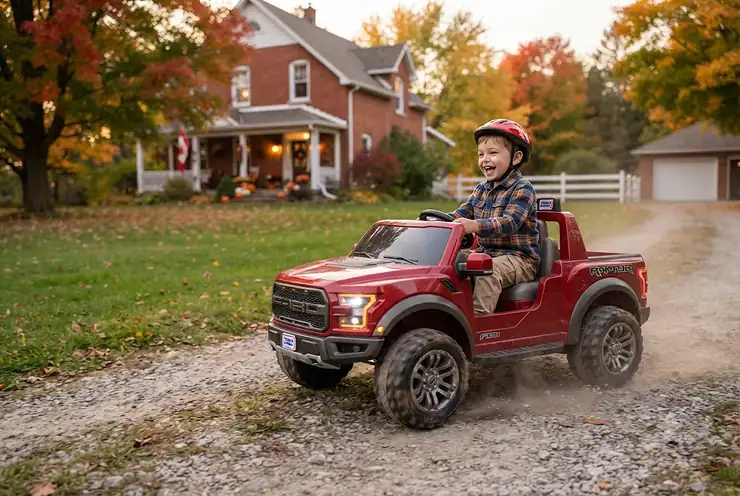
Somewhere in your neighbourhood right now, a four-year-old is idling at the end of a driveway, one hand on a plastic steering wheel, absolutely convinced they are hauling something important. That’s the whole appeal of a 12v power wheels truck: it hands a kid the shape of grown-up responsibility — a working horn, a set of headlights, sometimes even a cargo bed — wrapped in something slow enough, low enough, and forgiving enough to survive a driveway full of mistakes. It’s a small machine that does a big job: turning “watch me!” into an actual afternoon of independent play. The category itself traces back decades — the Power Wheels brand that popularized battery-powered ride-on toys in North America dates to the mid-1980s, and the basic formula it established still shapes nearly everything on this list.
But the category has gotten crowded, and not in a helpful way. Licensed truck bodies from Chevrolet, Toyota, and Dodge sit next to generic off-road builds; some run one motor, others run two; some seat one kid, some seat two. Figure out the wrong one and you’re looking at a truck that dies on hills, a battery that won’t survive a Canadian winter of storage, or a roll cage that cracks by month three. This guide breaks down seven real, currently available models — budget, mid-range, and premium — with the actual specs interpreted in plain language, the genuine aggregated review sentiment behind each one, and the buying framework that Canadian parents actually need going into 2026.
Quick definition, since it comes up in nearly every search: a 12v power wheels truck is a battery-powered ride-on toy vehicle built around a 12-volt rechargeable battery, styled like a full-size pickup, and typically limited to speeds between roughly 2.5 and 5 mph so young drivers (usually ages 3 to 8) can operate it with a foot pedal or steering wheel, often with a parent override remote for backup control.
Quick Comparison Table
| Truck | Style | Seating | Price Range (CAD) | Best For |
|---|---|---|---|---|
| TOBBI 12V Off-Road Ride On Truck | Rugged/camo off-roader | 1 seat | Under C$250 | Tightest budget, ages 2-4 |
| Best Choice Products Chevrolet Silverado | Licensed pickup | 1 seat | C$250-C$350 | Realistic look on a budget |
| JOYMOR 12V Two-Seater Ride On Truck | Generic pickup | 2 seats | C$250-C$350 | Cheapest way to fit two kids |
| Costzon Toyota Licensed Dump Truck | Licensed pickup + dump bed | 1 seat | C$300-C$400 | Hauling, sand and yard play |
| Costzon 2-Seater Dump Truck | Off-road UTV + dump bed | 2 seats | C$350-C$450 | Two kids who both want cargo duty |
| Kid Trax Ram 3500 Dually | Licensed dually pickup | 2 seats | C$350-C$450 range | Manual dump bed, sibling pairs |
| Rollplay Chevy Silverado Two-Seat | Licensed pickup | 2 seats | C$400-C$500 range | Best all-around build quality |
Looking at this lineup, there’s a clear split between single-seat trucks built for younger, budget-conscious buyers and two-seat trucks aimed at siblings or a parent-and-child pairing. The Costzon dump-bed models and the Kid Trax Ram 3500 Dually stand out for families who want the truck to actually do something — haul sand, dump leaves — rather than just drive in circles, while the Rollplay Chevy Silverado justifies its higher price with noticeably tougher hardware.
💬 Just one click — help other Canadian golfers make a smarter bag choice too!😊
Top 7 12V Power Wheels Trucks: Expert Analysis
1. TOBBI 12V Off-Road Ride On Truck — best entry point under C$250
The TOBBI 12V Off-Road Ride On Truck is where most budget-conscious searches for a 12v power wheels truck land first, and it earns that spot honestly. Under the hood it’s a straightforward single-motor 12V setup, paired with oversized off-road-styled tires and coil suspension at all four corners — not luxury hardware, but enough to smooth out a cracked driveway or a bumpy lawn without rattling a toddler’s teeth loose. It includes a working horn, LED headlights, and a parent-operated RC remote, which matters more than it sounds: a two-year-old who panics and freezes on the pedal is a lot easier to manage when you can steer them home yourself.
Based on the spec comparison against pricier trucks on this list, what you’re trading away here is refinement, not function — the suspension travel is shorter and the plastic body panels flex more under rough handling. This is the right pick for ages 2 to 5, first-time ride-on buyers, and anyone who wants to test whether their kid actually likes driving before spending C$400+. Reviewers consistently report that assembly is the roughest part of ownership, with several noting the steering column and roll cage need extra attention (a dab of thread-locker or an added screw) to stop working loose under repeated rough play; sturdiness reports beyond the first year are mixed.
Pros:
- ✅ Lowest price point of any 12V truck on this list
- ✅ RC remote gives parents a real safety override
- ✅ Off-road tire and suspension setup handles lawns well
Cons:
- ❌ Roll cage and steering column need reinforcing out of the box
- ❌ Single motor struggles on inclines over gentle slopes
At around C$200-C$250, this is honest value for a first ride-on truck — just budget an hour of assembly patience and don’t expect it to survive a driveway with any real grade.
2. Best Choice Products Chevrolet Silverado — best licensed look for the price
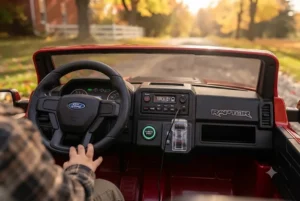
Where the TOBBI is generic-off-roader styling, the Best Choice Products Chevrolet Silverado buys you an officially licensed body — a scaled-down Silverado with a proper grille, a truck bed for storage, and the brand recognition that makes a five-year-old feel like they’re driving Dad’s actual truck. It runs a single 12V motor capped at 2.5 mph, with roughly an hour of runtime per charge, a Bluetooth speaker built into the dash, and a parent remote with forward/reverse and turning control.
What most buyers overlook about this model is that the low top speed is a feature, not a shortfall, for the 3-to-5 age range it’s actually built for — it’s slower than nearly everything else on this list, which is exactly what you want for a first-time driver still learning where the brake pedal lives. Aggregated review data (67 ratings, averaging 4.5 stars on major retail platforms at the time of research) skews positive, with parents specifically praising the accurate Silverado styling and the Bluetooth speaker as a genuine hit with kids; the recurring complaint is a fairly light overall build that isn’t meant for kids pushing toward the 66 lb weight cap.
Pros:
- ✅ Officially licensed Chevrolet Silverado design and badging
- ✅ Bluetooth speaker is a consistent reviewer favourite
- ✅ Lockable doors and seat harness for younger riders
Cons:
- ❌ 2.5 mph top speed feels slow past age 5
- ❌ Lighter-duty plastic than the dually and two-seat models
At around C$250-C$350, this is the pick when the styling and brand recognition matter as much as raw performance — a strong choice for the 12v ride on truck for kids search specifically aimed at younger toddlers.
3. JOYMOR 12V Two-Seater Ride On Truck — cheapest way to fit two kids
The JOYMOR 12V Two-Seater Ride On Truck solves a specific problem: most 12V trucks are single-seat, and most two-seat trucks jump straight to premium pricing. JOYMOR splits the difference with dual bucket-style seating rated for either two toddlers together or one bigger child solo, a 110 lb weight capacity, three drive speeds, and both a 2.4G parent remote and manual foot-pedal control for the kids themselves.
Here’s what to weigh with this one: spreading a 12V single-motor system across two seats means less power per rider than a dedicated two-motor build, so acceleration on grass or a slight incline is noticeably softer than the pricier two-seaters further down this list. Reviewers consistently note that the truck runs well on flat pavement and driveways but bogs down faster than expected once a second, heavier passenger climbs in — a fair trade at this price, but worth knowing going in. It also carries the same 1-2 hour runtime typical of entry 12V builds, which is on the shorter end for a truck meant to entertain two kids at once.
Pros:
- ✅ True two-seater layout at a single-seat price point
- ✅ Both foot-pedal and remote control modes included
- ✅ Adjustable seatbelts and working LED headlights
Cons:
- ❌ Noticeably slower with two riders aboard
- ❌ Shorter runtime than dedicated two-motor trucks
Priced in the C$250-C$350 range, this is the budget answer to the two-seater electric toy trucks search — just keep expectations realistic about hill performance with both seats full.
4. Costzon 12V Licensed Toyota Ride On Truck with Electric Dump Bed — best for hauling and sand play
This is where the ride on trucks with cargo bed search finds its natural home. The Costzon Licensed Toyota Ride On Truck pairs an officially licensed Toyota pickup body with a genuinely functional electric dump bed — push a button and the bed tilts to unload sand, blocks, or a wagon-load of pinecones, then an openable tailgate lets everything spill out cleanly. Dual 25W motors (an upgrade over the single-motor budget trucks above) push speeds from 1.9 to 3.7 mph, with a 2.4G remote offering three speed levels plus an emergency stop for parents.
The spec sheet won’t tell you this, but user reports suggest the electric dump function is the single biggest driver of long-term play value in this category — kids treat it less like a car and more like a piece of construction equipment, which extends interest well past the usual “drives it twice, forgets about it” pattern of simpler ride-ons. ASTM and CPSIA certification is standard across the Costzon lineup, and reviewers frequently mention the dual-motor setup handling grass and mild inclines better than comparable single-motor trucks in this price bracket, though a few note the dump-bed mechanism is delicate enough that rough handling by an unsupervised sibling can jam it.
Pros:
- ✅ Working electric dump bed with openable tailgate
- ✅ Dual 25W motors outperform single-motor budget trucks
- ✅ Officially licensed Toyota styling and detailing
Cons:
- ❌ Dump mechanism needs gentle handling to avoid jamming
- ❌ Single-seat only, despite the higher price point
Expect to pay in the C$300-C$400 range — genuinely good value if hauling and dumping is the actual play pattern you’re buying for.
5. Costzon 2-Seater Dump Truck — best cargo bed for two kids
Take everything that makes the Toyota dump truck appealing and add a second seat: the Costzon 2-Seater Dump Truck is built as an off-road UTV-style body with a 110 lb combined weight capacity, an automatic tilting dump bed, an included shovel, and — a genuinely clever touch — a rocking mode on the 12V version that lets kids sway back and forth between drives. Four spring-suspended wheels and a rechargeable battery round out the build.
Based on the spec comparison, this model’s real advantage over the single-seat Costzon Toyota above isn’t raw power, it’s the social play pattern: two kids can load and unload a dump bed together, which is a genuinely different (and often longer-lasting) kind of engagement than one kid driving solo laps around the yard. Aggregated review sentiment describes the build as sturdy for its price class, with the automatic dump mechanism and shovel accessory called out repeatedly as favourites for sandbox and yard-cleanup play; a recurring caution in reviews is that the rocking mode and dump function both add moving parts, so gentle supervision during the first few uses helps avoid pinched fingers.
Pros:
- ✅ Automatic dump bed plus included shovel for real hauling play
- ✅ Two-seat layout with a 110 lb combined capacity
- ✅ Rocking mode adds a second play mode between drives
Cons:
- ❌ More moving parts mean more things that can eventually wear out
- ❌ Best suited to yard and grass use, less so pavement-only driveways
At roughly C$350-C$450, this is the strongest pick on this list for two kids who both want cargo-bed duty rather than just a back seat.
6. Kid Trax Ram 3500 Dually Longhorn Edition — best for realistic hauling detail
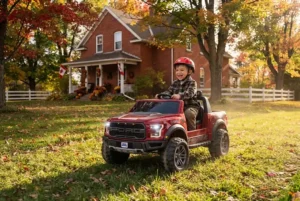
The Kid Trax Ram 3500 Dually Longhorn Edition goes further into realism than any other truck here: dually rear wheels (four tires across the back axle, just like the real thing), a manual dump bed with an opening tailgate, simulated turbo-diesel engine sound that responds to the foot pedal, and a Longhorn-style interior with mock-wood dash trim and western-stitched seats. It’s a single forward speed (up to 5 mph) plus reverse, running on a 12V system with Kid Trax’s one-step “Direct Connect” charging port.
What most buyers overlook here is that “manual” dump bed is deliberate, not a missed feature — Kid Trax builds it that way so kids physically lift and dump cargo themselves, which turns loading sand or leaves into a hands-on activity rather than a button-press. Reviewers consistently report that the engine-sound simulation is a genuine hit with kids who’ve ridden in a real diesel truck, and that the two-seater bench comfortably fits a wider age range than expected — families report use from age 2 well into 5 or 6. The recurring complaint across aggregated feedback involves assembly difficulty, with several reviewers noting the doors and grille require more force and patience to install correctly than expected, and one notable pattern of reports describing a smaller-than-expected included battery for a truck of this size.
Pros:
- ✅ Realistic turbo-diesel engine sound tied to the pedal
- ✅ Manual dump bed with real opening tailgate
- ✅ Dually rear wheel styling stands out from every other model here
Cons:
- ❌ Assembly reported as more difficult than average
- ❌ Included battery runs smaller than the truck’s size suggests
Priced around C$350-C$450, the Ram 3500 Dually earns its spot for families who want the single most detail-rich pickup on the market, dump bed included.
7. Rollplay 12V Chevy Silverado Two-Seat — best overall build quality
Closing out the list, the Rollplay 12V Chevy Silverado Two-Seat is the truck to buy when budget is less of a constraint than durability. It runs two forward speeds (2.5 and 5 mph) plus a 2.5 mph reverse, with real opening front doors, chrome trim details, a backlit dashboard, working speakers, an MP3 connector, and a rated weight capacity around 130 lbs — comfortably the highest ceiling on this list, which matters for two-seaters expected to survive a wider age range.
On paper, this means the Rollplay is built to be handed down between siblings rather than retired after one child outgrows it, and the aggregated review picture backs that up: feedback consistently highlights the doors, chrome trim, and dashboard lighting as noticeably more “finished” than the plastic-heavy budget trucks earlier on this list. What the spec sheet won’t tell you is that the two-speed system (rather than a single fixed top speed) gives parents genuine room to dial performance up as a child’s confidence grows, instead of buying a second truck later. The main critique in reviewer feedback is straightforward: at this price, expectations run higher, and a small number of buyers note the assembled weight (nearly 70 lbs) makes moving the truck in and out of a garage a two-person job.
Pros:
- ✅ Two forward speeds let performance grow with the child
- ✅ Highest weight capacity of any truck on this list
- ✅ Real opening doors, chrome trim, and backlit dash
Cons:
- ❌ Highest price point in this roundup
- ❌ Nearly 70 lbs assembled — awkward to move solo
Expect a price in the C$400-C$500 range for the Rollplay Chevy Silverado — the truck to choose when “buy once” matters more than shaving costs upfront.
Practical Usage Guide: Setup, Break-In, and the First 30 Days
Getting a 12v power wheels truck right starts before the first drive, and it’s worth a direct read of Health Canada’s own guidance on ride-on toy safety before the truck ever comes out of the box — it specifically flags that only adults should install and charge batteries, since mismatched battery types or improper installation can overheat, and that a child on a ride-on toy can move faster than expected, so clearing furniture, cords, and drop-offs like stairs or pool edges from the play area matters before the first drive. On assembly day, resist the urge to skip straight to the fun parts: nearly every reviewer complaint across this list traces back to rushed assembly, particularly around the steering column and door hinges, which tend to work loose faster if they weren’t seated correctly to begin with. Budget 45-90 minutes, keep the included tools (not your own — factory hardware is often metric and undersized), and consider a drop of thread-locking compound on any bolt that will see repeated stress, like the steering column mount.
Before the first drive, fully charge the battery for the initial cycle — most 12V systems specify 8-18 hours for that first charge, longer than the routine top-up charges after. Set the truck up on a flat, open surface for the first few sessions so a new driver can learn the pedal and brake without navigating obstacles at the same time. During the first 30 days, the most common mistakes are letting the battery run down to empty repeatedly (it shortens lead-acid battery lifespan) and leaving the truck outside uncovered between uses, which speeds up UV fading and brittleness in the plastic body panels well before the motor itself gives out.
Maintenance from there is minimal but not optional: check tire and wheel bolts monthly for the first season, keep contacts on the charging port free of dirt, and store the battery at partial charge (never fully drained) if the truck goes unused for more than a few weeks — a detail particularly relevant for Canadian garages that swing from summer heat to winter cold.
✨ Don’t Miss These Exclusive Deals!
🔍 Take backyard driving to the next level with these carefully vetted picks. Click through to check current pricing and availability before you commit — a few minutes of comparison now can save a returned box later.
Real-World Scenarios: Matching a Truck to Your Family
The single-toddler household, budget under C$300: if you’ve got one three-year-old and a tight budget, the TOBBI 12V Off-Road Ride On Truck or the Best Choice Products Chevrolet Silverado both fit — TOBBI if rough terrain and off-road looks matter more, the Silverado if brand recognition and Bluetooth music win the day.
Siblings close in age who’ll fight over one seat: this is squarely a two-seater situation. The JOYMOR Two-Seater covers it on a budget; the Costzon 2-Seater Dump Truck covers it with a cargo bed thrown in for genuine shared play, not just shared seating.
The kid who’s obsessed with “real” trucks — construction, hauling, dump beds: both Costzon dump-bed models and the Kid Trax Ram 3500 Dually were built for exactly this profile. If manual, hands-on dumping matters more than a button press, the Kid Trax wins; if a push-button dump bed with less physical effort suits a younger driver, the Costzon Toyota is the better fit.
Multi-child households planning to hand a truck down over several years: the Rollplay Chevy Silverado Two-Seat is built with the highest weight capacity and most durable hardware on this list, which matters more than any other factor when a truck needs to survive more than one kid’s growth spurt.
How to Choose a 12V Power Wheels Truck
- Match top speed to age, not ambition. A 2.5 mph truck is right for a first-time three-year-old driver; a 5 mph two-speed truck like the Rollplay suits a more experienced six- or seven-year-old.
- Check the weight capacity against your child’s actual weight, with room to grow. Most 12V trucks cap between 60 and 130 lbs — buying near the ceiling shortens the truck’s useful life.
- Decide if a cargo bed is a feature you’ll actually use. If sandbox or yard-cleanup play is part of the plan, a dump-bed model like the Costzon Toyota earns its premium over a plain pickup body.
- Weigh single-seat versus two-seat honestly. Two-seaters split motor power across more weight, so expect softer acceleration unless the model runs dual motors.
- Factor in assembly tolerance. Licensed, detail-heavy trucks (Kid Trax, Rollplay) tend to need more patience at setup than simpler off-road builds.
- Look at battery runtime versus your actual play sessions. A 1-hour runtime is plenty for a driveway loop but tight for an afternoon at the park.
- Confirm parent remote control is included if a young or nervous driver is involved. It’s the safety net that turns a scary first drive into a manageable one.
Common Mistakes When Buying a 12V Ride On Truck
The most frequent mistake is buying purely on looks — a licensed body style is genuinely appealing, but it says nothing about motor count, weight capacity, or battery runtime, all of which matter more day-to-day. A close second is underestimating terrain: a truck rated for pavement and light grass will bog down fast on gravel, mulch, or anything with real incline, so matching the tire and suspension setup to your actual yard matters more than most listings suggest.
Parents also frequently skip checking whether a parent remote is included, then discover on day one that there’s no way to intervene if a toddler panics mid-drive. And a subtler mistake: buying the cheapest available two-seater without checking whether it runs one motor or two — a single-motor two-seater, like the JOYMOR above, is a perfectly reasonable choice at the right price, but it’s not a fair swap for a dual-motor build if two full-size kids will regularly ride together.
12V Ride-On Trucks vs Traditional Pedal-Powered Toys
| Factor | 12V Electric Ride-On Truck | Pedal-Powered Ride-On |
|---|---|---|
| Physical effort required | Minimal (foot pedal for on/off) | High (constant leg power) |
| Age range typically suited | 2-8 years | 3-10 years |
| Terrain capability | Grass, driveways, mild inclines | Pavement-focused |
| Best For | Younger kids, realistic “driving” feel | Older kids, active play, no charging needed |
| Ongoing cost | Battery charging, eventual battery replacement | None beyond initial purchase |
The trade-off here is fairly clean: electric trucks deliver a more realistic driving experience with almost no physical effort from the child, which suits younger drivers who don’t yet have the leg strength or coordination for a pedal-powered alternative. Pedal-powered ride-ons, by contrast, ask for more physical engagement and never need charging, which some parents specifically prefer as an active-play counterbalance to screen time. Neither option is objectively better — it comes down to whether you’re prioritizing the realistic “I’m driving” experience or the physical activity angle.
What to Expect: Real-World Performance
Specs on a box rarely translate cleanly into a Tuesday afternoon in the driveway, so here’s the practical translation. A 2.5 mph top speed, common across several trucks on this list, feels roughly like a brisk adult walking pace — plenty fast for a toddler to feel like they’re “driving,” slow enough that a parent can jog alongside without effort. Push into the 5 mph range offered by the Rollplay and Kid Trax models, and that becomes closer to a light jog for an adult to keep pace with — noticeably more thrilling for an older child, and worth the extra attention on flat, open ground.
Runtime numbers also deserve real-world translation: a 1-hour rated runtime rarely means one continuous hour of driving, since most play sessions involve stopping, restarting, and idling between bursts of actual movement — in practice, that 1-hour rating often stretches across an afternoon of intermittent play. Battery charge time, typically 8-12 hours, means these trucks are effectively an overnight-charge appliance; plan around that rather than expecting a quick top-up before an outing.
12V Power Wheels Trucks for Different Family Situations
For a single young driver just starting out, a lighter single-seat truck with a firm parent-remote override — the TOBBI or Best Choice Products Silverado — reduces both cost and the learning curve. For households juggling two similarly aged kids, a genuine two-seater removes the fight over turns entirely, provided the motor setup (single versus dual) matches how demanding two kids together will actually be on the hardware. For families where hauling and cargo play matter as much as driving, the dump-bed models turn the truck into more of an outdoor toolset than a vehicle, which tends to extend how long a child stays interested well past the novelty of simply driving in circles.
Long-Term Cost & Maintenance: What a Truck Actually Costs Over Time
The sticker price is only part of the total cost of ownership. Every 12V ride-on eventually needs a replacement battery — lead-acid units typically last one to two seasons of regular use before capacity noticeably drops, and a fresh 12V battery generally runs in the C$40-C$70 range at the time of research. Tires, especially on models with softer plastic treads, are the next most common wear item, alongside charger ports that can loosen with repeated plugging.
| Cost Factor | Typical Range (CAD) | Frequency |
|---|---|---|
| Replacement 12V battery | C$40-C$70 | Every 1-2 seasons |
| Replacement charger | C$20-C$35 | As needed |
| Replacement wheels/tires | C$15-C$40 per set | Occasional, heavy-use dependent |
Looking at the table, a truck in the C$250-C$350 range that needs a battery replacement after one season is still, on a per-use basis, comparable in value to a pricier C$450 truck that goes two full seasons before needing the same part. The real value calculation isn’t the upfront price alone — it’s upfront price divided by expected seasons of use, which is why the tougher-built Rollplay and Kid Trax models can work out cheaper per year of play despite costing more at checkout.
Features That Actually Matter (And Those That Don’t)
Motor count and weight capacity matter more than almost anything else on the spec sheet — they directly determine how the truck performs with an actual child aboard, on actual terrain, over actual months of use. A dump bed matters if hauling play is genuinely part of the plan, and matters far less if it isn’t. Parent remote control matters enormously for the youngest drivers and progressively less as a child gets confident.
What matters less than the marketing suggests: Bluetooth speakers and sound effects are genuinely fun on day one and largely ignored by week three, according to consistent patterns in aggregated reviewer feedback — nice to have, not worth paying a premium for alone. Similarly, chrome trim and cosmetic detailing look great in product photos but have no bearing on how the truck actually drives or how long it lasts.
Safety, Regulations & Compliance in Canada
In Canada, ride-on toys sold to consumers fall under the Canada Consumer Product Safety Act and the associated Toys Regulations, which set mechanical, electrical, thermal, and flammability requirements that manufacturers and importers are responsible for meeting before a toy reaches store shelves or an Amazon.ca listing — you can review the industry guide to these safety requirements directly from Health Canada. Look for ASTM and CPSIA certification callouts in the listing (most trucks in this roundup carry them), as they indicate the manufacturer has tested against recognized safety benchmarks for things like battery contacts, choking hazards, and structural stress.
Beyond the vehicle itself, certification claims on the box are worth a second glance — safety recalls in this exact category have previously involved battery chargers carrying unauthorized certification marks rather than problems with the trucks themselves, which is a detail worth checking before you assume every “certified” label is accurate.
Problem → Solution: Fixing Common Ride-On Truck Issues
Problem: the truck won’t hold a charge like it used to. This is almost always the battery reaching the end of its lifespan rather than a fault with the truck itself — a replacement 12V battery in the C$40-C$70 range typically restores full runtime.
Problem: the steering feels loose or wobbly. Nearly every truck on this list has reviewer feedback pointing to the steering column as the first part to loosen under repeated play; a properly tightened mounting bolt, occasionally reinforced with thread-locking compound, resolves this in most cases.
Problem: the truck struggles on grass or a slight incline. Single-motor trucks are simply underpowered for this compared to dual-motor builds like the Costzon Toyota — if terrain performance matters more than expected after purchase, it’s worth checking whether a motor upgrade kit exists for that specific model before assuming the truck is defective.
Problem: a dump bed or rocking mechanism has jammed. These moving parts typically fail from being forced past their intended range rather than from normal wear — check for obstructions first, and supervise younger kids the first few times they operate it solo.
Problem: the truck sat unused over winter and won’t start in spring. This is very often a fully drained battery rather than a mechanical fault; a full 8-18 hour charge cycle resolves it in the majority of cases reported by owners.
Problem: you’re not sure if your specific model or charger has ever been recalled. It’s worth a quick check of Canada’s public recalls and safety alerts database — past recalls in this exact toy category have involved chargers carrying unauthorized safety certification marks, so a two-minute search by brand name is time well spent.
Buyer’s Decision Framework
If your budget is under C$300 and you have one young toddler, choose a single-seat off-road or licensed-body truck like the TOBBI or Best Choice Products Silverado, because low speed and low cost matter more than durability at this stage. If you have two kids close in age, choose a genuine two-seater, and specifically choose a dual-motor model if both kids will regularly ride together, because a single motor spread across two riders under-delivers on hills and grass. If hauling, dumping, or sandbox play is part of your kid’s actual interests, choose a dump-bed model over a plain pickup, because the added play pattern extends real-world interest well past simple driving. If you’re buying with hand-me-down durability in mind across multiple kids or several seasons, choose the highest weight-capacity, most reinforced build on your shortlist — even at a higher upfront price — because the total cost per season of use tends to work out lower.
FAQ
❓ What age is a 12V power wheels truck good for?
❓ How fast do 12V ride-on trucks go?
❓ How long does a 12V power wheels battery last on a charge?
❓ Can two kids ride a two-seater electric toy truck at once?
❓ Are 12V ride-on trucks with a cargo bed worth the extra cost?
Conclusion
There’s no single best 12v power wheels truck — there’s a best truck for your specific kid, budget, and yard. For a first ride-on on a tight budget, the TOBBI 12V Off-Road Ride On Truck and Best Choice Products Chevrolet Silverado both deliver real value without overreaching on price. For families needing two seats, the choice comes down to whether cargo play matters (the Costzon 2-Seater Dump Truck) or budget rules everything (the JOYMOR Two-Seater). For hauling-obsessed kids, the Costzon Toyota and Kid Trax Ram 3500 Dually both deliver genuine dump-bed play, just through different mechanisms — push-button versus manual. And for families planning to hand a truck down across multiple kids or seasons, the Rollplay Chevy Silverado Two-Seat earns its higher price through noticeably tougher hardware and the highest weight capacity here.
Whichever you choose, the fundamentals matter more than the badge on the hood: match top speed and weight capacity to your actual child, decide honestly whether a cargo bed fits how they’ll play, and don’t skip the assembly and charging steps that keep these trucks running season after season.
✨ Ready to find the right truck for your driveway? Check current availability and pricing on the models above before they sell out for the season! 🚚
Recommended for You
- 12V Ride On Car With Rubber Tires And Remote: 7 Top Picks (2026)
- 12v Ride On Sports Car: 7 Top Picks for Canadian Kids in 2026
- 6v Ride On Tractor With Trailer: 7 Best Picks for 2026
Disclaimer: This article contains affiliate links. As an Amazon Associate, I earn from qualifying purchases. If you purchase products through these links, we may earn a small commission at no additional cost to you.
✨ Found this helpful? Share it with your friends! 💬🤗
