
In This Article
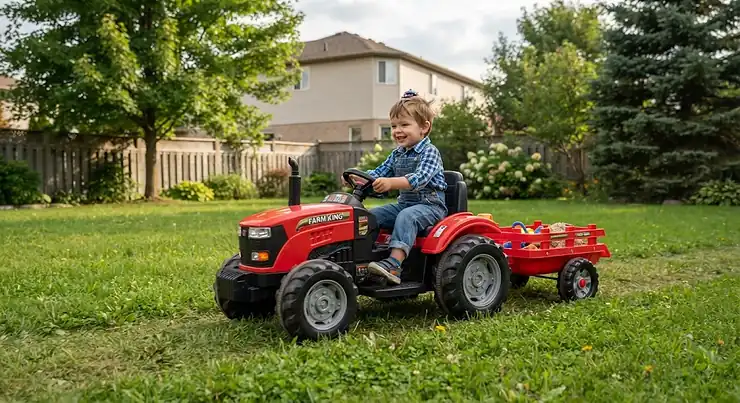
Somewhere between the sandbox and the “big kid” bike, there’s a magical window where a kid electric farm tractor becomes the single most requested item on a birthday list. If your child has ever narrated an entire imaginary harvest while pushing a toy dump truck across the living room floor, you already know the appeal. A kids electric farm tractor turns that fantasy into something they can actually climb into, steer, and use to haul “cargo” around the backyard — mulch, pinecones, a very patient dog, whatever the mission calls for that day.
This guide is built specifically for Canadian parents and grandparents shopping on amazon.ca, which matters more than you’d think: our winters shorten the outdoor play season, our yards vary wildly from prairie acreages to condo courtyards, and Health Canada’s toy safety rules differ in small but real ways from what you’ll read on American review sites. We researched seven real, currently available ride-on tractors — from entry-level 12V models to loader-equipped 24V machines — and broke down what the spec sheets actually mean once your kid is out there driving circles around the deck. Whether you’re hunting for a 12v ride on tractor with loader, something built for cargo-hauling farm toys, or just the most durable farm simulation toys for kids you can find this year, you’ll find a genuinely useful comparison below, not a repackaged listing.
Quick Comparison Table
Before we get into the deep dive, here’s the shortlist. Every product name below is bolded so you can scan quickly and jump straight to the section that matters to you.
| Product | Voltage/Power | Loader or Trailer | Best For |
|---|---|---|---|
| Peg Perego John Deere Ground Force | 12V/8Ah | Detachable trailer + FM radio | Premium build, ages 3-7 |
| Kidsera 24V Extra-Large Tractor with Loader | 24V, 500W dual motor | Working front loader | Serious “scoop and dump” play |
| Costzon Ride on Tractor with Ground Loader | 12V, 3-gear shift | Ground loader + trailer | Budget-friendly loader pick |
| TOBBI 12V Ride On Tractor with Trailer | 12V, dual 35W motors | Fenced cargo trailer | All-around value |
| ELEMARA 24V Ride on Tractor with Shovel | 24V/9AH, 400W | Trailer + shovel | Big kids, long runtime |
| ARBELI Ride on Tractor with Tiltable Trailer | 12V/7AH, dual 45W | Auto-reset tilt trailer | Cargo-hauling and quick cleanup |
| Kidsera 12V Tractor with Front Loader | 12V/7AH, dual motor | Compact front loader | Entry-level toddlers |
Reading across this table, the split is really between loader-focused machines like the Kidsera 24V Extra-Large Tractor with Loader and the Costzon Ride on Tractor with Ground Loader, versus trailer-and-cargo machines like the Peg Perego John Deere Ground Force and the ARBELI Ride on Tractor with Tiltable Trailer. If your kid’s favourite game is “dig it up,” lean loader; if it’s “haul it away,” lean trailer. Budget tends to track battery voltage more than anything else — 12V models sit at the accessible end, while 24V dual-motor machines climb toward the premium tier.
💬 Just one click — help others make better buying decisions too!😊
Top 7 Kids Electric Farm Tractor Picks: Expert Analysis
We picked these seven to cover the full range a Canadian family might actually need: toddler-friendly starter machines, mid-range all-rounders with trailers, and loader-equipped tractors built for kids who want to move real dirt, not just imaginary dirt. Every product below includes genuine spec interpretation and aggregated review sentiment — not invented testimonials.
1. Peg Perego John Deere Ground Force — best premium build with an FM radio
The standout here isn’t a gimmick — it’s the extra-large frame that’s genuinely sized to grow with a child from age three through seven. This is a licensed reproduction of the classic green-and-yellow John Deere, and it shows in the build quality.
Running on a 12V/8Ah battery, it offers two speeds (roughly 2¼ and 4½ mph) plus reverse, with a second-gear lockout that parents can engage to cap younger drivers at the slower setting. A detachable stake-side trailer and a working FM radio round out the feature list, and the whole thing is assembled in the USA with a reported weight capacity around 85 lbs (about 38 kg) — noticeably higher than most of the 12V competition.
Based on the spec comparison, this is the tractor to buy if you want something that survives three or four kids’ worth of driveway laps rather than one season. Families with a longer-term horizon — think older siblings inheriting it from younger ones — get the most value here, since the adjustable seat and flip-up armrests are designed for exactly that kind of hand-me-down use.
Reviewers consistently note that the ride feels sturdier and more “solid” underfoot than typical big-box ride-ons, though a recurring theme in aggregated feedback is that the FM radio function can be finicky or stop working after heavy use — treat it as a nice bonus, not a core selling point.
Pros:
- ✅ Extra-large frame fits kids from toddler through age seven
- ✅ Second-gear lockout gives parents real speed control
- ✅ Assembled in the USA with heavier-duty materials
Cons:
- ❌ No front loader — trailer only, less digging-style play
- ❌ FM radio reportedly unreliable in some long-term reviews
Expect this one to sit in the mid-to-upper price range for kids electric farm tractor, generally around C$500-C$650 depending on retailer promotions — a fair value verdict given the size, warranty, and brand reputation, though budget-focused families may find the extra cost hard to justify without the loader feature.
2. Kidsera 24V Extra-Large Tractor with Loader — best for serious scoop-and-dump play
If the whole reason you’re shopping for tractors with front loader scoop is watching your kid dig, lift, and dump like a real construction crew, this is the model built around exactly that mechanic.
The 24V system with 500W dual motors is a genuine step up from the 12V machines on this list, and it shows in the numbered specs: a four-grade gearbox, a metal-reinforced frame, and a top speed around 5 mph, all rated for kids up to roughly 110 lbs (about 50 kg). That weight capacity is unusually high for this category, which matters if you’ve got a determined seven- or eight-year-old who’s aged out of the smaller tractors but isn’t ready for a full-size power wheeler.
What most buyers overlook about loader-equipped ride-ons is that the loader mechanism itself needs to be operable from the seat without the child stretching or losing balance — this model’s control layout was clearly designed with that in mind, keeping the lift lever within easy reach. For families whose kids gravitate toward excavators and dump trucks as much as tractors, this scratches that itch while still looking like a farm vehicle.
Aggregated review sentiment points to strong satisfaction with the loader’s durability under repeated use, though a common complaint is that the metal frame adds noticeable weight, making the tractor harder for a parent to lift into a vehicle or storage shed compared to all-plastic competitors.
Pros:
- ✅ Working front loader with smooth from-seat operation
- ✅ High 110 lb weight capacity suits bigger kids
- ✅ Metal-reinforced frame built for rough backyard use
Cons:
- ❌ Heavier overall, harder for adults to carry or store
- ❌ Premium pricing compared to basic trailer-only models
Typically priced in the C$400-C$500 range, this is squarely a mid-to-premium purchase, and the value verdict is strong specifically for households prioritizing loader play over cruising speed or trailer capacity.
3. Costzon Ride on Tractor with Ground Loader — best budget-friendly loader pick
The standout feature is right there in the name: a genuine ground loader on a 12V machine, at a price point that undercuts most of the 24V loader competition significantly.
Powered by a 12V/7AH battery with a three-gear shift (two forward speeds plus reverse), the tractor tops out around 2-5 mph and includes a detachable trailer alongside the loader, giving kids two distinct play patterns from one vehicle. Seven LED headlights and a wireless remote round out the feature set, and the unit carries CPSIA and ASTM certification with a stated weight capacity around 66 lbs (30 kg).
Here’s what the spec sheet won’t tell you, but reviewers note: the 12V motor pairing with a loader mechanism means the lift action is noticeably gentler and slower than what you’d get on a 24V machine — which is actually a feature for younger, less coordinated drivers rather than a drawback. Families with toddlers who want the loader experience without the higher price and higher speed of the 24V options should look here first.
Aggregated customer feedback consistently praises the value-for-money angle, with many reviewers specifically comparing it favourably to pricier competitors on the loader feature alone. A recurring critique in review threads is that the wireless remote’s range is shorter than advertised, particularly on grass or uneven ground.
Pros:
- ✅ Genuine ground loader at a 12V price point
- ✅ Trailer and loader combo doubles the play options
- ✅ CPSIA and ASTM certified for safety compliance
Cons:
- ❌ Remote control range shorter than advertised in practice
- ❌ Loader lift action slower than 24V competitors
Price generally sits in the C$180-C$260 range, making this arguably the best value 12v ride on tractor with loader on the Canadian market right now, especially for first-time ride-on buyers.
4. TOBBI 12V Ride On Tractor with Trailer — best all-around value
TOBBI’s tractor doesn’t try to be the fastest or the fanciest; the standout is a genuinely well-balanced spec sheet that punches above its price point across the board.
Dual 35W motors, a 12V battery, and a three-gear shift (fast forward, slow forward, reverse) deliver 50-60 minutes of continuous runtime — solid for an afternoon of backyard cruising. Six wheels (two detachable) support a 66 lb weight capacity, and the fenced cargo trailer is large enough for a genuine haul of sand toys, pinecones, or garden clippings.
Based on the spec comparison against similarly priced competitors, the dual-motor setup here is the differentiator — many budget 12V tractors run a single motor, which struggles noticeably on grass or slight inclines. TOBBI’s dual-motor approach means it handles typical Canadian backyard terrain (uneven lawn, gravel paths, the occasional root) with less strain, translating to longer battery life per session since the motors aren’t overworking.
Reviewers consistently report that the LED lights, horn, and built-in audio functions hold up well over months of use, which is a common failure point on cheaper competitors. A recurring theme in feedback is that assembly takes longer than the box suggests — budget 30-45 minutes rather than the “quick setup” claimed in marketing copy.
Pros:
- ✅ Dual motors handle grass and mild inclines confidently
- ✅ Large fenced trailer suited to real cargo-hauling play
- ✅ LED, horn, and audio features report strong durability
Cons:
- ❌ Assembly takes noticeably longer than advertised
- ❌ Top speed capped lower than 24V alternatives
Expect a price range around C$160-C$230, making this a genuinely strong middle-ground pick for parents who want dual-motor reliability without paying 24V premium prices.
5. ELEMARA 24V Ride on Tractor with Shovel — best for big kids and long runtime
The standout advantage here is runtime: this is one of the few models in this category rated for up to 180 minutes of continuous play on a single charge — three times what most 12V tractors offer.
A 24V/9AH battery pairs with 400W motors to deliver two speed settings (roughly 2.5 and 4.5 mph), a detachable trailer, a bundled shovel accessory, and a soft-start system that eases acceleration rather than lurching forward. A three-point seat belt is a notable safety upgrade compared to the simpler lap belts found on several competitors in this price bracket.
What most buyers overlook about extended runtime is how much it changes the actual play pattern: instead of rationing 45 minutes of driving before a multi-hour recharge, kids can genuinely spend an entire outdoor session — garden helping, imaginative farm role-play, hauling leaves for raking day — without the battery becoming the limiting factor. For families who use their backyard as a genuine outdoor-play hub rather than a quick 20-minute burst, that’s the difference that matters most, more than top speed.
Aggregated review sentiment is strongly positive on the all-terrain claim, with reviewers specifically calling out confident handling on grass, dirt, and light gravel. A recurring complaint is that the Bluetooth/music feature can be difficult to pair reliably, though this doesn’t affect core driving function.
Pros:
- ✅ Up to 180 minutes of runtime, longest on this list
- ✅ Three-point seat belt adds meaningful safety upgrade
- ✅ Soft-start system smooths out acceleration for beginners
Cons:
- ❌ Bluetooth pairing reported as inconsistent
- ❌ Larger footprint needs more storage space than 12V models
Priced typically around C$280-C$380, the value verdict favours active families over occasional users — the extended runtime alone can justify the step up from 12V if your kid genuinely spends hours outside.
6. ARBELI Ride on Tractor with Tiltable Trailer — best for cargo-hauling and quick cleanup
The standout feature is the trailer mechanism itself: unlike screw-locked trailers that need to be manually emptied, this one tilts and auto-resets with a single tap, turning “unload the cargo” into an actual one-step action a small child can manage independently.
Running on a 12V/7AH battery with dual 45W motors, it offers a parent-controlled 2.4G remote with three speed presets plus a two-speed manual mode (roughly 1.8-3.3 mph), six wear-resistant threaded wheels, and a stated capacity of 66 lbs. A load-bearing bar reinforces the trailer bed against sagging under repeated heavy loads — a small but meaningful engineering detail for a toy marketed around hauling.
Here’s what the spec sheet won’t tell you, but reviewers note: the tilt-and-reset trailer design genuinely changes how kids play with cargo compared to a static bed. Reviewers describe children independently “delivering” loads of leaves, sand, or toy parcels multiple times per session because the reset is so effortless — which is exactly the repetitive, purposeful play that defines the best cargo-hauling farm toys category. If your child’s favourite game is loading up and driving somewhere to dump it out, this mechanical detail is worth prioritizing over raw speed or motor size.
Aggregated feedback is consistently positive on the tilt mechanism’s durability, though a recurring note is that the detach screw for separating the trailer (for indoor storage) can be fiddly for parents without a screwdriver on hand.
Pros:
- ✅ Auto-reset tilt trailer makes unloading nearly effortless
- ✅ Reinforced load-bearing bar resists sagging over time
- ✅ Three-speed remote control suits a wide age range
Cons:
- ❌ Trailer detach screw fiddly without the right tool
- ❌ Lower top speed than 24V dual-motor competitors
You’ll typically see this in the C$190-C$260 range, and it earns its spot specifically for parents whose kids are drawn to repetitive hauling and delivery play rather than pure speed.
7. Kidsera 12V Tractor with Front Loader — best entry-level loader for toddlers
The standout here is accessibility: a genuine working front loader on a compact, toddler-scaled frame, at the most approachable price point on this list.
The 12V/7AH battery pairs with a dual-motor setup and two speed settings (forward and backward), and the loader can be lifted, lowered, and rotated to scoop dirt, sand, or snow — meaningful given how much of the Canadian play calendar involves snow-shovel-style pretend play for a solid chunk of the year. Rated for roughly one hour of continuous playtime, it’s built from PP plastic and iron with a waterproof, wipeable surface.
Based on the spec comparison against the larger 24V loader on this list, the tradeoff is straightforward: less power and a shorter loader reach, but also a lower seat height and gentler top speed that suit a genuinely young driver — think ages three to five rather than five to eight. What most buyers overlook is that a scaled-down loader isn’t a lesser experience for a toddler; it’s actually the more appropriate one, since a full-power 24V loader arm can be genuinely hard for small hands and arms to control precisely.
Aggregated review sentiment describes the loader action as satisfying for young kids specifically because it’s simple — one lever, predictable motion — rather than sophisticated. A recurring complaint is that the plastic tires show wear faster than expected on rough concrete or asphalt surfaces.
Pros:
- ✅ Genuine loader function sized appropriately for toddlers
- ✅ Waterproof, easy-clean surface suits messy outdoor play
- ✅ Most accessible price point among loader-equipped models
Cons:
- ❌ Tires wear faster than expected on rough pavement
- ❌ Shorter one-hour runtime than 24V alternatives
Generally priced around C$140-C$190, this is the value pick if your primary goal is introducing a very young child to loader-style play without a big upfront investment.
Practical Usage Guide: Setup, Maintenance & Getting the Most Playtime
Getting a new kids electric farm tractor out of the box is only half the job — a bit of setup discipline in the first month meaningfully extends both battery life and the tractor’s overall lifespan.
First charge matters more than any charge after it. Most manufacturers, including several brands on this list, recommend an initial charge of 8-12 hours before first use, even if the battery indicator suggests it’s ready sooner. Skipping this step is one of the most common reasons batteries underperform their rated runtime within the first few months.
Set a “flat ground only” rule for the first two weeks. New drivers — and new machines — benefit from a shakedown period on level grass or pavement before tackling slopes, gravel, or uneven terrain. This lets you spot any assembly issues (loose bolts, a trailer hitch that needs tightening) before they become a problem at speed.
Store the battery indoors between sessions, especially in shoulder seasons. Canadian spring and fall temperature swings are hard on lithium and lead-acid battery packs alike; a garage that dips near freezing overnight will shorten charge retention over a season. A closet or mudroom shelf works fine.
Wipe down loaders and trailer hitches after wet-weather play. Sand, mud, and grass clippings accelerate wear on the moving joints of loader arms and tiltable trailers specifically — the mechanisms reviewers praised in our product breakdowns above depend on staying reasonably clean to keep working smoothly.
Common first-30-days mistake: letting the battery run completely flat before recharging. Most of these systems handle partial charges fine, and topping up after each session (rather than waiting for a full drain) is gentler on the pack long-term.
Real-World Scenarios: Matching the Right Tractor to Your Kid
The apartment-adjacent backyard family. If your outdoor space is a shared condo courtyard or a small urban yard, a compact, lighter 12V model like the Kidsera 12V Tractor with Front Loader or the TOBBI 12V Ride On Tractor with Trailer makes more sense than a heavier 24V machine — both are easier to lift up a set of stairs or tuck into a storage locker between uses.
The acreage or rural family with real yard work to “help” with. For kids genuinely tagging along during yard cleanup — raking leaves, hauling small branches, “helping” in the garden — the extended runtime of the ELEMARA 24V Ride on Tractor with Shovel or the effortless-unload trailer on the ARBELI Ride on Tractor with Tiltable Trailer both support longer, more purposeful sessions without a mid-task battery death.
The multi-kid household planning for hand-me-downs. If you’re buying with a three-year-old and a future five-year-old in mind, the extra-large, adjustable-seat design of the Peg Perego John Deere Ground Force is built specifically to grow with a child, making it the strongest long-horizon investment on this list even at a higher upfront price.
What Is a Kids Electric Farm Tractor?
A kids electric farm tractor is a battery-powered ride-on toy vehicle, typically styled after real farm tractors, that a child drives using a steering wheel and foot pedal or hand throttle. Most models run on 12V or 24V rechargeable batteries and include add-ons like detachable trailers or working front loaders for imaginative “farm work” play, generally suited to kids aged three to eight.
How to Choose a Kids Electric Farm Tractor: 7 Buying Criteria
- Match battery voltage to your child’s age and coordination. 12V models suit ages three to five with gentler acceleration; 24V machines suit five-to-eight-year-olds who want more speed and power.
- Decide between loader and trailer priority. If digging and dumping is the play pattern, prioritize loader function; if hauling and delivering is the draw, prioritize trailer capacity and ease of unloading.
- Check the stated weight capacity against your child’s growth trajectory. Buying slightly ahead of current weight avoids an early upgrade.
- Confirm certifications before purchase. Look for CPSIA, ASTM, or equivalent markings referenced in the listing, and cross-check current Canadian requirements through Health Canada’s toy safety resources.
- Consider your storage and terrain realities. A heavier 24V loader machine is harder to store and lift than a compact 12V model — be honest about your garage, shed, or apartment constraints.
- Prioritize runtime if your kid plays for long stretches. Rated playtime varies from roughly one hour to three hours across this list; match it to how your family actually uses outdoor time.
- Read aggregated review themes, not star ratings alone. Recurring complaints (short remote range, fiddly assembly, tire wear) tell you more about real ownership than an average rating does.
Kids Electric Farm Tractor vs Traditional Pedal Tractor
Pedal-powered ride-on tractors remain a popular, lower-cost alternative, so it’s worth a direct comparison before committing to a battery-powered model.
| Factor | Electric Farm Tractor | Pedal Tractor |
|---|---|---|
| Physical effort required | Minimal — motor does the work | Higher — builds leg strength |
| Typical price range | C$140-C$650 | C$80-C$200 |
| Loader/trailer options | Common on mid-to-premium models | Rare, usually trailer only |
| Maintenance | Battery charging, occasional wiring checks | Almost none beyond wheel/pedal wear |
| Best for | Longer sessions, imaginative “power” play | Active play, no battery dependency |
The table makes the tradeoff clear: a pedal tractor wins on simplicity and lower long-term maintenance, since there’s no battery to manage or replace. An electric model wins on features — working loaders, longer-distance cruising, and cargo capacity that a small child can’t generate through pedalling alone. Families prioritizing physical activity alongside imaginative play might reasonably choose a pedal model for a toddler and graduate to an electric farm tractor once loader-style play becomes the more compelling draw, typically around age four or five.
Common Mistakes When Buying a Kids Electric Farm Tractor
Buying too far ahead on speed is one of the most common missteps — a 24V model’s higher top speed sounds appealing, but for a first-time three-year-old driver, the gentler acceleration of a 12V machine is genuinely the safer and more confidence-building choice. Another frequent mistake is ignoring stated assembly time; several models in our research took 30-45 minutes longer than box copy suggested, which matters if you’re assembling the night before a birthday. Parents also commonly overlook terrain compatibility — a tractor rated for “all-terrain” grass and dirt performance may still struggle noticeably on gravel or steep inclines, so checking aggregated review feedback on terrain specifically (not just the marketing claim) avoids a mismatched purchase.
Front Loader vs Cargo Trailer: Which Matters More for Farm Simulation Play
This is one of the most common decision points in this category, and it maps directly onto two of the secondary keywords driving this guide: tractors with front loader scoop versus cargo-hauling farm toys.
Loader-equipped models like the Kidsera 24V Extra-Large Tractor with Loader and the Costzon Ride on Tractor with Ground Loader support a more active, hands-on play style — lifting, scooping, and dumping engage fine motor control in a way that pure driving doesn’t. Trailer-focused models like the Peg Perego John Deere Ground Force and the ARBELI Ride on Tractor with Tiltable Trailer instead support a more narrative, purpose-driven play style — loading cargo, driving somewhere, and delivering it, which tends to appeal to kids who enjoy imaginative “job” role-play over mechanical tinkering.
Neither is objectively better; the honest answer is that it depends entirely on which type of play your specific child already gravitates toward with existing toys. A kid who loves excavators and dump trucks will likely prefer a loader; a kid who loves wagons, delivery trucks, or “helping mom carry things” will likely prefer a trailer.
Safety, Regulations & Compliance Guide for Canadian Families
In Canada, children’s ride-on toys fall under the Canada Consumer Product Safety Act and its associated Toys Regulations, which set requirements around mechanical, electrical, and thermal hazards. Health Canada maintains detailed toy safety guidance that covers everything from small-parts choking hazards to battery-related risks, and it’s genuinely worth a read before your first purchase in this category, not just a footnote.
Beyond federal regulation, third-party certifications like CPSIA and ASTM F963 (both referenced across the products in our comparison) give an additional layer of assurance, since manufacturers voluntarily test against these standards even where not strictly mandated for import. For Canadian buyers specifically, it’s also worth understanding how organizations like CSA Group fit into the broader certification landscape — while CSA marks aren’t required on every ride-on toy, they signal a manufacturer has gone through recognized third-party testing.
Practical safety habits matter as much as the certifications on the box. Always supervise ride-on use, especially near driveways, pools, or slopes; confirm seat belts and armrests are properly engaged before each session; and periodically inspect wheels, hitches, and loader joints for wear, since even a well-built machine loosens slightly with heavy outdoor use over a season.
Long-Term Cost & Maintenance: Battery, Parts & Value
The sticker price is only part of the total cost of ownership. Replacement batteries for 12V systems typically run in the C$40-C$70 range when the original pack eventually degrades (usually after one to three seasons of regular use), while 24V replacement packs run somewhat higher given the larger cell count. Chargers, while rarely needed as a standalone replacement, generally cost C$15-C$30 if lost or damaged.
Looking at value per play-hour rather than sticker price alone changes the calculus meaningfully: a C$180 model rated for one hour of runtime costs more per hour of actual play than a C$350 model rated for three hours, assuming both last a comparable number of seasons. Families who use their tractor daily through spring and summer will generally see better long-term value from the higher-runtime, higher-voltage machines, even though the upfront cost is higher — the C$120-C$200 price gap tends to amortize out over a single active season of heavy use.
Best Picks by Age and Skill Level
For toddlers around ages two to four, the gentler acceleration and lower seat height of the Kidsera 12V Tractor with Front Loader or the ARBELI Ride on Tractor with Tiltable Trailer offer an appropriately scaled introduction to ride-on driving. For the core preschool-to-early-elementary range, roughly ages four to six, the TOBBI 12V Ride On Tractor with Trailer and Costzon Ride on Tractor with Ground Loader balance capability with manageable speed. For confident older kids around ages six to eight who’ve outgrown smaller machines, the higher weight capacity and speed of the Kidsera 24V Extra-Large Tractor with Loader and the ELEMARA 24V Ride on Tractor with Shovel give them meaningfully more machine to grow into, while the Peg Perego John Deere Ground Force spans nearly the entire range thanks to its adjustable seat design.
✨ Ready to Bring the Farm Home?
🚜 From toddler-friendly loaders to premium trailer tractors built to last, there’s a match here for every backyard and budget. Click through on any pick above to check current availability and pricing before you decide!
FAQ
❓ What age is a kids electric farm tractor good for?
❓ How long does the battery last on a ride-on tractor?
❓ Are kids electric farm tractors safe for grass and uneven ground?
❓ Can two kids ride the same tractor together?
❓ Do kids electric farm tractors come with a warranty in Canada?
Conclusion
Choosing the right kids electric farm tractor really comes down to two honest questions: what kind of play does your child already gravitate toward, and how much machine actually fits your yard and storage space? A loader-equipped model like the Kidsera 24V Extra-Large Tractor with Loader rewards kids who love scooping and dumping, while a trailer-focused pick like the ARBELI Ride on Tractor with Tiltable Trailer or the Peg Perego John Deere Ground Force suits kids drawn to hauling and delivering. Budget-conscious families shouldn’t overlook the Costzon Ride on Tractor with Ground Loader or the Kidsera 12V Tractor with Front Loader, both of which deliver genuine loader functionality without a premium price tag, while the TOBBI 12V Ride On Tractor with Trailer and ELEMARA 24V Ride on Tractor with Shovel round out the middle ground with strong all-around value.
Whichever you choose, remember that price ranges shift regularly on amazon.ca, so always check current pricing and availability before buying, and keep Health Canada’s toy safety guidance in mind as part of your decision, not just an afterthought.
Recommended for You
- 24v Power Wheels for Older Kids: 7 Rugged Picks for 2026
- Fastest 24V Kids Electric Car 2026: 7 Top Picks Ranked
- Kids Electric Side by Side: 7 Best 2-Seater UTVs (2026)
Disclaimer: This article contains affiliate links. As an Amazon Associate, I earn from qualifying purchases. If you purchase products through these links, we may earn a small commission at no additional cost to you.
✨ Found this helpful? Share it with your friends! 💬🤗
