
In This Article
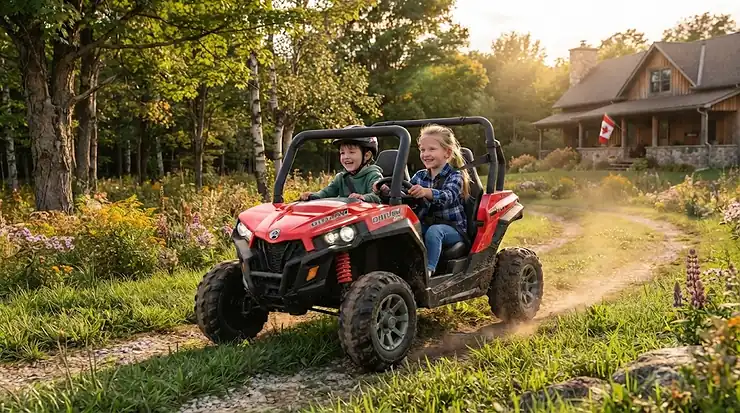
Somewhere in every Canadian backyard, there’s a patch of grass that’s about to get a lot more interesting. That’s the promise of a kids electric side by side: two seats, a steering wheel just big enough for small hands, and a battery pack that turns a Saturday afternoon into an expedition. If you’ve got two kids who fight over literally everything — the remote, the last waffle, whose turn it is on the swing — a two-seater changes the math. Nobody has to wait their turn when there’s room for both of them right there, side by side.
But here’s the thing nobody tells you before you start scrolling through listings: “kids electric side by side” covers an enormous range of machines, from C$250 entry-level ride-ons with a single motor to C$500+ dual-motor UTVs with real suspension and 4WD-style traction. Get the match wrong and you’ll either overpay for features your driveway never needs, or undershoot and watch the thing bog down the first time it meets a slope.
This guide breaks down seven real, currently available models — pulled from actual product listings, not guesswork — across budget, mid-range, and premium tiers. Every entry gets honest commentary on what the spec sheet means once wheels hit gravel, plus aggregated review sentiment where it’s verifiable. As the Wikipedia entry on side-by-side vehicles explains, the “side by side” name comes from the bucket-seat layout borrowed from full-size UTVs — and that same layout is exactly what makes the kids’ versions such a hit for siblings and best friends who want to ride together, not one after the other.
Quick Comparison Table
| Model | Voltage / Power | Max Speed | Runtime | Best For |
|---|---|---|---|---|
| Best Choice Products Honda Talon | 24V dual motor | 4.4 mph | ~90 min | Premium licensed off-road look |
| Best Choice Products Range Rover Sport | 24V dual motor | 4 mph | ~120 min | Longest playtime, luxury styling |
| MOEYURO 800W UTV | 24V, 800W | 5 mph | ~60-75 min | Speed and multimedia features |
| Funride/Joyracer 2 XL Seater UTV | 24V, 4×100W | 4.9 mph | ~45-90 min | 4WD-style traction on rougher yards |
| Aosom 12V Off-Road Truck | 12V, 4-motor | ~2.5 mph | ~45 min | Budget 4-motor pull on grass |
| Costway 12V 2-Seater UTV | 12V single-speed range | ~2.5 mph | ~45-60 min | First-time buyers, younger toddlers |
| OLAKIDS 12V Dump Bed UTV | 12V | 2-4 km/h | ~45 min | Functional play with cargo dumping |
Look closely and a pattern jumps out: the jump from 12V to 24V isn’t just a bigger number on the box — it’s roughly double the usable torque, which matters enormously the moment your driveway isn’t dead flat. The Best Choice Products Honda Talon and Range Rover Sport sit at the top of the price range specifically because dual 24V motors and longer runtimes cost more to build reliably. Meanwhile, the 12V entries like the Costway 12V 2-Seater UTV and OLAKIDS 12V Dump Bed UTV trade outright power for a gentler learning curve — ideal if your kids are closer to three than seven.
💬 Just one click — help others make better buying decisions too!😊
Top 7 Kids Electric Side by Side UTVs: Expert Analysis
1. Best Choice Products Honda Talon 24V 2-Seater — officially licensed off-road styling
The standout here is the licensing deal: this isn’t a generic UTV shape with a sticker slapped on, it’s built to mirror the actual Honda Talon body lines, down to the wide fender flares. That licensing tends to matter more to parents than kids, honestly, but it does translate into better panel fit and fewer flimsy plastic seams than unlicensed knockoffs.
Under the hood you get a 24V battery system feeding dual motors, good for roughly 90 minutes of continuous runtime and a top speed around 4.4 mph — quick enough to feel adventurous, slow enough that a parent jogging alongside can still catch up. The extra-wide two-person bench seat is rated to handle two average-sized kids without the sag you sometimes get on narrower budget models.
Based on the spec comparison against its closest rivals, this is the pick for families who want the “real UTV” aesthetic and don’t mind paying a premium for brand licensing and build quality. Reviewers consistently report that the parent-remote override is one of the most-used features in the first month, since it lets a nervous new driver get comfortable before taking full manual control.
Pros:
- ✅ Officially licensed Honda Talon styling and proportions
- ✅ Strong 90-minute runtime for extended backyard sessions
- ✅ Dual-motor 24V setup handles mild inclines confidently
Cons:
- ❌ Premium licensing pushes it to the top of the price range
- ❌ Assembly reportedly takes longer than simpler single-motor models
Priced in the C$300-C$400 range at the time of research, the Best Choice Products Honda Talon earns its spot through build quality and runtime rather than raw novelty — check current price before deciding, since promotions shift often.
2. Best Choice Products Range Rover Sport 24V 2-Seater — longest runtime in this lineup
What immediately stands out is the 120-minute runtime claim — a genuine outlier among 24V kids’ UTVs, most of which land closer to 60-90 minutes. That extra hour matters more than people expect on long weekend visits to the cottage, where the last thing you want is a dead battery at the two-hour mark of a family gathering.
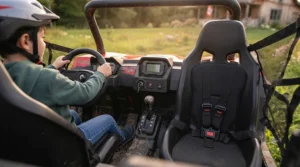
The licensed Range Rover Sport body brings a more “SUV” silhouette than the boxier UTV-style competitors, with two preset speeds (2 mph and 4 mph) and dual 24V motors driving the rear wheels. Weight capacity sits around 132 lbs combined, which comfortably covers two kids in the 3-8 age bracket the manufacturer targets.
Here’s what most buyers overlook about the licensed luxury models: the styling premium doesn’t just mean cosmetics — the extra plastic thickness on body panels tends to hold up better against driveway scrapes than thinner unlicensed shells. Aggregated review sentiment across major retailers points to the adjustable seat harnesses and LED headlights as consistent high points, with occasional complaints about assembly instructions being terse.
Pros:
- ✅ Class-leading ~120-minute runtime on a single charge
- ✅ Individual adjustable harnesses for each seat
- ✅ Licensed Range Rover Sport detailing and LED lighting
Cons:
- ❌ Assembly instructions are reportedly light on detail
- ❌ Top speed of 4 mph is modest versus higher-wattage rivals
Expect a price in the mid-C$300s to C$400s range; given the runtime advantage, the Best Choice Products Range Rover Sport offers strong value-per-minute-of-play even if it isn’t the fastest option here.
3. MOEYURO 800W 24V 2-Seater UTV — quickest top speed on this list
The 800W motor output is the headline feature, and it shows: this model tops out around 5 mph, noticeably brisker than most 24V competitors capped near 4-4.4 mph. On paper this means faster acceleration off the line and better hill-holding when two kids are aboard rather than one.
Three selectable speed settings let parents dial things back for a first ride and open things up once confidence builds, while spring suspension on all four wheels smooths out the bumps that would otherwise rattle a rigid-frame ride-on. Bluetooth audio, an included remote, and full LED lighting round out a feature set that reads more like a premium electric go-kart than a toy.
What the spec sheet won’t tell you, but reviewers note, is that the extra speed demands a slightly larger supervised play area — a small backyard can feel tight at 5 mph with two riders aboard. This one rewards families with more open space, like a driveway loop or a large fenced yard, rather than a cramped patio.
Pros:
- ✅ Fastest top speed (5 mph) in this comparison
- ✅ Three selectable speed modes for gradual confidence-building
- ✅ Full spring suspension smooths rough grass and gravel
Cons:
- ❌ Higher top speed needs a larger supervised play area
- ❌ Shorter runtime (roughly 60-75 minutes) than the licensed models above
In the C$350-C$450 range at typical listing prices, the MOEYURO 800W UTV is the speed-and-features pick for families with room to let it stretch its legs.
4. Funride/Joyracer 2 XL Seater 24V UTV — best traction for uneven ground
Four independent 100W motors — one per wheel — is the standout advantage here, and it’s a genuinely different approach from the single-motor or dual-motor layouts used elsewhere on this list. Four-corner power means better traction on grass, light gravel, or a slightly sloped lawn, since no single wheel has to do all the work when the surface gets uneven.
The 7Ah battery pairs with those four motors for a claimed 45-90 minute runtime window depending on terrain and how enthusiastically the kids drive, and dual control options — a foot pedal for the driver, a 2.4GHz remote for parents — keep both generations happy. Extra-large bucket-style seats accommodate a wider age and size range than some of the narrower competitors.
Based on the spec comparison, this is the practical choice for households whose “backyard” is really more of a side-yard-with-a-slope, a gravel driveway, or a mixed-terrain rural property. Aggregated feedback highlights the Bluetooth speaker quality as a pleasant surprise and flags the plastic wheel treads as the first wear point on rougher surfaces.
Pros:
- ✅ Four independent motors improve traction on uneven ground
- ✅ Dual control: foot pedal for kids, remote for parents
- ✅ Extra-large XL seats fit a wider size range
Cons:
- ❌ Runtime varies significantly with terrain (as low as 45 min)
- ❌ Plastic wheel treads wear faster on gravel than on grass
Typically listed in the C$280-C$380 range, the Funride/Joyracer 2 XL Seater UTV is the value pick for anyone whose yard isn’t perfectly flat.
5. Aosom 12V Off-Road Truck — most motors for the price
It’s easy to assume 12V means “underpowered,” but the Aosom 12V Off-Road Truck pushes back on that with a genuine four-motor rear-wheel-drive layout — unusual at this voltage and price point. That extra motor count compensates for the lower 12V ceiling, giving noticeably better pull on grass than single-motor 12V rivals.
Two wide seats with safety belts, four 15.75-inch traction wheels with spring suspension, and a full media centre (USB, Bluetooth, MP3, aux) round out a spec sheet that punches above its voltage class. Continuous drive time runs up to 45 minutes depending on speed selected — modest, but reasonable for a shorter attention-span age group.
Here’s what most buyers overlook: a four-motor 12V setup often out-pulls a lazier dual-motor 24V unit on soft grass, simply because torque is distributed across more contact points. Reviewers commonly mention the dual steering options (in-car wheel or remote) as genuinely useful for the youngest drivers who aren’t ready for full independence yet.
Pros:
- ✅ Rare four-motor drivetrain at 12V price point
- ✅ Dual steering: wheel-and-pedal or 2.4GHz remote
- ✅ Full multimedia centre with Bluetooth and USB input
Cons:
- ❌ 45-minute runtime is on the shorter side
- ❌ Lower top speed than 24V dual-motor competitors
Priced around C$250-C$330, the Aosom 12V Off-Road Truck delivers unusually strong traction for its entry-level price bracket.
6. Costway 12V 2-Seater UTV with Slow Start — gentlest learning curve
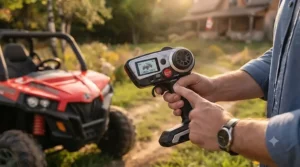
The slow-start function is the real headline feature — rather than lurching forward the instant the pedal is pressed, torque ramps in gradually, which matters enormously for a nervous first-time driver aged three or four. That single detail makes this one of the more toddler-friendly options in the 12V tier.
Two seats rated for a combined 130 lbs, three-point harnesses on each side, and lockable opening doors give it genuinely practical touches usually reserved for pricier models. One-button start, high/low speed selection, forward and reverse gears, and a working horn round out a feature list built around approachability rather than outright performance.
Based on the spec comparison, this is squarely the pick for families with younger children (roughly ages 2-5) or a nervous second child who’s watched an older sibling ride something faster and wants in — just more gently. Aggregated review sentiment consistently praises the slow-start ramp as reducing “jerky first rides,” with occasional notes that top speed feels modest for kids over six.
Pros:
- ✅ Slow-start ramp reduces jerky, scary first launches
- ✅ Lockable opening doors for easy in-and-out access
- ✅ 130 lbs combined weight capacity across two seats
Cons:
- ❌ Top speed feels modest once kids pass about age six
- ❌ 12V ceiling limits performance on slopes or thick grass
Generally found in the C$300-C$400 range, the Costway 12V 2-Seater UTV is the value-conscious choice for younger or more cautious first-time drivers.
7. OLAKIDS 12V Dump Bed UTV — functional play beyond just driving
The rear dump bed is what sets this one apart from every other entry on this list — it transforms the vehicle from a pure ride-on into something closer to a working toy truck, letting kids haul sand, leaves, or toys and then tip the bed to unload. That single feature adds a layer of imaginative, functional play that pure speed-focused models don’t offer.
Wide double seats, opening lockable doors, bright LED headlights and ambience lighting, and a rotatable steering wheel replicate real UTV controls at a 12V price point, while the soft-start function and four-wheel spring suspension keep the ride gentle for younger passengers. Two speeds (roughly 2-4 km/h) and dual control (child-driven or parent remote) match the approachable positioning of the Costway model above.
What most buyers overlook about dump-bed ride-ons is how much longer they extend outdoor play time — kids who tire of just driving in circles often shift into “job mode,” hauling material around the yard for twenty extra minutes. Reviewers commonly flag the included accessories (shovel, cones in some bundles) as a nice value-add versus competitors that charge extra for attachments.
Pros:
- ✅ Working dump bed adds functional, imaginative play
- ✅ Soft-start and spring suspension suit younger riders
- ✅ Dual control options for gradual independence
Cons:
- ❌ Lower top speed limits appeal for kids over age seven
- ❌ Dump-bed mechanism adds a moving part that needs occasional checks
Typically priced in the C$280-C$370 range, the OLAKIDS 12V Dump Bed UTV is the pick for families who want more than straight-line driving out of playtime.
Practical Usage Guide: First 30 Days With a Kids Electric Side by Side
Getting a new ride-on right on day one saves you a return-shipping headache later. Start with a full 8-12 hour initial charge before the first drive, even if the box says it arrived “pre-charged” — most 12V and 24V battery packs benefit from a complete top-up cycle to calibrate properly, and skipping this step is the single most common cause of disappointing early runtime.
For the first three or four sessions, keep the vehicle in its lowest speed setting regardless of which model you’ve chosen, including the faster MOEYURO 800W UTV. Let kids build steering confidence on flat, open ground — a driveway or level lawn — before introducing any incline or turf transition. Parents managing the remote override, standard on most of these models, should resist the urge to take over at the first wobble; a few corrected near-misses build far more driving skill than a parent doing all the steering from day one.
Maintenance in the first month is light but non-negotiable: wipe down wheels after grass or mud sessions so debris doesn’t work into wheel bearings, check that all bolts from assembly haven’t loosened after the first few rides (vibration settles hardware in quickly), and store the battery at roughly 50% charge if the vehicle will sit unused for more than two weeks, which extends long-term battery health noticeably. Common first-month mistakes include letting the battery fully drain repeatedly, charging overnight every single time rather than only when needed, and skipping the bolt-check after assembly.
Real-World Scenarios: Matching Siblings to the Right Ride
The competitive siblings, ages 5 and 7, suburban backyard. Two kids who race everything need a model that can genuinely go — the MOEYURO 800W UTV‘s 5 mph top speed and three-speed selector let the ride grow with their confidence, while its spring suspension keeps things smooth even when they’re pushing it. A fenced backyard or a quiet cul-de-sac gives enough room for the extra pace to feel exciting rather than cramped.
The nervous younger rider paired with a confident older sibling, ages 3 and 6. This is where slow-start technology earns its keep. The Costway 12V 2-Seater UTV ramps torque in gently enough for the three-year-old to feel in control, while the older sibling can flip to the higher of the two speed settings once they’re riding solo. Parent-remote override covers the gap when the younger one needs a confidence boost.
The rural or acreage family with an uneven yard. Flat pavement is a luxury not every Canadian property has. For sloped grass, gravel patches, or a mix of both, the four-motor traction on the Funride/Joyracer 2 XL Seater UTV or the Aosom 12V Off-Road Truck outperforms single- or dual-motor rivals, since power reaches all four wheels rather than just two.
What Is a Kids Electric Side by Side?
A kids electric side by side is a battery-powered ride-on vehicle built with two bucket-style seats positioned next to each other, mimicking the layout of full-size off-road UTVs. Most run on 12V or 24V battery systems, top out between 2 and 5 mph, and include a parental remote override alongside child-operated pedal and steering controls.
How to Choose a Kids Electric Side by Side
- Match voltage to age and terrain. Younger kids (ages 2-5) generally do better on gentler 12V models like the Costway 12V 2-Seater UTV; older or more adventurous kids benefit from 24V power like the Best Choice Products Honda Talon.
- Check the combined weight capacity, not just “2-seater.” A 110-130 lbs rating covers most sibling pairs under age eight, but two growing nine-year-olds may push past it.
- Prioritize runtime if outings run long. The Best Choice Products Range Rover Sport‘s ~120-minute battery beats shorter-runtime rivals for cottage weekends or extended family gatherings.
- Consider terrain-specific traction. Multi-motor layouts like the Funride/Joyracer or Aosom models handle grass and slight slopes better than single-motor units.
- Decide how much you value extras. Bluetooth audio, LED light shows, and dump beds don’t affect core performance but do affect how long the novelty lasts.
- Confirm parent-override remote control. Nearly every model here includes one, but it’s worth double-checking before buying — it’s the safety net for the first few weeks.
- Budget for accessories and replacement parts. Charger cables, wheel treads, and harness buckles are common wear items worth checking availability for before committing to a brand.
Kids Electric Side By Side vs Traditional Single-Seat Ride-On Toys
| Factor | Two-Seater Side by Side | Traditional Single-Seat Ride-On |
|---|---|---|
| Sibling conflict | Both kids ride together | One waits while the other drives |
| Typical price range | C$250-C$450 | C$150-C$300 |
| Runtime per charge | 45-120 minutes (varies by model) | Often 30-60 minutes |
| Social play | Encourages cooperative and imaginative play | More solitary |
| Best For | Households with 2+ kids close in age | Only-child households or big age gaps |
A single-seat ride-on is cheaper and lighter to store, but it doesn’t solve the fundamental sibling problem: someone is always waiting their turn. Two-seater side by side vehicles cost more up front, yet the reduced backyard bickering alone makes them worth it for many families — especially once you factor in that a single-seat model often still needs a second unit purchased later anyway, once the second child gets old enough to want their own turn behind the wheel.
✨ Don’t Miss These Exclusive Deals!
🔍 Give your kids a ride they’ll actually share. Click through on any model above to check current pricing and availability before stock shifts for the season.
Two-Seater Side by Side Vehicles for Siblings and Playdates
Two-seater side by side vehicles solve a very specific parenting headache: shared ownership without shared frustration. Instead of negotiating whose turn it is, siblings — or a kid and their best friend from down the street — get in together, which changes the entire social dynamic of the toy. It stops being a solo joyride and starts being a shared adventure, complete with backseat driving, in the most literal sense.
The width of the seat matters more than most buyers expect going in. Models like the Best Choice Products Range Rover Sport and Best Choice Products Honda Talon use genuinely wide bench-style seating rated for a combined 128-132 lbs, which comfortably fits two kids in the 3-8 age range without either one feeling squeezed against the door. Narrower or less generously padded seats can feel cramped once both riders are aboard, even if the weight rating technically allows it — so if your kids are on the taller or broader side for their age, checking the listed seat width (not just the weight capacity) pays off before you buy.
Playdates add a wrinkle worth planning for: if the visiting friend is meaningfully bigger or smaller than your own child, the harness and door-lock adjustability found on the Costway 12V 2-Seater UTV and OLAKIDS 12V Dump Bed UTV becomes genuinely useful, letting you tighten or loosen straps between rides rather than owning a vehicle that only truly fits one specific kid.
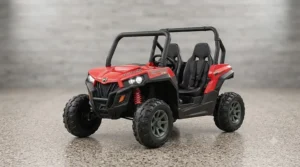
Off-Road UTVs for Siblings: Common Buying Mistakes
Mistake one: buying based on speed alone. A 5 mph top speed sounds thrilling until you realize your yard is 30 feet long — the MOEYURO 800W UTV‘s extra pace is wasted, even counterproductive, in a small or tightly fenced space.
Mistake two: ignoring terrain compatibility. Single-motor 12V units struggle noticeably on slopes or thick grass compared to the four-motor layouts in the Aosom 12V Off-Road Truck or Funride/Joyracer 2 XL Seater UTV. If your “backyard” has any grade to it at all, this is worth weighing before you check out.
Mistake three: overlooking runtime versus charge time. An 8-12 hour recharge paired with a 45-minute runtime means realistically one solid play session per day. Families who want multiple shorter sessions — say, before and after school — should lean toward the longer-runtime Best Choice Products Range Rover Sport rather than assuming all models recharge equally fast.
Mistake four: skipping the combined weight capacity check. Two kids growing quickly can outpace a 110 lbs rating faster than parents expect; re-check this number against actual current weights, not just ages, before buying for two.
Mistake five: assuming all “2-seater” listings are equally spacious. As covered above, seat width and door-lock adjustability vary meaningfully between models even at similar price points.
Family Outdoor Electric Toys: Long-Term Cost & Maintenance
The sticker price is only the opening chapter of the ownership story. Replacement batteries for 12V and 24V systems typically run C$40-C$90 depending on capacity, and most packs hold a meaningful charge for 1-2 riding seasons of regular use before capacity noticeably fades — longer if you follow the storage-charge guidance from the usage section above. Wheel treads, the first wear point on rougher terrain, are usually available as aftermarket parts in the C$15-C$30 range per set.
Total cost of ownership over two to three years, including one likely battery replacement and occasional tread swaps, tends to land C$100-C$180 above the original purchase price across this entire lineup — a modest premium relative to how many separate single-seat ride-ons you’d otherwise buy as siblings grow through different stages. Compared with other family outdoor electric toys — think electric scooters or hoverboards — side by side UTVs generally hold value better for multi-child households precisely because two kids can use the same unit simultaneously rather than needing two of everything.
| Cost Factor | Typical Range (CAD) | Frequency |
|---|---|---|
| Replacement battery | C$40-C$90 | Every 1-2 seasons |
| Wheel tread set | C$15-C$30 | As needed on rough terrain |
| Charger replacement | C$20-C$35 | Rarely, if lost/damaged |
| Harness/buckle parts | C$10-C$20 | Occasional |
Looking at the table above, the real long-term cost driver is battery replacement rather than cosmetic wear, so it’s worth confirming a model’s battery is sold separately by the same brand before you commit — some off-brand units make replacement parts frustratingly hard to source later.
Safety, Regulations & Compliance Guide for Canadian Families
Kids’ ride-on electric vehicles sold in Canada fall under the Canada Consumer Product Safety Act and the associated Toys Regulations, which set requirements around mechanical hazards, electrical safety, and battery-related risks. Health Canada’s industry guide to toy safety requirements covers exactly this kind of product, and it’s worth a skim if you want to understand what “compliant” actually means on a label rather than just trusting marketing copy.
Battery chargers deserve particular attention. Health Canada has previously recalled a ride-on toy charger over a falsely applied certification mark — a reminder that the charger, not just the vehicle body, is where electrical risk concentrates. Always use the charger that shipped with the unit, never substitute a generic one, and unplug it once charging completes rather than leaving it connected overnight as a matter of routine.
Provincially, most of these vehicles operate purely on private property (driveways, backyards, private acreages) rather than public roads, which sidesteps most provincial vehicle-licensing rules entirely — but always confirm local bylaws if you’re near shared trails or common green space, since some municipalities restrict motorized toys even off-road. Constant adult supervision is non-negotiable regardless of the model’s built-in safety features; harnesses and remote overrides reduce risk, they don’t eliminate the need for a parent within arm’s reach, especially near driveways, pools, or roadways.
Features That Actually Matter (And Those That Don’t)
Bluetooth audio and LED light shows are fun, but they’re genuinely optional — kids forget about the music within a week and mostly just want to drive. What actually matters: runtime relative to how long your kids typically play outside, motor count and layout relative to your specific terrain, and combined weight capacity relative to your kids’ actual current size, not their age bracket on the box.
Parent-remote override is not optional in any meaningful sense — treat it as a baseline requirement, not a bonus feature, regardless of price tier. Suspension quality matters more on gravel or uneven grass than on smooth pavement, so weigh it accordingly against your actual yard rather than assuming every family needs it equally. Dump beds, working horns, and rotatable steering wheels are genuinely nice quality-of-life touches, but none of them should outweigh the core runtime-versus-terrain-versus-weight-capacity match discussed throughout this guide.
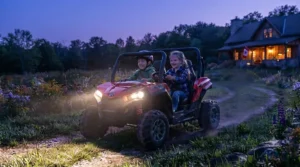
Frequently Asked Questions
❓ How fast do kids electric side by side vehicles go?
❓ Can two kids really ride safely at the same time?
❓ How long does the battery last on a full charge?
❓ Is a 12V or 24V kids UTV better for a 3-year-old?
❓ Do these vehicles work on grass and gravel, not just pavement?
Conclusion
Choosing between seven genuinely different kids electric side by side vehicles comes down to three questions: how old and how big are the riders, what does your yard actually look like, and how long do you need the battery to last between charges. Budget-focused families with younger kids will likely land on the Costway 12V 2-Seater UTV or OLAKIDS 12V Dump Bed UTV, while households with rougher terrain should lean toward the four-motor traction of the Funride/Joyracer 2 XL Seater UTV or Aosom 12V Off-Road Truck. Families chasing longer play sessions or a premium off-road look will get the most satisfaction from the Best Choice Products Honda Talon or Range Rover Sport, and speed-focused households have a clear winner in the MOEYURO 800W UTV.
Whichever one ends up in your driveway, the underlying win is the same: two kids, one vehicle, zero arguments about whose turn it is. That alone tends to make the investment pay for itself within the first weekend.
Recommended for You
- Kids Electric Dirt Bike 12V With Training Wheels: 7 Best 2026 Picks
- 12v ride on quad: 7 Best Picks for 2026
- Ride On Jeep Gift for Christmas 2026: 7 Top Picks Compared
Disclaimer: This article contains affiliate links. As an Amazon Associate, I earn from qualifying purchases. If you purchase products through these links, we may earn a small commission at no additional cost to you.
✨ Found this helpful? Share it with your friends! 💬🤗
