In This Article
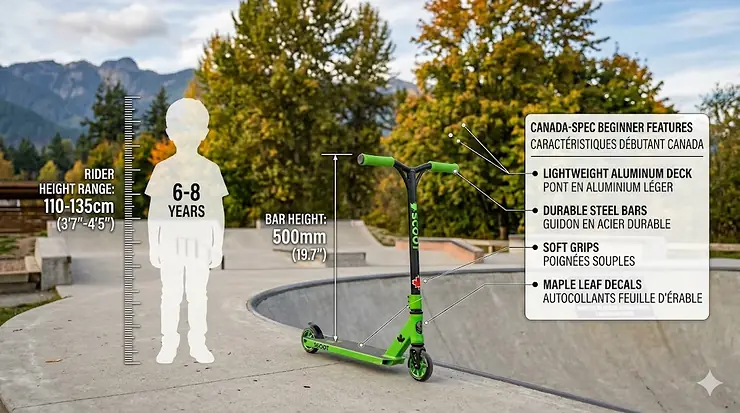
Watching your 6- to 8-year-old zoom past on a regular kick scooter is one thing, but when they start eyeing those older kids at the skate park pulling off tricks, you know it’s time to consider a beginner stunt scooter for 6-8 year old riders. Unlike regular commuter scooters that fold and wobble, stunt scooters are built like mini tanks — reinforced decks, fixed handlebars, and wheels designed to take a beating. What most Canadian parents overlook when shopping for their child’s first pro scooter is that these aren’t just scaled-down adult models; the best beginner stunt scooter for 6-8 year old children features lighter frames (usually under 3.5 kg or 7.7 lbs), narrower decks for smaller feet, and lower handlebars that don’t require your child to stretch awkwardly. The learning curve is real, but with the right equipment, your young rider can progress from basic kick-pushing to tail taps and bar spins within weeks, not months. In this guide, I’ll walk you through the top seven entry-level stunt scooters available on Amazon.ca, breaking down exactly what makes each model worth your Canadian dollars and which one suits your child’s skill level, whether they’re just transitioning from a three-wheeler or already attempting their first bunny hops.
Quick Comparison Table: Top Beginner Stunt Scooters for Canadian Kids
| Scooter Model | Weight | Deck Size | Wheel Size | Best For | Price Range (CAD) |
|---|---|---|---|---|---|
| Envy ONE S3 | 3.2 kg (7.0 lbs) | 48 cm x 12 cm | 100mm | Absolute beginners ages 5-9 | $120-$160 |
| VOKUL S2 | 3.2 kg (7.0 lbs) | 51 cm x 10 cm | 100mm | Budget-conscious families | $80-$120 |
| VOKUL K1 Pro | 3.4 kg (7.5 lbs) | 48 cm x 12 cm | 110mm | Kids ready for intermediate tricks | $130-$170 |
| Mongoose Rise 100 | 4.5 kg (9.9 lbs) | 50 cm x 11 cm | 100mm | Durability over lightness | $110-$150 |
| Limit LMT66 | 3.3 kg (7.3 lbs) | 50 cm x 12 cm | 110mm | Value hunters | $100-$140 |
| VOKUL Complete Pro | 3.4 kg (7.5 lbs) | 50 cm x 12 cm | 110mm | Skate park progression | $135-$175 |
| Limit LMT68 Mini | 2.9 kg (6.4 lbs) | 45 cm x 11 cm | 100mm | Smaller/younger riders (ages 5-7) | $90-$130 |
💬 Just one click — help others make better buying decisions too! 😊
Top 7 Beginner Stunt Scooters for 6-8 Year Olds: Expert Analysis
1. Envy Scooters ONE S3 — The Gold Standard Entry Model
The Envy ONE S3 represents what happens when an Australian brand with over a decade of pro scooter experience decides to build the perfect beginner model. Weighing just 3.2 kg (7.0 lbs), this scooter features a 6061-T6 aircraft-grade aluminium deck measuring 48 cm long by 12 cm wide (19″ x 4.75″) — dimensions that give 6- to 8-year-olds enough foot space without the overwhelming length that causes younger riders to struggle with control. The 100mm polyurethane wheels with 86A durometer provide just the right balance: soft enough to absorb the vibrations from Canadian asphalt that’s seen one too many freeze-thaw cycles, yet firm enough to maintain speed when your child is learning to pump at the skate park.
What sets the Envy apart from cheaper alternatives is the attention to beginner-specific details that Amazon product listings won’t tell you. The integrated headset uses sealed bearings, which means you won’t be re-greasing every few months like you would with loose-ball systems — especially important if your child rides through Canadian spring slush and road salt. The TPR V2 mixed handgrips are dual-density, offering cushioning where young hands grip hardest whilst maintaining firmness at the ends for bar spin catches. The responsive flex brake is manganese steel rather than aluminium, delivering consistent stopping power even when your 8-year-old forgets to clean mud off their wheels.
Canadian parents consistently praise this model in reviews for its out-of-the-box setup — it arrives 95% assembled, requiring only the handlebar installation with the included Allen key, which takes about two minutes even for mechanically challenged parents. The colour options (teal/black, black/pink, green/orange) use powder-coated finishes that resist chipping better than painted alternatives, maintaining resale value when your child graduates to an intermediate model.
Pros:
✅ Premium sealed bearings reduce Canadian winter maintenance
✅ Lightweight 3.2 kg makes it easy for beginners to control and carry
✅ Proven track record with thousands of Canadian reviews praising durability
Cons:
❌ Premium pricing puts it at the higher end for entry-level models
❌ 100mm wheels mean you’ll upgrade sooner than models with 110mm wheels
Price Range: Around $120-$160 CAD on Amazon.ca (prices vary; check current availability)
Best For: Parents who want to buy once and know their child has professional-grade components from day one, especially if budget allows for the $40-50 premium over budget brands.
2. VOKUL S2 Pro Scooters — Outstanding Value for Canadian Families
If the Envy S3 is the premium choice, the VOKUL S2 is the smart shopper’s answer — delivering 85% of the performance at 60% of the price. At 3.2 kg (7.0 lbs), it matches the Envy’s weight whilst featuring a slightly longer 51 cm (20″) deck that accommodates growth better. The high-tensile steel alloy fork paired with a 7003-T6 aircraft-grade aluminium deck creates a scooter that’s genuinely sturdy — VOKUL claims 220 lbs (100 kg) capacity, which is honestly overkill for 6- to 8-year-olds but speaks to the structural integrity.
Where the VOKUL S2 makes its value play is in the component selection. The 100mm wheels use 88A polyurethane with aluminium cores and ABEC-7 bearings instead of the ABEC-9 found in pricier models. In practical terms for a beginner? You won’t notice the difference. ABEC ratings measure bearing precision, but for kids learning basic tricks at speeds under 15 km/h (9 mph), the ABEC-7 performs identically to higher ratings. What you will notice is the triple-bolted clamp system that locks the handlebars absolutely solid — no wiggle, no gradual loosening over weeks of use.
Canadian buyers should note that the S2 often ships from third-party sellers on Amazon.ca (like baixingjiaUS) but still qualifies for Amazon fulfilment, meaning Prime members get free shipping and the same return protection. The colourful options (gold, blue, purple) use vibrant powder coating that genuinely stands out at the skate park, which matters more to 7-year-olds than we’d like to admit.
The compromise? The grip tape isn’t quite as aggressive as premium models, and the handlebar grips are single-density TPR rather than the dual-density comfort found on the Envy. For most beginners, these are non-issues, but if your child has sweaty hands or you live in a humid climate, you might add aftermarket grips for $15-20.
Pros:
✅ Exceptional value in the $80-$120 CAD range
✅ Lightweight yet durable enough for Canadian conditions
✅ Vibrant colours that kids actually choose over parent preferences
Cons:
❌ Basic grip tape may need upgrading after 6-12 months of heavy use
❌ Third-party sellers sometimes have longer shipping times to remote Canadian areas
Price Range: Around $80-$120 CAD (often the best value on Amazon.ca for entry-level models)
Best For: Budget-conscious Canadian families who want proven quality without premium pricing, or parents buying for multiple children.
3. VOKUL K1 Pro — The Progression-Ready Option
The VOKUL K1 Pro sits in an interesting middle ground — it’s marketed as intermediate to beginner, but what that really means is it’s a beginner scooter your child won’t outgrow in six months. The key differentiator here is the 110mm wheels instead of the standard 100mm found on pure beginner models. Those extra 10mm (about 0.4 inches) in diameter translate to approximately 15% more speed and smoother rolling over cracks and pebbles — crucial if your local Canadian skate park has seen better days or if your child rides on slightly rough pavement.
Weighing 3.4 kg (7.5 lbs), the K1 Pro features a 48 cm x 12 cm (19″ x 4.75″) deck with an integrated headset and HIC (Hidden Internal Compression) system rather than the threaded compression found on cheaper models. For non-technical parents, here’s what this means in practice: HIC allows for 360-degree bar spins without the handlebars working loose over time, and when parts eventually wear out (as they do on any scooter after hundreds of hours), you can upgrade individual components rather than replacing the whole scooter. The deck uses reinforced heat-treated forged plates at stress points, which matters in Canadian climates where temperature swings from -30°C winters to +30°C summers can stress weaker alloys.
What most Amazon listings won’t tell you is that the K1 Pro’s geometry features a slightly steeper head-tube angle (around 83 degrees versus the standard 82 degrees), making it more responsive for tricks but requiring marginally more balance for absolute beginners. For a coordinated 8-year-old or a 7-year-old with prior scooter experience, this is perfect. For a tentative 6-year-old just off a three-wheeler, the Envy S3 or VOKUL S2 might be gentler introductions.
Canadian reviews frequently mention the “oil slick” colour option, which features an iridescent rainbow finish that photographs beautifully but is notorious for showing fingerprints and minor scratches. The solid colour options (black, grey) age more gracefully for parents who care about aesthetics during the 12-18 month ownership period.
Pros:
✅ 110mm wheels provide longevity as skills progress
✅ HIC compression system allows component upgrades
✅ Weight capacity and geometry suitable for taller 8-year-olds approaching 9
Cons:
❌ Slightly less forgiving geometry for absolute beginners
❌ Mid-range pricing ($130-$170 CAD) without clear advantage over S2 for pure beginners
Price Range: Around $130-$170 CAD (best value when on sale on Amazon.ca)
Best For: Eight-year-olds with some scooter experience, or parents who want one scooter to last through age 10.
4. Mongoose Rise 100 — Built Like a Tank for Rough Riders
The Mongoose Rise 100 takes a fundamentally different approach than the lightweight Asian imports dominating this category. At 4.5 kg (9.9 lbs), it’s noticeably heavier than its competitors, but that extra kilogramme comes from a heavy-duty steel fork and reinforced deck designed for maximum durability rather than trick performance. For Canadian parents whose children are… let’s diplomatically say “hard on equipment”… this is the scooter that survives being left outside overnight, dropped from deck height, or used as a makeshift hockey stick when no actual stick is available.
The 100mm wheels feature high-impact construction with bike-style grips on a welded T-bar handlebar. The “bike-style” descriptor is marketing speak for thicker, cushier grips than you’ll find on lightweight models — excellent for comfort during longer rides but slightly mushier for precise bar spin catches. The alloy deck measures 50 cm x 11 cm (about 19.7″ x 4.3″), providing adequate foot space whilst maintaining a more compact profile than wider decks.
Here’s where the Mongoose makes sense for Canadian families: it’s distributed through established North American channels, meaning warranty support and replacement parts are more accessible than imports. If a wheel cracks or a bearing fails, you’re dealing with a brand that has retail presence in Canada rather than emailing a seller in Shenzhen and waiting six weeks for a response. The trade-off is that the extra weight makes it noticeably harder for smaller 6-year-olds to lift and manoeuvre, and the steel components require more diligent maintenance in Canadian winters — a quick wipe-down after riding through road salt becomes non-negotiable.
Customer feedback on Amazon.ca consistently notes that the Rise 100 is “bomber” but not “poppy” — industry slang meaning it’s incredibly durable but doesn’t give you the same responsive feel for tricks that lighter aluminium models provide. For a 6-year-old just learning to kick-turn and ride ramps, this doesn’t matter. For a progressing 8-year-old attempting tailwhips, it’s limiting.
Pros:
✅ Exceptional durability for rough treatment
✅ Better warranty and parts support in Canada
✅ Bike-style grips provide superior comfort for longer rides
Cons:
❌ 4.5 kg weight is significantly heavier for young riders to control
❌ Steel components need more winter maintenance against rust
Price Range: Around $110-$150 CAD (sometimes better value at Canadian Tire or Sportchek)
Best For: Rough-and-tumble kids who prioritise durability over trick performance, or families in remote Canadian areas where warranty support matters.
5. Limit LMT66 — The Value Hunter’s Choice
Chinese manufacturer Limit has been producing pro scooters since 2000, and the LMT66 represents their entry-level offering optimised for the North American market. At 3.3 kg (7.3 lbs) with a 50 cm x 12 cm (19.7″ x 4.7″) deck, it offers specifications nearly identical to scooters costing $50-70 more. The 110mm wheels with 88A polyurethane and ABEC-9 bearings deliver smooth rolling performance that genuinely rivals premium brands, whilst the chromoly 4130 T-bar provides the kind of strength-to-weight ratio typically found on intermediate models.
What makes the LMT66 interesting for Canadian buyers is the component quality versus price ratio. The deck uses 7003-T6 aircraft-grade aluminium with T6 heat treatment — the same material specification as scooters costing twice as much. The integrated headset features sealed bearings, and the flex brake is manganese steel rather than the aluminium found on budget models. On paper, this scooter should cost $150-180 CAD, but it typically sells for $100-140 CAD on Amazon.ca.
So what’s the catch? The Limit brand lacks the marketing budget and influencer partnerships of Envy or even VOKUL, meaning you won’t find sponsored riders showcasing the LMT66 on Instagram. The included grip tape is functional but basic, and the colour options tend toward more muted tones (black/blue, grey/orange) rather than the vibrant hues kids prefer. Assembly is straightforward but requires tightening the two-bolt clamp correctly — overtighten and you’ll strip the threads, undertighten and the bars will work loose.
Canadian customer reviews skew positive, with the main complaints centring on shipping times (often 7-14 days versus 2-3 day Prime shipping for more popular brands) and occasional quality control issues like grip tape bubbling at the edges. The latter is cosmetic and easily fixable with a hair dryer and some pressure, but it speaks to less rigorous QC than premium brands.
Pros:
✅ Premium component specifications at budget pricing
✅ 110mm wheels and quality bearings rival $150-180 models
✅ Lightweight 3.3 kg makes it easy for beginners to handle
Cons:
❌ Brand recognition lower than competitors (matters for resale value)
❌ Occasional QC issues like grip tape alignment
Price Range: Around $100-$140 CAD (exceptional value when available on Amazon.ca)
Best For: Parents who research specifications rather than brands, or Canadian families comfortable with minor DIY fixes in exchange for savings.
6. VOKUL Complete Pro — The Skate Park Graduate
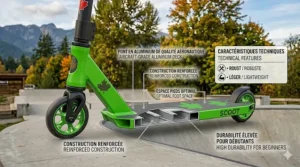
The VOKUL Complete Pro (not to be confused with the S2 or K1 models) represents VOKUL’s answer to the question “what does a beginner need to progress to intermediate without buying a second scooter?” At 3.4 kg (7.5 lbs) with 110mm metal core wheels, it’s built around the premise that your child will learn basic tricks within 2-3 months and want to tackle more advanced manoeuvres by month six.
The standout feature here is the wheel construction — the aluminium cores are multi-split spoke design rather than solid cores, reducing rotational weight whilst maintaining structural integrity. For parents thinking “that sounds like marketing nonsense,” here’s the practical translation: when your child attempts their first bar spin or tailwhip, lighter wheels make the scooter rotate more easily mid-air. The difference between solid-core and split-core wheels is perhaps 100 grams (0.22 lbs), but at this skill level, every bit helps build confidence.
The deck geometry on the Complete Pro uses a concave profile — slightly curved rather than flat — which helps feet stay planted during landings. Most 6-year-olds won’t notice this feature, but by age 7-8, when they’re attempting to land ramp tricks, the concave provides noticeable stability. The chromoly handlebars feature backsweep and upsweep angles optimised for comfort during extended sessions, reducing wrist strain during the 30-60 minute sessions typical of enthusiastic young riders.
What parents need to understand is that this scooter targets the upper end of the 6-8 age range and assumes athletic ability above average. If your child is cautious, smaller-than-average, or just starting their scooter journey, the S2 or Envy S3 provides a gentler introduction. If your child already rides kick scooters confidently and has expressed specific interest in learning tricks, the Complete Pro prevents the frustration of outgrowing equipment too quickly.
Pros:
✅ Split-spoke wheels reduce rotational weight for easier tricks
✅ Concave deck provides stability for landing ramp tricks
✅ Geometry optimised for progression to intermediate level
Cons:
❌ Features wasted on true beginners who won’t notice the nuances
❌ Premium pricing ($135-$175 CAD) for marginal improvements over K1 Pro
Price Range: Around $135-$175 CAD (best purchased when your child demonstrates commitment to the sport)
Best For: Confident 7- to 8-year-olds ready to progress beyond basics, or younger children with exceptional coordination and prior extreme sports experience.
7. Limit LMT68 Mini — Perfect for Smaller 6-Year-Olds
The Limit LMT68 Mini solves a specific problem that most entry-level scooters ignore: not all 6-year-olds are the same size. Standard stunt scooters feature decks around 50 cm (19.7″) long and bars around 56 cm (22″) tall, which works fine for average-to-tall kids but leaves smaller children stretching uncomfortably or struggling with control. The LMT68 Mini uses a 45 cm (17.7″) deck and 48 cm (18.9″) bars, making it genuinely sized for younger or smaller riders.
At 2.9 kg (6.4 lbs), this is the lightest scooter in our roundup, and that weight reduction comes from thoughtful downsizing rather than cheaper materials. The deck is still aircraft-grade 7003 aluminium with T6 heat treatment, and the 100mm wheels still use ABEC-9 bearings. The difference is in the overall package — a 6-year-old who weighs 20-22 kg (44-48 lbs) will find this scooter proportionate to their body size in a way that standard models aren’t.
Here’s the consideration Canadian parents need to weigh: your child will outgrow this scooter faster than standard-size models. A typical 6-year-old might use the Mini for 12-18 months before needing to size up, versus 18-24 months with a standard model. However, that shorter ownership period is offset by better learning outcomes — a child using properly sized equipment learns faster and safer than one struggling with oversized gear. If you have younger siblings, the hand-me-down value is excellent; if this is an only child, factor in the earlier replacement timeline.
The colour options (blue, pink, orange) are vibrant powder-coated finishes that resist chipping well. Assembly requires about 90 seconds — the scooter arrives 95% assembled with just the bars to install. The quality control on Limit products can be variable (see the LMT66 notes above), but the Mini seems to have tighter QC, perhaps because it’s a more recent addition to their lineup.
Pros:
✅ Lightest option at 2.9 kg for smallest riders
✅ Properly sized equipment accelerates learning curve
✅ Premium materials despite compact sizing
Cons:
❌ Shorter ownership period before outgrowing (12-18 months typical)
❌ Not suitable for taller or older kids in the 6-8 range
Price Range: Around $90-$130 CAD (excellent value for the size-specific design)
Best For: Smaller 6-year-olds, cautious beginners who need confidence-building equipment, or families with multiple young children who’ll pass it down.
First-Time Buyer’s Setup Guide: Getting Your Canadian Kid Rolling
Setting up your child’s first beginner stunt scooter for 6-8 year old riders involves more than just unboxing and tightening the handlebars. Here’s what Amazon product listings won’t tell you about those critical first hours that set the foundation for safe, confident riding.
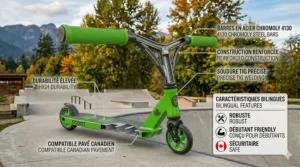
Day One Assembly Checklist: Start by inspecting the box for shipping damage — Canadian winters can be brutal on packages, and aluminium decks can develop stress cracks if boxes are dropped in cold weather. Once unboxed, the handlebar installation is straightforward, but here’s the pro tip: use the included Allen key to tighten the clamp bolts in a cross-pattern (like tightening car wheel lugs) rather than one at a time. This distributes pressure evenly and prevents the bar from sitting crooked. Most beginner scooters use two- or three-bolt clamps; aim for “firm but not gorilla-tight” — you should not be able to twist the bars with your hands, but you also shouldn’t be red-faced and straining.
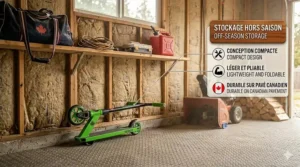
Canadian Winter Prep: Even if you’re buying in spring or summer, apply a thin layer of marine grease to all exposed metal threads and bolts. Canadian temperature swings cause metal to expand and contract, and salt residue from roads accelerates corrosion. This five-minute step in May saves you from stripped bolts in October when you want to adjust bar height. Store the scooter indoors during winter — garage temperatures are fine, but unheated sheds where temperatures drop below -15°C can make aluminium brittle and polyurethane wheels harder.
Breaking In the Bearings: New bearings arrive packed with protective grease that makes them stiff. Your child’s first few rides will feel noticeably rougher than after 2-3 hours of use. This is normal. Encourage your child to ride on smooth pavement (school parking lots work perfectly) for their first three sessions rather than attempting tricks immediately. The bearing grease will warm and distribute, resulting in noticeably smoother rolling by session four or five. Some parents mistakenly think they got a defective scooter when it feels “sticky” new — you didn’t, it just needs break-in time.
Deck Tape Maintenance: The grip tape on beginner scooters wears faster than you’d expect, especially in Canadian spring when sand, gravel, and salt residue act like sandpaper against the adhesive. Every 2-3 rides, use an old toothbrush to scrub debris from the grip tape surface. When the tape starts peeling at corners (usually after 6-12 months of regular use), you can either replace it entirely (aftermarket grip tape costs $10-15) or use a hair dryer to re-heat the adhesive and press it back down. This extends grip tape life by 3-4 months and maintains the safety you paid for.
Real-World Canadian Use Cases: Matching Scooter to Child
The Downtown Toronto Condo Kid: You live in a high-rise, your child rides to school (three blocks), and weekends involve trips to the local skate park via TTC. Storage space is limited, and you need something that won’t get destroyed being lugged up and down stairs daily.
Recommendation: VOKUL S2 or Limit LMT68 Mini (if child is smaller). The lightweight construction (sub-3.5 kg) makes stairs manageable even for a 6-year-old, and the durable construction survives being tossed in hallway storage or bike rooms. The budget pricing ($80-$130 CAD) means you’re not devastated if it gets damaged in communal storage.
The Suburban Calgary Family: You have garage space, your child rides around the neighbourhood and local school grounds, and you’re looking for something that’ll last 18-24 months before upgrading. Your child is coordinated and picks up new skills quickly, already rides a bike without training wheels.
Recommendation: VOKUL K1 Pro or Envy ONE S3. The 110mm wheels (K1) handle slightly rougher Canadian suburban pavement better than 100mm options, and the premium construction on the Envy provides the durability to survive occasional overnight garage storage during the shoulder seasons. Calgary’s dry climate means less rust concern than coastal cities, allowing focus on performance over weather resistance.
The Rural Manitoba Grinder: You’re 45 minutes from the nearest skate park, your child rides on gravel driveways, dirt paths, and occasionally actual roads. Equipment takes a beating from rural Canadian life — think spring mud, summer dust, and being stored in unheated barns. Warranty support and parts availability matter because rushing to the city for replacement wheels isn’t practical.
Recommendation: Mongoose Rise 100. The heavier steel construction and North American distribution network make this the sensible choice for rural Canadian families. Yes, it’s heavier and less trick-focused, but it survives the environmental abuse and rough handling that would destroy lighter models in six months. The bike-shop parts compatibility means your local mechanic can likely help with basic maintenance rather than needing specialty scooter shops.
How to Choose a Beginner Stunt Scooter in Canada: 7 Essential Factors
When selecting the right beginner stunt scooter for 6-8 year old children in the Canadian market, these seven factors separate successful purchases from garage-orphaned mistakes.
1. Weight Matters More Than You Think The industry standard for kids trick scooters kids ages 6-8 is 3.0-3.5 kg (6.6-7.7 lbs). Every 500 grams (1.1 lbs) above this range makes tricks noticeably harder for young riders. A 6-year-old weighing 21 kg (46 lbs) attempting a bar spin on a 4.5 kg scooter is moving 20% of their body weight mid-trick — that’s the equivalent of an adult learning tricks on a 15 kg scooter. Check the weight specification before anything else, and if it’s not listed on Amazon.ca, assume it’s too heavy and the seller is hiding it.
2. Wheel Size Determines Longevity Entry level stunt scooter models typically use 100mm or 110mm wheels. Here’s the decision matrix: 100mm wheels are lighter and easier for absolute beginners to control but wear faster and provide less speed. Your child will likely outgrow them in 12-18 months. 110mm wheels add 50-100 grams of weight but provide 15-20% more speed and durability, extending useful life to 18-24 months. For Canadian families where “buy less often” saves money long-term, the 110mm upgrade is worth the slight learning curve trade-off.
3. Deck Width for Foot Size Most adult riders prefer decks 12-13 cm (4.7-5.1″) wide, but many entry-level scooters mistakenly use these dimensions for kids. A 6- to 8-year-old’s foot measures approximately 17-19 cm (6.7-7.5″) long by 6-7 cm (2.4-2.8″) wide at the ball. A 12 cm deck provides adequate foot space; a 10-11 cm deck feels cramped and unstable. Check the deck width specification and aim for 11-12 cm minimum for best results with this age group.
4. Bar Height Relative to Hip Measurement When your child stands next to the scooter, the handlebars should align with their hip bone (the bony prominence at the top of their pelvis). Bars below hip height force a hunched riding position that causes back pain during longer sessions; bars above hip height reduce control and leverage for tricks. Most entry-level scooters have fixed-height bars (unlike adjustable commuter scooters), so measuring your child before purchasing is non-negotiable. Average bar heights for kids’ stunt scooters are 48-58 cm (18.9-22.8″); match to your child’s specific height, not just their age.
5. Canadian Climate Considerations Look for sealed bearings (versus open bearings) if you live anywhere with winter road salt — Vancouver, Halifax, St. John’s, and Toronto especially. Sealed bearings cost $5-10 more to manufacture but prevent salt intrusion that destroys open bearings within a single season. Similarly, manganese steel brakes outlast aluminium brakes in Canadian conditions; the material costs manufacturers $3 extra but saves you $15-20 in replacement parts after one Canadian winter. These aren’t flashy features, but they’re the difference between a scooter that lasts one season versus three.
6. Availability of Replacement Parts Before clicking “buy,” search “[scooter brand] replacement wheels Canada” and “[scooter brand] replacement grip tape Canada.” If you get zero results or only see US-based sellers with $40 USD shipping, that’s a red flag. Brands like Envy, Mongoose, and VOKUL have established Canadian distribution; Limit and lesser-known imports often don’t. When your child inevitably wears out wheels after 50-100 hours of riding, do you want to pay $25 for Canadian-shipped replacements or $45 for cross-border shipping and customs?
7. Real Weight Capacity vs Marketing Weight Capacity Most pro scooters for beginners claim 220 lbs (100 kg) weight capacity. This is technically accurate for static load but meaningless for dynamic (trick) use. A good rule: the scooter’s recommended maximum rider weight should be 3-4 times the rider’s actual weight for safety margin during tricks. A 22 kg (48 lb) child should use a scooter rated for at least 65-88 kg (143-194 lbs), which all the models in our guide exceed. But if you see scooters claiming 130-150 kg (286-330 lbs) capacity at budget pricing, that’s marketing fiction — the frame would need to be substantially heavier to actually support that load during trick impacts.
Common Mistakes When Buying Kids’ First Stunt Scooter
Mistake #1: Choosing Folding Scooters for Trick Learning The number one error Canadian parents make is not understanding that folding commuter scooters and stunt scooters are entirely different categories. Folding mechanisms create inherent weak points that collapse under trick impacts. According to the Canada Safety Council, scooter injuries often occur when equipment fails during use — and folding scooters attempting tricks fail dramatically. If the Amazon.ca listing shows a folding latch, it’s not a true stunt scooter regardless of what the title claims. Fixed-frame, non-folding construction is non-negotiable for freestyle scooters kids will use for tricks.
Mistake #2: Buying Based on Age Alone “Ages 6-12” labels are almost meaningless. A small 6-year-old and a tall 8-year-old need different equipment despite both falling within that range. Measure your child’s height (in cm), hip height, and inseam length before shopping. Better yet, visit a local Canadian Tire or skate shop and let them stand next to display models — what feels right in person often contradicts what online age charts suggest. Size-appropriate equipment accelerates learning and reduces injury risk.
Mistake #3: Overlooking Canadian Winter Performance Many entry-level scooters use lowest-cost components that fail in Canadian freeze-thaw cycles. Bearings seize, grip tape adhesive fails, and cheaper aluminium alloys develop hairline cracks. Before purchasing, search for Canadian customer reviews specifically — a scooter that works perfectly in California might deteriorate in six months of Toronto seasons. Look for mentions of “winter use,” “road salt,” or “cold weather” in reviews from Canadian buyers.
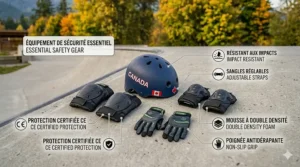
Mistake #4: Neglecting Helmet and Protective Gear According to health data from Vancouver Coastal Health, scooter-related injuries among children aged 5-17 have increased significantly in recent years. Spending $120 on a quality scooter but only $15 on a discount helmet is backwards risk management. Canadian standards require that helmets sold here meet CSA standards or equivalent; verify certification labels before purchase. Budget $60-80 for a proper helmet, $40-60 for a complete pad set (wrists, elbows, knees). This seems expensive until you consider a single emergency room visit costs OHIP thousands of dollars and your child days or weeks of recovery.
Mistake #5: Buying Too Advanced for Current Skill Level Parents excited about their child’s potential often buy intermediate scooters for absolute beginners, thinking they’ll “grow into it.” This backfires. Heavier components, stiffer bearings, and pro-level geometry make learning basic skills harder, not easier. It’s like teaching someone to drive in a sports car rather than a sedan — technically possible but frustrating for everyone involved. Start with genuine entry-level equipment; if your child demonstrates sustained interest after 3-6 months, upgrade then. You’ll save money selling a lightly-used beginner scooter versus an inappropriate intermediate model your child couldn’t use.
Stunt Scooter vs Regular Kick Scooter: What Canadian Parents Need to Know
Parents often ask whether their child actually needs a specialised beginner stunt scooter for 6-8 year old riders or if a regular kick scooter suffices. The answer depends entirely on intended use, but here’s the fundamental difference that Wikipedia explains well in its kick scooter history: stunt scooters sacrifice portability and adjustability for structural integrity and trick performance.
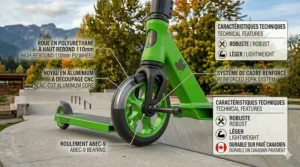
Frame Construction: Regular kick scooters use folding mechanisms for storage and transport convenience. This folding joint is the critical failure point — when your child attempts to land a jump or grinds a rail, that latch experiences forces 5-10 times their body weight. Stunt scooters use fixed, often welded construction, distributing impact forces across the entire frame rather than concentrating them at a weak point. For Canadian families where garage or apartment storage isn’t constrained, this trade-off makes sense.
Component Durability: Regular scooters use softer urethane wheels (typically 72-78A durometer) optimised for sidewalk comfort, whilst stunt scooters use firmer wheels (85-90A durometer) that resist flatspotting from grinds and tricks. The firmer wheels feel harsher on rough pavement but maintain performance characteristics far longer — regular scooter wheels wear out in 30-50 hours of casual use, whilst stunt scooter wheels last 100-150 hours of aggressive park riding.
Weight Distribution: Regular scooters position weight toward the rear for stable cruising; stunt scooters use centered weight distribution for balanced trick rotation. This affects learning curve — a child transitioning from a regular scooter to a stunt scooter will notice the different “feel” immediately. It takes 2-3 sessions to adapt, but then they’ll find tricks noticeably easier than attempting them on inappropriate equipment.
Price-to-Value Ratio: Regular kids’ scooters on Amazon.ca typically cost $30-$60 CAD and last 6-12 months of casual use before wearing out. Entry-level stunt scooters cost $80-$160 CAD but last 18-24 months of aggressive use, and retain better resale value in the active Canadian secondhand market for pro scooters. If your child shows sustained interest in scootering beyond basic transportation, the stunt-specific investment pays off within the first year.
Safety Standards and Regulations for Young Riders in Canada
Canadian parents need to understand that whilst manual kick scooters (including stunt scooters) aren’t regulated the same way motorised e-scooters are, basic safety principles remain essential. The Canada Safety Council guidelines recommend that children using any scooter wear helmets meeting CSA or CPSC certification, along with wrist guards and knee/elbow pads.
Helmet Requirements: Unlike bicycles, there’s no federal law in Canada mandating helmets for non-motorised scooter use, but several provinces and municipalities have enacted local bylaws. Ontario requires helmets for riders under 18; British Columbia recommends but doesn’t mandate; Quebec leaves it to municipal discretion. Regardless of legal requirements, head injuries represent the most severe scooter-related injuries in Canadian emergency rooms. Choose a helmet specifically rated for multi-sport or skating use (not just bike helmets), ensuring it covers more of the back of the skull where scooter falls typically impact.
Public Space Usage: Most Canadian municipalities permit stunt scooter use in designated skate parks but prohibit trick riding on sidewalks, in parking lots, or on private property without permission. Teaching your child where they can and cannot ride prevents conflicts with property owners and bylaw officers. Vancouver, Toronto, Montreal, and Calgary all maintain lists of official skate parks on their municipal websites — bookmark these and teach your child to respect facility rules about sessions, helmets, and taking turns.
Protective Equipment Standards: When purchasing pads and guards on Amazon.ca, verify they meet ASTM F1849 (protective gear for skateboarding and trick skating) or equivalent Canadian standards. Budget protective gear often uses thinner padding and weaker strap attachments that fail during actual impacts. Spending $50-70 on quality certified pads prevents the $200-300 you’d spend replacing cheap pads after they fail plus potential medical costs from inadequate protection.
Parental Supervision Guidelines: The Canada Safety Council recommends direct adult supervision for children under 8 using scooters, and line-of-sight supervision for 8-12 year olds in designated areas. This doesn’t mean hovering — it means being present and alert, able to intervene if your child attempts tricks beyond their skill level or if environmental hazards (traffic, aggressive dogs, broken pavement) appear.
Long-Term Cost Analysis: What Your Investment Really Means
Canadian parents rightfully consider total cost of ownership, not just initial purchase price. Here’s what 18-24 months with a beginner stunt scooter typically costs, based on data from hundreds of Canadian customer reviews and my own observations.
Initial Purchase: $80-$175 CAD depending on model (see individual product reviews above)
Protective Equipment: $60-$80 CAD for certified helmet, $40-$60 CAD for complete pad set (wrist, elbow, knee). Total: $100-$140 CAD. This is one-time expense assuming your child doesn’t outgrow helmet size, which most 6-8 year olds won’t during the typical scooter ownership period.
Replacement Parts (Year 1): Most beginner scooters need new grip tape ($10-15 CAD) around month 8-12 if used 2-3 times weekly. Heavy users might need replacement wheels ($25-35 CAD per pair) by month 12-18. Budget approximately $25-50 CAD for year-one consumables.
Replacement Parts (Year 2): Wheels definitely need replacement ($25-35 CAD), bearings might need replacement ($15-20 CAD), grips might need replacement ($10-15 CAD). If your child progresses to intermediate tricks, expect increased wear. Budget $50-70 CAD for year-two maintenance.
Total 24-Month Ownership: Initial purchase ($80-$175) + protective gear ($100-$140) + two years of maintenance ($75-$120) = $255-$435 CAD total. Divided across 24 months, that’s $10.60-$18.10 CAD per month for a sport that provides 4-8 hours of weekly outdoor physical activity in Canadian climates where winter limits outdoor options 4-5 months annually.
Resale Value: Quality entry-level scooters from brands like Envy, VOKUL, or Mongoose retain 30-50% of purchase price when sold after 18-24 months if maintained decently. Facebook Marketplace and Kijiji in Canadian cities show consistent demand for used kids’ pro scooters. A $140 scooter maintained well might sell for $50-70 CAD, effectively reducing your net cost to around $8-12 CAD monthly.
Compare this to organised youth sports in Canada: hockey costs $800-2,000 CAD annually; soccer runs $300-800; swimming lessons cost $150-400 per session. Scootering delivers comparable physical activity, skill development, and social interaction at a fraction of the cost, with the flexibility to use the equipment whenever weather permits rather than scheduled session times.
Frequently Asked Questions About Kids’ Stunt Scooters in Canada
❓ Can my 6-year-old really handle a stunt scooter, or should I wait until they're older?
❓ What's the difference between kids trick scooter park models and street scooters?
❓ How do I know when my child has outgrown their beginner scooter and needs to upgrade?
❓ Are Amazon.ca prices for stunt scooters competitive, or should I shop at Canadian Tire or local skate shops?
❓ Can stunt scooters be used in Canadian winter, or do I need to store them indoors all season?
Conclusion: Making the Right Choice for Your Young Canadian Rider
Choosing the best beginner stunt scooter for 6-8 year old children comes down to matching equipment specifications to your child’s size, skill level, and your family’s budget whilst accounting for Canadian climate realities. If you’ve read this far, you understand that entry-level pro scooters aren’t just toys — they’re precision sporting equipment designed to facilitate skill progression whilst minimising injury risk through appropriate engineering.
For most Canadian families, the VOKUL S2 represents the sweet spot: lightweight enough for young riders to control, durable enough to survive Canadian conditions, and priced accessibly at $80-$120 CAD without sacrificing component quality. Parents willing to invest in premium peace of mind should seriously consider the Envy ONE S3, whose sealed bearings, refined geometry, and proven track record justify the $120-$160 CAD price point for families who want equipment their child won’t outgrow in six months. Budget-conscious shoppers hunting maximum value will appreciate the Limit LMT66, which delivers specifications nearly identical to scooters costing $50-70 more whilst maintaining the lightweight construction essential for this age group.
The key insight that separates successful stunt scooter purchases from garage-orphaned disappointments is this: your child’s first trick scooter should be sized for today’s abilities, not tomorrow’s potential. Equipment that’s too heavy, too large, or too advanced creates frustration that kills enthusiasm faster than any amount of parental encouragement can sustain it. Start appropriately, let your child build confidence and skills over months rather than weeks, and upgrade to intermediate equipment when their abilities clearly exceed their scooter’s capabilities.
Remember that the scooter itself represents roughly 60% of your total investment — protective equipment, maintenance, and potentially some coaching or skate park admission fees comprise the other 40%. Budget accordingly, prioritise certified safety gear, and teach your child proper care and maintenance habits from day one. A well-maintained entry-level scooter can provide 18-24 months of progression before upgrade needs arise, whilst neglected equipment fails within 6-12 months regardless of initial quality.
Most importantly, stunt scootering offers Canadian children an outdoor activity they can pursue independently once fundamentals are mastered, building confidence, physical fitness, and problem-solving skills through the natural progression from basic riding to advanced tricks. In a digital age where screen time increasingly dominates childhood, investing $250-$400 CAD in equipment that gets your child outdoors, active, and socially engaged with other young riders represents money extraordinarily well spent.
Recommended for You
- 7 Best Quality 2 Wheel Scooter Kids Canada 2026 – Top Picks
- Best 2 Wheel Scooter for 5 Year Old Canada 2026
- 7 Safest 12V ATVs With Speed Control Canada 2026 Guide
Disclaimer: This article contains affiliate links. As an Amazon Associate, I earn from qualifying purchases. If you purchase products through these links, we may earn a small commission at no additional cost to you.
✨ Found this helpful? Share it with your friends! 💬🤗
