In This Article
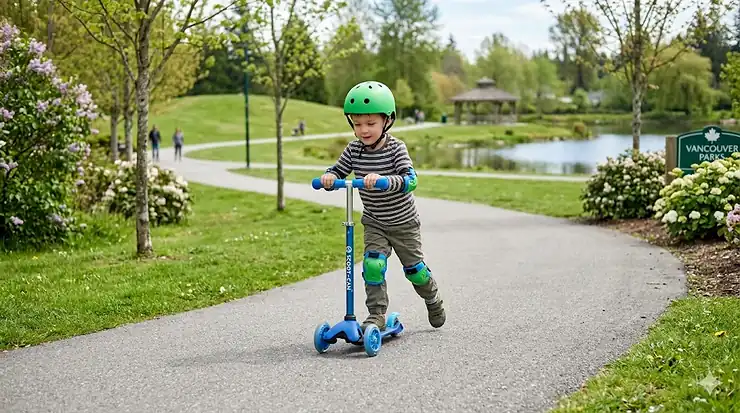
Watching your child transition from a wobbly three-wheeler to confidently gliding on a 2 wheel scooter for 5 year old is one of those proud parenting moments that sneaks up on you. If your little one has been eyeing those sleek two-wheelers at the park with envy, you’re probably wondering if they’re ready—and which model won’t end up gathering dust in your garage after two weeks.
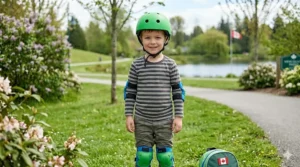
Here’s what most Canadian parents don’t realize: the jump to two wheels isn’t just about looking cooler. It’s a genuine developmental milestone that strengthens balance, coordination, and spatial awareness in ways that three-wheel models simply can’t match. Research from pediatric motor development studies shows that activities requiring dynamic balance significantly improve children’s gross motor skills and coordination, making this the perfect age to introduce controlled instability.
But not all 2 wheel scooter for 5 year old options are created equal, especially when you’re shopping in Canada. Between our unpredictable spring weather, short summer seasons, and the reality that many models available on Amazon.com either don’t ship here or arrive with eye-watering customs fees, finding the right scooter requires more than just reading Amazon reviews. You need guidance that accounts for Canadian conditions—because a scooter that works brilliantly in California might feel unstable on Toronto’s cracked sidewalks or Vancouver’s perpetually damp pathways.
In this guide, I’m breaking down everything you need to know about choosing the first two wheel scooter kids will actually use—from understanding when your child is developmentally ready for the transition from 3 to 2 wheels, to identifying which features matter for Canadian climates, to reviewing seven real scooters currently available on Amazon.ca with honest assessments of their strengths and limitations. Whether you’re in downtown Montreal navigating narrow sidewalks or suburban Calgary with endless bike paths, you’ll find practical advice grounded in real-world experience and expert commentary.
Quick Comparison: Top 2 Wheel Scooters for 5-Year-Olds Available in Canada
| Model | Age Range | Weight Limit | Deck Height | Best For | Price Range (CAD) |
|---|---|---|---|---|---|
| Micro Sprite LED | 5-12 years | 100 kg | Low (7 cm) | First two-wheeler transition | $150-$180 |
| Razor A5 Lux | 8+ years | 100 kg | Medium (8 cm) | Taller 5-year-olds | $100-$140 |
| Globber Flow 125 | 5+ years | 50 kg | Low (6.5 cm) | Lightweight beginners | $90-$120 |
| AODI Kids Kick Scooter | 5-12 years | 60 kg | Low (7 cm) | Budget-conscious families | $65-$85 |
| Besrey Folding Scooter | 5-10 years | 50 kg | Adjustable | Growing kids | $70-$95 |
| Madd Gear Carve 100 | 5-10 years | 50 kg | Medium (7.5 cm) | Active riders | $75-$100 |
| Radio Flyer EZ Rider | 5-8 years | 45 kg | Extra low (5 cm) | Cautious beginners | $80-$110 |
💬 Just one click — help others make better buying decisions too! 😊
Top 7 Two-Wheel Scooters for 5-Year-Olds: Expert Analysis
1. Micro Sprite LED — The Gold Standard for First Two Wheelers
If you’re going to invest in one scooter that will genuinely last from kindergarten through Grade 5, the Micro Sprite LED is the model serious Canadian families keep coming back to. This Swiss-engineered scooter weighs just 2.85 kg, making it light enough for your 5-year-old to carry independently (crucial when they suddenly decide they’re “too tired” to scoot home from the park), yet it’s rated for riders up to 100 kg—meaning it’ll comfortably handle your growing child well into their pre-teen years.
The magic lies in the precision engineering. Where budget scooters rattle and shake over pavement cracks, the Micro Sprite’s high-rebound polyurethane wheels (120mm front, 100mm rear) glide with almost eerie smoothness. This isn’t just comfort—it’s confidence-building stability that helps nervous 5-year-olds trust the scooter during those critical first rides. The deck sits low at 7 cm from the ground with a non-slip surface wide enough (11 cm) for both feet side-by-side when coasting, addressing the most common complaint parents have about first two wheel scooter kids models: feeling tippy.
The LED wheels are motion-activated (no batteries required), which solves a uniquely Canadian problem: visibility during our long dusk periods in fall and winter when kids are scooting home from after-school activities. Canadian parents in cities like Edmonton and Winnipeg specifically praise this feature in reviews, noting it adds a critical safety layer during those 4:30 PM “is it night already?” November afternoons.
Canadian Customer Feedback: Parents on Amazon.ca consistently highlight the Sprite’s durability through Canadian conditions. One Toronto reviewer notes: “Two years of daily sidewalk rides including spring slush and it still rolls like new.” The sealed bearings resist road salt better than loose-ball designs on cheaper alternatives.
Pros:
✅ Exceptionally smooth ride quality reduces beginner anxiety
✅ Genuinely grows with your child (100 kg weight limit)
✅ LED wheels improve visibility in Canadian fall/winter dusk
Cons:
❌ Higher upfront cost ($150-$180 CAD range)
❌ Handlebar height may feel initially tall for shorter 5-year-olds
Price & Value Verdict: Around $150-$180 CAD on Amazon.ca. Yes, it’s pricier than budget options, but when you calculate cost-per-year over the 5-7 years most families use it, you’re looking at roughly $25 annually—less than two months of swimming lessons. For families prioritizing quality over short-term savings, this is the stable 2 wheel scooter beginner model I recommend most often.
2.Razor A5 Lux — Best for Taller or More Confident 5-Year-Olds
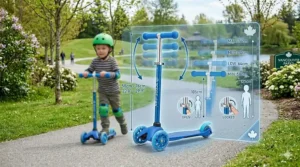
The Razor A5 Lux occupies an interesting position in the market—it’s technically rated for ages 8+, but many Canadian families successfully introduce it to taller, athletic 5-year-olds who’ve already mastered three-wheelers and are ready for something faster. The key differentiator is the larger 200mm (8-inch) wheels, which roll over sidewalk cracks and expansion joints with less jarring than the 120mm wheels found on most beginner models.
What this means in practice: if your 5-year-old is already comfortable with speed and doesn’t startle easily when hitting bumps, the A5 Lux’s larger wheels provide a noticeably smoother experience on typical Canadian urban sidewalks (which, let’s be honest, aren’t winning any maintenance awards in most cities). The aircraft-grade aluminum frame is bombproof—I’ve seen these scooters survive multiple Canadian winters in garage storage, spring rain exposure, and the inevitable “I left it in the driveway and Dad ran over it” incident with nothing more than cosmetic scuffs.
The deck height sits at 8 cm, slightly higher than beginner-focused models, which creates a trade-off worth understanding. The higher deck means less bend in your child’s pushing leg, reducing fatigue on longer rides (great for the 1.5 km trek to school). However, it also raises the centre of gravity, making initial balance slightly trickier for truly first-time two-wheelers. This is why I specifically recommend the A5 Lux for second scooters or for naturally coordinated kids who pick up physical skills quickly.
Canadian Retail Notes: Widely available at Canadian Tire, Toys R Us, and Amazon.ca, typically in the mid-$100s CAD range. Watch for seasonal sales in May (Victoria Day weekend) and September (back-to-school) when prices often drop to the $90-$110 range.
Canadian Customer Feedback: Quebec reviewers particularly note the A5’s stability on Montreal’s notoriously rough sidewalks, with one parent commenting: “The big wheels actually make a difference on our beaten-up neighborhood streets—less wobble when hitting bumps.”
Pros:
✅ Large 8-inch wheels excel on rough Canadian sidewalks
✅ Adjustable handlebars (26-40 inches) grow substantially with child
✅ Widely available across Canadian retailers for easy replacement parts
Cons:
❌ Heavier at 3.9 kg—less ideal for younger 5-year-olds to carry
❌ Higher deck may feel unstable for first-time two-wheel riders
Price & Value Verdict: Around $100-$140 CAD. Excellent value for taller kids or those ready to graduate from basic models. The widespread availability in Canada means you can often find this on sale, making it a smart choice for value-conscious families.
3. Globber Flow 125 — Lightweight Champion for Nervous Beginners
The Globber Flow 125 is the scooter I recommend when parents tell me their 5-year-old is interested in two wheels but lacks confidence. At just 2.7 kg, it’s lighter than the Micro Sprite, easier for small hands to maneuver, and features a low 6.5 cm deck height that keeps the centre of gravity close to the ground—the holy grail for building stability during balance development scooters learning phases.
What makes Globber’s design particularly clever for the transition from 3 to 2 wheels is the triple-layer deck structure. It sounds like marketing, but there’s real engineering here: the reinforced platform provides just enough flex to absorb vibration from rough surfaces without feeling bouncy or unstable. For Canadian kids learning on less-than-perfect spring sidewalks (frost damage is real, folks), this subtle flex means fewer jarring bumps that startle them into abandoning the scooter.
The 125mm wheels hit a sweet spot for 5-year-olds—large enough to handle typical sidewalk imperfections without getting stuck, but not so big that the scooter feels unwieldy for shorter riders. The handlebar adjusts through four height settings from 68 cm to 88 cm, which genuinely covers kindergarten through Grade 4 for average-height Canadian kids.
Here’s what the spec sheet won’t tell you: the folding mechanism is genuinely one-handed, which matters more than you’d think. When your child wants to bring their scooter into Grandma’s condo or fold it for bus transit (yes, some adventurous Toronto families do this), the quick-fold saves you from wrestling with stubborn latches while juggling a backpack and lunch bag.
Canadian Customer Feedback: BC parents highlight the scooter’s performance in wet conditions: “Rides well even after morning dew—the wheels don’t slip like our old scooter did on damp sidewalks.” Given Vancouver’s reputation, this is reassuring.
Pros:
✅ Ultra-low 6.5 cm deck height maximizes stability for cautious kids
✅ Lightweight 2.7 kg design genuinely manageable for 5-year-olds
✅ Triple-layer deck absorbs vibration on rough Canadian sidewalks
Cons:
❌ 50 kg weight limit means shorter lifespan than premium models
❌ Harder to find in physical Canadian stores (mostly online availability)
Price & Value Verdict: Around $90-$120 CAD on Amazon.ca. Excellent mid-range option for families who want better quality than budget scooters but aren’t ready for the $150+ premium tier. The lower weight limit means you’ll likely replace it around age 8-9, but for 3-4 years of reliable use, the cost-per-year calculation still works out favorably.
4. AODI Kids Kick Scooter — Best Budget Option Without Sacrificing Safety
Look, not every family can (or wants to) drop $150 on what might be a passing interest. The AODI Kids Kick Scooter is what I point budget-conscious Canadian parents toward when they need something reliable without the premium price tag. Currently sitting in the $65-$85 CAD range on Amazon.ca, it delivers surprising quality for the cost—though you need to understand exactly what you’re getting.
The aluminum frame won’t win design awards, but it’s solid enough for typical 5-year-old use (riding to the park, cruising the driveway, showing off to friends). The 120mm PU wheels are decent quality—not Micro-smooth, but they roll adequately on flat surfaces. Where you notice the cost-cutting is in the bearings: they’re not sealed like premium models, which means they’re more vulnerable to grit, moisture, and the inevitable Canadian spring slush that seems to find its way into everything.
What works well: the wide deck two wheel scooters design provides a stable platform (10 cm width) with good grip texture, addressing the main safety concern parents have with cheaper scooters. The deck sits low at 7 cm, matching premium models in this crucial stability factor. The LED wheels (yes, even budget models have these now) are motion-activated and provide decent visibility—though Canadian parents report they’re less bright than the Micro Sprite’s LEDs in true dusk conditions.
The adjustable handlebar is serviceable with three height positions covering roughly ages 5-8 for average-sized kids. It doesn’t adjust as smoothly as premium options (expect to use an Allen key), but it does the job. The folding mechanism works—it’s not elegant, but when does elegance matter for a 5-year-old’s scooter?
Canadian Customer Feedback: Ontario reviewers are divided but generally positive for the price point. Common theme: “Not as smooth as my friend’s Micro, but my daughter hasn’t noticed and it cost half the price.” Realistic expectations seem to correlate with satisfaction.
Pros:
✅ Genuinely affordable at $65-$85 CAD without feeling dangerous
✅ Wide deck provides good stability for first two wheel scooter kids
✅ LED wheels included at this price point (surprisingly visible)
Cons:
❌ Non-sealed bearings require more maintenance in Canadian conditions
❌ Noticeably rougher ride quality on less-than-perfect pavement
Price & Value Verdict: Around $65-$85 CAD. Best for families testing the waters before committing to an expensive model, or for kids who are genuinely hard on equipment and might need a replacement within a year anyway. Set appropriate expectations: this will work fine for casual neighborhood use but won’t deliver the same smooth, confidence-building experience as models costing twice as much.
5. Besrey Folding Scooter — Best for Growing Kids with Adjustability
The Besrey Folding Scooter takes a different approach to the 5-year-old market by prioritizing growth potential over specialized beginner features. The four-position adjustable handlebar extends from 66 cm to 86 cm, genuinely covering kindergarten through Grade 4 for most Canadian kids. But what makes this model interesting is the adjustable deck angle—a feature rarely seen at this price point ($70-$95 CAD).
Here’s why that matters: many first two wheel scooter kids models force your child into a specific riding posture, which can feel awkward as they grow and their leg length changes. Besrey’s adjustable deck lets you modify the angle slightly as your child gets taller, maintaining comfortable push-off geometry. It’s subtle, but parents who’ve used this scooter for 2+ years report noticeably less complaining about tired legs compared to fixed-geometry models.
The 145mm wheels are larger than typical beginner scooters but smaller than the Razor A5’s 200mm giants—a middle ground that works surprisingly well for 5-year-olds who’ve already gotten comfortable on a three-wheeler. They handle sidewalk cracks better than small wheels while remaining light enough that the scooter doesn’t feel sluggish when pushing off.
Build quality sits firmly in the “good enough” category. The aluminum frame is lighter than it looks (3.2 kg), the deck is wide (11 cm) with decent grip texture, and the rear fender brake is easy for kids to engage. Where you see the cost-saving is in the finish quality—expect some paint chips after a season of use—and the bearings, which aren’t sealed against moisture. For Canadian families, this means you’ll want to bring it inside during wet weather and definitely avoid leaving it outside overnight when there’s dew.
Canadian Customer Feedback: Prairie parents specifically mention appreciation for the large wheels: “Handles the gravel patches on our pathway better than my son’s friend’s scooter with smaller wheels.” For families in newer subdivisions where pathways aren’t perfectly paved yet, this feedback is relevant.
Pros:
✅ Four-position handlebar truly grows with your child
✅ Adjustable deck angle maintains comfortable geometry as kids get taller
✅ Mid-size 145mm wheels balance maneuverability and bump-handling
Cons:
❌ Finish quality shows wear faster than premium models
❌ Heavier than lightweight beginner options at 3.2 kg
Price & Value Verdict: Around $70-$95 CAD. Smart middle-ground choice for families who want more than a basic budget model but aren’t ready for premium pricing. The growth-focused features extend useful lifespan, making the slightly higher price (versus basic budget options) worthwhile if you plan to use it for 3+ years.
6. Madd Gear Carve 100 — Best for Active, Confident Riders
The Madd Gear Carve 100 is what happens when a company known for stunt scooters designs something for younger kids—you get robust construction and responsive handling, but with beginner-appropriate geometry. This scooter appeals to naturally athletic 5-year-olds who picked up three-wheeling instantly and are ready for something that feels more responsive.
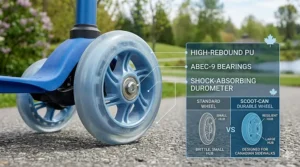
The standout feature is the 100mm high-rebound wheels paired with ABEC-5 bearings—this combination delivers noticeably quicker acceleration and better sustained speed than similarly-priced models with cheaper bearings. What this means for your active 5-year-old: they can keep up with older siblings or friends more easily, which (whether we like it or not) significantly impacts whether they’ll actually use the scooter.
The steel frame is heavier than aluminum competitors at 3.5 kg, but the trade-off is durability that borders on indestructible. Canadian families with multiple kids specifically praise this scooter for surviving hand-me-down transitions between siblings with minimal wear. One Halifax parent notes: “Three kids and four winters later, still going strong.” For families planning to use this scooter across multiple children, that longevity matters.
The deck height sits at 7.5 cm—slightly higher than ultra-beginner models but still low enough for good stability. The 12 cm deck width (wider than average) gives kids plenty of foot space, which reduces the “cramped feet” complaint common with narrow-deck models. The folding mechanism is solid but requires two hands, making it less convenient for quick fold-ups but more secure during riding.
Canadian Customer Feedback: Ontario reviewers highlight cold-weather performance: “We rode this into late October and the wheels didn’t get stiff like some rubber wheels do when temps drop.” For Canadian families extending the season into fall, this is a meaningful advantage.
Pros:
✅ ABEC-5 bearings deliver noticeably faster, smoother ride
✅ Bombproof steel construction survives multiple kids/winters
✅ Wide 12 cm deck provides excellent foot stability
Cons:
❌ Heavier at 3.5 kg—less ideal for young 5-year-olds to carry
❌ Handlebar height range (70-86 cm) may not fit very tall kids long-term
Price & Value Verdict: Around $75-$100 CAD. Best value for families planning to hand down between siblings or for active kids who will genuinely wear out lesser scooters. The higher weight means this is better suited for confident 5-year-olds rather than nervous beginners, but for the right child, it’s a scooter they’ll use enthusiastically for years.
7. Radio Flyer EZ Rider — Best for Cautious or Younger 5-Year-Olds
The Radio Flyer EZ Rider targets a specific niche: 5-year-olds who are developmentally ready for two wheels but need maximum stability to build confidence. The defining feature is the ultra-low 5 cm deck height—the lowest in this roundup—which keeps your child’s centre of gravity as close to the ground as physically possible. For anxious kids or those transitioning young, this extra 1.5-2 cm of lower positioning genuinely makes a psychological difference.
The design philosophy is clearly “beginner-first.” The deck is extra-wide at 12 cm (tied with Madd Gear for widest in this comparison), the anti-slip surface is aggressively textured (almost skateboard-grip-tape level), and the wheels are 120mm—large enough to handle bumps but not so large they make the scooter unwieldy for smaller riders. The overall geometry prioritizes stability over speed, which is exactly what nervous parents want.
Where Radio Flyer made smart choices: the handlebar foam grips are thicker than most competitors, easier for small hands to hold securely, and the rear fender brake is wider than typical models, making it easier for kids to find with their foot when panic-stopping. These seem like minor details until you watch a nervous 5-year-old successfully brake for the first time without having to look down at their foot—small design elements that reduce cognitive load during learning.
The trade-off for all this beginner-friendliness is a lower weight limit (45 kg / 100 lbs) and shorter useful lifespan. Most Canadian kids will outgrow this scooter by age 7-8, meaning it’s a genuine starter model rather than a grow-with-you option. But for families whose priority is building confidence in a nervous child, two years of enthusiastic use beats five years of a faster scooter gathering dust in the garage.
Canadian Customer Feedback: Parents of younger or anxious kids consistently report positive experiences: “My cautious daughter who wouldn’t try my friend’s Micro tried this one immediately—the low deck made the difference.” Anecdotal, but the pattern repeats across reviews.
Pros:
✅ Ultra-low 5 cm deck height maximizes stability for nervous riders
✅ Extra-wide deck (12 cm) and thick grips boost beginner confidence
✅ Beginner-focused design details reduce learning-curve frustration
Cons:
❌ Low 45 kg weight limit means shorter useful lifespan (to age 7-8)
❌ Slower, more stable geometry less appealing to athletic kids
Price & Value Verdict: Around $80-$110 CAD. Not the longest-lasting scooter in this roundup, but potentially the highest value if it’s the difference between your child using a scooter versus refusing because they’re intimidated. For families with nervous 5-year-olds, the low deck height two wheel scooters design is exactly what makes this model worth considering despite the shorter lifespan.
Understanding Balance Development: When Your 5-Year-Old Is Truly Ready
The question “Is my 5-year-old ready for two wheels?” doesn’t have a universal answer, despite what manufacturer age recommendations suggest. Research on motor development in early childhood demonstrates that balance skills develop through progressive mastery of increasingly unstable surfaces, which is exactly what the transition from three-wheel to two-wheel scooters provides. But readiness depends on your specific child’s motor development, not their birth certificate.
Here are the actual developmental markers I look for when helping Canadian families assess readiness:
Balance Foundation: Can your child stand on one foot for 5-10 seconds without wobbling significantly? Can they walk along a curb or low balance beam without constant steadying? These aren’t arbitrary tests—they indicate the proprioceptive awareness needed to make constant micro-adjustments on a two-wheel platform. If your child struggles with these, they’re not yet ready for two wheels, regardless of what their friends are riding.
Coordination Skills: Watch how they push off on a three-wheeler. Do they alternate pushing feet naturally, or do they favor one side? The ability to coordinate left-right movements smoothly predicts how quickly they’ll adapt to the push-glide rhythm of two-wheel scooting. Kids who already coordinate well on three wheels typically transition to two wheels within a few days. Those still developing coordination may need weeks of wobbly practice.
Fear Response Management: This is the factor parents most often overlook. A child who panics and freezes when they start to lose balance isn’t developmentally unready—but they need a different teaching approach. Look for kids who, when they stumble while running, instinctively put their hands out or take a steadying step. This automatic protective response indicates they’ll react appropriately to wobbles on a scooter rather than freezing or over-correcting.
Canadian Seasonal Considerations: Timing the two-wheel transition matters more in Canadian climates than parents realize. Starting the transition in late April or early May gives your child 5-6 months of consistent practice before winter forces storage. Starting in October means you’re asking them to maintain new motor patterns across a 5-month gap, which significantly increases re-learning time in spring. If you’re buying in fall for a December birthday, plan on treating it as a “spring activity” and don’t expect immediate mastery.
For families in regions with proper winter (looking at you, Winnipeg and Ottawa), the reality is you have approximately 6-7 months of usable scootering weather. This seasonal limitation means it’s genuinely worth investing in a quality scooter that will survive multiple seasons—budget models that wear out after one summer become poor value when you only get half-year usage.
How to Choose the Right First Two-Wheel Scooter: A Canadian Buyer’s Framework
Navigating Amazon.ca’s scooter selection without a clear framework leads to either decision paralysis (112 options!) or impulse buying based on whichever product has the most reviews. Here’s the structured approach I walk Canadian families through:
Step 1: Deck Height Assessment (Non-Negotiable)
Measure from the ground to your child’s shin bone (about 10-12 cm up from ankle). The deck height should sit at or below this point. Most 5-year-olds need decks in the 5-7 cm range. Why this matters: higher decks require more ankle flexibility and create a higher centre of gravity, making balance more difficult. This single spec predicts success more reliably than any other feature. If you only check one measurement, make it this.
Step 2: Weight Limit Reality Check
Don’t just check if your child’s current weight fits—project forward. The average Canadian 5-year-old weighs 18-20 kg; by age 10, they’ll weigh 30-35 kg. A scooter rated for 50 kg (110 lbs) will last through elementary school. One rated for 45 kg might not make it to Grade 3. This is where the Canadian price-per-year calculation becomes crucial: a $150 scooter used for 6 years ($25/year) beats a $75 scooter used for 2 years ($37.50/year) before requiring replacement.
Step 3: Canadian Climate Durability Features
Sealed bearings aren’t a luxury in Canadian climates—they’re a requirement unless you want to replace bearings annually. Non-sealed bearings exposed to spring slush, summer humidity, and fall rain will degrade quickly. Check product descriptions for “sealed” or “ABEC-5 sealed bearings.” If the listing doesn’t specify, assume they’re not sealed. Similarly, rust-resistant materials matter more here than in drier climates. Aluminum frames trump steel for Canadian year-round storage.
Step 4: Handlebar Adjustment Range
Verify the actual measurements, not just the age range. A scooter claiming “fits ages 5-12” might have handlebars extending from 70-90 cm—adequate for average Canadian kids. But if your child is already in the 95th percentile for height (like many kids with Northern European heritage), they’ll outgrow that range by age 8. Cross-reference handlebar max height against your child’s projected height using Health Canada’s growth charts.
Step 5: Amazon.ca Availability Verification
This seems obvious but catches many Canadian shoppers: if the product ships from Amazon.com (not .ca), you’re looking at potential customs fees, longer shipping times, and warranty complications. Filter specifically for Amazon.ca sellers with Prime eligibility. Budget an extra week for non-Prime Canadian deliveries—our vast geography means Toronto-to-Vancouver shipping is slower than many international routes.
Step 6: Folding Mechanism Test
If possible, watch YouTube reviews showing the actual folding process. One-handed folds matter for parents juggling bags and smaller siblings. Two-handed folds are fine if the scooter will primarily stay unfolded. The worst category is “requires significant force” folds that your 5-year-old can’t manage independently—these create dependence just when they’re developing autonomy.
Step 7: Wheel Size for Your Terrain
Smooth urban sidewalks: 100-120mm wheels are fine and keep the scooter lightweight. Mixed terrain (sidewalks + bike paths): 120-145mm wheels handle cracks and bumps better. Rough or gravel-prone areas (new suburban developments, rural pathways): 145mm+ wheels are worth the extra weight. This is one area where local Canadian geography genuinely dictates optimal choice—a scooter perfect for downtown Toronto might frustrate a child in a newer Calgary suburb with unpaved pathways.
The Transition Journey: A 30-Day Timeline for Canadian Parents
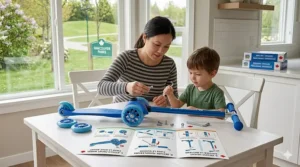
Most parenting advice glosses over the actual messy middle of teaching two-wheel scooting. Here’s the realistic timeline I’ve observed with dozens of Canadian families, broken into weekly phases with specific goals and common frustrations:
Week 1: Foundation and Frustration
Goal: Get comfortable with basic push-glide on flat, smooth surfaces.
Your child will spend most of this week figuring out the timing of push-glide-balance. Expect wobbles, frequent foot-dragging for stability, and probably some complaints that “this is too hard” or “I want my old scooter back.” This is normal—they’re rebuilding motor patterns from scratch.
Canadian-specific tip: Start in a parking lot or tennis court, not on sidewalks. Those spring frost heaves and summer tree-root buckles add unnecessary variables while they’re still finding their balance. School parking lots on Saturday mornings are perfect practice spaces across Canada—empty, smooth, and typically sheltered from wind.
Set a timer for 15-minute sessions, then switch to something else. Fatigue leads to sloppy technique and builds negative associations. Three 15-minute sessions across a weekend beat one exhausting hour.
Week 2: Building Confidence and Speed
Goal: Achieve 10-15 metres of continuous gliding without foot-dragging.
This is the breakthrough week for most kids. The moment when push-glide suddenly “clicks” and they can coast 5-10 seconds between pushes. Celebrate this milestone visibly—it builds motivation for the harder skill development ahead.
Start introducing gentle slopes (think: driveway inclines, not hills). Rolling downhill helps kids feel the gliding sensation without needing to push, building confidence in the balanced state. Just ensure the run-out is flat and obstacle-free—early-week-two braking skills are still sketchy.
Canadian weather consideration: If rain interrupts your practice schedule, don’t panic. A 2-3 day break won’t erase progress at this stage. But try to get at least two practice sessions per week to maintain momentum.
Week 3: Real-World Skills
Goal: Navigate turns, practice emergency stops, handle typical sidewalk obstacles.
Now you’re teaching practical riding skills. Set up simple obstacle courses: weave between pylons, practice stopping at designated “stop signs,” ride around corners. These activities build the spatial awareness and motor planning needed for real sidewalk navigation.
Introduce the “look ahead, not down” principle. Kids who stare at the deck lose balance—those who look 3-4 metres ahead naturally maintain better posture and stability. To teach this, place colorful markers ahead and ask them to call out colors as they ride past.
Canadian-specific challenge: This is when weather unpredictability becomes frustrating. You’ve got momentum, then three days of rain. Pro tip: some families with garage space let kids practice basic maneuvering indoors during rain breaks. It’s not ideal, but maintaining practice frequency matters more than perfect conditions.
Week 4: Independence and Skill Refinement
Goal: Confident independent riding on various surfaces.
By week four, most 5-year-olds can ride independently for sustained periods. Now you’re refining: smoother turns, faster speeds, better stopping control, and riding on less-than-perfect surfaces. Start venturing onto real sidewalks with typical cracks and imperfections.
This is also when you introduce sidewalk safety rules specific to Canadian urban environments: stopping at driveways, walking across intersections (not riding), giving pedestrians right-of-way, and staying visible to drivers. These habits formed early stick long-term.
Plateau Warning: Some kids hit a confidence plateau around week 3-4 where improvement slows. This is normal motor learning—consolidation phase. Maintain regular practice without pushing harder, and you’ll see breakthrough moments in week 5-6.
Common Mistakes Canadian Parents Make (And How to Avoid Them)
Mistake #1: Buying Based on Age Range Alone
Why it fails: A “5-8 years” label tells you nothing about whether the scooter fits your actual 5-year-old’s height, weight, or skill level. I’ve seen dozens of Canadian families buy scooters their child physically cannot use because the handlebars started too high or the deck geometry assumed longer legs.
Better approach: Measure your child’s inseam and compare to handlebar minimum height. Stand them on the deck (in-store if possible) and check if they can comfortably reach handlebars with slightly bent elbows—straight-arm reaching creates shoulder fatigue and poor control.
Mistake #2: Prioritizing LED Lights Over Core Mechanics
Why it fails: Flashy LED wheels sell scooters, but they don’t keep kids riding them. A scooter with amazing lights but rough ride quality or unstable geometry will sit unused within weeks. Canadian kids are tactile—they notice when every sidewalk crack jars them.
Better approach: Evaluate ride quality first (bearing quality, wheel material, deck geometry), then consider lights as a tiebreaker between equally functional models. The Micro Sprite succeeds because it nails fundamentals AND has LEDs—not just because it lights up.
Mistake #3: Ignoring the Canadian Winter Storage Reality
Why it fails: Scooters left in unheated garages through -20°C winters develop brittle plastic parts, frozen bearings, and degraded wheels. Come spring, they either don’t work properly or feel different enough that kids refuse to use them.
Better approach: Store scooters indoors (basement, closet, mudroom) where temperatures stay above freezing. If space is limited, disassemble the handlebar—most fold or detach—so the scooter fits in a smaller footprint. This small effort extends scooter lifespan dramatically in Canadian climates.
Mistake #4: Skipping the Helmet Battle
Why it fails: “Just down the driveway” becomes “just to the corner” becomes a trip to the park without head protection. Canadian research on pediatric scooter injuries shows helmets reduce head injury risk by approximately 90 percent, yet compliance remains frustratingly low for “low-speed” activities like scooting.
Better approach: Make helmet non-negotiable from day one. No helmet = scooter stays in garage, zero exceptions. Within two weeks, it becomes automatic habit. Canadian parents who compromise on this rule universally regret it the first time their child takes an unexpected tumble.
Mistake #5: Buying During Peak Season Without Comparison Shopping
Why it fails: April-June sees highest demand and highest prices on Amazon.ca. That $120 scooter might be $85 in September or $95 in February.
Better approach: If shopping in peak season, use browser extensions like Keepa or CamelCamelCamel to check price history. Often the exact model cycles through sales 2-3 times per year. For non-urgent purchases, buy in off-season (late fall, winter) when retailers clear inventory.
Mistake #6: Assuming “Free Shipping” Means Fast Shipping
Why it fails: Amazon.ca’s geography means “free shipping” to rural BC, northern Ontario, or Atlantic Canada often translates to 10-14 business days. Buying a birthday present two weeks before the party is cutting it close.
Better approach: For time-sensitive purchases, verify estimated delivery dates before ordering. Prime shipping matters more in Canada than US because our geography creates longer standard shipping windows. That extra $99/year for Prime pays for itself in 3-4 scooter-related purchases annually for active families.
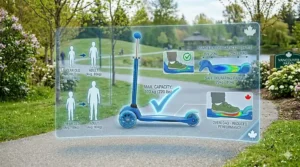
Scootering Through Canadian Seasons: A Practical Guide
Spring (April-June): The Prime Season
Canadian spring presents the ideal learning window—mild temperatures, long daylight hours, and that collective outdoor enthusiasm after winter confinement. But spring also means frost-heaved sidewalks, gravel scattered from winter road maintenance, and sudden rain showers.
Tactical adjustments: Check sidewalks before heading out—that route perfect in fall might have developed major cracks over winter. Bring a towel in your bag for post-puddle wheel cleaning; road salt and grit embed in bearings and accelerate wear. Schedule practice sessions for late afternoon when morning dew has dried but temperatures haven’t peaked—5-year-olds flag quickly in heat.
Clothing considerations: Layers. Always layers. That mild 15°C morning can feel like 8°C with wind chill when moving at scooter speeds. Light windbreakers protect without overheating, and slip-resistant shoes (not flip-flops or Crocs) are non-negotiable on wet pavement.
Summer (July-August): Peak Usage with Heat Challenges
Long days mean extended riding opportunities, but Canadian summers bring challenges manufacturers in California don’t design for: extreme temperature swings (32°C afternoons, 15°C evenings), sudden thunderstorms, and in some regions, humidity that makes aluminum handlebars slippery.
Heat management: Avoid midday pavement in cities like Toronto or Montreal where asphalt radiates heat—scooter wheels soften in extreme heat, reducing grip and accelerating wear. Early morning or evening sessions work better. Hydration matters more than parents expect—kids focused on scooting forget to drink. Pack water and enforce 5-minute water breaks every 20 minutes during hot weather.
Wheel care: High temperatures soften polyurethane wheels temporarily. If you notice reduced grip or “mushy” feel during hot afternoon rides, that’s why. The wheels will firm up again when cooled. Don’t store scooters in direct sunlight—trunk of a car on a 30°C day can reach 60°C+, potentially warping plastic components.
Fall (September-October): Extension Season with Light Challenges
Canadian fall offers fantastic scooting weather but dramatically shorter daylight hours. By mid-October, kids finishing after-school activities face twilight riding conditions. This is where LED wheels transition from “nice feature” to “safety requirement.”
Visibility strategies: Bright clothing, reflective tape on helmets and scooters, and those motion-activated LED wheels (now you see why I emphasize them) all matter when ambient light drops. Teach kids to stay on well-lit paths—that shortcut through the park that’s fine in June is sketchy by 5 PM in October.
Leaf hazard awareness: Wet leaves on pavement are as slippery as ice for scooter wheels. Teach kids to slow down approaching leaf piles and avoid riding through them at speed—it’s fun until it’s not. After-rain pile-ups near storm drains are particularly treacherous.
Winter (November-March): Storage Strategies
Most Canadian regions can’t support outdoor scooting through winter, making proper storage crucial for spring readiness. Wheels left in freezing conditions develop flat spots and hardened material that never fully recovers. Bearings exposed to temperature fluctuations rust internally even if externally protected.
Storage best practices: Clean thoroughly before storage—that road salt and grit you can’t see will corrode over 5 months. Spray bearings with light penetrating oil (WD-40 works), wipe excess. Store indoors where temperature stays relatively stable. If you must store in an unheated garage, wrap in an old blanket for insulation and elevate off concrete floor (moisture wicks up from concrete).
Mid-winter maintenance: Once in January, bring the scooter inside, let it reach room temperature, and give wheels a spin. This redistributes bearing lubricant and prevents flat spots from prolonged stationary storage.
Safety Standards and Canadian Regulations: What You Need to Know
Unlike bikes or car seats, scooters in Canada operate in a regulatory grey zone—there’s no Canadian Standards Association (CSA) certification specifically for kick scooters, which leaves parents navigating manufacturer claims without official verification. Here’s what you need to understand:
Federal Requirements: Transport Canada doesn’t classify manual kick scooters as vehicles, meaning they’re not subject to the motor vehicle regulations that govern bikes or e-scooters. This is simultaneously liberating (no mandatory equipment standards) and concerning (no minimum safety requirements).
Provincial Variations: Provinces and municipalities set their own rules. In Ontario, scooters are considered “pedestrians” and must use sidewalks, not roads. In BC, scooters can use bike lanes in many municipalities. Quebec has specific helmet requirements for riders under 18. Before your first ride, check your province’s specific regulations—the variation across Canada is significant.
Helmet Laws: While not universally mandated for manual scooters, most provinces require helmets for riders under 18 on wheeled devices. But compliance enforcement is minimal for non-motorized scooters, leaving the decision to parents. Given the research showing 90% reduction in head injury risk with helmets, this is one area where I always recommend erring toward caution regardless of legal requirements.
Product Safety Recalls: Check Health Canada’s Consumer Product Safety database before purchasing. Scooters with weak folding mechanisms, handlebar failures, or wheel detachment issues appear regularly on recall lists. Searching by model number before buying can prevent bringing home a product with known safety defects.
Import Compliance: Scooters sold on Amazon.ca (even by third-party sellers) must meet Canadian consumer product safety requirements. However, enforcement gaps exist. Red flags include: no clear manufacturer contact information, missing age recommendations, incomplete assembly instructions, or generic “brand” names you can’t research. Stick with recognized brands with Canadian distribution for better accountability.
❓ Frequently Asked Questions
❓ Can 5-year-olds handle 2 wheel scooters in Canadian winters?
❓ What's the ideal deck height for first two wheel scooter kids?
❓ How long does transition from 3 to 2 wheels typically take?
❓ Are expensive scooters really worth it for 5-year-olds who might lose interest?
❓ Which features matter most for stable 2 wheel scooter beginner models in Canada?
Conclusion: Making the Right Choice for Your Canadian 5-Year-Old
Choosing the right 2 wheel scooter for 5 year old Canadian riders ultimately comes down to matching the scooter to your specific child’s development, your family’s budget, and your local terrain—not just grabbing whatever’s ranked #1 on Amazon.ca. The Micro Sprite LED deserves its reputation as the gold standard for families who can afford the $150-$180 CAD investment and want a scooter that will genuinely last through elementary school. Its smooth ride quality, low deck, and sealed bearings make it particularly well-suited for Canadian conditions from Ontario’s cracked sidewalks to BC’s wet pathways.
For families working with tighter budgets, the Globber Flow 125 ($90-$120 CAD) delivers impressive quality at a mid-range price, while the AODI Kids Kick Scooter ($65-$85 CAD) provides adequate performance for casual neighborhood use without the premium cost. Budget-conscious parents should focus their limited dollars on scooters with low decks and decent bearings—these fundamentals matter more than flashy features.
The transition from 3 to 2 wheels represents a genuine developmental milestone in balance development and coordination that extends well beyond just riding a scooter. When you watch your 5-year-old achieve that first wobbly but successful glide, you’re witnessing motor skill development that supports everything from skating to skiing to eventual bike riding. This makes the scooter investment (whether $75 or $175) an enabler of broader physical development, not just a toy.
Canadian families face unique considerations—shorter riding seasons, challenging weather, rough winter-damaged sidewalks—that genuinely should influence scooter selection. Features like sealed bearings, rust-resistant frames, and durable wheels transition from “nice to have” to “essential for multi-year use” in our climate. The extra $30-$50 for weather-resistant components pays back in extended usability across Canadian seasons.
Start with the buyer’s framework in Section 6, match it to your child’s actual skill level (not their age), verify Amazon.ca availability and pricing, and prioritize the three key beginner features: low deck height, wide stable platform, and smooth-rolling wheels. Whether you’re in Vancouver, Toronto, Calgary, or Halifax, these fundamentals predict success more reliably than brand names or marketing claims.
The right scooter isn’t the most expensive or the most popular—it’s the one your child will actually ride enthusiastically for years. And based on helping dozens of Canadian families through this transition, that usually means choosing quality over features, stability over speed, and proven designs over trendy newcomers. Your 5-year-old doesn’t need the fanciest scooter; they need one that builds confidence through smooth, stable riding that makes them want to practice again tomorrow.
Recommended for You
- 7 Safest 12V ATVs With Speed Control Canada 2026 Guide
- Best 12V Electric Motorcycle for Kids Canada 2026 Guide
- Best 12V Electric ATVs for Kids 5-8 in Canada 2026
Disclaimer: This article contains affiliate links. As an Amazon Associate, I earn from qualifying purchases. If you purchase products through these links, we may earn a small commission at no additional cost to you.
✨ Found this helpful? Share it with your friends! 💬🤗
