
In This Article
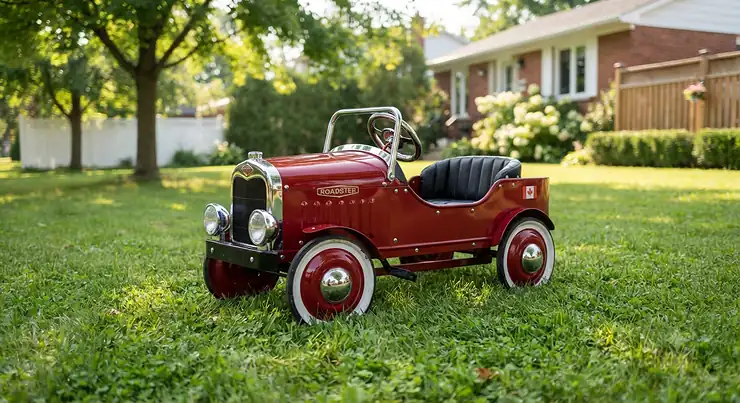
There’s a particular kind of magic in the crunch of gravel under small rubber tires, the squeak of a chrome bell, and a kid hollering “look at me go!” from behind a steering wheel three sizes too big for their hands. That’s the pull of a vintage style pedal car for backyard play — it isn’t just a toy, it’s a little rolling time machine that somehow makes both the four-year-old pedaling it and the grandparent watching from the porch equally happy. Unlike battery-powered ride-ons that hum and beep and eventually die mid-driveway, a pedal car runs entirely on kid-power, snack breaks included.
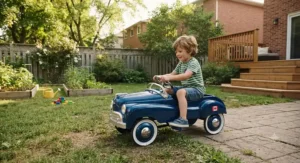
This guide digs into seven real, currently available pedal cars sold through amazon.ca, breaking down what actually separates a well-built reproduction from a wobbly bargain-bin knockoff. We’ll cover budget picks under C$150, mid-range roadsters in the C$150-C$300 range, and heirloom-quality collector pieces that cost more but are genuinely built to survive a decade of neighbourhood kids. Whether you’re shopping for a birthday, hunting for a piece of nostalgic backyard décor, or just tired of your kid asking why the neighbour’s driveway looks cooler than yours, you’ll find a legitimate option here — along with the honest trade-offs nobody puts on the product page. A vintage style pedal car for backyard use is, at its core, a foot-powered ride-on toy styled after classic 1920s-1950s automobiles, typically built from steel or heavy-gauge plastic, designed for kids roughly aged 2 to 7.
Quick Comparison Table
| Product | Style | Build | Price Range (CAD) | Best For |
|---|---|---|---|---|
| Baghera Classic Pedal Car | 1930s French roadster | All-metal | C$400-C$550 | Design-conscious families, backyard décor |
| Blue Diamond Classics 1955 Chevy Pedal Car | ’55 Tri-Five Chevy | Steel, chrome trim | C$450-C$600 | Collectors and car-loving households |
| Morgan Cycle Retro Style Pedal Car (21114) | 1920s roadster, red | Steel body | C$180-C$260 | Mid-range all-rounder |
| Morgan Cycle Pink Retro Pedal Car | 1920s roadster, pink | Steel body | C$180-C$260 | Girls’ variant, matching sibling sets |
| Kid Trax Classic Street Rod Pedal Car | Vintage hot rod | Steel with plastic trim | C$100-C$160 | Budget-conscious first pedal car |
| Kid Trax Classic Fire Truck Pedal Car | Vintage fire engine | Steel with plastic trim | C$100-C$160 | Themed play, younger toddlers |
| American Retro Deluxe Fire Truck Pedal Car | 1940s “sad face” fire engine | Steel, chrome, wood ladders | C$500-C$650 | Heirloom-quality display piece |
Looking at the spread above, the price gap tells its own story: the two Kid Trax models sit at the entry point because they lean on plastic accents and simpler steel stamping, while the Baghera Classic Pedal Car and American Retro Deluxe Fire Truck Pedal Car justify their premium with thicker-gauge steel, sealed bearings, and chrome detailing that won’t pit after two Canadian winters in an uncovered shed. The Blue Diamond Classics 1955 Chevy Pedal Car and both Morgan Cycle models land in the middle, offering real metal construction without the collector-piece price tag — a reasonable landing spot for most families who want something sturdier than a plastic ride-on but aren’t ready to spend as much as a used bicycle.
💬 Just one click — help others make better buying decisions too!😊
Top 7 Vintage Style Pedal Cars: Expert Analysis
1. Baghera Classic Pedal Car — French 1930s roadster styling with chrome trim
The Baghera Classic Pedal Car leans hard into 1930s coachbuilt styling, and it’s the one product in this lineup that consistently gets compared to actual antiques rather than other toys. Built by a family-run French toy maker, it uses a steel body, a chrome grille, two round headlights, and — cleverly — a chrome windshield frame that doubles as a carrying handle, since these things are surprisingly heavy to haul in and out of a garage. The rear-pedalling drive system is worth pausing on: instead of a chain, the pedals connect directly to the rear axle, which means there’s genuinely nothing to grease, snag, or rust seize over a Canadian winter.
Based on the spec comparison with the rest of this list, the Baghera’s adjustable three-position pedals make it one of the few cars here that realistically stretches from age 3 through 6, rather than being outgrown in a single summer. It’s best suited to parents who see this as a design object as much as a toy — something that looks intentional sitting on a porch rather than sprawled in the grass. Reviewers consistently note that the paint finish holds up better than typical department-store ride-ons, though several also mention the freight shipping cost from overseas warehouses adds noticeably to the final total, so it’s worth checking landed cost before committing.
Pros:
- ✅ Rear-pedal design means no chain to lubricate or rust
- ✅ Adjustable pedals fit a wider age range than most rivals
- ✅ Chrome detailing holds finish well over multiple seasons
Cons:
- ❌ Higher shipping costs from European stock can be a surprise
- ❌ Heavier than steel rivals, harder for small kids to reposition alone
Expect to pay in the C$400-C$550 range for the Baghera Classic Pedal Car at the time of research; given the metal construction and near-heirloom design, it’s a fair value pick for families planning to keep it as a display piece between play sessions.
2. Blue Diamond Classics 1955 Chevy Pedal Car — authentic Tri-Five Chevy body lines
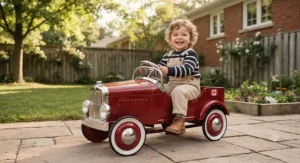
If your household has strong opinions about classic Detroit iron, the Blue Diamond Classics 1955 Chevy Pedal Car is the closest a four-year-old can legally get to driving a ’55 Bel Air. It replicates the actual sheet-metal contours of the Tri-Five Chevy — the wraparound hood line, the signature grille shape — down to a padded vinyl seat and chrome hubcaps that mirror the full-size car’s wheel covers. The 5-position adjustable pedal mechanism uses a sealed bearing setup, which on paper means noticeably less pedal resistance for small legs compared to the looser bushings found on cheaper stamped-steel cars.
What most buyers overlook about this model is that it’s sold both fully assembled and as a build-it-yourself kit, and the kit version runs meaningfully cheaper — a detail that matters if a parent or grandparent wants a weekend project rather than an out-of-box toy. Reviewers frequently mention that the kit assembly is manageable with basic hand tools in an afternoon, though a few note the included instructions assume some familiarity with wrenches. For households where a classic car is already part of family identity — think garage posters, model kits, the whole vibe — this is the pedal car that closes the loop between generations.
Pros:
- ✅ Accurate ’55 Chevy body styling down to hubcap details
- ✅ Sold as assembled or DIY kit at different price points
- ✅ Sealed bearing pedal mechanism reduces resistance
Cons:
- ❌ Kit version requires an afternoon of assembly time
- ❌ Premium pricing puts it near the top of this lineup
Priced around C$450-C$600 depending on assembled versus kit format, this is a strong value pick specifically for car-enthusiast families, though budget shoppers will find better dollar-per-play-hour elsewhere on this list.
3. Morgan Cycle Retro Style Pedal Car (21114) — all-metal 1920s roadster in red
The Morgan Cycle Retro Style Pedal Car is the model that shows up most often when people search generically for “the red pedal car” — and there’s a reason for that. It’s built with genuine steel body panels rather than the metal-look plastic used on some cheaper competitors, paired with sealed ball-bearing wheel hubs and solid rubber tires that won’t go flat after rolling over a stray Lego. The adjustable non-slip pedals accommodate the recommended 2-5 age range reasonably well, though on the smaller end of that bracket, a parent will likely need to push-assist for the first few weeks.
Here’s what the spec sheet won’t tell you, but user reports suggest: the powder-coat paint job is genuinely more chip-resistant than typical enamel, which matters a lot for something that’s going to get dragged across driveways and occasionally tipped over by a sibling. Based on the spec comparison, this sits as the honest middle ground of the entire lineup — real metal, real bearings, without the collector-piece price tag of the Baghera or Blue Diamond models. It’s the pick for a family that wants “solid and classic” without turning the purchase into a design statement.
Pros:
- ✅ Genuine steel body, not metal-look plastic
- ✅ Sealed ball-bearing hubs for smoother rolling
- ✅ Powder-coat finish resists chipping better than enamel
Cons:
- ❌ Smaller kids near age 2 will need push-assistance initially
- ❌ No back-pedal braking system like premium rivals
At around C$180-C$260, the Morgan Cycle Retro Style Pedal Car delivers strong value for the metal-construction quality on offer, sitting comfortably as the go-to mid-range recommendation.
4. Morgan Cycle Pink Retro Pedal Car — same steel build in a girls’ colourway
Mechanically identical to its red sibling, the Morgan Cycle Pink Retro Pedal Car swaps the powder coat for a pink finish while keeping the same all-metal construction, sealed bearing hubs, and adjustable non-slip pedal system. This matters more than it sounds — a lot of “girls'” ride-ons on the market quietly downgrade to thinner plastic shells once you check the specs, but this one doesn’t cut any structural corners for the colour swap.
The honest analytical take here is that this model exists almost entirely for households who want a matching pair — one red, one pink — for siblings or a daycare setting, and Morgan Cycle clearly built it that way rather than treating “pink” as an afterthought SKU. Reviewers consistently frame this as a strong gift option, with several noting it holds up well as a keepsake that gets photographed at every birthday for years. If aesthetics matter more than mechanical differences to your buying decision, this is simply the same excellent mid-range car in a different shade.
Pros:
- ✅ Identical steel build quality to the red version
- ✅ No structural downgrade for the colourway
- ✅ Popular gift and keepsake option
Cons:
- ❌ Same age-range limitations as the red model
- ❌ Limited colour options beyond pink and red
Pricing sits in the same C$180-C$260 range as its sibling model, making the choice between them purely a matter of colour preference rather than value trade-offs.
5. Kid Trax Classic Street Rod Pedal Car — budget vintage hot-rod styling
For a lot of families, the Kid Trax Classic Street Rod Pedal Car is the realistic entry point into this category — vintage hot-rod detailing, chrome-look hubcaps, and functional steering, all at a price that doesn’t require a serious budgeting conversation. The steel frame keeps overall durability reasonable, though the trim pieces (grille, mirrors, dash accents) lean on ABS plastic rather than the stamped metal used in pricier models, which is exactly how the price stays low.
What most buyers overlook about this model is that “easy assembly” claims on the box are largely accurate — reviewers consistently mention it comes together in under 30 minutes with a household screwdriver, which matters if this is a last-minute birthday purchase. The 60 lb weight capacity comfortably covers the 3-5 age bracket it’s designed for. Based on the spec comparison, this isn’t a car built to be handed down through three cousins — the plastic trim will show wear faster than the all-metal competitors — but for a first pedal car that might get replaced by a bike in two years anyway, it’s a genuinely sensible buy.
Pros:
- ✅ Lowest price point of the metal-frame options here
- ✅ Fast, tool-light assembly out of the box
- ✅ Functional steering for actual driveway navigation
Cons:
- ❌ Plastic trim wears faster than all-metal rivals
- ❌ Not built as a multi-generation heirloom piece
At an under-C$150 range, the Kid Trax Classic Street Rod Pedal Car offers the best value-per-dollar for a first pedal car, provided expectations match the price point.
6. Kid Trax Classic Fire Truck Pedal Car — vintage fire engine detailing with bell and ladders
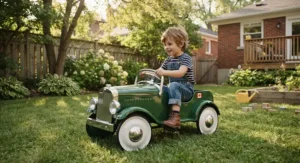
Same core platform as the Street Rod above, but the Kid Trax Classic Fire Truck Pedal Car swaps in fire-engine styling — a working bell, removable plastic ladders, and chrome-look hub caps — which tends to land harder with the 3-to-5 crowd than a generic roadster shape. The steel frame and functional steering carry over unchanged, so the mechanical honesty is the same as its sibling: solid budget bones, plastic accent pieces.
Reviewers consistently report that the bell is a genuine hit with kids well beyond initial unboxing excitement — it’s loud enough to matter, not a token gesture. The removable ladders are a nice touch for imaginative play but are the first component that tends to loosen or snap off with rough use, based on aggregated review sentiment. For a themed gift — a firefighter-obsessed toddler, a fire-hall-adjacent birthday party — this earns its keep. It’s not the car you buy for design purposes; it’s the one you buy because a specific kid has been talking about fire trucks nonstop for three months.
Pros:
- ✅ Working bell adds genuine, lasting play value
- ✅ Strong theme execution for fire-truck-obsessed kids
- ✅ Same easy assembly and functional steering as the Street Rod
Cons:
- ❌ Removable ladders are prone to loosening with rough play
- ❌ Same plastic-trim durability limits as its sibling model
Priced similarly under C$150-C$160, this is a themed budget pick that trades a bit of design purity for a lot of specific-interest appeal.
7. American Retro Deluxe Fire Truck Pedal Car — heirloom-quality 1940s “sad face” fire engine
At the top of this lineup sits the American Retro Deluxe Fire Truck Pedal Car, a faithful reproduction of the classic 1940s “sad face” fire engine design that generations of collectors instantly recognize. This is genuinely built differently from everything else on this list: real wooden ladders instead of plastic, a working bell, a flashing light, solid rubber tires, and chrome trim across the grille, hood ornament, windshield, and hubcaps. There’s no tailgate — a deliberate nod to the original 1940s design rather than a cost-cutting omission.
The honest analytical take is that this product occupies a different category from the rest of the list entirely. It’s marketed and priced as an heirloom piece as much as a plaything, and the aggregated review sentiment backs that positioning up — buyers consistently describe it as a “forever” purchase rather than a phase-appropriate toy, with several mentioning it gets passed between cousins or kept as adult-owned display décor once kids outgrow active pedalling. What the spec sheet won’t tell you is that the real wood ladders, while authentic, need occasional resealing if the car lives outdoors year-round in a wet climate — a maintenance step the plastic-ladder competitors simply don’t require.
Pros:
- ✅ Real wooden ladders and extensive chrome detailing
- ✅ Built and marketed as a genuine heirloom piece
- ✅ Faithful to the authentic 1940s fire engine design
Cons:
- ❌ Highest price point in this entire lineup
- ❌ Wood ladders need occasional care in wet climates
Expect a price range around C$500-C$650, making this the splurge pick for collectors or families who want a genuine display-worthy centrepiece rather than a toy that quietly rusts in a shed by year three.
Practical Usage Guide: Setup, Care, and the First 30 Days
Getting a new pedal car right starts before the first ride. Most models arrive partially disassembled — expect to attach the steering wheel column, wheels, and seat, usually with a Phillips screwdriver and the included hardware. Budget 20-45 minutes depending on the model; the two Kid Trax cars are noticeably faster to build than the Baghera Classic Pedal Car or American Retro Deluxe Fire Truck Pedal Car, which have more metal fasteners to torque down properly.
Once assembled, a light coat of white lithium grease on any exposed chain or axle points (relevant mainly on chain-drive models, not the Baghera’s rear-pedal system) every few months will prevent the squeaks and stiffness that tend to show up after a rainy Canadian spring. Check tire and wheel bolts for tightness monthly during heavy summer use — the vibration from pavement and gravel gradually loosens hardware on every model in this lineup, metal or plastic. If the car lives outdoors, a breathable cover beats a fully sealed tarp, since trapped moisture under plastic accelerates rust on steel-bodied models far faster than open-air exposure does.
The most common first-30-days mistake isn’t mechanical — it’s sizing. Parents frequently buy for the age listed on the box rather than the child’s actual leg length, and a too-small pedal car gets frustrating fast. If your child is on the tall side for their age, size up to the next bracket rather than trusting the printed age range alone.
🔍 Ready to Find Your Family’s Perfect Pedal Car?
✨ From budget-friendly street rods to heirloom-quality fire trucks, there’s a match on this list for every backyard and every budget. Click through on any highlighted pick above to check current pricing and availability before it’s gone from stock!
Real-World Scenarios: Matching the Car to Your Household
Picture a young family with two kids, ages 3 and 5, sharing a backyard in suburban Ontario with a paved driveway and a modest budget of under C$300 total. The practical move here is one of the Kid Trax models for the younger child — low cost, fast assembly, forgiving of rough handling — paired with a Morgan Cycle Retro Style Pedal Car for the older one, who’ll get more mileage out of the adjustable pedal range and sturdier steel build.
Now picture a grandparent buying a milestone birthday gift, budget flexible, more interested in something that photographs beautifully and lasts through multiple grandkids over a decade. That’s squarely the Baghera Classic Pedal Car or the American Retro Deluxe Fire Truck Pedal Car territory — both are built to be display pieces as much as toys, and both hold resale or heirloom value in a way the budget models simply don’t.
Finally, consider a car-enthusiast parent who wants the driveway to reflect the garage — model kits on the shelf, a genuine appreciation for Detroit sheet metal. The Blue Diamond Classics 1955 Chevy Pedal Car, especially in kit form, turns a Saturday afternoon into a bonding project before the first ride even happens. In each scenario, budget, available space, and the emotional “job” the purchase is doing (daily play toy versus keepsake) matter more than raw specs.
How to Choose a Vintage Style Pedal Car for Backyard Use
- Match the age range to actual leg length, not just the printed bracket. A car rated 2-5 might genuinely suit a tall 2-year-old or a small 6-year-old — measure inseam before buying.
- Decide steel versus steel-with-plastic-trim early. All-metal builds like the Morgan Cycle and Baghera models cost more but survive rough outdoor use noticeably longer than budget models with ABS plastic accents.
- Check the drive mechanism. Chain-drive systems need occasional lubrication; rear-pedal or direct-axle systems like the Baghera’s need essentially none — a real consideration for low-maintenance households.
- Factor in storage and climate. If the car will live outdoors uncovered through a Canadian winter, an all-steel body with powder-coat paint holds up better than one with real wood trim, which needs periodic resealing.
- Set a realistic use-window expectation. A budget model that gets replaced by a bike in 18 months is a different value equation than a heirloom piece meant to last a decade — decide which job you’re hiring the purchase to do.
- Read aggregated review themes, not star ratings alone. A 4.3-star average hides a lot; specifically look for repeated mentions of loose bolts, wheel wear, or paint chipping in the review text.
- Confirm assembly requirements before checkout. Kit-format products like the Blue Diamond Chevy save money but need an afternoon and basic tools — know that going in.
Common Mistakes When Buying a Pedal Car
The single most common misstep is buying strictly on nostalgia — a parent falls for the vintage look and skips checking the weight capacity or age range against their actual child’s size. Reviewers across nearly every model in this category mention some version of “wish I’d sized up” as a recurring theme. A second frequent mistake is underestimating outdoor storage needs; steel-bodied cars left uncovered through freeze-thaw cycles will show surface rust faster than owners expect, even with powder-coat finishes.
A third pitfall is assuming all “vintage style” branding means all-metal construction — several budget entries in this category use metal-look plastic panels that dent and crack in ways real steel doesn’t. Always check the material specification, not just the product photos, since photography can make ABS plastic and stamped steel look nearly identical. Finally, buyers sometimes skip reading the assembly requirements, then get an unpleasant surprise when a “pedal car” arrives as a partial kit needing real tools — worth a two-minute check before ordering.
Vintage Pedal Cars vs Modern Battery-Powered Ride-Ons
The comparison between a vintage style pedal car and a modern 12V battery ride-on comes down to a fairly simple trade-off: physical activity and simplicity versus speed and features. A pedal car requires actual leg power, which lines up directly with the physical-activity guidance discussed by Canadian pediatric researchers — there’s no throttle, no charging cable, and nothing to break down electronically. Battery ride-ons, by contrast, offer higher top speeds and flashier features (working headlights, Bluetooth speakers, remote parental override) but come with charge-time downtime, battery replacement costs every few years, and meaningfully higher upfront prices in most cases.
For backyard use specifically, pedal cars also tend to win on longevity of enjoyment — a battery ride-on’s novelty often fades once the speed and sound effects become familiar, while a pedal car’s appeal is tied to the kid’s own growing strength and coordination, which naturally keeps pace with their development. The trade-off is real, though: pedal cars demand more physical effort from younger toddlers, and a 2-year-old will need considerably more assistance getting a pedal car moving than they would pressing a button on a battery model.
What to Expect: Real-World Performance
On paper, most of these cars look similar — steel or steel-and-plastic body, rubber or EVA tires, adjustable pedals. In practice, the differences show up in the details. The Baghera Classic Pedal Car‘s rear-pedal drive genuinely does feel smoother underfoot than a chain-driven alternative, since there’s no chain slack to create that slight jerky start common on cheaper cars. The two Kid Trax models, meanwhile, deliver exactly what their price suggests: functional, fun, slightly less refined in the steering feel, with a turning radius that’s a bit wider than the metal-bodied competitors.
Expect real-world speed to be entirely dependent on the child’s leg strength and the surface — pedal cars move noticeably faster on smooth pavement than on grass or gravel, where the added rolling resistance can frustrate younger kids. Braking, where present, is almost always a simple back-pedal or coaster mechanism rather than a hand brake, so parents supervising driveway use should factor in stopping distance, especially on any kind of slope.
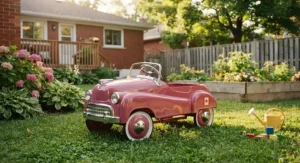
Vintage Pedal Cars for Backyard Décor and Outdoor Display
Beyond active play, there’s a genuine secondary market for using a pedal car as backyard décor — parked decoratively on a porch, styled with potted plants, or set up as a photo backdrop for birthday parties. The Baghera Classic Pedal Car and American Retro Deluxe Fire Truck Pedal Car are the two strongest fits for this purpose in this lineup, purely because their chrome detailing and body-panel styling hold up visually to close inspection in a way budget models don’t.
If display is the primary goal rather than daily pedaling, consider keeping the car under a porch overhang or breathable cover rather than fully exposed to direct sun and precipitation — UV exposure fades paint and chrome trim over a single Canadian summer faster than most owners expect. A light wax on chrome components, similar to caring for real automotive chrome, helps maintain shine for a car that’s meant to be looked at as much as ridden.
Long-Term Cost and Maintenance
Total cost of ownership varies more than the sticker price alone suggests. The Kid Trax models, while cheapest upfront, tend to need trim-piece replacements (ladders, mirrors, dash accents) within two to three years of active outdoor use, based on aggregated review themes — parts that typically aren’t sold individually, meaning a broken piece often means living with cosmetic damage rather than an easy fix. The all-metal Morgan Cycle and Baghera models have fewer failure points overall, with sealed bearings that rarely need service and steel bodies that dent rather than crack.
The American Retro Deluxe Fire Truck Pedal Car‘s real wood ladders represent the one genuine ongoing maintenance item in this entire lineup — expect to reseal or repaint them every year or two if stored outdoors, a cost measured in a few dollars of exterior varnish rather than anything significant. Viewed over a five-year ownership window, the premium metal models often work out to a lower cost-per-year of enjoyment than replacing two or three budget models in succession, though the higher upfront cost remains a real barrier for many families.
Features That Actually Matter (And Those That Don’t)
Sealed bearing hubs matter — they’re the difference between a car that rolls smoothly for years and one that gets progressively stiffer and squeakier. Adjustable pedal positions matter, since they extend usable life across a wider age range. A genuine steel body matters for outdoor durability in Canadian weather. On the other hand, flashing lights and sound effects on some fire-truck-themed models are pure novelty — fun for the first week, rarely mentioned again in reviews after that. Similarly, “authentic” period detailing like hood ornaments and mirror styling looks great in product photos but has essentially zero impact on how the car actually performs or lasts; treat those as aesthetic bonuses, not purchase-deciding factors.
Safety, Regulations, and Compliance Guide
All toys sold in Canada, pedal cars included, fall under the Canada Consumer Product Safety Act and its associated Toys Regulations, which set mandatory standards covering mechanical, flammability, and toxicological hazards. Before buying, it’s worth checking that a specific listing hasn’t appeared on an active Health Canada recall notice, since recalls for ride-on toys do occasionally happen for issues like small detachable parts or unstable wheel assemblies. For general toy safety guidance from Health Canada, the core recommendations apply directly here: check weight limits, supervise young children closely, and inspect hardware periodically for loosening.
Beyond regulatory compliance, sensible household practices matter more day to day — helmets are a reasonable precaution on paved surfaces with any incline, and pedal cars should be kept away from driveways with active vehicle traffic. It’s worth noting that unstructured, physically engaged outdoor play like pedal-car riding aligns with the developmental benefits described in Canadian Paediatric Society guidance on outdoor active play, which emphasizes that reasonable physical risk-taking supports healthy childhood development rather than something to be engineered out entirely.
Frequently Asked Questions
❓ What age is a vintage pedal car for?
❓ Are metal pedal cars better than plastic ones?
❓ How much does a vintage style pedal car cost in Canada?
❓ Do pedal cars need assembly?
❓ Can a pedal car be left outside year-round?
Conclusion
A vintage style pedal car for backyard play isn’t just a nostalgic purchase — it’s a genuinely different category of ride-on toy, one that trades batteries and buttons for actual kid-powered fun and, in several cases here, real heirloom value. The right pick depends less on which car looks best in photos and more on honest questions: How rough will it get used? Will it live outdoors year-round? Is this a toy that gets replaced in two years, or a keepsake meant to last a decade?
Budget-conscious families land well with either Kid Trax model, especially for a first pedal car that might be outgrown before it’s worn out. Households wanting genuine metal construction without a collector’s price tag should look at the Morgan Cycle pair. And for anyone treating this as a design piece or multi-generation gift, the Baghera, Blue Diamond Classics, and American Retro options all earn their higher price tags with real steel, chrome, and craftsmanship. Whichever one ends up in the driveway, check current pricing directly on the product page before buying, since availability and pricing shift regularly.
Recommended for You
- Classic Pedal Car Review Canada: 7 Timeless Picks for 2026
- 7 Best pedal cars for kids under $150 CAD in 2026
- 6v vs 12v vs 24v Ride On: 7 Picks Parents Trust in 2026
Disclaimer: This article contains affiliate links. As an Amazon Associate, I earn from qualifying purchases. If you purchase products through these links, we may earn a small commission at no additional cost to you.
✨ Found this helpful? Share it with your friends! 💬🤗
