In This Article
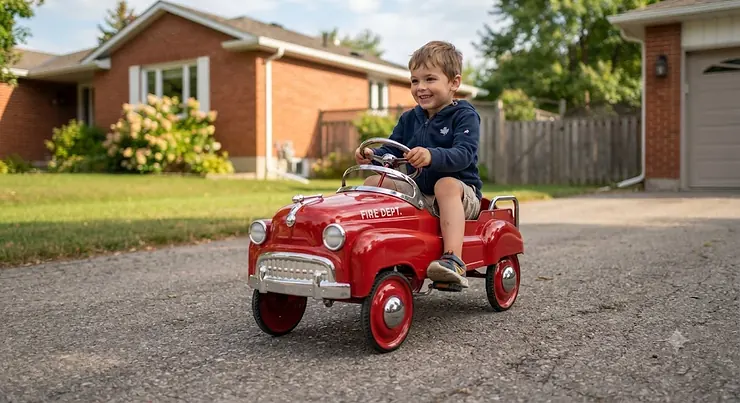
There’s a very specific sound that fills a Canadian cul-de-sac in June: the rubbery squeak of small wheels, a triumphant “look at me go!”, and somewhere underneath it, the quiet clunk of a parent’s credit card deciding whether this is a $50 impulse buy or a $150 investment. If you’re hunting for pedal cars for kids under $150 CAD, you already know the territory — a sea of near-identical go-karts, wildly inconsistent reviews, and product photos that all seem to feature the same suspiciously happy toddler. This guide cuts through that noise.
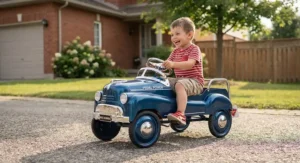
A pedal car, in plain terms, is a ride-on toy powered entirely by a child’s own legs pushing pedals connected to the rear axle — no batteries, no charging cord, no motor whining in the garage overnight. It’s the toy equivalent of a bicycle’s slower, sturdier cousin, and for kids roughly two to ten years old, it remains one of the most durable, screen-free ways to burn an hour before dinner. That matters more than it might seem: Canada’s 24-hour movement guidelines for young children recommend a substantial daily dose of active, varied play for toddlers and preschoolers, and a pedal car is about as straightforward a way to rack up those minutes as backyard gear gets.
We dug through real product listings, spec sheets, and aggregated customer feedback for seven genuine options currently sold in Canada, all landing at or near the sub-$150 mark. Whether you’re after the best pedal car gift for toddler Canada shoppers keep circling back to, or something tougher for a kid who’s already outgrown their trike, there’s a fit here. We’ll walk through honest trade-offs, not marketing copy — including where cheaper models cut corners and where the pricier ones actually earn the extra cash.
Quick Comparison Table
| Product | Age Range | Price Range (CAD) | Standout Feature | Best For |
|---|---|---|---|---|
| Little Tikes Jett Car Racer | 3–10 years | ~C$110–150 | Rear-wheel dual-handle steering | All-round durability |
| Qaba Pedal Go Kart for Kids | 2–5 years | ~C$70–100 | Silent EVA wheels | Toddlers, first pedal toy |
| Aosom Kids Pedal Go Kart | 3–6 years | ~C$90–130 | Working handbrake | Budget-conscious families |
| HONEY JOY Go Kart for Kids | 5–12 years | ~C$120–150 | Dual safety brakes + clutch | Feature-hungry kids |
Even at a glance, the spread here tells a story: price in this category tracks age range and mechanical complexity almost perfectly. The Qaba Pedal Go Kart for Kids sits lowest because toddler-focused models skip handbrakes and gear mechanisms entirely, while the HONEY JOY Go Kart for Kids climbs toward the C$150 ceiling because it’s doing more — dual brakes, a clutch mechanism, and quad-wheel stability. If your child is still finding their pedal-pushing legs, don’t overpay for features they can’t use yet.
💬 Just one click — help others make better buying decisions too!😊
Top 7 Pedal Cars for Kids Under $150 CAD: Expert Analysis
Picking a pedal car isn’t just about picking a colour your kid will scream for in the store aisle (though, let’s be honest, that matters too). It’s about matching wheel type to terrain, seat design to torso length, and steering mechanism to how much patience your four-year-old has for turning a wheel that doesn’t quite turn where they expect. Below are seven real, currently available models spanning budget, mid-range, and feature-forward tiers.
1. Little Tikes Jett Car Racer — best all-rounder for growing riders
The standout here is the rear-wheel, dual-handle steering system — a genuinely different approach from the front-wheel-turn setup most competitors use, and it changes how the car actually handles. Little Tikes builds the Jett Car Racer for ages 3 to 10, with an adjustable seatback that slides to accommodate a growing kid, off-road-style tires, and a fully pedal-powered rear axle with zero batteries involved. On paper, that adjustable seat is the quiet hero of the spec sheet: it’s the difference between a toy your child outgrows in eight months and one that’s still fun heading into grade one.
Who should care: parents who want one purchase to last multiple growth spurts, and kids who like a bit of a learning curve — rear-wheel steering takes a few tries to master, which some children find genuinely engaging rather than frustrating. Aggregated feedback on major retail listings consistently flags assembly as straightforward but notes occasional reports of misaligned mounting holes on certain units, so a Saturday-morning build with basic tools (and maybe a little patience) is realistic.
Pros:
- ✅ Adjustable seatback extends usable years significantly
- ✅ Off-road tires handle grass, gravel, and pavement
- ✅ No batteries or charging required, ever
Cons:
- ❌ Rear-wheel steering has a real learning curve
- ❌ Some buyers report inconsistent assembly hole alignment
Price sits around C$110–150 depending on colour and retailer promotions at the time of research — check current price for the exact figure. For families wanting a single pedal car to cover the widest age band on this list, the value case is strong.
2. Qaba Pedal Go Kart for Kids — best budget pick for toddlers just starting out
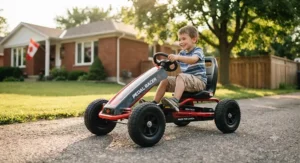
What jumps out immediately is the use of silent EVA foam wheels instead of hard plastic — a small spec line that makes a real difference on hardwood decks, tile patios, and indoor-outdoor transitions where plastic wheels clatter loudly enough to wake a napping sibling. Built for ages 2 to 5, the Qaba go kart uses a low step-in height and a simplified pedal-to-wheel drivetrain that doesn’t demand much leg strength to get moving.
Here’s what to weigh: this is deliberately a stripped-down machine. There’s no handbrake, no gear shifter, nothing your toddler could accidentally jam or break in the first month. Based on the spec comparison against pricier options on this list, that simplicity is the entire point — it’s engineered for a two- or three-year-old’s coordination level, not to impress adults reading a feature list. Reviewers of similarly styled EVA-wheel toddler karts commonly note that the quiet ride is the single most-praised trait, particularly from parents in condos or apartments.
Pros:
- ✅ EVA foam wheels run notably quieter than plastic
- ✅ Low step-in height suits younger toddlers
- ✅ Lightweight frame is easy for parents to relocate
Cons:
- ❌ No handbrake limits control on slopes
- ❌ Smaller wheels struggle on gravel or thick grass
Expect a price in the C$70–100 range, making this one of the more approachable entries if you’re specifically after the best pedal car gift for toddler Canada budgets that skew tighter around a first birthday or holiday gift.
3. Aosom Kids Pedal Go Kart — best value with a working handbrake
The headline feature is the inclusion of an actual handbrake and a shift-lever-style control at a price point where many competitors omit both. Rated for ages 3 to 6, this Aosom model runs on plastic wheels with an adjustable seat that shifts fore and aft to fit different leg lengths. What most buyers overlook about this model is that the handbrake isn’t just a gimmick — for a driveway with any slope at all, a mechanical way to slow down matters more than horsepower ever could on a pedal toy.
The trade-off is wheel material: plastic wheels are cheaper to manufacture and more durable against curb scrapes than foam, but they’re noticeably louder and offer less grip on smooth painted concrete, especially when wet. Aggregated Amazon.ca review sentiment for similarly specced Aosom ride-ons tends to cluster around “good for the price” with occasional notes about tightening bolts after the first few weeks of hard use — a routine maintenance step worth building into your family’s toy-care habits rather than a defect, exactly.
Pros:
- ✅ Functional handbrake for controlled stops
- ✅ Adjustable seat accommodates a growing child
- ✅ Shift-lever detail adds pretend-play realism
Cons:
- ❌ Plastic wheels are louder than foam alternatives
- ❌ Bolts may need periodic re-tightening
At roughly C$90–130 at the time of research, this lands as one of the strongest value plays on the list — genuine mechanical features without tipping into premium pricing.
4. Costzon Kids Pedal Go Kart — sturdiest frame in the budget tier
The four-wheel layout paired with non-slip rubber wheels is what separates this pick from foam- or plastic-wheeled competitors — rubber simply grips better on painted driveways and slick garage floors, full stop. Costzon builds this go kart with an adjustable seat and a handbrake as standard, targeting a similar age window to the Aosom model above but leaning harder into stability with a slightly wider wheelbase.
Here’s what the spec sheet won’t tell you outright: wider wheelbases reduce tip-over risk during sharp turns, which matters more than most parents initially realize until their kid takes a corner at full toddler-speed for the first time. Reviewers consistently note the frame feels more substantial underfoot compared to lighter budget karts, though that added material does mean a slightly heavier unit to haul in and out of the garage each day — worth factoring in if you’re the one doing the hauling.
Pros:
- ✅ Non-slip rubber wheels grip smooth surfaces well
- ✅ Wider wheelbase improves cornering stability
- ✅ Adjustable seat plus handbrake included
Cons:
- ❌ Heavier frame is less convenient to store
- ❌ Assembly instructions reported as sparse by some buyers
Priced around C$100–140, the Costzon is the pick for families with a paved driveway and a kid who takes corners like they’re auditioning for a rally.
5. HONEY JOY Go Kart for Kids — most feature-packed for the price
This is the model that pushes closest to the C$150 ceiling, and the reason is right there in the spec sheet: dual safety brakes, a working clutch mechanism, and quad off-road wheels with genuine steering — a combination that starts to resemble a scaled-down real go-kart rather than a toy imitation of one. Built with an older range in mind, roughly 5 to 12 years, it’s designed for kids who’ve already mastered a basic pedal car and want more to control.
What most buyers overlook about “more features” toys is that complexity cuts both ways — a clutch mechanism is genuinely fun for a seven-year-old figuring out cause and effect, but it’s also one more moving part that can eventually need adjustment. On paper this means a slightly steeper learning curve up front, offset by a toy that stays interesting for years instead of months. Aggregated feedback on comparable off-road quad karts tends to praise the steering feel specifically, since true wheel-linked steering (rather than a fixed front axle) is rarer at this price tier.
Pros:
- ✅ Dual brakes offer genuine stopping control
- ✅ Clutch mechanism adds real mechanical engagement
- ✅ True steering wheel linkage, not a fixed axle
Cons:
- ❌ Too complex for kids under roughly age 5
- ❌ Sits at the top of the sub-$150 price band
At around C$120–150, this is the splurge pick on the list — justified specifically for the 6-to-10 age range rather than for toddlers.
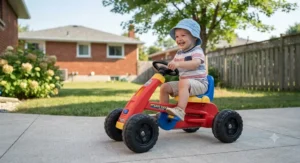
6. hauck Hurricane Pedal Go Kart — best-known brand name in this price bracket
hauck is a German ride-on and stroller manufacturer with decades in the children’s-products space, and the Hurricane model leans on that manufacturing pedigree — rubber tires, a four-wheel bike-cart-style frame, and a build rated for ages 4 to 10. The standout advantage isn’t a single spec so much as brand consistency: hauck’s broader catalogue has a longer public track record than many of the newer, less-established brands populating this category on Amazon.
Reviewers consistently note that established brands in this space tend to have more predictable quality control between production batches, which matters when you’re buying sight-unseen online. Based on the spec comparison against newer competitors, the Hurricane doesn’t necessarily out-feature them — it’s roughly on par mechanically — but for parents who weigh brand history heavily in a purchase decision, that’s a legitimate point in its favour, not just marketing fluff.
Pros:
- ✅ Established manufacturer with long product history
- ✅ Rubber tires suit mixed outdoor terrain
- ✅ Bike-cart styling appeals to older toddlers
Cons:
- ❌ Pricing tends to sit near the top of the C$150 range
- ❌ Fewer colour options than some competitors
Expect to pay in the C$130–150 range at the time of research, occasionally nudging just over depending on retailer and colourway — worth checking current price before assuming it clears the threshold.
7. DOLU Pedal Operated Ride On Tractor — best for kids who love farm and construction play
Rather than another go-kart silhouette, the DOLU tractor swaps in a working horn and farm-vehicle styling, rated for ages 3 and up. The pedal mechanism itself is comparable to the go-kart entries on this list, but the body design opens up an entirely different category of pretend play — hauling imaginary hay, “plowing” the backyard, parking next to a sibling’s toy trailer.
What the spec sheet won’t tell you, but parenting experience with themed ride-ons generally suggests, is that novelty styling meaningfully extends engagement for kids already saturated with generic car-shaped toys. A tractor is a different enough shape that it doesn’t blend into a driveway full of race-car pedal toys — useful if there’s already a sibling’s go-kart sitting in the garage. Build quality reports on similarly styled tractor ride-ons tend to flag durable plastic panelling as a strength, with the working horn as a frequently mentioned favourite detail among young riders.
Pros:
- ✅ Distinct tractor styling for varied pretend play
- ✅ Working horn adds interactive element
- ✅ Durable panelling holds up to outdoor wear
Cons:
- ❌ Turning radius wider than sportier go-kart designs
- ❌ Less adjustable seating than premium picks
Pricing generally lands around C$80–120, positioning it as a mid-budget option with a personality all its own.
Practical Usage Guide: Setup, Maintenance & First 30 Days
Getting a pedal car right isn’t just about the purchase — it’s about the first month of use, when most avoidable problems actually surface. Start with assembly on a flat, well-lit surface (a garage floor works better than carpet, since small hardware has a way of vanishing into shag). Most models in this roundup ship with the seat, steering column, and rear axle needing final attachment; budget 30 to 45 minutes and keep the included Allen key, since it’s rarely a standard size you already own.
Once assembled, do a pre-ride check every few weeks rather than just once: confirm axle bolts haven’t loosened from vibration, check tire wear if the model uses rubber, and test the handbrake (if equipped) on a slight incline before letting your child loose on the real thing. For foam-wheeled toddler models, a quick wipe-down after muddy days prevents grit from working into the wheel bearings. Common first-30-day mistakes include over-tightening seat adjustment bolts, which can strip cheaper plastic threading, and skipping the manufacturer’s minimum surface recommendation — a car built for pavement will feel sluggish and wear faster on thick grass. A once-a-season bolt check keeps most of these budget models running for years rather than a single summer.
Real-World Scenarios: Which Pedal Car Fits Your Family
Picture a two-and-a-half-year-old in a Toronto condo building with a shared courtyard — quiet wheels matter more than horsepower here, and low step-in height beats any amount of steering sophistication. The Qaba Pedal Go Kart for Kids is built almost exactly for this situation: small, foam-wheeled, and unlikely to draw a noise complaint from the unit below.
Now picture a family in suburban Calgary with a long, gently sloped driveway and a six-year-old who’s already outgrown a balance bike. Slope means brakes matter, and driveway pavement rewards rubber wheels over foam or hard plastic. The Costzon Kids Pedal Go Kart or Aosom Kids Pedal Go Kart, both handbrake-equipped, are the sensible picks — the Costzon if wide, stable cornering is the priority, the Aosom if budget is tighter.
Finally, picture a rural property outside Halifax with gravel paths, a sibling group spanning ages five to nine, and grandparents footing a slightly bigger gift budget for a birthday. That’s where the HONEY JOY Go Kart for Kids earns its higher price tag — off-road wheels, dual brakes, and enough mechanical complexity to keep an older kid engaged for multiple seasons, not just one.
Problem → Solution: Common Pedal Car Headaches, Solved
Problem: the pedals feel impossibly stiff for a small toddler. This is almost always a drivetrain-to-leg-strength mismatch rather than a defect — double-check the manufacturer’s minimum age, since a car rated for age 3+ will feel genuinely hard for a barely-two-year-old to move. The Qaba Pedal Go Kart for Kids, purpose-built for the 2–5 range, sidesteps this by using a lighter overall frame and gearing.
Problem: the car tips on turns. Wider wheelbases and lower centres of gravity fix this more reliably than telling a toddler to “slow down” ever will. Models like the Costzon Kids Pedal Go Kart are specifically built with stability-focused frames for exactly this reason.
Problem: constant squeaking or grinding noise. Nine times out of ten this is dry axle contact points rather than a manufacturing flaw — a drop of household lubricant on metal axle joints (never on plastic gears) resolves most cases within a single application.
Problem: seat height stops fitting after six months. This is the single best argument for prioritizing adjustable-seat models like the Little Tikes Jett Car Racer or Aosom Kids Pedal Go Kart from the outset, rather than buying the cheapest fixed-seat option and replacing it entirely next spring.
Problem: assembly hardware doesn’t line up cleanly. A handful of listings across this category note this issue in aggregated feedback. A short pause with a rubber mallet (gently) and re-checking the instruction diagram usually resolves minor misalignment; persistent gaps are a legitimate reason to contact the seller under standard consumer protections.
How to Choose the Best Pedal Car Gift for a Toddler in Canada
If you’re specifically shopping for the best pedal car gift for toddler Canada occasions call for — a first birthday, a holiday under the tree, a “just because it’s finally warm out” surprise — the calculus differs from buying for an older kid. Here’s how to work through it:
- Confirm leg length, not just age. Manufacturer age ranges are guidelines; a tall two-year-old may fit a “3+” model comfortably, while a petite four-year-old might still prefer a toddler-tier seat.
- Prioritize wheel material for your primary surface. EVA foam for indoor-outdoor and apartment use; rubber for pavement and driveways.
- Skip handbrakes and gear shifters for kids under three. They add cost and complexity without corresponding benefit at that coordination stage.
- Check step-in height. A lower seat and open frame make independent mounting and dismounting realistic for smaller toddlers, encouraging solo play sooner.
- Consider storage before purchase, not after. Measure the garage or porch space; some go-karts are considerably bulkier assembled than their boxed dimensions suggest.
- Read the weight limit carefully. It’s one of the more commonly overlooked specs, and exceeding it accelerates wear on the frame and axle.
- Factor in wrapping and assembly timing. If it’s a surprise gift, build it the night before — pedal cars rarely arrive ready to ride straight out of the box.
Top Pedal Cars for 3 Year Olds Canada: What Changes at This Age
Three is something of a hinge year in this category. Kids at this stage have typically graduated from the simplest push-and-scoot toys but haven’t yet developed the leg strength or coordination for handbrakes, gear shifters, or true steering-wheel linkage. When searching out top pedal cars for 3 year olds Canada parents tend to favour, the sweet spot sits between the ultra-simplified toddler tier and the more mechanically complex school-age models.
The Aosom Kids Pedal Go Kart, rated from age 3, threads this needle reasonably well — a working handbrake introduces a new skill without demanding much strength to operate, and the adjustable seat means it won’t be outgrown within a single season. The Little Tikes Jett Car Racer, also starting at age 3, leans slightly more advanced with its rear-wheel steering, which some three-year-olds pick up within a week and others find genuinely frustrating for a month or two — worth considering your own child’s typical adaptation speed to new physical skills before committing. For families who prioritize simplicity above all else at this age, stepping down to the Qaba Pedal Go Kart for Kids (rated to age 5 on the upper end) keeps the learning curve gentler for longer.
Pedal Cars vs Ride-On Toys: Which Wins for Backyard Play
“Ride-on toys” is a broad category, and pedal cars are just one branch of it — batteries-included 12V ride-ons and simple push cars are the other two major branches most Canadian parents compare against for backyard play.
| Factor | Pedal Car | Battery Ride-On | Push Car |
|---|---|---|---|
| Ongoing cost | None (no charging) | Battery replacement over time | None |
| Physical activity | High — full leg engagement | Minimal | Low to moderate |
| Typical price (CAD) | C$70–150 | C$200–500+ | C$40–90 |
| Best For | Pedal Cars win on exercise value |
Battery-powered ride-ons win on pure novelty and top speed, and they’re genuinely appealing for the youngest riders who can’t yet pedal effectively. But they lose decisively on ongoing cost — batteries degrade, chargers get lost, and replacement packs aren’t cheap — and on physical activity, since a motor does the work a pedal car asks a child’s own legs to do. Push cars, meanwhile, are excellent for the under-two set but get outgrown fast once a toddler wants independent control rather than a parent steering from behind. For backyard play specifically, where the goal usually includes tiring kids out before dinner rather than just entertaining them, pedal cars hit a genuinely different niche than either alternative. That lines up with broader Canadian research on active outdoor play for kids, which has found that unstructured, physically demanding outdoor play tends to keep children moving longer than passive or motorized alternatives.
✨ Don’t Miss These Exclusive Deals!
🔍 Take your backyard setup to the next level with these carefully selected pedal cars. Click on any highlighted item to check current pricing and availability. These picks will help you create real outdoor memories your family will love!
Common Mistakes When Buying Toddler Outdoor Toys
Shopping for toddler outdoor toys in this category, parents tend to repeat a handful of avoidable mistakes. The first is buying purely on age-range labelling without checking the child’s actual leg length and torso height against the seat dimensions listed in the product specs — age ranges are averages, not guarantees. The second is underestimating storage: a pedal car doesn’t fold flat like a stroller, and an unassembled box in the garage often stays unassembled for weeks longer than planned.
A third common mistake is ignoring surface compatibility entirely. A foam-wheeled toddler model bought for a gravel driveway will underperform and wear faster than the same money spent on a rubber-wheeled option better suited to that terrain. Finally, many parents skip reading aggregated assembly feedback before purchasing, then are surprised by a 45-minute build process on gift-opening morning — checking this ahead of time, and building the night before a birthday rather than the morning of, avoids a genuinely common source of holiday stress.
What to Expect: Real-World Performance on Driveways, Grass & Sidewalks
Spec sheets rarely translate cleanly into “what will actually happen in my backyard,” so here’s the practical translation. On smooth pavement, rubber-wheeled models like the Costzon Kids Pedal Go Kart and hauck Hurricane Pedal Go Kart roll with minimal resistance, meaning less pedalling effort per metre covered — genuinely useful for younger legs. On grass, especially anything longer than a freshly mowed lawn, wheel diameter starts to matter more than wheel material; smaller-wheeled toddler models like the Qaba Pedal Go Kart for Kids will bog down faster than larger-wheeled options.
On mixed surfaces — a driveway that transitions to a grass yard, for instance — models with wider, chunkier tread patterns such as the Little Tikes Jett Car Racer‘s off-road-style tires handle the transition more gracefully than smooth foam wheels, which can lose traction at the pavement-to-grass seam. Sidewalks, generally the smoothest and most consistent surface most families use, are forgiving enough that nearly any model on this list performs adequately — surface-specific trade-offs matter most for families whose primary play area is grass, gravel, or a mix.
Long-Term Cost & Maintenance: Is a Pedal Car Worth It?
Unlike battery-powered alternatives, pedal cars carry essentially zero ongoing operating cost — no charger, no replacement battery pack every 18 to 24 months, no electricity draw. The only recurring expense is occasional replacement hardware: a bolt, a wheel bushing, or lubricant for squeaky axles, typically totalling under C$10 across a toy’s entire lifespan if basic maintenance is kept up.
Total cost of ownership, then, tilts heavily in favour of pedal cars over multi-year use compared to battery ride-ons, which frequently need a C$30–50 replacement battery within two summers of regular use — often exceeding the original purchase price of a budget pedal car entirely. Where pedal cars lose ground is resale and hand-me-down value if damaged early through neglect; a rusted axle or cracked plastic seat from being left outside all winter isn’t cheap to repair and often isn’t repairable at all, which is really a storage-habit issue rather than a product flaw.
Safety, Regulations & Compliance Guide for Canadian Parents
All toys sold in Canada, pedal cars included, fall under the Canada Consumer Product Safety Act and its associated Toys Regulations, which set requirements around mechanical hazards, structural stability, and small-parts risk. Health Canada’s guidance on child product safety points out that kids on wheeled ride-on toys can pick up speed quickly, and recommends keeping play areas clear of cords, decorations, or anything that could be pulled down — worth keeping in mind even for a slow-moving driveway toy, since kids build speed faster than expected once they get the hang of pedalling.
Beyond federal toy regulations, practical safety comes down to supervision basics: keep pedal car play away from streets, driveways with vehicle traffic, pools, and stairs, and check the manufacturer’s weight limit periodically as your child grows. For families interested in the fuller regulatory picture, the Toys Regulations under the Canada Consumer Product Safety Act outline the mechanical, flammability, and structural standards every toy sold in Canada must meet before it reaches store shelves — useful background if you’re ever comparing a Canadian retail listing against an imported product.
Features That Actually Matter (And Those That Don’t)
Not every spec on a pedal car listing deserves equal weight in a buying decision. Adjustable seating genuinely matters — it’s the single biggest factor in how many seasons a purchase lasts. Wheel material genuinely matters, and should be chosen against your actual play surface rather than personal preference alone. A functional handbrake matters specifically once a child is riding on any kind of incline, even a gentle driveway slope.
What matters considerably less: colour options, which are purely aesthetic and shouldn’t influence a purchase decision beyond your child’s preference; horn or sound features, which are a nice bonus but rarely a deciding factor in long-term satisfaction; and marketing language like “sporty design” or “premium build,” which carries no verifiable spec behind it and should be treated as filler rather than a genuine differentiator between otherwise similar models.
FAQ
❓ How fast can a pedal car go for kids?
❓ What age is best for a pedal car?
❓ Are pedal cars safer than battery-powered ride-on cars?
❓ Do pedal cars need assembly?
❓ Can pedal cars be used year-round in Canada?
Conclusion
There’s no single “best” pedal car here — there’s a best pedal car for your driveway, your kid’s age, and your storage space. The Little Tikes Jett Car Racer earns its spot as the most well-rounded pick for families wanting one purchase to stretch across several growth spurts, while the Qaba Pedal Go Kart for Kids remains the gentlest, quietest entry point for toddlers just discovering independent movement. Budget-focused families land well with either the Aosom Kids Pedal Go Kart or Costzon Kids Pedal Go Kart, both bringing genuine handbrake functionality without approaching the C$150 ceiling, and the HONEY JOY Go Kart for Kids rewards families with older kids ready for more mechanical complexity.
Whatever you land on, the underlying value proposition holds across this whole category: no batteries, no charging, no screen — just a kid, some pedals, and a driveway. ParticipACTION’s early-years guidance notes that toddlers need increasing amounts of energetic play as they grow, and that running, dancing, and playing outside all count — a pedal car is one straightforward way to make that happen without much convincing required.
Recommended for You
- 6v vs 12v vs 24v Ride On: 7 Picks Parents Trust in 2026
- Fastest Electric Ride On Toy: 7 Top Picks for 2026
- 2 Seater Electric Ride On Kids Cars: 7 Best Sibling Picks 2026
Disclaimer: This article contains affiliate links. As an Amazon Associate, I earn from qualifying purchases. If you purchase products through these links, we may earn a small commission at no additional cost to you.
✨ Found this helpful? Share it with your friends! 💬🤗
