In This Article
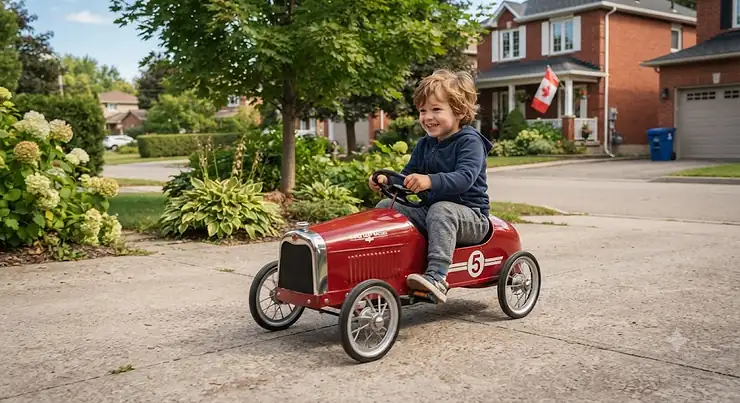
Somewhere between the driveway and the backyard fence, a pedal race car for kids turns an ordinary Tuesday afternoon into the Monaco Grand Prix. No batteries, no charging cable, no “Mom, it died again” fifteen minutes into playtime — just legs, gears, and a kid absolutely convinced they’re leading the pack. That’s the quiet appeal of these things. They’re loud in spirit and dead silent in operation, which, frankly, is a rare combination in the modern toy aisle.
But “pedal race car” covers a surprisingly wide field — from plastic push-racers a toddler can barely steer to steel-framed go-karts with hand brakes and pneumatic tires built to survive three younger siblings. Picking the right one means understanding your kid’s age, your driveway’s terrain, and how long you actually want this thing lasting in the garage. We dug into real specs, real owner feedback, and current Canadian retail listings to build this guide — no invented reviews, no rewritten Amazon copy, just honest analysis you can act on. According to Health Canada’s toy safety program, ride-on toys sold here must meet mechanical safety standards under the Canada Consumer Product Safety Act, which is worth keeping in mind as you shop — we’ll get into what that actually means for pedal cars later on.
By the end of this guide, you’ll know which of the seven models below fits your kid’s age and driving style, what separates a $150 driveway toy from a $500 heirloom, and how to avoid the three mistakes that send most pedal cars back to the store within a month.
Quick Comparison Table
| Product | Age Range | Best For | Price Range (CAD) |
|---|---|---|---|
| Little Tikes Jett Car Racer | 3-6 years | Budget-friendly first racer | Under C$120 |
| Aosom Pedal Go Kart | 5-12 years | Adjustable seating for growing kids | C$150-C$220 |
| Costzon Kids Pedal Go Kart | 3-8 years | Feature-rich mid-range value | C$180-C$260 |
| HONEY JOY Off-Road Pedal Go Kart | 3-8 years | Rough terrain and off-road play | C$200-C$280 |
| Hauck Lightning Pedal Go Kart | 4-9 years | Racing-themed graphics and styling | C$220-C$300 |
| BERG Buzzy | 2-5 years | Toddlers transitioning off ride-on toys | C$250-C$330 |
| BERG Buddy | 3-8 years | Premium build, long-term durability | C$450-C$600 |
A quick look at this table tells most of the story: age range and terrain narrow the field faster than price does. The BERG Buddy sits at the top of the price ladder, but its pneumatic tires and BFR (brake-freewheel-reverse) pedal system justify the gap for families expecting years of daily use rather than a single summer. On the other end, the Little Tikes Jett Car Racer proves you don’t need a triple-digit budget to get a genuinely fun first racer — it just trades durability and top speed for accessibility. If your driveway is gravel or your backyard has any incline at all, skip straight to the off-road-rated options like the HONEY JOY Off-Road Pedal Go Kart, since smooth-tire budget models will struggle there.
💬 Just one click — help others make better buying decisions too!😊
Top 7 Pedal Race Cars for Kids: Expert Analysis
1. Little Tikes Jett Car Racer — best budget entry point for first-time riders
The standout here is simplicity: this is a push-and-steer racer, not a geared go-kart, and that’s exactly why it works so well for the youngest drivers. There’s no chain, no pedal mechanism to jam, and no clutch to confuse a three-year-old — just a low-slung race car body, rear-wheel steering via dual handles, and an adjustable seat back that grows with the kid. The molded plastic shell keeps the weight low, which matters more than it sounds like it should; lighter ride-ons are easier for small legs to actually get moving.
Based on the spec comparison against other entry-level ride-ons, the Little Tikes Jett Car Racer‘s dual-handle rear steering is its real differentiator — most budget racers in this price bracket use a fixed direction, forcing the kid to push in a straight line. This one lets an older sibling or parent steer from behind while the little one “drives,” which smooths the transition period before they can steer solo. It’s best suited to kids aged three to six who are still building coordination and leg strength, not the eight-year-old who wants actual pedal-powered speed.
Reviewers consistently report that assembly takes under ten minutes and that the low seat height makes it easy for toddlers to climb in and out unassisted — a detail that matters more during the first few weeks of ownership than any spec sheet suggests. A recurring theme in aggregated feedback is that the plastic wheels can feel slippery on smooth tile or hardwood, so outdoor pavement or a garage floor with some texture is the better environment for this one.
Pros:
- ✅ Extremely low learning curve for toddlers and preschoolers
- ✅ Dual-handle steering lets parents assist from behind
- ✅ Lightweight shell is easy for small kids to push and control
Cons:
- ❌ No pedal-drive mechanism — this is a push racer, not a true pedal kart
- ❌ Plastic wheels lose traction on smooth indoor flooring
Priced under C$120 in most Canadian listings, the Little Tikes Jett Car Racer delivers strong value as a first racer, though families expecting true pedal-powered speed should look further down this list.
2. Aosom Pedal Go Kart — best adjustable fit for a wide age range
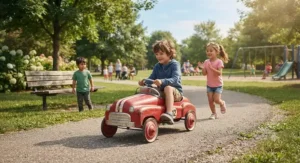
What most buyers overlook about this model is how much runway the adjustable bucket seat actually buys you. Rather than locking a child into one seating position, the Aosom Pedal Go Kart slides along a rail system, meaning a five-year-old and a ten-year-old sibling can both use the same kart without either one feeling cramped or overextended. That’s a meaningful cost-per-use advantage if you’ve got kids spanning several years apart.
The four rubber wheels and shock-absorbing frame handle uneven driveway pavement noticeably better than the hard plastic wheels on cheaper push-racers, and the included handbrake gives kids actual stopping control rather than relying on foot-drag or simply coasting to a halt. On paper, this means a genuinely useful safety feature that a lot of budget karts skip entirely to hit a lower price point.
Aggregated review sentiment points to two consistent themes: parents appreciate the adjustable seat’s longevity value, and several report that assembly, while straightforward, benefits from having a second adult around to hold the frame steady while bolts go in. The handbrake is frequently praised as more responsive than expected at this price tier.
Pros:
- ✅ Sliding bucket seat fits a wide five-to-twelve age range
- ✅ Functional handbrake adds real stopping control
- ✅ Rubber wheels with shock absorption handle bumps well
Cons:
- ❌ Assembly is easier with two people rather than one
- ❌ Frame is plastic-based rather than steel, limiting max rider weight
In the C$150-C$220 range, the Aosom Pedal Go Kart earns its spot as a mid-budget option that stretches across several years of a kid’s growth, which meaningfully lowers the effective cost-per-year compared to single-size alternatives.
3. Costzon Kids Pedal Go Kart — best feature set for the price
Here’s what the spec sheet won’t tell you outright: the gear shifter on the Costzon Kids Pedal Go Kart is mostly cosmetic — it doesn’t change actual mechanical resistance the way a real go-kart’s gearing would — but it’s a genuinely clever touch for imaginative play. Kids treat it like a real transmission, “shifting up” before a straightaway, and that kind of pretend-play detail is exactly the sort of value-add that separates a toy kids actually bond with from one that gets ignored after a week.
Beyond the novelty gear lever, the non-slip big wheels and steering wheel setup are functionally solid: the wide wheelbase keeps the kart stable during sharper turns, which matters for kids testing the limits of speed on a driveway loop. The adjustable seat and included handbrake put this model on par with pricier competitors on core safety features, while undercutting them on price.
A common thread in aggregated review sentiment is that the Costzon Kids Pedal Go Kart assembles faster than comparable models — many owners report thirty minutes or less — and that the seat padding, while basic, holds up better than expected after a full summer of outdoor use. Some reviewers note the plastic wheel hubs show wear signs after a year of daily riding on rough pavement.
Pros:
- ✅ Novelty gear shifter adds imaginative-play value
- ✅ Wide wheelbase improves cornering stability
- ✅ Faster-than-average assembly time reported by owners
Cons:
- ❌ Gear shifter is cosmetic, not mechanically functional
- ❌ Wheel hubs show wear after a year of rough-pavement use
At around C$180-C$260, the Costzon Kids Pedal Go Kart hits a sweet spot for families who want a genuinely fun, well-rounded kart without stepping into premium territory.
4. HONEY JOY Off-Road Pedal Go Kart — best for rough terrain and active riders
If your backyard has grass, gravel, or anything beyond flat concrete, this is the model worth the closer look. The HONEY JOY Off-Road Pedal Go Kart‘s EVA rubber tires and reinforced steering system are built specifically for uneven ground — a detail that matters enormously in practice, since most budget pedal karts are engineered and tested almost exclusively on smooth pavement.
Based on the spec comparison, the inclusion of an actual clutch mechanism alongside the pedal drivetrain is unusual at this price point; it adds a layer of mechanical realism that older kids notice and appreciate, even if the functional gain over a direct-drive kart is modest. The adjustable seat and dual safety brakes round out a feature set that, on paper, punches above its price class.
Reviewers consistently describe the off-road tires as the standout feature, with several noting the kart handles small bumps, cracks, and grass transitions without the jarring stops that plastic-wheeled competitors experience. A recurring critique in aggregated feedback is that the clutch mechanism, while fun, requires more explanation for younger kids than a simple pedal-and-go setup.
Pros:
- ✅ EVA off-road tires perform well on grass and gravel
- ✅ Dual safety brakes for genuine stopping control
- ✅ Novelty clutch adds engagement for older kids
Cons:
- ❌ Clutch mechanism has a learning curve for younger riders
- ❌ Heavier frame than pavement-only competitors, harder to store
Sitting around C$200-C$280, the HONEY JOY Off-Road Pedal Go Kart is the clear pick for households where “outdoor terrain” means more than a flat driveway.
5. Hauck Lightning Pedal Go Kart — best racing-themed styling for speed-obsessed kids
This one leans hardest into the racing fantasy, and that’s precisely the point. The Hauck Lightning Pedal Go Kart wears aggressive racing graphics, a low sporty seating position, and styling cues borrowed straight from motorsport — the kind of visual language that speaks directly to a kid who’s watched a few too many race highlight reels. Looks aside, the ergonomic frame design keeps the pedal geometry closer to a real go-kart’s proportions than most of its competitors.
What most buyers overlook about the racing-themed category generally is that the styling isn’t purely cosmetic — a lower centre of gravity, which the Hauck Lightning Pedal Go Kart‘s design leans into, genuinely improves stability during tighter cornering, which is exactly the kind of “speed play” scenario these karts are built around. Reviewers consistently note the graphics hold up well against fading after a season outdoors, a detail that separates it from cheaper printed-decal competitors whose designs peel within months.
Aggregated feedback also flags the seat as narrower than some competitors, which suits leaner kids well but may feel snug for larger riders in the upper end of the age range.
Pros:
- ✅ Motorsport-inspired styling with durable, fade-resistant graphics
- ✅ Lower seating position improves cornering stability
- ✅ Ergonomic pedal geometry closer to real go-kart proportions
Cons:
- ❌ Narrower seat may feel snug for larger kids
- ❌ Racing graphics command a premium over plainer competitors
At roughly C$220-C$300, the Hauck Lightning Pedal Go Kart is the pick for families whose kid cares as much about looking fast as going fast.
6. BERG Buzzy — best transitional pedal kart for toddlers
The BERG Buzzy occupies a specific and important niche: it’s engineered for the two-to-five age bracket, right at the transition point between balance-focused ride-on toys and true pedal-driven karts. Its four EVA tires are puncture-proof by design, and the low, wide stance is built to prevent tipping — a real concern at this age when a child’s centre of gravity is still developing.
Here’s what the spec sheet won’t tell you: the reverse-pedal function on the BERG Buzzy is genuinely more intuitive for toddlers than a handbrake would be, since braking by pedaling backward maps naturally onto how a toddler already understands “stop” through physical motion, rather than requiring them to learn a separate hand-lever action. That’s a meaningful piece of age-appropriate engineering that budget competitors targeting the same age range often skip.
Reviewers with young toddlers consistently note the assembly is close to tool-free, and that the kart’s low weight makes it easy for a parent to lift in and out of a car trunk for park trips. A recurring theme is that most three-year-olds need a few sessions before mastering forward propulsion, which is normal at this developmental stage rather than a flaw in the product.
Pros:
- ✅ Reverse-pedal braking is intuitive for toddlers
- ✅ Puncture-proof EVA tires need zero maintenance
- ✅ Low, wide stance resists tipping during early riding attempts
Cons:
- ❌ Toddlers typically need multiple sessions to master pedaling
- ❌ Sized out by around age five, shorter usable window than larger karts
Priced around C$250-C$330, the BERG Buzzy commands a premium over generic toddler pedal karts, but the tip-resistant design and intuitive braking are worth it for the two-to-four crowd specifically.
7. BERG Buddy — best premium build for long-term durability
If there’s a “buy it for life” option on this list, it’s the BERG Buddy. The standout feature is its BFR system — brake, freewheel, and reverse — which lets a kid stop simply by pausing their pedal stroke, then immediately pedal backward without any gear-shifting fuss. Paired with genuine pneumatic tires rather than solid rubber or EVA foam, the ride quality and rolling resistance are in a different class from every other kart on this list.
Based on the spec comparison, the robust steel-tube frame is the real justification for the price jump: where budget and mid-range karts use reinforced plastic or thin-gauge metal, the BERG Buddy‘s frame is built to absorb years of driveway impacts, curb bumps, and the general abuse that comes with three or four kids cycling through ownership over time. The adjustable steering column and swing-axle suspension smooth out uneven pavement in a way that plastic-wheeled competitors simply can’t replicate.
Aggregated customer sentiment is strikingly consistent across sources: owners repeatedly cite the smooth pedal action and low rolling resistance as noticeably better than cheaper karts they’d previously owned, and several report the kart being passed down through multiple children with only minor cosmetic wear. A recurring caveat is that some parts, like the seat cushion, are sold separately from certain accessory bundles — worth checking before you order.
Pros:
- ✅ BFR system makes braking and reversing genuinely intuitive
- ✅ Steel-tube frame and pneumatic tires built for years of use
- ✅ Swing-axle suspension smooths out uneven terrain
Cons:
- ❌ Highest price point on this list by a wide margin
- ❌ Some accessories, like seat cushions, sold separately
At around C$450-C$600, the BERG Buddy is a genuine investment, but for families expecting multi-year or multi-child use, the cost-per-year math often works out favourably against replacing two cheaper karts.
Practical Usage Guide: Setup, Maintenance, and First 30 Days
Getting a pedal race car for kids set up right the first time saves you a return trip to the toolbox later. Most models, including the Costzon Kids Pedal Go Kart and Aosom Pedal Go Kart, ship partially disassembled — budget ninety minutes with a second adult for anything involving a steel frame like the BERG Buddy, and closer to thirty minutes for lighter plastic models like the Little Tikes Jett Car Racer.
Once assembled, a quick monthly check goes a long way: tighten the seat bolts, inspect the wheel axles for wobble, and check chain or pedal linkage tension on geared models. Karts with pneumatic tires, like the BERG Buddy, need occasional air top-ups — check pressure every few weeks during heavy summer use, since underinflated tires increase pedaling effort and accelerate rim wear.
The most common first-30-days mistake isn’t mechanical — it’s terrain mismatch. Parents frequently buy a smooth-tire model for a gravel driveway, then wonder why the kart feels sluggish or the wheels wear unevenly. Match the tire type to your actual riding surface before you buy, not after. Store the kart under cover when possible; UV exposure fades plastic bodies and graphics faster than almost any other factor, which is especially relevant for graphic-heavy models like the Hauck Lightning Pedal Go Kart.
Real-World Scenarios: Which Pedal Race Car Fits Your Kid?
The apartment-dwelling toddler. If your three-year-old’s main “track” is a shared driveway or a nearby park path, the BERG Buzzy is built exactly for this scenario — its light weight makes it easy to carry down a few flights of stairs or toss in a trunk, and the reverse-pedal braking suits a rider who’s still building coordination.
The suburban backyard racer, age six to nine. With a mid-sized yard, some grass, and maybe a gravel side path, a family in this situation gets the most mileage from the HONEY JOY Off-Road Pedal Go Kart or the Costzon Kids Pedal Go Kart — both handle mixed terrain and offer enough seat adjustability to last several growth spurts without a replacement purchase.
The multi-kid household planning years of use. If two or three kids across a wide age range will share one kart over several years, the math favours the BERG Buddy despite the higher upfront cost — its steel frame and pneumatic tires are engineered to survive daily riding across multiple kids, which meaningfully lowers the effective cost-per-child compared to buying (and eventually replacing) two budget karts.
Buyer’s Decision Framework
If your child is under five and still building coordination, choose a low-stance toddler kart like the BERG Buzzy, because tip resistance and intuitive braking matter more than top speed at this age. If your driveway or yard includes grass, gravel, or any incline, choose an off-road-rated model like the HONEY JOY Off-Road Pedal Go Kart, because smooth-tire karts lose traction and wear unevenly on uneven ground. If budget is the primary constraint and your kid is a first-time rider, choose the Little Tikes Jett Car Racer, because its push-racer simplicity removes the mechanical failure points that drive up long-term costs. If you’re buying for multiple kids across several years, choose the BERG Buddy, because its steel frame amortizes the higher upfront cost across a much longer usable lifespan.
✨ Don’t Miss These Exclusive Deals!
🔍 Take your kid’s outdoor playtime to the next level with these carefully selected pedal race cars. Click on any highlighted model to check current pricing and availability. These karts help create the kind of active, screen-free afternoons your family will remember for years!
How to Choose a Pedal Race Car for Kids
- Match age to the manufacturer’s range first, size second. A kart rated for three-to-eight years, like the BERG Buddy or Costzon Kids Pedal Go Kart, accounts for both leg length and the coordination needed to operate pedals and steering together — don’t just eyeball height.
- Check tire material against your actual terrain. Solid plastic wheels are fine on smooth concrete but struggle on grass or gravel; EVA or pneumatic tires, like those on the BERG Buzzy and BERG Buddy, handle mixed surfaces far better.
- Prioritize a real braking mechanism for kids over five. A handbrake, as found on the Aosom Pedal Go Kart and Costzon Kids Pedal Go Kart, gives older, faster-pedaling kids meaningfully more control than relying on foot-drag alone.
- Weigh frame material against expected lifespan. Steel frames cost more upfront but survive multi-year, multi-kid use far better than reinforced plastic — factor in how many kids or years you expect out of the kart.
- Confirm assembly requirements before you buy. Steel-frame premium models generally need more tools and two adults; budget plastic models are often solo-assembly jobs under thirty minutes.
- Look for seat adjustability if you have more than one child. Sliding or multi-position seats, like on the Aosom Pedal Go Kart, extend usable years significantly compared to fixed single-position seating.
- Factor in storage and weather exposure. A kart that lives outdoors year-round needs UV-resistant materials and rust-resistant hardware more than one that’s garaged between uses.
Common Mistakes When Buying a Pedal Race Car for Kids
The single most common mistake is buying strictly by age recommendation without accounting for the child’s actual size or coordination — a small-for-age five-year-old may do better on a toddler-rated BERG Buzzy than jumping straight to a kart built for five-to-twelve. The second frequent misstep is ignoring terrain entirely; a beautiful racing-themed kart with smooth wheels is a poor match for a gravel driveway, no matter how good it looks in photos. Third, many parents skip checking maximum weight ratings, which matters enormously if siblings of different ages will share one kart — exceeding the rated weight accelerates frame and axle wear regardless of how gently the kart is ridden. Finally, some buyers assume all pedal karts include a handbrake; several budget models, particularly simple push-racers like the Little Tikes Jett Car Racer, rely on drag-to-stop mechanics instead, which is worth confirming if braking control is a priority for your family.
Pedal Car vs Ride-On Car for Toddlers
This is one of the most common points of confusion for parents shopping this category, and it’s worth untangling clearly. A ride-on car for toddlers is typically foot-propelled — the child pushes off the ground with their feet, Flintstones-style, with no pedal mechanism at all. A true pedal car, by contrast, uses a crank-and-pedal drivetrain connected to the rear wheels, which requires more coordination but delivers real forward propulsion without the child’s feet ever touching the ground.
For toddlers under three, ride-on cars generally make more sense: the mechanics are simpler, there’s no risk of feet slipping off pedals mid-motion, and the learning curve is close to zero. Somewhere between ages two and four — depending heavily on the individual child — is when a transitional pedal kart like the BERG Buzzy becomes viable, since its reverse-pedal braking and low gearing are specifically engineered for developing coordination. By five or six, most kids are ready for a full pedal go-kart like the Costzon Kids Pedal Go Kart or HONEY JOY Off-Road Pedal Go Kart, which demand more leg strength but reward it with genuine speed and steering control that ride-on cars simply can’t match. The practical takeaway: don’t rush a toddler into a geared pedal kart before they’re ready — a frustrated toddler who can’t get the pedals moving will lose interest fast, regardless of how cool the kart looks.
Racing Themes and Speed Play: What to Expect in Real-World Performance
Racing themes aren’t just decoration — they’re doing real psychological work. Kids engaged in speed play, the kind of imaginative, high-energy pretend-racing that pedal karts are built around, benefit from more than just physical exercise; the narrative element (laps, rivalries, finish lines drawn in chalk) keeps engagement high long after a plain-looking kart would get abandoned in the garage. Models like the Hauck Lightning Pedal Go Kart, with its aggressive graphics and low racing-style seating position, lean into this directly, and reviewers consistently note that racing-themed styling correlates with longer daily play sessions compared to plainer designs.
On paper, top speeds for pedal karts in this category typically range from roughly 5 to 10 km/h depending on the rider’s leg strength and the kart’s gearing — modest by adult standards, but genuinely fast from a kid’s-eye view a few centimetres off the ground. What the spec sheet won’t tell you is that perceived speed matters more than actual speed here: a low seating position, like on the Hauck Lightning Pedal Go Kart or BERG Buddy, makes even modest velocities feel exhilarating, which is exactly why racing-style karts consistently out-engage taller, upright ride-on toys at comparable speeds. This kind of energetic outdoor play also lines up well with the Canadian 24-Hour Movement Guidelines, which recommend at least 60 minutes of moderate-to-vigorous physical activity daily for kids aged five to seventeen — a target that a genuinely engaging pedal kart can make feel like play rather than exercise.
Sporty Pedal Race Cars for Older Kids
Kids in the seven-to-ten range typically outgrow the toddler-focused karts and start caring about two things: does it look genuinely fast, and can it actually keep up with them physically. Sporty design for older kids means more than paint — it means a lower centre of gravity for confident cornering, a wider wheelbase for stability at higher pedal cadence, and a frame rated for a heavier rider without sacrificing handling. The BERG Buddy‘s adjustable steering column and steel frame handle this transition well, since it can be sized up as the child grows rather than being outgrown within a season.
Here’s what most buyers overlook about this age bracket specifically: older kids also care about social credibility among peers, and a kart that looks like a toy for younger children — regardless of how mechanically capable it is — tends to get quietly abandoned. This is where the aggressive racing graphics on the Hauck Lightning Pedal Go Kart genuinely earn their keep; reviewers note that kids in this age range are noticeably more willing to keep riding a kart that looks the part, which matters more for long-term usage than raw specs alone.
Long-Term Cost and Maintenance
Total cost of ownership is where budget and premium karts diverge most sharply. A C$150 plastic-wheeled model may need wheel or axle replacement within a year or two of daily outdoor use, and once a proprietary plastic part cracks, sourcing a replacement is often more hassle than it’s worth — many families simply replace the whole kart. A steel-frame, pneumatic-tired option like the BERG Buddy costs three to four times more upfront but is designed around serviceable parts: tires can be re-inflated or patched, and the frame itself rarely fails under normal use. If you’re budgeting for genuine multi-year, multi-child use, the cost-per-year math frequently favours the premium option, even though the sticker price looks steeper at checkout.
Safety, Regulations, and Compliance Guide
All toys sold in Canada, including pedal race cars for kids, fall under the Canada Consumer Product Safety Act and its associated Toys Regulations, which set mechanical, structural, and material safety standards that manufacturers must meet before a product reaches store shelves. As the Government of Canada’s toy safety resource explains, these rules cover hazards ranging from small parts and sharp edges to structural stability — all directly relevant to ride-on toys like pedal karts, where a stable, well-built frame is a genuine safety feature, not just a durability one.
Beyond the regulatory baseline, a few practical habits matter more than any spec sheet: always confirm the manufacturer’s maximum weight rating before letting an older sibling take a turn, supervise young riders near driveways or streets regardless of how slow the kart’s top speed is, and periodically check bolts, axles, and any handbrake cabling for wear, especially on models used daily through a full Canadian summer. If safety helmets are a household rule for bikes and scooters, extending that habit to pedal karts — particularly faster racing-style models like the Hauck Lightning Pedal Go Kart — is a reasonable, low-cost precaution. It’s also worth periodically checking Health Canada’s consumer product recall listings for any updates affecting ride-on toys, since recalls are issued after products are already on shelves.
✨ Ready to Pick the Perfect Ride?
🔍 Compare current prices on today’s top pedal race cars for kids and find the one that matches your child’s age, terrain, and racing dreams. A few minutes of comparison now saves a lot of backyard disappointment later!
Frequently Asked Questions
❓ What age is appropriate for a pedal race car for kids?
❓ How fast can a pedal race car for kids go?
❓ Do pedal race cars need regular maintenance?
❓ Is a pedal car or a ride-on car better for a toddler?
❓ Are pedal race cars safe for use on driveways and streets?
Conclusion
A pedal race car for kids earns its keep in a way a lot of modern toys simply don’t — no screens, no charging cables, just legs, imagination, and the occasional dramatic finish-line photo finish across the driveway. The right pick really does come down to three honest questions: how old and coordinated is your rider, what does your actual riding surface look like, and how many years (and kids) do you realistically expect to get out of it. Budget options like the Little Tikes Jett Car Racer and Aosom Pedal Go Kart deliver genuine fun without a big commitment, mid-range picks like the Costzon Kids Pedal Go Kart, HONEY JOY Off-Road Pedal Go Kart, and Hauck Lightning Pedal Go Kart balance features against price nicely, and premium models like the BERG Buzzy and BERG Buddy are built for families thinking years, not months, ahead. Whichever you choose, matching age, terrain, and expected lifespan to the kart’s actual specs — not just its racing graphics — is what separates a toy that gets ridden every day from one that gathers dust by August.
Recommended for You
- Vintage Style Pedal Car for Backyard: 7 Picks for 2026
- Classic Pedal Car Review Canada: 7 Timeless Picks for 2026
- 7 Best pedal cars for kids under $150 CAD in 2026
Disclaimer: This article contains affiliate links. As an Amazon Associate, I earn from qualifying purchases. If you purchase products through these links, we may earn a small commission at no additional cost to you.
✨ Found this helpful? Share it with your friends! 💬🤗
