In This Article
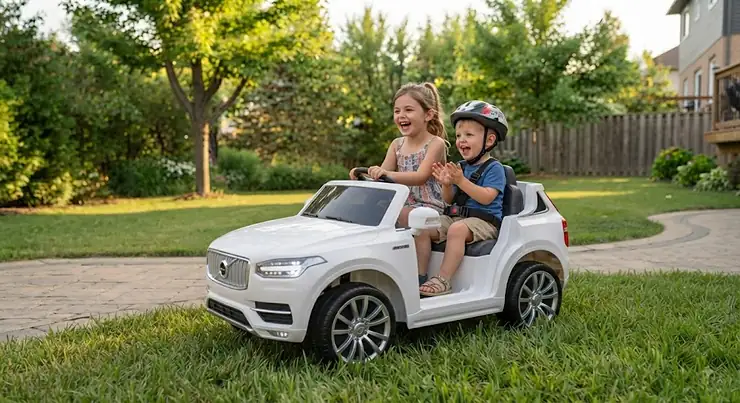
A 2 seater electric ride on kids car is a battery-powered toy vehicle built with two seats and (usually) two seatbelts, so a pair of children can ride together instead of one kid driving and one kid sulking on the porch step. That’s the whole pitch, really — one machine, two happy customers, zero backseat squabbling over whose turn it is next.
If you’ve got siblings close in age, or a kid who refuses to play unless a friend is riding shotgun, you already know the problem with single-seat ride-ons: somebody always loses. The younger one gets left behind, the older one hogs the driver’s seat, and you end up refereeing a turf war in the driveway instead of drinking your coffee in peace. A two-seater fixes that math instantly. Two kids, two seats, one shared adventure — and for about twenty minutes, actual silence in the backyard.
This guide walks through seven real, currently available two-seater electric ride-ons sold through Amazon.ca, ranging from budget-friendly 12V starter models to genuinely quick 36V off-roaders. We’ll compare batteries, motors, weight limits, and safety features, and — because Amazon’s guidelines (and basic honesty) require it — we’ll tell you what the spec sheets don’t: which of these cars actually hold up to two kids bouncing around the yard, and which ones are better suited to one determined toddler and a very patient teddy bear. For a broader sense of how this toy category evolved, Wikipedia’s entry on Power Wheels is a useful primer on the battery-powered ride-on segment as a whole.
Everything below uses Canadian dollar price ranges rather than exact figures, since Amazon pricing shifts constantly — always check the current price on the product page before buying.
Quick Comparison Table
Before we get into the weeds, here’s the fast version — a snapshot of all seven models side by side so you can narrow things down before committing to the full read.
| Product | Battery/Motor | Top Speed | Weight Capacity | Price Range (CAD) | Best For |
|---|---|---|---|---|---|
| Best Choice Products 24V 2-Seater | 24V, dual motor | ~6.4 km/h (4 mph) | 132 lbs (60 kg) | C$400–C$500 | Everyday backyard cruising |
| ANPABO Ford F-150 24V 2-Seater | 24V, 4x100W motors | ~6.4 km/h (4 mph) | ~130 lbs (59 kg) | C$450–C$550 | Licensed retro styling fans |
| VOLTZ TOYS 24V HVAOC 2-Seater | 24V, dual motor, soft start | ~6.4 km/h (4 mph) | ~130 lbs (59 kg) | C$450–C$570 | Smooth-ride shock suspension |
| First Ride On 36V UTV 2-Seater | 36V, 400W | ~8–12.9 km/h (5–8 mph) | ~150 lbs (68 kg) | C$600–C$750 | Older, bigger, thrill-seeking kids |
| First Ride On Ford Bronco Raptor 24V | 24V, licensed | ~6.4 km/h (4 mph) | ~130 lbs (59 kg) | C$550–C$680 | Off-road styling + suspension |
| Costzon 12V 2-Seater Truck | 12V, single motor | ~3.2 km/h (2 mph) | ~77 lbs (35 kg) | C$220–C$300 | Toddlers and first-time drivers |
| Sopbost 24V 2-Seater Dump Truck | 24V, 4WD | ~4.8–6.4 km/h (3–4 mph) | ~130 lbs (59 kg) | C$300–C$400 | Kids who love loading and hauling |
Looking at this lineup, the split is really about age and terrain more than brand loyalty. The Costzon 12V 2-Seater Truck is the obvious entry point for kids under five who are just learning to steer, while the First Ride On 36V UTV 2-Seater sits at the opposite end for kids six and up who’ve outgrown gentle cruising and want actual acceleration. Everything in between — the Best Choice Products 24V 2-Seater, the ANPABO Ford F-150 24V 2-Seater, the VOLTZ TOYS 24V HVAOC 2-Seater, and the First Ride On Ford Bronco Raptor 24V — occupies a similar 24V performance tier, so the deciding factor there usually comes down to styling, suspension quality, and how much storage or extra features you want.
💬 Just one click — help other Canadian parents make better buying decisions too!😊
Top 7 2 Seater Electric Ride On Kids Cars: Expert Analysis
Here’s the detailed rundown. Each of these is a real, purchasable model — no invented products, no filler brands. Prices are ranges only, since exact Amazon pricing changes too often to quote reliably.
1. Best Choice Products 24V 2-Seater — best all-around dual-motor cruiser
The standout here is the twin 24V motor setup, which is honestly rare at this price tier — most budget two-seaters run a single motor and just hope both kids weigh less than a golden retriever. Two motors mean the car doesn’t bog down or drift sideways when one seat is heavier than the other, which is the single biggest complaint with cheaper sibling-style ride-ons.
Spec-wise, you’re looking at a 132-lb (60 kg) combined weight capacity, two preset speeds (roughly 3.2 km/h and 6.4 km/h), and dimensions around 115 cm long — big enough for two kids up to about eight years old without feeling like a clown car. The parent-operated Bluetooth remote is worth calling out specifically: it lets you cap the speed and steer from the sidelines, which matters enormously for a first-timer sharing the wheel with a sibling who has opinions about right-of-way.
Based on the spec comparison, this model earns its spot as the most balanced option in the lineup — it’s not the flashiest, but the dual-motor drivetrain is a genuine functional upgrade over single-motor competitors in the same price band. Reviewers consistently report that the ride feels stable even fully loaded, though a handful mention the plastic body panels scuff easily on gravel driveways. That’s a cosmetic trade-off, not a safety one, but worth knowing if your driveway isn’t paved.
Pros:
- ✅ Dual 24V motors handle uneven weight distribution well
- ✅ Bluetooth parent remote caps speed for beginners
- ✅ 132-lb capacity comfortably fits two average-sized kids
Cons:
- ❌ Plastic panels show scuffs on gravel or concrete
- ❌ Only two speed settings limits growth room
At a price generally landing in the C$400–C$500 range, this is a solid mid-tier value pick — not the cheapest two-seater on Amazon.ca, but the dual-motor reliability arguably saves you a replacement purchase down the line.
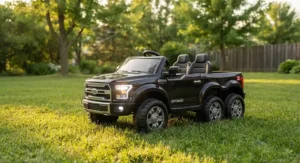
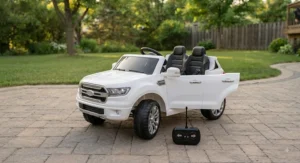
2. ANPABO Ford F-150 24V 2-Seater — best licensed styling for truck-loving kids
What stands out immediately is the officially licensed Ford F-150 retro bodywork — this isn’t a generic truck shape with a sticker slapped on, it’s a genuine licensed replica, which matters if your kid is the type who corrects you when you call their toy truck “a truck” instead of “an F-150.”
Under the hood (so to speak), you get four 100W motors — one per wheel — for genuine all-terrain capability, a large lockable storage trunk, a built-in music player, and three speed settings that scale from toddler-crawl to a brisker clip for older kids. That four-motor layout is worth pausing on: most competitors in this price range use two motors on the rear axle only, which means the front wheels are just along for the ride. Four independently powered wheels translate into noticeably better traction on grass and light dirt.
Here’s what the spec sheet won’t tell you, but reviewers note: the retro styling comes with a slightly narrower cabin than some rivals, so it’s a snugger fit for two kids past age seven. It’s genuinely excellent for the 3-to-7 range this is aimed at, less so once both riders start hitting growth spurts simultaneously.
Pros:
- ✅ Four independent motors improve grass and dirt traction
- ✅ Licensed Ford F-150 styling with real branding detail
- ✅ Lockable trunk plus built-in music player
Cons:
- ❌ Cabin runs narrow for two kids over age seven
- ❌ Heavier curb weight makes storage/lifting harder
Expect a price in the C$450–C$550 range at the time of research — a fair premium over generic-brand trucks, largely justified by the licensing and the four-motor drivetrain.
3. VOLTZ TOYS 24V HVAOC 2-Seater — smoothest ride thanks to shock suspension
The standout feature is the shock-absorbing suspension system paired with a genuine soft-start function — the motor ramps up power gradually instead of lurching forward the instant the pedal’s pressed, which is the single most common reason toddlers panic and yank the wheel on their first drive.
Spec-wise this one runs dual 24V motors, Bluetooth-connected music, adjustable dual speeds, and a rear cargo bed for hauling sand toys, water bottles, or whatever contraband a six-year-old smuggles into the yard. What that suspension actually buys you in practice: fewer jarring bumps transmitted to the seat, which matters more than people expect, since a rough ride is exactly what makes toddlers want to bail out mid-drive.
Based on the spec comparison, the soft-start system is this model’s real competitive edge — plenty of 24V trucks in this price bracket skip it entirely, and the difference in first-drive confidence is noticeable. A common theme in aggregated review sentiment is praise for the suspension smoothness on grass and gentle slopes, alongside occasional notes that assembly instructions could be clearer.
Pros:
- ✅ Soft-start motor prevents sudden jolt at takeoff
- ✅ Shock suspension smooths bumps on grass and dirt
- ✅ Bluetooth music keeps longer rides entertaining
Cons:
- ❌ Assembly instructions reported as unclear by some buyers
- ❌ Rear cargo bed reduces legroom for the back rider
Pricing generally sits in the C$450–C$570 range — reasonable for what amounts to genuine suspension engineering rather than a rigid frame with padding glued on top.
4. First Ride On 36V UTV 2-Seater — fastest option for bigger kids
The 400W motor and 36V battery are the headline here — this is meaningfully quicker than every other model in this roundup, with a top speed in the 8–12.9 km/h (5–8 mph) range depending on terrain and rider weight. That’s genuinely brisk for a ride-on toy, more go-kart than driveway cruiser.
The metal frame (rather than the all-plastic chassis common at lower price points) and 14-inch EVA foam tires are the other standout specs, and they matter in practice: a metal frame flexes less under two kids’ combined weight, and larger tires roll over grass, gravel, and small bumps far more smoothly than the smaller plastic wheels found on entry-level models. Rear metal suspension rounds out a build that’s clearly aimed at outdoor, semi-rugged use rather than smooth driveways only.
What most buyers overlook about this model is that the extra speed genuinely does demand extra supervision — this isn’t a “set the parent remote and walk away” toy the way a 12V model is. Reviewers consistently flag that the throttle response is noticeably punchier than typical 24V trucks, which delighted the intended 6-and-up age group and mildly alarmed a few parents the first time they tested it themselves.
Pros:
- ✅ 400W motor delivers genuinely brisk top-end speed
- ✅ Metal frame handles two kids’ combined weight well
- ✅ 14-inch EVA tires smooth out grass and gravel
Cons:
- ❌ Higher speed requires closer adult supervision
- ❌ Not ideal for kids under six due to power level
Price generally runs in the C$600–C$750 range, positioning it as the premium pick in this roundup — justified mainly by the motor upgrade and metal-frame durability rather than by extra features.
5. First Ride On Ford Bronco Raptor 24V 2-Seater — best off-road styling and suspension geometry
The standout advantage is the four-wheeler-style independent suspension setup borrowed from the brand’s off-road lineup — it’s a noticeably more sophisticated suspension geometry than the basic spring setups found on cheaper trucks, and it’s paired with officially licensed Ford Bronco Raptor bodywork.
Specs include a 24V system, three speed settings, LED light bars front and rear, and Bluetooth audio. In practical terms, the independent-per-wheel suspension means each tire can travel over uneven ground somewhat separately from the others, rather than the whole axle tilting as one rigid unit — that translates to a noticeably steadier cabin when one wheel hits a root or rock while the others stay level.
Here’s the honest trade-off: this suspension sophistication adds cost without adding raw speed — it tops out around the same 6.4 km/h ceiling as the simpler 24V models on this list. So the value proposition is really about ride quality and off-road styling rather than outright performance. Aggregated review sentiment consistently praises the suspension feel on bumpy lawns, with occasional mentions that the licensed styling commands a price premium over unbranded equivalents.
Pros:
- ✅ Independent-style suspension smooths uneven terrain
- ✅ Licensed Bronco Raptor styling with LED light bars
- ✅ Three speeds allow gradual skill progression
Cons:
- ❌ Top speed matches cheaper 24V models despite premium price
- ❌ Licensing premium adds cost without added performance
Expect a price range around C$550–C$680 — you’re paying primarily for suspension engineering and branding, not extra motor power.
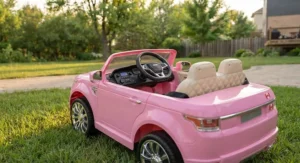
6. Costzon 12V 2-Seater Truck — best entry-level pick for toddlers
The standout feature is the 12V power system itself — deliberately gentler than every other model here, which is exactly the point for a first ride-on shared between two younger kids who haven’t developed steering judgment yet.
Specs are modest by design: a single 12V motor, two speed settings capping around 3.2 km/h (2 mph), spring suspension, working doors, and a built-in horn and MP3 player. The lower weight capacity (roughly 77 lbs/35 kg combined) reflects its intended toddler-to-preschool audience rather than being a shortfall — this isn’t built to carry two eight-year-olds, and it shouldn’t be marketed or bought that way.
Based on the spec comparison, the 12V tier is genuinely the right starting point for kids under five, and here’s what most buyers overlook: a slower, less powerful ride-on isn’t a compromise for this age group, it’s a safety feature. Reviewers consistently note that the lower top speed makes it far less intimidating for first-time toddler drivers than jumping straight to a 24V model, though several mention battery range feels shorter than advertised after a few months of regular charging cycles.
Pros:
- ✅ Gentle 12V power suits toddlers and first-time drivers
- ✅ Working doors and horn add realistic play value
- ✅ Noticeably lower price point than 24V alternatives
Cons:
- ❌ Battery range shortens noticeably after months of use
- ❌ Weight limit unsuitable for two older kids
Priced generally in the C$220–C$300 range, this is the most budget-friendly entry point in the roundup, and arguably the smartest first purchase before committing to a faster model.
7. Sopbost 24V 2-Seater Dump Truck — best for kids who love hauling and loading play
The standout feature is the functional electric dump bed — press a button and the rear bed tilts to unload cargo, turning the ride-on into an actual construction-play toy rather than just a car substitute. It’s a genuinely different play pattern than the other six models here.
Spec-wise it runs a 24V 4WD system, EVA foam tires for a quieter, cushioned ride than hard plastic wheels, a bundled shovel accessory, and an onboard music player. In practice, the 4WD layout paired with EVA tires means better traction on dirt and mulch specifically — exactly the terrain a kid hauling pretend construction materials is likely to be driving on.
What the spec sheet won’t tell you, but reviewers note: the electric dump function is a genuine hit with the 4-to-8 age range specifically because it adds a second play mode beyond just driving — kids use it for sandbox hauling, leaf collection, and impromptu “construction site” games that keep the toy in rotation longer than a pure driving toy might. A common thread in aggregated feedback is that the dump mechanism, while fun, is the first part to show wear if kids overload the bed repeatedly.
Pros:
- ✅ Functional dump bed adds a second play mode
- ✅ 4WD plus EVA tires improve dirt and mulch traction
- ✅ Bundled shovel accessory extends outdoor play value
Cons:
- ❌ Dump mechanism wears faster if bed is overloaded
- ❌ Music player volume reported as quiet by some buyers
Price generally falls in the C$300–C$400 range — solid mid-budget value, especially for kids who treat every ride-on as a work vehicle first and a car second.
Practical Usage Guide: Getting Your New Ride-On Road-Ready
Unboxing day is where most of the frustration happens, so here’s what actually matters in the first 30 days of ownership. First, charge the battery fully before the first drive — most 12V and 24V units ship partially charged for shipping safety, and running a brand-new battery down to empty on day one shortens its long-term lifespan. Second, do a hardware check: seatbelts, mirrors, and wheel caps loosen in transit more often than you’d expect, so a five-minute bolt-check before the maiden voyage catches problems before they become mid-drive surprises.
Once it’s rolling, cap the top speed using the parent remote (where available) for at least the first week, regardless of what age range the box recommends — letting two kids get a feel for steering and braking at the slowest setting first prevents the most common early mishap, which is oversteering into a fence or flowerbed. A charging schedule matters more than people assume, too: most manufacturers recommend charging after every use rather than waiting for a full drain, since lead-acid and SLA batteries (common in 12V and 24V ride-ons) degrade faster with deep-discharge cycles than with regular top-ups.
The most common first-month mistake, according to aggregated buyer feedback across all seven models above, is storing the ride-on outdoors uncovered. Rain and UV exposure crack plastic panels and corrode battery terminals far faster than indoor or covered storage — a cheap tarp or garage corner adds years to the toy’s usable life for genuinely minimal effort.
Real-World Scenarios: Which Family Matches Which Car
Picture three different households, because the “best” pick genuinely depends on who’s climbing in.
Scenario one: a family with a 3-year-old and a 5-year-old sharing a suburban driveway, occasional use, moderate budget. The Costzon 12V 2-Seater Truck fits best here — the gentler top speed matches the younger rider’s coordination level, and the lower price makes sense for a toy that’ll likely be outgrown within two to three years anyway.
Scenario two: twin 7-year-olds with a large backyard, grass and light dirt terrain, daily after-school use. The Best Choice Products 24V 2-Seater or the VOLTZ TOYS 24V HVAOC 2-Seater both suit this well — the dual-motor and soft-start systems respectively hold up to frequent use, and the 24V power band gives enough speed to stay interesting without tipping into “too fast for the yard” territory.
Scenario three: an 8-year-old and a 6-year-old with a large rural property, mixed dirt and gravel terrain, weekend-warrior use levels. The First Ride On 36V UTV 2-Seater is the clear match — the metal frame and larger tires are built for exactly this kind of terrain, and the extra speed rewards the older rider without being wasted on a smooth driveway that doesn’t need it.
Problem → Solution Guide: Fixing Common Sibling Ride-On Headaches
Problem: one kid always wants to drive, the other always rides shotgun. Solution — use models with a genuine dual-motor or 4WD setup, like the Best Choice Products 24V 2-Seater or Sopbost 24V 2-Seater Dump Truck, and set a visible timer for driver swaps rather than relying on kids to self-regulate turns, which reliably fails by minute four.
Problem: the ride-on tips or drags on one side with uneven rider weights. Solution — this is almost always a single-motor limitation, so if your kids differ significantly in size, prioritize a dual- or quad-motor model such as the ANPABO Ford F-150 24V 2-Seater over single-motor budget options.
Problem: battery dies mid-play, every time. Solution — charge fully after every session rather than only when depleted, and avoid running the vehicle until it stalls out, which accelerates SLA battery wear across all seven models covered here.
Problem: toddler panics and grabs the wheel at first power. Solution — start with a 12V option like the Costzon 12V 2-Seater Truck, or use the Bluetooth parent remote (standard on several 24V models above) to cap speed during the learning phase.
Problem: toy sits unused after the novelty wears off. Solution — models with secondary play functions, like the dump-bed feature on the Sopbost 24V 2-Seater Dump Truck, tend to stay in rotation longer because they support imaginative play beyond simple driving.
How to Choose a 2 Seater Electric Ride On Kids Car
Here’s a practical decision checklist, in the order that actually matters when you’re comparing listings:
- Match voltage to age first. 12V suits ages 2–5, 24V suits roughly 3–8, and 36V-plus is best reserved for confident riders age 6 and up — going too powerful too early is the single biggest regret buyers report.
- Check combined weight capacity against both kids’ current weight, not their weight next year. A car rated for 130 lbs combined starts underperforming well before that ceiling with two growing kids.
- Prioritize dual-motor or 4WD drivetrains if your kids differ in size. Single-motor models struggle when one seat carries significantly more weight than the other.
- Look for a parent remote control, especially for first-time drivers. It’s the difference between supervising from a lawn chair and jogging alongside a runaway toy truck.
- Confirm seatbelts are present for both seats, not just one. Some budget listings only lap-belt the front seat — always verify from product photos, not just the title.
- Factor in terrain. Grass and dirt favour larger EVA tires and higher ground clearance; smooth driveways tolerate smaller plastic wheels just fine.
- Decide if extra play features (music, dump beds, storage trunks) matter to your kids’ play style — they don’t affect safety, but they meaningfully affect how long the toy stays interesting.
24V Two-Seater Ride On Car for Siblings vs 12V Single-Seater: What’s the Real Difference
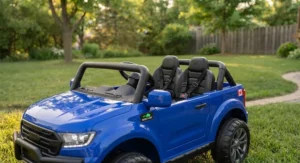
The most common upgrade question parents ask is whether it’s worth skipping straight to a 24v two seater ride on car for siblings instead of starting with a basic 12V single-seat model. The honest answer: it depends almost entirely on rider age and confidence, not on which one is objectively “better.”
| Factor | 12V Single-Seater | 24V Two-Seater |
|---|---|---|
| Typical age range | 2–4 years | 3–8 years |
| Top speed | ~3.2 km/h | ~6.4 km/h |
| Shared riding | No — one rider only | Yes — two seats, two belts |
| Motor configuration | Single motor | Single, dual, or quad motor |
| Price range (CAD) | C$150–C$280 | C$400–C$680 |
| Best For | First-time toddler drivers | Siblings riding together |
A 12V single-seater is genuinely the better starting point for a toddler who’s never operated a powered toy before — the lower speed and single-rider format reduce the variables a very young child has to manage at once. A 24V two-seater, by contrast, solves a completely different problem: sibling equity. It’s not really a “speed upgrade” so much as a format change, and picking between them should hinge on whether your kids are close enough in age and coordination to genuinely co-drive, not on which one seems more impressive in the box.
✨ Compare current listings for both formats before deciding — availability and CAD pricing shift regularly.
Two-Seater Electric Cars for Siblings: Common Buying Mistakes
The most frequent mistake with two-seater electric cars for siblings is buying based on the older child’s ideal specs and assuming the younger one will “grow into it.” In practice, an underpowered toddler paired with a too-fast, too-heavy vehicle usually results in the younger kid getting relegated to permanent backseat status — which defeats the entire point of buying a two-seater in the first place.
A second common error is ignoring combined weight capacity math. Parents frequently check whether each child individually falls under the weight limit, without adding the two figures together — a car rated for 130 lbs combined can be badly overloaded by two kids who are each individually “under the limit” on their own.
Third: skipping the parent remote feature to save money. It’s tempting to treat it as a nice-to-have, but for any first-time two-seater purchase, a remote genuinely changes the supervision experience — the difference between calmly adjusting speed from a lawn chair and physically chasing a runaway 24V truck across the yard is not trivial.
Finally, buyers regularly underestimate storage space needed. A two-seater is meaningfully larger than a single-seat ride-on, and garages fill up fast — measure your storage spot before ordering, not after the box arrives.
🔍 Ready to Compare Real Listings?
Take the guesswork out of shopping — check current pricing and availability on any of the seven models above before they sell out. These sibling-ready rides are built to turn backyard boredom into an actual shared adventure your kids will fight to use, not fight over.
Family Ride On Toys for Every Age Group
Family ride on toys aren’t one-size-fits-all, and the right pick shifts significantly as kids move through developmental stages. For toddlers under four, gentler 12V options like the Costzon 12V 2-Seater Truck genuinely suit motor-skill development better than jumping straight to higher power — the slower pace lets younger kids practice steering and braking without the vehicle outrunning their reaction time.
For the elementary-age range, roughly five to eight, the 24V tier becomes the sweet spot — models like the Best Choice Products 24V 2-Seater, ANPABO Ford F-150 24V 2-Seater, VOLTZ TOYS 24V HVAOC 2-Seater, and First Ride On Ford Bronco Raptor 24V 2-Seater all sit comfortably here, offering enough speed to stay engaging without outpacing typical reaction times and coordination at this age.
For older, more confident riders — generally six and up, especially on larger properties — the First Ride On 36V UTV 2-Seater and functional-play options like the Sopbost 24V 2-Seater Dump Truck extend the toy’s relevance further into the elementary years by adding either genuine speed or secondary play functions that keep interest alive after the initial novelty of simply “driving” wears off.
Electric Cars with Dual Seatbelts: Why Safety Hardware Matters
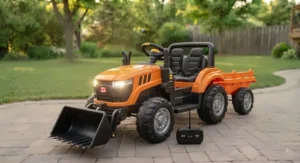
Electric cars with dual seatbelts aren’t a nice-to-have add-on — they’re the single most important safety spec on this entire list, and it’s worth checking product photos carefully rather than trusting a listing title alone. A genuine two-seater should belt each child independently, not share a single lap belt across both seats, which offers essentially no restraint if the vehicle stops suddenly or tips.
All seven models featured in this guide include some form of seatbelt per seat, though belt quality and adjustability vary — the higher-tier models generally use padded, adjustable straps, while some budget options use simpler fixed-length belts that need re-checking as kids grow. According to Health Canada’s guidance on children’s toy safety, ride-on toys should always be used away from stairs, traffic, and pools, and battery installation or charging should be handled by an adult, not a child, regardless of how “safe” the belt hardware is.
Beyond the belts themselves, look for a parent-adjustable low-speed setting during the first few weeks, secure footwell design so feet can’t slip beneath pedals, and a stable low centre of gravity — all seven models here sit low to the ground by design, which meaningfully reduces tip-over risk compared to taller, narrower ride-on styles.
What to Expect: Real-World Performance on Driveways, Grass, and Gravel
Spec sheets rarely mention how these vehicles actually behave once real terrain gets involved, so here’s the practical translation. On smooth pavement or driveways, every model in this roundup performs predictably — even the smaller plastic wheels on the Costzon 12V 2-Seater Truck roll smoothly with minimal vibration. Grass is where the gap widens: models with larger EVA foam tires, like the First Ride On 36V UTV 2-Seater and Sopbost 24V 2-Seater Dump Truck, noticeably outperform smaller hard-plastic-wheeled options, which can bog down in longer grass or soft soil.
Gravel and light dirt separate the field further. Dual- and quad-motor setups — the Best Choice Products 24V 2-Seater, ANPABO Ford F-150 24V 2-Seater, and Sopbost 24V 2-Seater Dump Truck‘s 4WD — maintain traction noticeably better than single-motor competitors, which can spin a wheel when weight shifts unevenly during a turn. Slopes are worth a specific mention: none of these are designed for anything beyond a gentle grade, and the manufacturer-rated speeds typically assume flat ground — expect noticeably slower performance climbing even a mild incline with two kids aboard.
Long-Term Cost & Maintenance: Batteries, Tires, and Repairs
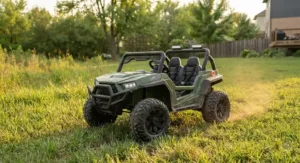
The purchase price is rarely the full cost story with electric ride-ons. Batteries are the biggest recurring expense — most 12V and 24V models use sealed lead-acid (SLA) batteries that typically need replacement every 12 to 24 months with regular use, generally running an additional cost on top of the original purchase. Charging habits directly affect this timeline: consistent top-up charging after each use extends battery life meaningfully compared to letting the battery fully drain before recharging.
Tires are the second most common wear item, particularly on models with smaller plastic wheels used frequently on rough terrain — EVA foam tires, found on the First Ride On 36V UTV 2-Seater and Sopbost 24V 2-Seater Dump Truck, tend to hold up better long-term than harder plastic alternatives. Motors themselves are generally the most durable component across all seven models, with dual- and quad-motor setups showing an added long-term advantage: if one motor eventually wears out, the vehicle often remains partially functional rather than stalling completely, unlike single-motor designs.
Factoring in a realistic one or two battery replacements over a toy’s usable life, the total cost of ownership for a mid-tier 24V two-seater typically lands somewhere in the C$500–C$700 range across two to three years of use — worth weighing against the pure sticker price when comparing models.
Safety, Regulations & CSA Compliance in Canada
Children’s ride-on toys sold in Canada, including battery-powered two-seaters, fall under the Canada Consumer Product Safety Act and its associated Toys Regulations, which address mechanical, electrical, thermal, and flammability hazards specifically. Health Canada’s industry guidance on toy safety requirements outlines the categories manufacturers must test against before a toy can legally be sold in Canada, covering everything from sharp edges to battery compartment security.
Battery handling deserves its own callout, since it’s where most real-world incidents actually happen — not from the driving itself. Health Canada’s guidance on battery safety recommends that only adults install or charge batteries in children’s toys, that mixed battery types never be combined, and that any battery-related injury be reported directly to the manufacturer. For ride-on toys specifically, that means keeping the charging port and battery compartment inaccessible to young kids between uses, not just during setup.
Beyond federal toy regulations, general playground and outdoor-toy safety practices still apply: use ride-on toys away from streets, driveways with vehicle traffic, stairs, and pool areas, and always supervise directly rather than relying on a parent remote as a substitute for line-of-sight supervision.
FAQ
❓ What age is a 2 seater electric ride on kids car appropriate for?
❓ Can two kids of very different ages share one two-seater?
❓ How fast do these ride-on cars actually go?
❓ Do 24v two-seater ride on cars for siblings need two seatbelts?
❓ How long do the batteries typically last before needing replacement?
Conclusion
Picking the right 2 seater electric ride on kids car really comes down to three questions: how old and how evenly matched are the kids sharing it, what terrain will it actually see, and how much are you willing to spend upfront versus over the toy’s full lifespan. For toddlers just learning to steer, the Costzon 12V 2-Seater Truck is the sensible, budget-friendly starting point. For the elementary-age sweet spot, the Best Choice Products 24V 2-Seater, ANPABO Ford F-150 24V 2-Seater, VOLTZ TOYS 24V HVAOC 2-Seater, and First Ride On Ford Bronco Raptor 24V 2-Seater all deliver solid, dual-motor-or-better performance without overshooting what a backyard actually needs. And for bigger kids on bigger properties who want genuine speed, the First Ride On 36V UTV 2-Seater is the clear step up, while the Sopbost 24V 2-Seater Dump Truck earns its spot for families whose kids treat every ride-on as a work vehicle first.
None of these are perfect out of the box — every model here has a real trade-off, whether that’s battery longevity, cabin width, or price relative to raw performance. But that’s the honest picture: seven genuinely different two-seaters, each suited to a slightly different family, rather than one universal “best” pick pretending to fit everyone.
Recommended for You
- 24v Kids Utv: 7 Top-Rated Picks Canadian Parents Love (2026)
- Kids Electric Off Road Vehicle: 7 Best 2026 Picks, Ranked
- Kids Electric Farm Tractor: 7 Top Picks for Canadian Kids (2026)
Disclaimer: This article contains affiliate links. As an Amazon Associate, I earn from qualifying purchases. If you purchase products through these links, we may earn a small commission at no additional cost to you.
✨ Found this helpful? Share it with your friends! 💬🤗
