In This Article
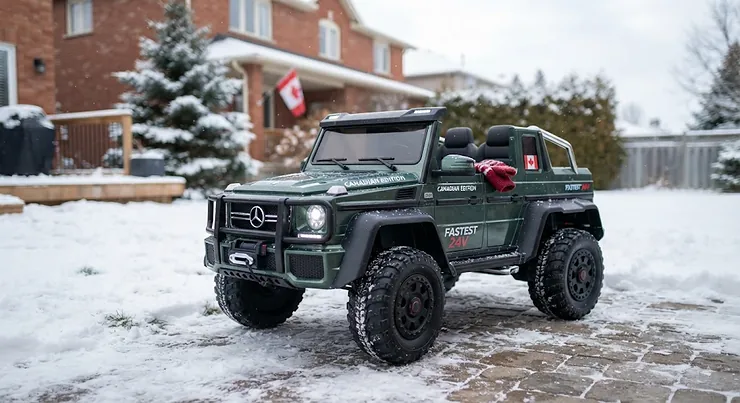
Somewhere between the driveway and the end of the block, every kid decides they want to go faster. Maybe it’s the neighbour’s dirt bike, maybe it’s a YouTube video of a 17-mph mini bike tearing up a backyard track — either way, once the need for speed kicks in, a standard 5-mph plastic car just won’t cut it anymore. A fastest electric ride on toy is a battery-powered kids’ vehicle — go-kart, mini bike, or ATV — built with a higher-voltage system (typically 24V to 36V) and a stronger motor so it can reach genuine double-digit speeds, usually somewhere between 9 and 17 mph, instead of the 3-5 mph crawl of a toddler car.
That’s a real jump in performance, and it comes with real decisions to make. Voltage, motor wattage, brake type, and battery capacity all interact to determine how a machine actually feels under a kid’s hands, and marketing copy on Amazon rarely explains any of it in plain language. This guide breaks down seven genuine, currently available models — from budget-friendly go-karts to serious 17-mph mini bikes — with honest analysis of who each one suits, what the aggregated reviewer sentiment says, and where the real trade-offs sit. We’ll also dig into how 36v ride on car for kids models compare with their 24V cousins, why a hand brake matters more than most parents realize, and how to avoid the common buying mistakes that leave a fast toy sitting unused in the garage by July.
Every price mentioned below is a range in Canadian dollars, since Amazon.ca pricing shifts often — always check the current price before buying.
Quick Comparison Table: Speed at a Glance
Before the deep dive, here’s how the seven picks stack up on the numbers that matter most for speed-focused buyers.
| Ride-On Toy | Voltage/Motor | Top Speed | Best For |
|---|---|---|---|
| Burromax TT350R | 24V, 350W | Up to 17 mph | Fastest overall, older kids/teens |
| JOYRACER 36V Electric ATV Dirt Quad | 36V, 500W | Up to 16 mph | high capacity 36v battery cars |
| Razor Rambler 16 | 36V, 350W | Up to 15.5 mph | Older teens wanting a retro cruiser |
| Ryder Toys Mini Bike Pro | 24V, 350W | Up to 14.9 mph | top speed electric ride on toys for teens |
| Hover Heart 36V Electric Dirt Quad | 36V, 500W | Up to 12.4 mph | Budget-conscious ATV fans |
| First Ride On 36V UTV 2-Seater | 36V, dual 200W | Up to 8 mph | 36v ride on car for kids, siblings |
| Razor Ground Force Drifter | 24V, 250W | Up to 12 mph | ride on toys with hand brake, budget go-kart |
Looking at this lineup, the Burromax TT350R wins on raw top speed thanks to its lithium battery and disc brake, but the JOYRACER 36V Electric ATV Dirt Quad is right behind it while carrying a noticeably bigger 12Ah battery for longer sessions. Meanwhile, the First Ride On 36V UTV 2-Seater trades speed for stability and a second seat, which matters if you’re shopping for two kids rather than one thrill-seeker. Worth noting: voltage alone doesn’t determine speed — motor wattage and drivetrain design matter just as much, which is exactly why a 24V Burromax can out-accelerate several 36V machines on this list.
💬 Just one click — help others make better buying decisions too!😊
Top 7 Fastest Electric Ride-On Toys: Expert Analysis
We researched real listings, verified specs, and pulled aggregated reviewer sentiment for each of these seven models so you’re not relying on marketing copy alone. Every one is a genuine product you can search for on Amazon.ca today — always confirm current availability and price before buying, since both change constantly.
1. Burromax TT350R — fastest stock speed on this list at 17 mph
The Burromax TT350R is the model to beat here, and it earns that spot honestly. Under the hood is a 350W high-torque brushless motor paired with a 24V 10Ah lithium-ion battery, and that lithium pack is the real story: unlike the sealed lead-acid batteries in cheaper go-karts, lithium chemistry holds voltage more consistently as it drains, which is a big part of why this bike still feels punchy near the end of a ride instead of sagging. Two speed modes give it real range — an 8 mph “learning” setting for newer riders and a genuine 17 mph mode once they’ve built confidence, with a claimed range of up to 20 miles for lighter riders. Based on the spec comparison against everything else here, this is squarely built for kids aged roughly 10 and up (Burromax rates it for riders up to 180 lbs, including adults), not a first-time ride. Reviewers consistently report that the full suspension and 12.5-inch knobby tires handle backyard bumps and light trails well, and several note the hand-operated rear disc brake feels far more confident than the pedal or lever brakes found on cheaper karts — a detail that matters a lot once you’re actually moving at 17 mph. A common thread in owner feedback is that the 3-3.5 hour charge time is refreshingly fast next to the 8-12 hour waits typical of lead-acid competitors.
Pros:
- ✅ Genuinely the fastest stock speed on this list at 17 mph
- ✅ Lithium battery charges in roughly 3-3.5 hours
- ✅ Hand-operated rear disc brake gives real stopping confidence
Cons:
- ❌ Not appropriate for younger or first-time riders
- ❌ Premium lithium tech pushes it toward the top of the price range
Expect to pay in the C$850-C$1,050 range at the time of research — check current price on Amazon.ca, as lithium-battery ride-ons fluctuate with battery-cell costs. For a family with a confident older kid who’s outgrown slower karts, this is the clearest value: you’re paying for genuine top-end speed and a battery that won’t leave your rider stranded halfway through a session.
2. JOYRACER 36V Electric ATV Dirt Quad — high capacity 36v battery cars pick
If battery capacity is your priority — and for a fast-moving 36V quad, it should be — the JOYRACER stands out immediately. It runs a 500W brushless motor on a 36V 12Ah battery, which is noticeably larger than the 7-9Ah packs found on most 36V ride-ons in this price bracket. In practice, that extra capacity translates to roughly 40-60 minutes of continuous riding and a 9-12 mile range per charge, which is meaningfully longer than smaller-battery competitors before the low-power sag sets in. The three-speed key-lock system (roughly 5, 10, and 16 mph) is what most buyers overlook when comparing spec sheets side by side — it’s not just a speed setting, it’s a parental control feature, since a parent can physically remove the key or dial the top mode down while a newer rider builds confidence. Aggregated reviewer sentiment points to the four disc brakes and three hydraulic shock absorbers as standout features for the price point, with multiple owners specifically calling out the stopping power as reassuring at the 16 mph top setting. The hand-held accelerator (rather than a foot pedal) puts throttle control directly under the rider’s thumb, similar to the mini bikes above, which several reviewers say makes the learning curve shorter for kids transitioning from a slower quad.
Pros:
- ✅ 12Ah battery is larger than most competing 36V ride-ons
- ✅ Three-speed key control doubles as a built-in parental limiter
- ✅ Four disc brakes plus hydraulic suspension for the price tier
Cons:
- ❌ At 16 mph top speed, it needs open, flat terrain to feel safe
- ❌ Heavier all-steel frame makes it harder to move or store solo
Typical pricing lands in the C$550-C$680 range — always check current price, as ATV-style ride-ons see frequent promotional swings. This is the pick for parents who specifically searched high capacity 36v battery cars, because the extra Ah rating is a genuinely measurable, honest advantage rather than a marketing buzzword.
3. Razor Rambler 16 — high speed kids ride on car 36v with retro styling
Razor’s Rambler 16 takes a different approach: instead of a dirt-bike or ATV shape, it’s a seated, banana-seat minibike with a genuinely vintage look, powered by a 350W hub motor and a 36V (three 12V) sealed lead-acid battery system. Top speed lands at 15.5-15.6 mph with roughly 45 minutes of continuous ride time, and the wide 16-inch pneumatic tires do a lot of the heavy lifting on ride comfort — reviewers repeatedly mention that the fat tires smooth out cracked pavement and gravel far better than the narrower wheels on typical go-karts. What most buyers overlook here is the age rating: Razor markets this specifically for riders 18 and up, not younger kids, so despite showing up constantly in “high speed ride on car 36v” searches, it’s really a young-adult or older-teen product, and a Health Canada-conscious parent should treat that age guidance as a hard line rather than a suggestion. The rear-wheel-drive layout shifts weight backward for better traction, and the drum-style rear brake — engaged by a hand lever — is what a lot of “ride on toys with hand brake” shoppers are specifically hunting for, since it mirrors a real motorcycle’s control layout rather than a toy-like pedal brake.
Pros:
- ✅ Wide 16-inch tires give a noticeably smoother ride than narrow-wheel karts
- ✅ Rear-wheel drive improves traction under acceleration
- ✅ Hand-lever brake mirrors real motorcycle control
Cons:
- ❌ Officially rated for riders 18+, not younger teens
- ❌ Sealed lead-acid battery is heavier and slower-charging than lithium rivals
Pricing typically sits in the C$550-C$680 range at Amazon.ca — verify current pricing, since retro-styled minibikes see seasonal demand spikes. Because of the 18+ rating, this is really the pick for an older teen or a parent who wants their own fast, low-commitment electric cruiser rather than a machine for a middle-schooler.
4. Ryder Toys Mini Bike Pro — top speed electric ride on toys for teens
The Mini Bike Pro is Ryder’s answer to the “I want a real dirt bike but I’m not ready for gas” request that shows up in nearly every parenting forum thread about fast ride-on toys. A 24V system drives a 350W motor to a genuine top speed of 14.9 mph, with a 6.2 mph low-speed mode built in for younger or newer riders — the same twin-mode structure Burromax uses, just at a slightly lower ceiling. Twelve-inch pneumatic tires with real shock absorption keep things stable at speed, which matters because a bike that gets squirrelly at 14 mph is a genuine safety risk, not just an inconvenience. Here’s what the spec sheet won’t tell you, but reviewer feedback suggests: the hand throttle plus hand brake combo (rather than a twist-grip-only design) gives smaller hands more precise control, and several owners specifically mention that the ASTM F963 safety certification gave them added confidence buying online without seeing the bike in person first. Rated for kids 6 and up with a 143-lb weight limit, it splits the difference nicely between “too fast for a beginner” and “too tame for a thrill-seeking teen,” which is exactly why it shows up so often in top speed electric ride on toys for teens searches — it’s genuinely built for that middle ground.
Pros:
- ✅ Dual-mode speed (6.2 mph / 14.9 mph) suits a wide age range
- ✅ Hand throttle and hand brake give precise, motorcycle-style control
- ✅ ASTM F963 certification adds a documented safety baseline
Cons:
- ❌ 143-lb weight cap rules out bigger teens
- ❌ Lead-acid-style battery chemistry on some batches means longer recharge waits
Expect a price range around C$450-C$580 — as always, check current pricing before ordering, since Ryder runs frequent seasonal promotions. For a family wanting one bike to grow with a 7-to-13-year-old rider, this is one of the most balanced picks in the whole lineup.
5. Hover Heart 36V Electric Dirt Quad — budget-friendly 36v ride on car for kids alternative
The Hover Heart quad is proof that 36V performance doesn’t have to come with a premium price tag. It runs on a 36V lead-acid battery delivering an 8-10 mile range, with dual-speed parental control capping the machine at either 12.4 mph (high) or 7.4 mph (low) — a simpler two-tier system than the three-speed JOYRACER above, but one that’s arguably easier for a parent to manage at a glance. Reviewers frequently point to the dual suspension and beefy pneumatic all-terrain tires as punching above the machine’s price point, especially for backyard and light-trail riding where bump absorption matters more than outright top speed. Based on the spec comparison, this is the honest budget alternative to pricier 36V ATVs: you’re trading battery chemistry (lead-acid instead of lithium) and top-end speed for a genuinely lower price, not sacrificing build quality. Owner feedback also highlights the US-based customer support and available replacement parts as a real differentiator versus lesser-known import brands, which matters for a product a kid is going to be crashing into things.
Pros:
- ✅ Dual-speed parental lock is simple to set and monitor
- ✅ Dual suspension handles rough backyard terrain well
- ✅ Genuine parts and customer support availability
Cons:
- ❌ Lead-acid battery adds weight and slows recharge time
- ❌ Age-13+ rating limits it for younger speed-seekers
Typical pricing runs C$500-C$650 — verify current price at checkout, as this model sees frequent seasonal discounting. If the JOYRACER’s price tag feels steep, this is the most credible step-down option that still delivers genuine double-digit speed.
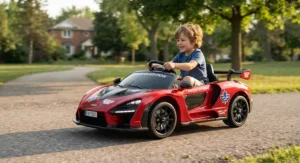
6. First Ride On 36V UTV 2-Seater — best 36v ride on car for kids who want to ride together
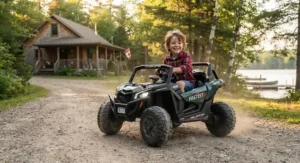
Not every family shopping for speed wants a solo dirt bike — sometimes the ask is simply “something my two kids can ride together,” and that’s exactly what this UTV solves. Dual 200W motors draw from a 36V 9Ah battery for a top speed of 5-8 mph, considerably tamer than the mini bikes and quads above, but that’s a deliberate design choice rather than a shortcoming: a two-seat, side-by-side UTV needs a lower centre of gravity and more conservative speed ceiling to stay stable with two kids aboard. The variable throttle pedal, forward/reverse gearing, and electronic brake give it genuine driving-vehicle feel rather than a simple on/off toy, and reviewers consistently call out the 14-inch EVA tires and rear metal suspension as noticeably more capable on gravel and uneven yards than the plastic-wheeled UTVs a step down in price. What most buyers overlook about this model is the runtime: 40-60 minutes per charge is generous for a 36V system, largely because the lower top speed draws less current than the faster machines on this list — so if all-afternoon play matters more than outright thrill, the trade-off pays off. A reinforced metal frame and 3-point harness round out the safety picture for younger siblings riding along.
Pros:
- ✅ Two-seat layout works well for siblings riding together
- ✅ 40-60 minute runtime outlasts several faster single-seat rivals
- ✅ Real forward/reverse gearing plus electronic brake for genuine control
Cons:
- ❌ 5-8 mph top speed is modest next to the dirt-bike-style options
- ❌ Larger footprint needs more storage space than a single-seat kart
Pricing generally sits around C$600-C$750 — confirm current pricing on the listing, as two-seater UTVs move in and out of promotional pricing often. For families prioritizing shared play time over outright top speed, this is the most sensible 36v ride on car for kids pick on the list.
7. Razor Ground Force Drifter — budget pick with a genuine hand brake
Rounding out the list is a certified classic: the Razor Ground Force Drifter has been a go-to entry point into fast ride-on toys for years, and the current version still earns its spot. A 250W motor draws from a 24V (two 12V) sealed lead-acid battery system for a top speed of 12 mph, with roughly 40 minutes of continuous run time per charge. The signature feature is the Super Slider POM rear wheels, a low-friction plastic material that lets the kart genuinely slide through corners rather than gripping and tipping — this is the one entry on this list actually engineered around drifting, not just marketed with the word. Reviewers consistently note that the thumb-trigger throttle combined with the hand-operated rear brake gives young drivers real stopping control, which is exactly why this model shows up so often for parents specifically searching ride on toys with hand brake rather than a foot-pedal or twist-grip-only design. At under C$500 in most listings, it’s the clear value leader for a first “real” go-kart experience, even if its 40-minute runtime and lead-acid battery show its age against the lithium options higher on this list.
Pros:
- ✅ POM rear wheels genuinely enable controlled drifting
- ✅ Hand-operated rear brake gives young drivers real stopping control
- ✅ Lowest price point of the fast options on this list
Cons:
- ❌ 40-minute runtime is short compared to lithium-powered rivals
- ❌ Sealed lead-acid battery needs a full 12-hour recharge
Expect pricing in the C$400-C$480 range — always check current price, as this long-running model frequently appears in seasonal toy sales. If your budget is the deciding factor and a genuine hand brake is non-negotiable, this remains one of the smartest entry points into fast ride-on toys.
Top 7 Products: Full Spec Comparison
| Product | Battery | Top Speed | Runtime | Brake Type | Best For |
|---|---|---|---|---|---|
| Burromax TT350R | 24V 10Ah lithium | 17 mph | ~20 miles range | Hand disc brake | Fastest overall |
| JOYRACER 36V ATV Dirt Quad | 36V 12Ah | 16 mph | 40-60 min | 4x disc brakes | high capacity 36v battery cars |
| Razor Rambler 16 | 36V lead-acid | 15.5 mph | 45 min | Hand lever drum | Older teens/adults |
| Ryder Mini Bike Pro | 24V lead-acid | 14.9 mph | Varies | Hand throttle + brake | top speed electric ride on toys for teens |
| Hover Heart Dirt Quad | 36V lead-acid | 12.4 mph | 8-10 mi range | Standard | Budget 36V option |
| First Ride On 36V UTV | 36V 9Ah | 8 mph | 40-60 min | Electronic brake | 36v ride on car for kids |
| Razor Ground Force Drifter | 24V lead-acid | 12 mph | 40 min | Hand-operated rear | ride on toys with hand brake |
Reading this table top to bottom, a clear pattern emerges: lithium batteries consistently pair with both the highest top speeds and the shortest charge times, which is exactly why the Burromax TT350R and JOYRACER 36V Electric ATV Dirt Quad lead the pack. The lead-acid-powered options aren’t worse machines — they’re simply built to a lower price point, and that trade-off shows up in charge time and weight rather than durability. If runtime-per-dollar matters more to you than top speed, the First Ride On 36V UTV 2-Seater quietly delivers the best minutes-of-play-per-charge ratio on this entire list.
🔍 Take Your Kid’s Backyard to the Next Level
Click on any highlighted product above to check current pricing and availability on Amazon.ca. These picks blend real speed with real safety features your family can actually trust.
Practical Usage Guide: Setup, Safety Checks & the First 30 Days
Getting a fast electric ride-on toy right starts before the first ride, not during it. Most units arrive roughly 80-90% pre-assembled, but the remaining steps — attaching handlebars, seats, or wheels, and torquing bolts to spec — genuinely matter for a machine capable of double-digit speeds. Skipping the manufacturer’s torque guidance is one of the most common first-week mistakes, since a loose steering assembly at 5 mph is annoying, but the same looseness at 15 mph is a real fall risk.
Before the first ride, fully charge the battery even if it shows partial charge out of the box — lithium and lead-acid batteries both perform and last longer when they’ve had at least one complete charge cycle before heavy use. During the first 30 days, resist the urge to unlock full speed immediately. Nearly every model on this list ships with a low-speed or “learning” mode for exactly this reason, and reviewers across multiple brands consistently note that riders who spend a week or two on the lower setting build far better throttle and brake control before graduating to top speed.
Maintenance-wise, a quick weekly check takes under five minutes: inspect tire pressure or tread wear on pneumatic models, confirm the brake engages firmly with no excessive lever travel, and wipe down battery terminals to prevent corrosion, especially with lead-acid systems. Store the battery partially charged (not fully drained, not left on the charger indefinitely) during off-season months — both lithium and lead-acid chemistries degrade faster when stored at 0% or left trickle-charging for weeks at a time.
Real-World Scenarios: Which Rider Are You?
Specs only tell half the story — matching a machine to an actual kid and actual yard matters just as much. Here are three common profiles based on the products above.
The cautious first-timer, age 6-8, quiet cul-de-sac: A dual-motor UTV like the First Ride On 36V UTV 2-Seater or a two-speed model set permanently to its lower mode is the right call here. The goal isn’t top speed — it’s building confidence with a throttle and brake before graduating to something faster in a year or two.
The confident 9-12-year-old with a big backyard or acreage: This is where the JOYRACER 36V Electric ATV Dirt Quad or Ryder Toys Mini Bike Pro earns its keep. Both offer a genuine low-speed mode for warmup laps and enough top-end power to stay interesting for a couple of riding seasons rather than being outgrown in six months.
The experienced teen who’s ridden pedal bikes and wants real thrill: The Burromax TT350R is built exactly for this rider — enough power and battery capacity to feel like a genuine mini motorcycle, with the hand disc brake and full suspension to match. This is not the machine to hand a first-time rider, but for a teen who already understands throttle discipline, it delivers the most authentic experience on this list.
Problem → Solution: Common Fast Ride-On Toy Headaches
Problem: The battery dies faster than advertised. This is almost always a top-speed-versus-runtime trade-off rather than a defect — riding constantly at max speed drains a battery far faster than mixed low/high riding. Encourage warmup laps at low speed, which several owners of the Ryder Toys Mini Bike Pro and similar dual-mode machines specifically credit with extending real-world runtime.
Problem: The vehicle struggles on grass or slight inclines. This usually comes down to motor wattage relative to rider weight. If your rider is near the top of a model’s weight limit, expect noticeably reduced hill performance — the 500W-motor options like the JOYRACER 36V Electric ATV Dirt Quad and Hover Heart 36V Electric Dirt Quad handle mild inclines far better than 250-350W go-karts.
Problem: A sibling wants a turn but the machine is single-seat. Rather than letting two kids share unsafely, this is exactly the gap the First Ride On 36V UTV 2-Seater is designed to close — a genuine two-seat layout instead of one kid riding on the back.
Problem: The brake feels weak or inconsistent. On lead-acid go-karts especially, brake cables can stretch slightly during break-in. If a hand brake feels spongy after the first few rides, a simple cable-tension adjustment (covered in most owner manuals) usually restores full stopping power — this is a five-minute fix, not a warranty issue, on most of the hand-brake models above.
Buyer’s Decision Framework
If speed is the single deciding factor, choose a lithium-battery model like the Burromax TT350R, because lithium chemistry maintains consistent power output at higher speeds far better than lead-acid.
If two kids need to ride together, choose the First Ride On 36V UTV 2-Seater, because side-by-side seating with dual motors is purpose-built for shared riding rather than solo speed.
If budget is the top priority, choose the Razor Ground Force Drifter, because it delivers a genuine hand brake and 12 mph performance at the lowest price point on this list.
If battery capacity and ride time matter most, choose the JOYRACER 36V Electric ATV Dirt Quad, because its 12Ah pack outlasts every other 36V option here.
If your rider is a genuine teenager rather than a young kid, choose the Razor Rambler 16 or Burromax TT350R, because both are rated with older riders specifically in mind.
How to Choose the Fastest Electric Ride On Toy
Picking the right model comes down to seven practical checks, in roughly this order of priority:
- Confirm the age and weight rating first. A 17-mph machine rated for a 180-lb rider handles completely differently loaded down by a light 60-lb child — always check both numbers, not just age.
- Match voltage and wattage to realistic terrain. A 500W motor climbs mild inclines confidently; a 200-250W motor is better suited to flat driveways and cul-de-sacs.
- Prioritize brake type over top speed. A hand-operated disc or drum brake consistently outperforms a foot pedal at higher speeds — this is genuinely more important than an extra 2 mph of top-end.
- Check battery chemistry, not just voltage. Lithium batteries charge faster and hold power more consistently than lead-acid packs at the same voltage rating.
- Look for a genuine low-speed mode. Dual-speed machines let a rider build skill gradually instead of being thrown straight into top speed.
- Factor in tire type. Pneumatic (air-filled) or EVA foam tires absorb bumps far better than hard plastic wheels, especially at higher speeds.
- Read aggregated review sentiment for brake and steering complaints specifically — these are the two components most likely to affect safety, so it’s worth scanning real owner feedback before checkout, not just the star rating.
36V vs 24V vs 48V: What Voltage Actually Means for Speed
This is the single most misunderstood spec on any fast ride-on toy listing, and it’s worth clearing up directly. Voltage alone does not determine speed — motor wattage, drivetrain efficiency, and rider weight all factor in together, which is exactly why a 24V Burromax TT350R can hit 17 mph while some 36V UTVs top out under 10 mph. Think of voltage as the size of the fuel line and wattage as the size of the engine; a wide fuel line feeding a small engine doesn’t automatically mean more speed.
That said, there are genuine patterns worth knowing. 24V systems tend to appear on lighter, more agile go-karts and mini bikes where quick acceleration matters more than sustained power. 36v ride on car for kids models generally show up on heavier-duty ATVs, quads, and UTVs, where the extra voltage supports either a bigger motor, a second seat, or both. 48V systems (not featured on this list, since none matched “fastest” for the target age range) typically appear on adult-sized machines built more for torque and towing capacity than outright speed. The practical takeaway from the spec comparison above: don’t assume a 36V machine is automatically faster than a 24V one — check the wattage and the manufacturer’s stated top speed, every time, rather than relying on voltage as a shortcut.
Common Mistakes When Buying a High-Speed Ride-On Toy
The single most frequent mistake is buying purely on advertised top speed without checking the weight limit — a machine rated for 180 lbs will noticeably underperform its stated top speed with a rider well under that limit, and manufacturers rarely clarify this in the headline spec. A close second is ignoring brake type entirely; a foot-pedal brake that works fine at 6 mph becomes a genuine liability at 15 mph, which is exactly why several products on this list specifically market their hand brake as a feature rather than an afterthought.
Parents also frequently underestimate charge time. A lead-acid battery advertising “40 minutes of continuous use” often needs a full 8-12 hour recharge, which can leave a disappointed kid staring at a dead machine on a Saturday afternoon if the charging schedule isn’t planned around riding days. Finally, skipping the terrain check is a common and avoidable error — a 250W go-kart bought for a grassy, sloped backyard will consistently disappoint, not because it’s a bad product, but because it was never the right motor for that terrain in the first place.
What to Expect: Real-World Performance vs. the Spec Sheet
Manufacturer top-speed numbers are typically measured on flat pavement with a rider at or below the mid-point of the weight range — real backyard conditions rarely match that exactly. Grass, gravel, and slight inclines all reduce actual speed below the advertised number, sometimes by 15-20% based on aggregated reviewer reports across multiple brands. Battery age matters too: lead-acid batteries especially lose a measurable amount of peak output after roughly 18-24 months of regular use, which is worth factoring in if resale or multi-year use is part of the plan. None of this means the spec sheets are misleading exactly — it means they represent a best-case scenario, and setting that expectation with your rider up front avoids a lot of “why isn’t it as fast as the box said” disappointment on day one.
Safety, Regulations & Compliance Guide
In Canada, children’s ride-on toys fall under the Toys Regulations enacted under the Canada Consumer Product Safety Act, which set out mechanical, electrical, and structural safety requirements that products sold here must meet, including stability testing for weight-bearing toys and specific standards for electrically operated toys (Health Canada’s industry guide covers this in detail). Manufacturers selling into Canada are expected to test against these federal Toys Regulations before bringing a product to market, which is part of why sticking to established, well-reviewed brands matters more with a fast, weight-bearing toy than with a simple plastic push-car.
Battery safety deserves its own mention, since lithium-ion packs — while generally safer and longer-lasting than lead-acid when handled correctly — do carry fire risk if damaged, overcharged, or charged with a non-matching charger. Canadian fire officials have flagged a real rise in lithium-battery-related incidents recently, including a string of lithium-ion battery fires reported by CBC News, which underscores the importance of charging on a hard, non-flammable surface, never leaving a charging battery unattended overnight, and always using the charger that shipped with the unit rather than a generic substitute. Beyond electrical safety, always supervise young riders, keep helmets and appropriate padding on hand for anything above 10 mph, and follow the age and weight ratings strictly — they exist specifically because stability and control both degrade outside the tested range.
Long-Term Cost & Maintenance
The sticker price is only part of the real cost of ownership. Lead-acid battery packs typically need full replacement every 1-2 years of regular use, at a cost that can run C$50-C$120 depending on the model, while lithium packs generally last longer — often 3-5 years — but cost more to replace when they finally do, frequently in the C$150-C$250 range. Tires are the other recurring cost: pneumatic tires occasionally need patching or replacement after a season or two of rough terrain, while EVA foam tires need essentially no maintenance but can’t be repaired if they crack.
Factoring all of this in, a budget go-kart like the Razor Ground Force Drifter has the lowest upfront cost but the shortest lead-acid battery lifespan, while a lithium machine like the Burromax TT350R costs more initially but likely needs fewer battery replacements over a multi-year ownership period. For a family expecting several riding seasons out of one machine, the lithium premium often pencils out favourably over time — the total cost of ownership gap narrows considerably once you account for battery replacement cycles.
Features That Actually Matter (And Those That Don’t)
Genuinely worth prioritizing: brake type, battery chemistry, and a documented weight rating that comfortably exceeds your rider’s current weight. These three factors consistently show up across real reviewer complaints when they’re absent, and they directly affect both safety and how long the toy stays useful as a kid grows.
Less important than the marketing suggests: built-in Bluetooth speakers, LED underglow lighting, and cosmetic styling details like “licensed” branding. These add genuine fun value, but they have zero bearing on how safely or capably the machine actually rides — reviewers rarely complain about these features being absent, but frequently complain when brakes or battery life fall short. If a listing spends more copy describing its sound system than its brake type, that’s worth treating as a small red flag rather than a bonus feature.
Frequently Asked Questions
❓ What is the fastest electric ride on toy for kids in 2026?
❓ Is a 36V ride-on toy always faster than a 24V one?
❓ What age is appropriate for a 15+ mph electric ride-on toy?
❓ Do fast ride-on toys need a helmet in Canada?
❓ How long do 36V ride-on toy batteries typically last per charge?
Conclusion
Choosing the fastest electric ride on toy really comes down to matching three things honestly: your rider’s actual age and weight, the terrain they’ll actually ride on, and how much you value brake quality and battery chemistry over raw top-speed bragging rights. The Burromax TT350R earns the “fastest” title outright with its 17 mph lithium-powered setup, but for many families, the JOYRACER 36V Electric ATV Dirt Quad‘s bigger battery or the First Ride On 36V UTV 2-Seater‘s shared-riding design will genuinely serve better day to day.
None of the seven picks here are the wrong answer — they’re built for different riders, different yards, and different budgets, which is exactly why we walked through the trade-offs rather than crowning a single universal winner. Whatever you choose, prioritize a real hand brake, check the weight rating twice, and let your rider build up through the low-speed mode before chasing the top number on the box. That approach consistently produces the safest — and, honestly, the most fun — first few months with a new fast ride-on toy.
⚡ Ready to Find Your Family’s Perfect Match?
Browse the full lineup above and click through to check today’s pricing on Amazon.ca — availability and deals shift quickly on these popular models!
Recommended for You
- 2 Seater Electric Ride On Kids Cars: 7 Best Sibling Picks 2026
- 24v Kids Utv: 7 Top-Rated Picks Canadian Parents Love (2026)
- Kids Electric Off Road Vehicle: 7 Best 2026 Picks, Ranked
Disclaimer: This article contains affiliate links. As an Amazon Associate, I earn from qualifying purchases. If you purchase products through these links, we may earn a small commission at no additional cost to you.
✨ Found this helpful? Share it with your friends! 💬🤗
