
In This Article
There’s a moment every parent recognizes. Your toddler, who only recently mastered standing without clutching the coffee table, spots a wheeled thing and decides — with the full conviction of a tiny CEO — that it is theirs. Now. Buying a ride-on toy for toddler online sounds like the easy part after that. It isn’t. Scroll through amazon.ca and you’ll find hundreds of near-identical plastic cars, scooters, walkers and balance bikes, each promising “hours of fun” and “developmental benefits” in the same breathless copy.
So what is a ride-on toy for toddler online, really? A ride-on toy is a child-powered (or parent-pushed) wheeled toy that a toddler sits on or straddles, moving it by scooting with their feet, gliding, or being pushed. Shopping for one online means comparing age fit, weight limits, stability, and surface suitability without testing it in a store first.
That last part is the catch. You can’t wobble-test a Cozy Coupe through a screen.
This guide fixes that. I’ve pulled real manufacturer specs, compared weight limits and seat heights side by side, and summarized what reviewers across retailers consistently praise or grumble about — no invented testimonials, no fake “I tested this in my driveway” stories. Just honest analysis.
And it matters more than it seems. Canada’s 24-Hour Movement Guidelines for the Early Years recommend at least 180 minutes of physical activity spread throughout the day for toddlers aged one to two, and warn against keeping kids restrained in strollers or seats for more than an hour at a stretch. A good ride-on quietly helps you hit that target — on a rainy Tuesday in November, in a Winnipeg basement, when the park is not an option.
Below, you’ll find seven non-electric picks from budget to premium, practical setup advice, a safety guide rooted in Canadian regulations, and a buyer’s framework that should make your decision in about ten minutes. Let’s roll.
Quick Comparison Table: 7 Best Ride-On Toys at a Glance
| Product | Age Range | Max Rider Weight | Toy Weight | Price Range (CAD) | Best For |
|---|---|---|---|---|---|
| Radio Flyer Scoot About Sport | 1-3 yrs | 19 kg (42 lb) | 1.7 kg | C$45-C$70 | Radio Flyer Scoot About Sport: tight budgets, apartments |
| Radio Flyer Scoot 2 Scooter | 1-4 yrs | 20 kg (44.1 lb) | 2.1 kg | C$60-C$90 | Radio Flyer Scoot 2 Scooter: growing from sitting to standing |
| YBIKE Pewi | ~1-3 yrs | ~20 kg (44 lb) | 1.8 kg | C$70-C$100 | YBIKE Pewi: brand-new walkers |
| Little Tikes Cozy Coupe | 18 mo-5 yrs | 22.7 kg (50 lb) | 7.8 kg | C$90-C$130 | Little Tikes Cozy Coupe: pretend play and backyard years |
| Step2 Whisper Ride II | 18 mo+ | 22.7 kg (50 lb) | ~8 kg | C$130-C$180 | Step2 Whisper Ride II: parent-push walks, stroller breaks |
| Mini Micro 3in1 Deluxe Plus | 1-5 yrs | 20 kg seated / 50 kg standing | ~2 kg | C$170-C$230 | Mini Micro 3in1 Deluxe Plus: long-term value, balance skills |
| Strider 12 Sport | 18 mo-4 yrs | 27 kg (60 lb) | 3.0 kg | C$170-C$220 | Strider 12 Sport: jump-starting pedal-bike readiness |
Prices are approximate ranges at the time of research and may vary — always check the current price on amazon.ca.
Reading across the table, the pattern is clear: the lightest toys (Radio Flyer Scoot About Sport, YBIKE Pewi) are the easiest for a one-year-old to manage, while the heavier Little Tikes Cozy Coupe and Step2 Whisper Ride II trade portability for stability and pretend-play appeal. The two premium picks — Mini Micro 3in1 Deluxe Plus and Strider 12 Sport — cost more up front but stretch across three to four years of use, which changes the value math considerably (more on that in the cost section).
💬 Just one click — help others make better buying decisions too!😊
Top 7 Ride-On Toy for Toddler Online Picks: Expert Analysis
1. Radio Flyer Scoot About Sport — lightest budget pick for first riders
At roughly 1.7 kg (3.77 lb), the Radio Flyer Scoot About Sport is light enough that a 13-month-old can actually push it around, lift a wheel over a doormat, and not get pinned when it tips.
The spec that matters most is the “clear kick path”: the body is narrow between the wheels, so little legs don’t smack plastic on every stride. Wide-set front wheels with working front steering add stability, and the 19 kg (42 lb) capacity comfortably covers most kids to age three. The compact 48 cm length means it’ll squeeze through condo hallways where a Cozy Coupe would jam.
Based on the spec comparison, this is the one I’d point first-time buyers toward if the goal is simply “get my one-year-old moving” without a big commitment. It doesn’t pretend to be a car or a scooter. It’s a pure scooting trainer — and that simplicity is the point.
Across retailer reviews, parents consistently mention how quickly young toddlers figure it out, while a recurring complaint is that the hard plastic wheels are noisy on tile and less happy on rough sidewalks.
Pros:
- ✅ Very light — toddlers can manage and reposition it alone
- ✅ Clear kick path prevents shin-bumping frustration
- ✅ Under-seat storage delights toddlers who hoard snacks
Cons:
- ❌ Hard wheels can be loud on hardwood and tile
- ❌ Outgrown by around age three
At around C$45-C$70, the Radio Flyer Scoot About Sport is the lowest-risk way to test whether your child loves ride-on play.

2. Radio Flyer Scoot 2 Scooter — flips from ride-on to scooter
The Radio Flyer Scoot 2 Scooter has a clever party trick: flip the deck, no tools, and a seated ride-on becomes a four-wheel standing scooter.
In ride-on mode, it works like any low seat-and-scoot toy. In scooter mode, the adjustable handle and four-wheel base let a two- or three-year-old practise standing balance without the tipping drama of a two-wheeler. Its 20 kg (44.1 lb) capacity and 1-4 year rating mean it can plausibly span three birthdays. At about 2.05 kg (4.52 lb), it’s still carry-it-up-the-stairs light.
What most buyers overlook is that four wheels are more forgiving than three for the scooter transition — the Mini Micro’s lean-to-steer design teaches more balance, but this one builds confidence faster for cautious kids. It suits families who want one toy to bridge the ride-on and scooter stages without a big price tag.
Reviewers commonly praise how easy the flip is, while some note the scooter mode is best suited to smooth pavement and that taller three-year-olds eventually hunch on the handle.
Pros:
- ✅ Two modes extend useful life to roughly age four
- ✅ Tool-free conversion takes seconds
- ✅ Four-wheel stability suits hesitant riders
Cons:
- ❌ Scooter mode struggles on cracked or gravel surfaces
- ❌ Tall preschoolers may outgrow handle height
In the C$60-C$90 range, the Radio Flyer Scoot 2 Scooter is one of the best cost-per-year values in this lineup.
3. YBIKE Pewi — walker that becomes a ride-on
The YBIKE Pewi starts life as a push walker for cruising babies and, once your child is steady, flips into a low ride-on — which is why it earns a spot for the very youngest riders.
Its multi-directional caster wheels let it glide sideways as easily as forward, so kids don’t get stuck in corners. The seat sits around 25.7 cm (10.13 in) high and the whole toy weighs about 1.8 kg, with a listed capacity of roughly 20 kg (44 lb). Instead of a steering handlebar, there’s a fixed circular grip — steering happens through body lean and the casters.
Here’s what to weigh: the same fast-rolling casters that make it fun indoors can make it zippy outdoors. Independent reviewers at Two Wheeling Tots rated it highly but cautioned that outdoor use needs flat, enclosed spaces and close supervision. It’s ideal for a confident 12-to-24-month-old in a home with hard floors.
Reviewers broadly agree on its stability from four wide-set wheels and its durability across multiple children, with assembly effort and speed on slopes cited as drawbacks.
Pros:
- ✅ Converts from walking aid to ride-on
- ✅ 360° casters make indoor steering effortless
- ✅ Wide wheelbase resists tipping
Cons:
- ❌ Can roll too fast for wobbly new walkers
- ❌ Not suited to sloped driveways or rough ground
At around C$70-C$100, the YBIKE Pewi offers strong value if you’d otherwise buy a separate push walker.
4. Little Tikes Cozy Coupe — the iconic backyard pretend-play car
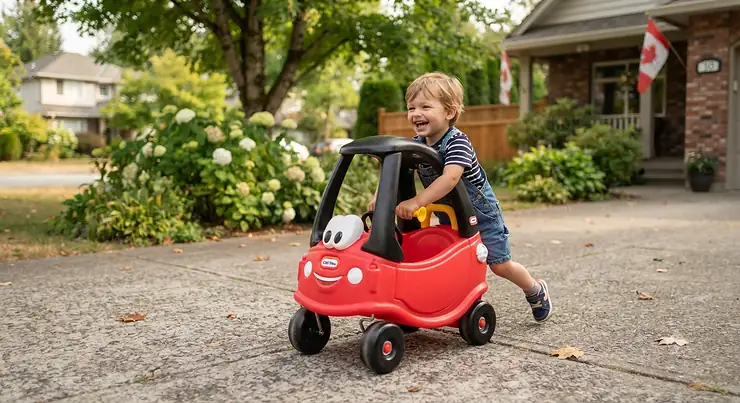
The Little Tikes Cozy Coupe is the red-and-yellow car that has been parked on North American lawns for decades, and its staying power comes from pretend play as much as riding.
It weighs about 7.8 kg (17.25 lb) and supports up to 22.7 kg (50 lb), rated from 18 months to 5 years. The removable floorboard is the key feature: with it in, a parent pushes via the roof handle while little feet stay inside; remove it and your child powers the car Flintstones-style. A working door, clicking ignition, horn and 360° front wheels turn every ride into a storyline.
On paper, that 7.8 kg mass is both a blessing and a curse. It makes the car stable and hard to tip, but it’s awkward to carry up porch steps and heavy for a toddler to push on grass. It’s best for families with a yard, driveway or garage — not a third-floor walk-up.
Reviewers consistently rave about how long kids stay interested, while common complaints include lengthy assembly and colours that fade after years of direct sun.
Pros:
- ✅ Grows from parent-push to foot-powered riding
- ✅ Doors, horn and ignition fuel imaginative play
- ✅ Heavy base makes it very hard to tip
Cons:
- ❌ Bulky to store and carry
- ❌ Assembly takes patience and a good screwdriver
At roughly C$90-C$130, the Little Tikes Cozy Coupe earns its price over four years of heavy use.
5. Step2 Whisper Ride II — quiet push car that doubles as a stroller break
The Step2 Whisper Ride II is less a scoot-toy and more a parent-powered buggy — perfect for toddlers who want the “I’m driving” feeling during neighbourhood walks.
It supports up to 22.7 kg (50 lb) from 18 months, includes a seat belt, a working horn, cup holders and under-hood storage. Its “Whisper Wheels” are designed to cut rolling noise on pavement — a real win at 7 a.m. on a quiet street. The folding push handle collapses for car trunks, and a roomier interior lets feet rest inside during pushes.
Honest take: this toy does less for toddler motor skills development than the others, because the parent does most of the work. But it shines as a stroller alternative for kids who refuse the stroller yet can’t walk a full loop to the park. Think of it as a transition vehicle — part stroller, part toy.
Reviewers frequently highlight how much quieter it is than older plastic push cars and how toddlers happily sit in it; recurring cons are its large footprint and limited performance on gravel or grass.
Pros:
- ✅ Seat belt and footrest keep kids contained on walks
- ✅ Quieter wheels than typical plastic ride-ons
- ✅ Folding handle simplifies car transport
Cons:
- ❌ Minimal independent riding or skill-building
- ❌ Bulky — needs real storage space
In the C$130-C$180 range, the Step2 Whisper Ride II is worth it mainly for families who walk daily.
6. Mini Micro 3in1 Deluxe Plus — Swiss-engineered, grows from 1 to 5
The Mini Micro 3in1 Deluxe Plus is the premium shape-shifter: ride-on with a parent push stick, sit-on scooter, and finally a proper three-wheel kick scooter.
The patented lean-to-steer mechanism is the headline. Instead of turning handlebars, kids lean their body to turn — which trains core balance and weight shifting in a way twist-steering never does. Load limits are 20 kg with the seat and 50 kg without, the handlebar adjusts from about 48 to 67 cm, and the whole thing weighs roughly 2 kg. The 120 mm front and 80 mm rear PU wheels roll far smoother than hard plastic.
Based on the spec comparison, this is the one toy here most likely to still be in daily use at age five. It suits families who plan to scooter to daycare, the corner store or the park — and who’d rather buy once than three times.
Reviewers consistently praise the build quality and smooth wheels, while the common gripes are the premium price and a short learning curve before toddlers “get” leaning to steer.
Pros:
- ✅ Three configurations cover roughly ages 1 to 5
- ✅ Lean-to-steer builds genuine balance skills
- ✅ Quiet, grippy PU wheels handle sidewalks well
Cons:
- ❌ Highest up-front cost in the scooter category
- ❌ Lean steering confuses some kids at first
At around C$170-C$230, the Mini Micro 3in1 Deluxe Plus delivers the best long-term value in this list.
7. Strider 12 Sport — the balance bike that skips training wheels
The Strider 12 Sport is the bridge from ride-on toy to real bicycle, and plenty of kids who start on one never need training wheels.
It weighs just 3.0 kg (6.7 lb) with a steel frame, flat-free 12-inch foam tires, and a seat that adjusts from 28 to 43 cm (11-17 in) — low enough for many 18-month-olds with an inseam of at least 31 cm. Maximum rider weight is 27 kg (60 lb), and Strider backs it with a two-year limited warranty. Footrests and a padded handlebar are built in.
The practical meaning of foam tires: zero flats, zero pumping, zero pressure-checking — but also less grip on wet leaves or gravel than air-filled tires. For most toddlers on sidewalks and park paths, that trade-off is worth it. It’s best for active kids nearing two who already walk confidently and love speed.
Reviewers overwhelmingly praise how fast children learn to balance and glide, while the common downside mentioned is that foam tires feel harsh on bumpy trails.
Pros:
- ✅ Very light — kids can steer and lift it themselves
- ✅ Flat-free tires mean no maintenance
- ✅ Builds pedal-bike balance before age four
Cons:
- ❌ Too tall for many kids under 18 months
- ❌ Foam tires slip on wet or loose surfaces
At roughly C$170-C$220, the Strider 12 Sport pays off if it spares you a training-wheel phase.
✨ Don’t Miss These Picks! 🔍
Take your toddler’s playtime to the next level with these carefully selected ride-ons. Click on any highlighted product to check current pricing and availability on amazon.ca. These toys help build the confident, active little movers your family will love watching grow!
Practical Usage Guide: Setup, First Rides and Maintenance
Unboxing day is where most ride-on frustration starts — and where most of it can be prevented.
Assembly tips
- ✅ Build it before your toddler sees it. The Little Tikes Cozy Coupe in particular can take a while, and a 20-month-old “helping” doubles that.
- ✅ Tighten every bolt, then tighten again after the first week of use. Plastic settles.
- ✅ For the Strider 12 Sport, set the seat so your child’s feet sit flat on the ground with a slight knee bend. Too high is the single biggest reason balance bikes get abandoned.
The first 30 days
Start indoors or on a flat, enclosed surface — a garage floor, a tennis court, a school parking lot on Sunday. Let your toddler explore at their own speed. Resist the urge to push them; kids learn scooting mechanics faster when they feel in control.
Common mistakes in the first month:
- ❌ Starting on a slope. Even a gentle driveway pitch can turn a slow scoot into a runaway ride.
- ❌ Skipping the helmet with balance bikes and scooters. Build the habit on day one, so it never becomes a negotiation.
- ❌ Expecting instant mastery. Many toddlers sit on a new ride-on for days before moving it. That’s normal.
Maintenance schedule
- Weekly: Wipe wheels and check for hair or string wrapped around axles — especially on caster-style toys like the YBIKE Pewi.
- Monthly: Check handlebar clamps, seat posts and folding joints on the Step2 Whisper Ride II and Mini Micro 3in1 Deluxe Plus.
- Seasonally: Rinse off road salt and grit after spring thaw; store plastic toys out of direct sun in summer to slow fading.
A five-minute check once a month is cheaper than any replacement part.
Real-World Scenarios: Matching the Right Ride-On to Your Family
Specs mean little without context. Here are three typical Canadian households and the reasoning behind each match.
Scenario 1: The Toronto condo family
Budget: under C$80. Space: 750 square feet, hard floors, an elevator ride to the outdoors. Frequency: daily indoor play, weekend park trips.
Best match: Radio Flyer Scoot About Sport or YBIKE Pewi. Both are under 2 kg, easy to carry in an elevator, and slim enough for hallways. The Pewi wins if your child is 10-14 months and still cruising; the Scoot About wins for confident walkers who want steering.
Scenario 2: The suburban Calgary backyard family
Budget: C$100-C$150. Space: a fenced yard, a driveway and a garage. Frequency: outdoor play most afternoons from May to October, basement play in winter.
Best match: Little Tikes Cozy Coupe. It thrives on driveways and garage floors, survives rain, and turns into a pretend-play centrepiece for siblings and visiting cousins. Pair it later with a scooter as your child grows.
Scenario 3: The walk-everywhere Montréal family
Budget: flexible, wants one long-lasting purchase. Space: a duplex with a small balcony and busy sidewalks. Frequency: daily walks to daycare and parks.
Best match: Mini Micro 3in1 Deluxe Plus, with the Strider 12 Sport as a second-birthday upgrade. The Micro’s push handle covers the early walks, then converts to a scooter that can keep pace with parents. If the family walks long distances with a younger toddler, the Step2 Whisper Ride II can fill the gap as a stroller substitute.
The takeaway? Your floor plan and daily routine should drive the decision far more than any product’s “best seller” badge.
Problem → Solution Guide: Fixing Common Ride-On Headaches
Even the right toy can hit snags. Here are the most frequent issues parents describe, and how to fix them.
Problem 1: “My toddler just sits on it and won’t move.” Solution: Check fit first. If feet can’t sit flat on the floor, the toy is too tall. Lower the seat (Strider 12 Sport, Mini Micro 3in1 Deluxe Plus) or switch to a lower-slung option like the Radio Flyer Scoot About Sport. Then model it — kids copy adults and older siblings enthusiastically.
Problem 2: “The wheels scratch our hardwood floors.” Solution: Clean grit from wheels regularly — most scratches come from trapped sand, not the plastic itself. Consider an indoor-only toy, and choose PU wheels (Mini Micro) over hard plastic for mixed use.
Problem 3: “It keeps tipping on turns.” Solution: Tipping usually comes from sharp turns at speed. Four-wheel designs like the Radio Flyer Scoot 2 Scooter and YBIKE Pewi are more forgiving. Keep early riding on flat ground, and teach “slow feet” before corners.
Problem 4: “My child outgrew it in six months.” Solution: Check the maximum rider weight and seat height range before you buy. Convertible designs — Scoot 2, Mini Micro, Cozy Coupe with its removable floor — stretch across more growth spurts.
Problem 5: “Winter kills our ride-on routine.” Solution: Move it indoors. A basement, unfinished garage or community centre gym gives lightweight ride-ons a second life from November to March. That’s especially valuable when daylight is short and outdoor play is limited.
How to Choose a Ride-On Toy for Toddler Online
Buying a ride-on toy for toddler online means relying on specs instead of a test drive. These seven steps cover what actually matters:
- Match the age to the real child, not the label. Age ranges are guidelines; your child’s walking confidence and height matter more.
- Check seat height against inseam. Feet should rest flat on the ground with bent knees. This single measurement predicts success better than anything else.
- Confirm the maximum rider weight. Look for at least 20 kg if you want the toy to last past age three.
- Weigh the toy itself. Under 3 kg means your toddler can control and reposition it independently; heavier toys need more parent involvement.
- Think about surfaces. Hard plastic wheels suit indoor floors; PU or foam wheels handle sidewalks better.
- Look for convertibility. A toy with two or three modes typically delivers more value per dollar.
- Verify safety basics. No small detachable parts, locking mechanisms on folding handles, and a sturdy, wide base.
If you remember only one step, make it number two. Most “my kid hates it” stories trace back to a seat that’s too tall or too low.
Ride-On Toys for 1 Year Old Canada: What Works at 12-24 Months
Choosing ride-on toys for 1 year old Canada shoppers is a different game from buying for a three-year-old. At 12 months, many children are just cruising or taking their first steps. By 18 months, most walk confidently. By 24 months, they’re running — badly, but enthusiastically.
That range calls for toys that are:
- Low. Seat heights around 20-28 cm let feet touch the ground.
- Light. Under 2-3 kg so they can manage the toy without adult help.
- Stable. Four wheels, a wide base, and no high centre of gravity.
For ride-on toys for 1 year old Canada families are comparing on amazon.ca, three picks stand out from this list. The YBIKE Pewi handles the pre-walking and early-walking phase best because it begins as a push walker. The Radio Flyer Scoot About Sport is ideal from about 13-15 months once steps are steady. The Mini Micro 3in1 Deluxe Plus, with its parent push stick attached, works from the first birthday, even before kids can scoot confidently.
What doesn’t work well for most one-year-olds? Balance bikes before 18 months (inseams are usually too short), and heavy ride-in cars they can’t push themselves. Ride-on toys for 1 year old Canada shoppers buy should grow into independence, not wait for it.
A Canadian bonus: many of these toys fit in a basement or hallway, which matters when a one-year-old’s “outdoor season” is shortened by snow, slush and early sunsets. Indoor riding keeps movement in the routine all year long.
Non-Electric Ride-On Toys for Toddlers vs Battery-Powered Ride-Ons
Every picture of a shiny battery-powered mini-SUV makes a certain kind of parent reach for their credit card. Here’s why non-electric ride-on toys for toddlers usually make more sense under age three.
| Factor | Non-Electric Ride-Ons | Battery-Powered Ride-Ons | Best For |
|---|---|---|---|
| Motor skill building | High — kids power every movement | Low — pressing a pedal does the work | Non-electric: Strider 12 Sport, Mini Micro 3in1 Deluxe Plus |
| Typical age fit | 12 months and up | Often 3 years and up | Non-electric: YBIKE Pewi, Radio Flyer Scoot About Sport |
| Upkeep | Minimal — tighten bolts, clean wheels | Battery charging, replacement packs | Non-electric: Radio Flyer Scoot 2 Scooter |
| Indoor use | Excellent for most models | Limited by size and speed | Non-electric: Radio Flyer Scoot About Sport |
| Price range | C$45-C$230 | Commonly C$200-C$600+ | Non-electric overall |
The data points one way: for toddlers, non-electric ride-on toys for toddlers deliver more developmental value, fewer maintenance headaches, and lower costs. Battery-powered ride-ons have a place — for older preschoolers, as a special treat — but they replace the pushing, balancing and steering that make ride-on play worthwhile in the first place.
There’s also the Canadian battery factor. Rechargeable lead-acid or lithium packs don’t love freezing garages, so a battery car stored outside all winter may need a new pack by spring. Non-electric ride-on toys for toddlers simply don’t care about the cold.
Toddler Motor Skills Development: What Ride-On Play Really Builds
It’s easy to dismiss a plastic scooter as “just a toy.” But toddler motor skills development happens in exactly this kind of repetitive, joyful movement.
Ride-ons target gross motor skills — the large-muscle movements of the legs, core and arms that underpin walking, running, jumping and climbing. Every scoot, lean and steer quietly strengthens several systems at once:
- Bilateral coordination: Alternating left-right pushes on a Radio Flyer Scoot About Sport trains both sides of the body to work together.
- Balance and core stability: Lean-to-steer on the Mini Micro 3in1 Deluxe Plus and gliding on a Strider 12 Sport force constant micro-adjustments of the trunk.
- Spatial awareness: Navigating around furniture, doorways and the family dog teaches toddlers to judge distance and speed.
- Motor planning: “If I turn now, I’ll miss the couch” is a surprisingly sophisticated thought for a two-year-old.
What the spec sheets won’t tell you is that toddler motor skills development isn’t only physical. Ride-ons also build confidence and independence. A toddler who can move themselves across the room — on their terms, at their speed — is practising decision-making as much as leg strength.
One realistic caveat: ride-on toys support development; they don’t replace free play, running, climbing or walking. Think of them as one well-chosen tool in a larger toddler motor skills development toolkit. If you have concerns about your child’s milestones, your family doctor or paediatrician is the right person to ask.

Gross Motor Play Toys: Where Ride-Ons Fit on the Toy Shelf
Parents often ask how many gross motor play toys a toddler actually needs. The answer is fewer than marketing suggests, but more than one.
A balanced collection of gross motor play toys usually covers four movement types:
- Rolling and riding: Ride-ons, scooters and balance bikes — the category this whole article is about.
- Climbing: A small indoor climber, a Pikler-style triangle, or supervised playground time.
- Throwing and kicking: Soft balls in a few sizes.
- Pushing and pulling: Wagons, push walkers, even a laundry basket.
Ride-ons earn a permanent spot among gross motor play toys because they combine leg strength, balance and steering in a single activity toddlers will repeat for hours. They’re also one of the few gross motor play toys that transfer directly to a real-world skill: riding a bicycle.
Here’s a practical idea. Instead of buying several similar ride-ons, pick one that fits right now and one convertible that grows. For example, pair a YBIKE Pewi for the first year with a Strider 12 Sport for age two onward. That’s two gross motor play toys covering roughly four years of development, without a garage full of plastic.
Rotating toys helps too. Put one ride-on away for a few weeks, then bring it back. The “new again” effect is remarkably powerful with toddlers.
Outdoor Ride-On Toys for Backyard: Surfaces, Seasons and Storage
Choosing outdoor ride-on toys for backyard use in Canada means planning for everything from July heat to February snow.
Surface matters most
- Concrete driveways and patios: Nearly every ride-on performs well. This is where the Little Tikes Cozy Coupe and Mini Micro 3in1 Deluxe Plus shine.
- Grass: Tough for small plastic wheels. Heavier cars like the Cozy Coupe push better than light scooters, but expect parent assistance.
- Gravel and dirt paths: Foam-tired balance bikes like the Strider 12 Sport cope best, though grip is limited on loose stones.
- Decks: Watch gaps between boards, which can catch small wheels.
Seasonal care
Canadian UV in summer fades plastics over time, so a shaded spot or tarp extends the life of outdoor ride-on toys for backyard use. In winter, bring toys into a garage or shed; plastic can become more brittle in extreme cold. After the spring melt, rinse off grit and road salt before the first ride.
Safe boundaries
Outdoor ride-on toys for backyard play are safest within a fenced area and away from driveways where cars move. A simple rule — “wheels stay on the patio” — gives toddlers clear, easy-to-understand limits.
Storage
Measure before you buy. A Cozy Coupe needs roughly 75 x 42 cm of floor space, while scooters can hang on a wall hook. Smart storage keeps outdoor ride-on toys for backyard play in good shape for years — and for the next sibling.
Ride-On Toy Safety Standards Canada: A Practical Guide
Ride-on toy safety standards Canada parents should know come largely from the federal Toys Regulations (SOR/2011-17) under the Canada Consumer Product Safety Act. You don’t need to read the legal text, but a few provisions translate directly into buying decisions:
- Small parts (section 7): Toys for children under three must not have separable parts small enough to be a choking hazard. Check horns, stickers, caps and decorative bits.
- Edges and points (sections 9-12): Metal, plastic and wood edges must be smooth and free of burrs.
- Fasteners and folding mechanisms (sections 14-15): Folding parts need safety stops or locks to prevent unexpected collapse — relevant for the folding handle on the Step2 Whisper Ride II and the adjustable stem on the Mini Micro 3in1 Deluxe Plus.
- Stability (section 18): Stationary toys that bear a child’s weight must stand level and firm.
- Surface coatings (section 24): Paints and coatings can’t exceed 90 mg/kg of total lead.
Buying online safely
When buying a ride-on toy for toddler online, stick to established brands and sellers with clear product information in English and French. Check the Government of Canada’s recall database before buying used toys, and read Health Canada’s toy safety guidance for broader tips on small parts and magnets.
At-home safety habits
- ✅ Helmets for balance bikes and scooters, every single ride.
- ✅ Active supervision — ride-ons and stairs are a dangerous combination, so gate stairways.
- ✅ No riding near pools, streets or sloped driveways.
Ride-on toy safety standards Canada has set a solid baseline, but the rest depends on how you use the toy at home. Regulations cover the product; supervision covers the child.
Long-Term Cost and Value: Cost-Per-Year Analysis
The sticker price tells you what a toy costs today. Cost-per-year tells you what it’s really worth.
| Product | Approx. Price (CAD) | Realistic Years of Use | Approx. Cost Per Year | Best For |
|---|---|---|---|---|
| Radio Flyer Scoot About Sport | C$45-C$70 | ~2 | C$23-C$35 | Radio Flyer Scoot About Sport: low-risk trial |
| Radio Flyer Scoot 2 Scooter | C$60-C$90 | ~3 | C$20-C$30 | Radio Flyer Scoot 2 Scooter: budget multi-stage |
| Little Tikes Cozy Coupe | C$90-C$130 | ~3.5 | C$26-C$37 | Little Tikes Cozy Coupe: siblings and hand-me-downs |
| Mini Micro 3in1 Deluxe Plus | C$170-C$230 | ~4 | C$43-C$58 | Mini Micro 3in1 Deluxe Plus: daily commuting families |
| Strider 12 Sport | C$170-C$220 | ~2.5 | C$68-C$88 | Strider 12 Sport: skipping training wheels |
Estimates are based on manufacturer age ranges and typical use; actual price and lifespan will vary.
The Radio Flyer Scoot 2 Scooter comes out as the cost-per-year champion, simply because its two modes stretch a low price across three years. The Strider 12 Sport looks expensive per year, but that math ignores what it replaces — often a training-wheel bike phase — and its resale value on local marketplace sites tends to hold up well. Durable brands also make the best hand-me-downs, which effectively halves cost-per-child for families with a second baby on the way.
Common Mistakes When Buying Ride-On Toys
Even well-researched parents fall into a few predictable traps.
Mistake 1: Buying for the child you’ll have next year. “They’ll grow into it” sounds economical, but a toy that’s too big today gets rejected, and toddlers can be stubborn about returning to something that once felt scary.
Mistake 2: Ignoring your floors and space. A Cozy Coupe in a small condo is a daily obstacle course. A lightweight scooter on thick carpet barely moves. Match the toy to your actual surfaces.
Mistake 3: Trusting star ratings alone. A 4.7-star toy may be loved by parents of three-year-olds and useless for your 14-month-old. Read reviews from parents with kids the same age as yours.
Mistake 4: Forgetting the helmet budget. Balance bikes and scooters need a properly fitted toddler helmet. Add C$30-C$60 to your plan.
Mistake 5: Choosing electric too early. As covered above, battery-powered toys skip the skill-building that makes non-electric ride-ons worthwhile.
Mistake 6: Skipping the assembly check. Loose handlebars and wobbly wheels cause many avoidable tumbles. Tighten everything, then check again after a week.
Avoid these six, and you’ll dodge most of the regret that fills one-star reviews.
Features That Actually Matter (And Those That Don’t)
Marketing copy loves bullet points. Your toddler doesn’t care about most of them.
Features that matter
- Adjustable seat or handlebar height: Directly extends useful life. The Strider 12 Sport and Mini Micro 3in1 Deluxe Plus lead here.
- Toy weight under 3 kg: Determines whether your child can ride independently.
- Wheel material: PU and foam are quieter and grippier; hard plastic is cheaper and fine for indoor floors.
- Convertible modes: Real modes that change how a child rides, not just decorative add-ons.
- Wide wheelbase: Stability builds confidence, and confidence builds skill.
Features that matter less
- Lights and sounds: Fun for about a week, then often a battery chore.
- Licensed character graphics: They don’t change performance, and kids’ favourite characters change fast.
- Excess storage compartments: Nice for snacks, not a deciding factor.
- “Educational” claims on packaging: Movement itself is the education — no screen or button needed.
The pattern is simple: prioritise fit, weight and stability; treat everything else as a bonus.
FAQ
❓ What age can a toddler start using a ride-on toy?
❓ Where can I buy a ride-on toy for toddler online in Canada?
❓ Are balance bikes better than tricycles for toddlers?
❓ Do toddlers need a helmet for ride-on toys?
❓ Is a more expensive ride-on toy worth it?
Conclusion
Here’s the whole guide in one breath: buy a ride-on toy for toddler online based on fit, weight and stability first — and let everything else be a bonus.
If you’re on a tight budget or testing the waters, the Radio Flyer Scoot About Sport is a smart, lightweight start. For a budget toy that grows, the Radio Flyer Scoot 2 Scooter is hard to beat. Very young walkers will love the YBIKE Pewi, while backyard families get years of imaginative play from the Little Tikes Cozy Coupe. The Step2 Whisper Ride II serves daily walkers who need a stroller alternative. And if you want to buy once and use it for years, the Mini Micro 3in1 Deluxe Plus and Strider 12 Sport deliver real long-term value and skill-building.
Whichever you choose, the true payoff isn’t the plastic or the paint. It’s the moment your toddler figures out that their own legs can take them somewhere — and races off to prove it, grinning. Pair that with sensible supervision, a helmet where needed, and a toy that’s sized for today’s child, and you’ve set up a daily habit of movement that supports healthy development through every Canadian season.
🚀 Ready to Get Rolling? 🛒
Your toddler’s next big adventure is just one click away. Tap any highlighted product above to check current prices and availability on amazon.ca, and choose the ride-on that fits your family’s space, budget and routine. Happy scooting!
Recommended for You
- 7 Best First Pedal Bikes For Preschoolers In Canada (2026)
- 7 Best Pedal Trikes With Push Handle for Toddlers in 2026
- 7 Best Pedal Trikes for Toddlers in Canada 2026
Disclaimer: This article contains affiliate links. As an Amazon Associate, I earn from qualifying purchases. If you purchase products through these links, we may earn a small commission at no additional cost to you.
✨ Found this helpful? Share it with your friends! 💬🤗
