
In This Article
Somewhere between the wobbly first steps and the “look Mom, no hands!” bike era sits one glorious, slightly chaotic phase: the tricycle years. If you’re shopping for a pedal trike for toddlers right now, you’ve probably already discovered that the options range from a $40 plastic classic to a six-stage stroller-trike hybrid that costs about as much as a decent car seat. Both can be the right answer, depending on your kid, your driveway, and your patience for assembling small metal parts on a Sunday morning.
A pedal trike for toddlers is a three-wheeled ride-on toy with a low centre of gravity, designed so a child around age 2 to 5 can learn to pedal, steer, and balance independently, without the tipping risk of a two-wheeled bike. Some models are pure pedal trikes from day one; others start as a parent-pushed stroller and convert into an independent trike as your child’s legs (and confidence) grow.
This guide skips the marketing fluff and gets into what actually matters: real specs, honestly summarized review sentiment, Health Canada’s toy safety guidance, and side-by-side comparisons that tell you which trike earns its price tag. We researched seven genuine, currently available models — pulling from Canadian and U.S. retailers, brand spec sheets, and aggregated customer feedback — so you can make a call based on evidence, not just a cute box photo. We’ll also dig into the developmental side of things (why pedalling is a bigger deal than it looks), the Canadian safety rules worth knowing, and a few honest “here’s what nobody tells you” sections that Amazon listings tend to skip entirely.
Quick Comparison Table
Short on time? Here’s the condensed version before we get into the full breakdown.
| Trike | Age Range | Type | Price Range (CAD) | Best For |
|---|---|---|---|---|
| Fisher-Price Harley-Davidson Tough Trike | 2–5 years | Pure pedal trike | C$50–C$80 | Toughest budget daily driver |
| Schwinn Roadster Classic Tricycle | 2–4 years | Pure pedal trike | C$150–C$200 | Classic build that lasts through siblings |
| Radio Flyer 4-in-1 Stroll ‘N Trike | 9 months–5 years | Grow-with-me trike | C$110–C$180 | Best all-around pick for most families |
| smarTrike STR7 6-in-1 | 6–36 months | Stroller-trike hybrid | C$160–C$220 | Smoothest one-handed steering |
A quick read on this snapshot: if you want one trike that survives daycare drop-off, backyard scrapes, and a move to grandma’s house without complaint, the Fisher-Price Harley-Davidson Tough Trike is hard to beat for the price. Families who want a single purchase that spans infancy through preschool tend to gravitate toward the Radio Flyer 4-in-1 Stroll ‘N Trike, since it genuinely converts through four distinct riding stages instead of just claiming to. And if you’re navigating uneven city sidewalks with a stroller in one hand and a toddler in the other, the smarTrike STR7’s touch-steering earns its higher price tag by letting you redirect the whole trike with a flick of the wrist.
Just one click — help other Canadian parents make better buying decisions too! 😊
Top 7 Pedal Trikes for Toddlers: Expert Analysis
We didn’t just skim spec sheets for this list. Every product below combines real manufacturer data with honestly summarized aggregated review sentiment from retailers like Amazon, Walmart, and brand sites — never invented quotes, never fabricated star ratings. Where reviews are genuinely mixed, we say so. Prices are shown as Canadian-dollar ranges rather than exact figures, since Amazon pricing shifts constantly; always check current price at checkout.
1. Fisher-Price Harley-Davidson Tough Trike — toughest budget pick for daily rowdy play
The name is a bit of a gag — there’s no motor here, obviously — but the “tough” part is earned. This is a straightforward, pedal-from-day-one trike with a wide wheelbase and a secret under-seat storage compartment that toddlers treat like a personal glove box.
The moulded plastic frame keeps weight low (helpful for parents who end up carrying it up apartment stairs more often than they’d like), while the rugged tire treads are built for pavement and packed dirt rather than smooth showroom floors. Based on the spec comparison with pricier metal-frame trikes in this roundup, what you’re trading away here is long-term seat and handlebar adjustability — this one doesn’t grow through multiple stages the way a convertible model does.
Who should buy it: parents who want a genuinely tough, low-maintenance first trike for a child who’s already steady on their feet, without paying for stroller-conversion features they won’t use. Aggregated review sentiment across Walmart and Amazon consistently describes the trike as sturdy for its price point, with several reviewers specifically noting it held up well through daycare use and multiple kids in the same family.
Pros:
- ✅ Hard-wearing plastic frame shrugs off daily rough play
- ✅ Zero-fuss pedal-and-steer design with fast assembly
- ✅ Under-seat storage compartment toddlers genuinely use
Cons:
- ❌ Hard plastic wheels get slippery on wet grass
- ❌ Front wheel sits far forward, so shorter toddlers may not reach the pedals yet
Expect this one to land in the C$50–C$80 range depending on retailer and colourway — genuinely one of the cheapest entries in this whole roundup, and the value verdict is simple: for a toddler who’s ready to pedal now, it’s hard to argue with the price.
2. Schwinn Roadster Classic Tricycle — classic pedal-first design with real chrome charm
If you want a trike that looks like it belongs in a vintage catalogue photo (and somehow still functions perfectly in 2026), the Schwinn Roadster is the pick. It’s a full-steel-frame, front-wheel-drive tricycle with a 12-inch front wheel, chrome-finished handlebars, real wood deck, and a five-position adjustable seat.
Here’s what the low centre of gravity actually buys you in practice: toddlers between roughly 29 and 37 inches tall can hop on and start pedalling with far less tipping risk than a taller-framed trike. The five-position seat is the detail that separates this from cheaper competitors — most budget trikes offer two or three seat settings at most, so this one genuinely stretches usable life across the 2-to-4-year window rather than being outgrown in a single summer.
Aggregated review sentiment on Walmart and Amazon is strongly positive, with reviewers repeatedly praising the build quality and describing the trike as noticeably heavier-duty than typical plastic alternatives — several specifically called out the chrome detailing as feeling closer to an adult cruiser bike than a toy. Schwinn also backs the frame with a lifetime warranty against manufacturing defects, which says something about how confident the brand is in the steel construction.
Pros:
- ✅ Full steel frame with chrome fenders built to last for years
- ✅ Five-position seat genuinely grows with your toddler
- ✅ Retro styling and real wood deck feel premium, not plasticky
Cons:
- ❌ Heavier steel build is harder for parents to lift and carry
- ❌ No parent push handle for early, assisted steering
Price-wise, expect a C$150–C$200 range in Canada. It’s a mid-tier spend that buys genuinely durable materials — the value case here is strongest for families who plan to hand this trike down to a younger sibling.
3. KRIDDO 2-in-1 Foldable Balance Bike and Toddler Tricycle — grows into a balance bike, not just a bigger seat
Most “grows with your child” trikes just move a seat backward. The KRIDDO 2-in-1 does something genuinely different: it converts from a stable, training-wheeled tricycle into a two-wheeled balance bike once your toddler’s coordination catches up, using detachable pedals that store in a slot under the seat instead of getting lost in the garage.
What this means in practice — based on the spec comparison — is that you’re buying two developmental stages of ride-on toy in a single purchase, rather than replacing a tricycle with a separate balance bike a year later. The front headlight is a small but thoughtful touch that most competitors in this price bracket skip entirely, useful for dusk rides around the block before dinner.
Reviewers on Amazon consistently highlight the pedal-storage design as the standout feature, since misplaced pedals are a genuinely common complaint across the broader toddler-tricycle category. What most buyers overlook about this model is that the frame runs a touch smaller than dedicated stroller-trikes, so it suits the earlier end of the toddler range better than a child pushing five years old.
Pros:
- ✅ Converts from trike to balance bike as skills improve
- ✅ Pedals store in a built-in slot so nothing gets lost
- ✅ Front headlight adds a genuine safety touch for early evening rides
Cons:
- ❌ Frame runs small for toddlers on the taller end of the age range
- ❌ No canopy or storage basket, unlike stroller-style competitors
Budget-wise this sits in the C$70–C$100 range, making it one of the better value-for-features picks in the whole lineup if the balance-bike conversion actually matters to your plans.
4. Little Tikes Perfect Fit 4-in-1 Trike — budget-friendly grow-with-me with serious storage
The Little Tikes Perfect Fit 4-in-1 takes the classic grow-with-me formula — infant stroll mode, pedal mode, learn-to-steer mode, and independent trike mode — and prices it more accessibly than most convertible competitors. A five-point harness and a protective safety bar handle the early stages, while a large storage bucket and beverage-holder tray make it genuinely useful for actual errands, not just backyard laps.
What the four-stage system means in real terms: parents get roughly two and a half years of usable life from a single purchase, starting around 9 months and stretching to about age 3, according to the manufacturer’s stated range. The shade canopy is a nice add for stroller-mode outings, and the 50-pound weight capacity gives some buffer for bigger toddlers.
Here’s where honesty matters, though. Aggregated review sentiment is more mixed than the other grow-with-me trikes in this list — reviewers rate it 3.7 out of 5 on average across a large review pool, with the most frequent complaints centred on front-wheel assembly being fiddly and the overall build feeling less premium than the price implies. That’s a real trade-off worth weighing against the lower cost.
Pros:
- ✅ Four growth stages span stroller to solo trike
- ✅ Five-point harness and safety bar reassure new parents
- ✅ Large parent storage bucket handles a full diaper bag’s worth of gear
Cons:
- ❌ Front-wheel assembly is reportedly fiddly and time-consuming
- ❌ Overall build quality feels below premium despite the mid-range price
Expect a C$140–C$190 range. The value verdict: it’s a reasonable buy if you go in expecting a budget-tier convertible trike rather than a premium one, and you’re comfortable with a slightly more involved assembly session.
5. Radio Flyer 4-in-1 Stroll ‘N Trike — best all-rounder from stroller to solo pedaling
This is the trike most likely to show up at a baby shower, and for good reason. The Radio Flyer 4-in-1 Stroll ‘N Trike converts through four genuinely distinct stages — infant trike, parent-steered trike, learn-to-ride trike, and classic independent trike — spanning roughly 9 months to 5 years on a single steel frame.
The UV-blocking canopy and three-point harness with headrest matter more than they sound on paper: Canadian summers get intense, and a low, forward-facing seat with no sun protection is a real problem on long stroller-mode walks. The removable wraparound snack tray and rear storage basket turn this into a legitimate stroller replacement for short outings, not just a toy that sits in the garage.
What most buyers overlook about the multi-stage design is how much the parent-steering handle changes the early experience — you retain full directional control while your toddler gets used to sitting upright and eventually pedalling, rather than handing over steering all at once. Genuine parent reviews (via brand and retailer review sections) repeatedly describe toddlers reacting with immediate excitement the first time they’re placed in the seat, and Radio Flyer’s long-standing parts-replacement program means a broken wheel or torn harness strap doesn’t mean buying a whole new trike.
Pros:
- ✅ Four riding modes genuinely span 9 months to 5 years
- ✅ UV-blocking canopy and 3-point harness cover both sun and safety
- ✅ Steel frame plus Radio Flyer’s parts program means long service life
Cons:
- ❌ Premium “Ultimate” trim adds real cost for features casual users may skip
- ❌ Bulkier footprint makes storage tight in a condo hallway or small entryway
Pricing runs roughly C$110–C$180 for the base and Sport trims, climbing toward C$300 for the fully loaded Ultimate package. For most families, the mid-tier trim delivers the best value-per-riding-stage of any trike in this roundup.
6. smarTrike STR7 6-in-1 — smoothest steering for city sidewalks and strollers-turned-trikes
The smarTrike STR7 is the trike for parents who’ve sworn at a stiff push-handle one too many times. Its patented touch-steering technology lets you redirect the entire trike with light pressure from one hand — genuinely useful when you’re also holding a coffee, a diaper bag, or a second kid’s hand.
Six growth stages take a child from a 6-month-old stroller-mode rider through recline, footrest, pedal-practice, steering-practice, and finally full independent trike — more stages than any other model in this roundup. A shock-absorbing frame is the detail that separates this from basic stroller-trikes: it smooths out sidewalk cracks and curb cuts noticeably, based on the spec sheet’s claims and consistent with what reviewers report about ride comfort. The trike also folds relatively compactly for a stroller-trike hybrid, a genuine advantage for families in condos or who travel.
Aggregated review sentiment is enthusiastic, with a Calgary parent quoted in industry coverage praising how effortlessly the touch-steering handled park pathways one-handed — a nice real-world confirmation of the marketing claim, for once. The trade-off is price: European retail pricing runs around €110, which typically translates to a noticeably higher Canadian shelf price than domestic competitors.
Pros:
- ✅ Touch-steering guides the trike over curbs and cracks with one hand
- ✅ Six growth stages cover 6-month-old stroller riders through independent trike
- ✅ Shock-absorbing frame smooths out cracked sidewalks and curb cuts
Cons:
- ❌ Premium import pricing sits above most budget-focused competitors
- ❌ Six-stage complexity means more small parts to track between uses
Expect a C$160–C$220 range in Canada. The value case is strongest for parents doing serious daily stroller mileage on imperfect urban sidewalks, where the steering tech earns its keep.
7. Joovy Tricycoo 4.1 Kids Tricycle — widest front tire for stability on rough pavement
Joovy built the Tricycoo 4.1 around one standout feature: an extra-wide front tire that noticeably improves stability compared to the narrower front wheels on most grow-with-me trikes. Paired with a front-wheel pedal-locking system and a fold-down footrest, it’s designed to ease a child from a 10-month-old passenger into an independent pedaller over roughly two years.
The large UPF 50 canopy is genuinely useful for sun protection on long walks, and the removable, machine-washable seat pad is a small detail that matters more than it sounds once snacks and sunscreen enter the picture. A height-adjustable push handle (32.5 to 38 inches) accommodates parents of noticeably different heights without anyone hunching.
Here’s where we owe you the honest version rather than the marketing version: aggregated review analysis of the Tricycoo 4.1 shows real split sentiment — roughly 41% positive against 49% negative in one large third-party review analysis, with recurring complaints about the push handle and canopy attachment feeling flimsy after a few months of regular use. That’s a meaningfully more mixed picture than most other products in this roundup, and it’s worth knowing before you commit to the premium price tag.
Pros:
- ✅ Extra-wide front tire adds real stability on cracked city pavement
- ✅ Removable, washable seat pad keeps things clean after park trips
- ✅ Large UPF 50 canopy blocks sun on long walks
Cons:
- ❌ Push handle and canopy attachment reportedly feel flimsy over time
- ❌ Review sentiment is notably mixed compared to other trikes in this class
Price sits around C$180–C$230, positioning it as a premium buy — one where the standout wide front tire is genuinely useful, but the mixed durability feedback deserves real weight in your decision.
Here’s the full spec-and-price snapshot for all seven, side by side:
| Trike | Age / Weight Limit | Frame & Wheel | Price Range (CAD) | Best For |
|---|---|---|---|---|
| Fisher-Price Harley-Davidson Tough Trike | 2–5 years | Plastic, wide wheelbase | C$50–C$80 | Toughest budget daily driver |
| Schwinn Roadster Classic Tricycle | 2–4 years, 29″–37″ tall | Steel, 12″ front wheel | C$150–C$200 | Classic build with 5-position seat |
| KRIDDO 2-in-1 Foldable Trike | 2–5 years | Steel/alloy, detachable pedals | C$70–C$100 | Trike-to-balance-bike conversion |
| Little Tikes Perfect Fit 4-in-1 | 9 months–3 years, up to 50 lb | Steel, 4-stage conversion | C$140–C$190 | Budget grow-with-me with storage |
| Radio Flyer 4-in-1 Stroll ‘N Trike | 9 months–5 years, up to 49 lb | Steel, 4-stage conversion | C$110–C$180 | Best all-rounder |
| smarTrike STR7 6-in-1 | 6–36 months, up to 38 lb | Alloy, touch-steering | C$160–C$220 | Smoothest one-handed steering |
| Joovy Tricycoo 4.1 | 10–30 months, up to 44 lb | Steel, extra-wide front tire | C$180–C$230 | Stability on rough pavement |
Looking at the table as a whole, the split is really between pure pedal trikes (Fisher-Price, Schwinn, KRIDDO) that assume your toddler is already steady on their feet, and grow-with-me stroller-trikes (Little Tikes, Radio Flyer, smarTrike, Joovy) that start earlier and cost correspondingly more. If your child is already walking confidently and pedalling is the only skill left to teach, skip straight to a pure pedal trike and save the money the conversion hardware would have cost.
How to Choose the Best Pedal Trike for Toddlers in Canada
What is a pedal trike for toddlers? In short: a three-wheeled, low-to-the-ground ride-on bike designed for children roughly 2 to 5 years old, built so they can learn pedalling and steering safely before graduating to a two-wheeled bike.
When you’re comparing top rated tricycles for toddlers Canada shoppers actually buy — rather than whatever’s cheapest in the search results — a handful of criteria matter far more than colour or brand name. Here’s the honest checklist we used to evaluate every product in this roundup.
- Match the age range to your child’s actual size, not just their birthday. A trike rated for “ages 2–5” assumes an average height curve; a smaller-than-average 3-year-old may do better with a trike rated for slightly younger riders, since reaching the pedals matters more than the number on the box.
- Check the seat adjustability. Multi-position seats (like the Schwinn Roadster’s five settings) stretch usable life across more birthdays than a single fixed seat, which directly affects your cost-per-year.
- Decide if you actually need stroller-mode. Grow-with-me trikes like the Radio Flyer and smarTrike genuinely replace a stroller for short trips, but that convenience adds bulk and cost — skip it if you already own a stroller you like.
- Weigh the frame material. Steel frames (Schwinn, Radio Flyer) tend to outlast plastic ones (Fisher-Price) under heavy daily use, but plastic is lighter to carry and usually cheaper.
- Look at the wheel width and tread, not just the wheel count. A wider front tire, like Joovy’s, genuinely improves stability on cracked sidewalks and gravel driveways — a detail that matters more in a Canadian winter-thaw driveway than a showroom floor.
- Read the aggregated review sentiment, not just the star average. A 4.4-star rating built on 655 reviews (like the Schwinn Roadster) tells you more than a 4.8-star rating built on 20 reviews.
- Budget for the whole lifespan, not just the purchase price. A C$70 trike your toddler outgrows in eight months can cost more per month of use than a C$180 trike that lasts three years.
Common mistakes buyers make when shopping this category: assuming a bigger trike is automatically “better value” (it isn’t, if your toddler can’t reach the pedals for a year); buying based on licensed character branding rather than fit and safety features; and skipping the weight-limit spec entirely, which matters more than people expect once a trike enters its second or third year of use as a sibling hand-me-down.
Top Pedal Trikes for 3 Year Olds Canada: What Changes at This Age
Three is a genuinely different developmental stage than two, and it shows up in what a trike needs to do well. By this point, most toddlers have moved past “does this seat exist” and into “can I actually pedal this thing to the end of the block without help.” According to Canadian gross-motor development benchmarks, independent tricycle pedalling is a typical milestone for 3-year-olds — meaning your trike shopping should shift from stroller-conversion features toward pure pedal performance.
For this age group specifically, the Schwinn Roadster Classic Tricycle and Fisher-Price Harley-Davidson Tough Trike are the strongest picks in this roundup, since both assume independent pedalling from the start rather than dedicating frame complexity to infant or push-handle modes your 3-year-old has already aged out of. The KRIDDO 2-in-1 is worth a second look here too, precisely because its balance-bike conversion anticipates the next developmental leap most 3-year-olds are approaching.
What most buyers overlook at this stage is seat height relative to pedal reach — a trike that fit comfortably at 2 can suddenly feel cramped by 3½, especially for taller kids, so re-checking the adjustable seat range before buying (or before a hand-me-down trike gets pressed back into service) genuinely matters. If your 3-year-old is already confidently walking, running, and climbing, they likely have the coordination to skip the training-wheel-style stability features entirely and go straight to a pure pedal trike.
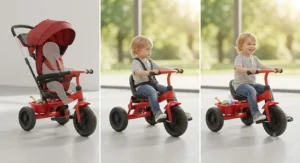
Pedal Trike vs Balance Bike vs Stroller Trike: Choosing Your Child’s First Ride-On
The “first ride-on” decision trips up a lot of first-time parents, mostly because the three main options genuinely serve different developmental goals rather than being interchangeable versions of the same idea.
| Feature | Pedal Trike | Balance Bike | Stroller-Trike Hybrid |
|---|---|---|---|
| Typical starting age | 2–3 years | 18 months–2 years | 6–9 months |
| Primary skill built | Pedalling coordination | Balance and steering | Passive comfort, then gradual pedalling |
| Tip-over risk | Low (3 wheels) | Moderate (2 wheels, low seat) | Very low |
| Long-term use | Usually 1–3 years | Often transitions straight to a 2-wheel bike | Can span infancy to age 5 |
| Parent involvement | Minimal after setup | Moderate, especially early on | High in early stages (pushing, steering) |
The analysis here matters more than the table alone suggests. A pure pedal trike builds pedalling and steering coordination simultaneously but doesn’t teach balance the way a two-wheeled bike eventually requires — that’s a separate skill your child will pick up later, often via a balance bike or training wheels. A balance bike, by contrast, skips pedalling entirely and focuses purely on the lean-and-steer balance that trikes don’t teach at all, which is why some child-development sources argue it’s the more efficient path to an eventual two-wheeler. A stroller-trike hybrid like the Radio Flyer or smarTrike essentially buys you time — it delays the “which ride-on do I need next” decision by starting earlier and converting gradually, at the cost of a bigger up-front purchase.
If your child is under 18 months, a stroller-trike or a dedicated stroller remains the more practical choice, full stop. Between 18 months and 2½, a balance bike or the KRIDDO 2-in-1 genuinely earns its place if your priority is an eventual two-wheeled bike sooner rather than later. Past age 2½, once basic walking and running coordination is solid, a pure pedal trike like the Schwinn Roadster or Fisher-Price Harley-Davidson delivers the most riding fun per dollar without the added stroller-conversion cost.
Toddler Motor Skills: How Pedal Trikes Build Coordination and Confidence
It’s easy to see a trike as pure entertainment, but the developmental case for pedalling is genuinely well established. Pedalling a tricycle is typically listed as a benchmark gross-motor milestone for 3-year-olds in child-development references, requiring a child to coordinate leg strength, bilateral leg movement, steering, and balance simultaneously — a meaningfully more complex task than walking or running alone.
Canadian researchers have released guidelines suggesting kids aged one to four should get at least three hours of physical activity spread throughout the day, a target that active ride-on play like tricycling helps meet in a way that’s genuinely fun rather than a chore for either the toddler or the parent trying to enforce it. What the spec sheet won’t tell you, but child-development research suggests, is that the repetitive, rhythmic nature of pedalling also reinforces the kind of bilateral coordination (using both sides of the body in a controlled, alternating pattern) that later supports skills like running, climbing stairs unaided, and even some early handwriting mechanics.
Here’s what most parents overlook: the steering component matters just as much as the pedalling. Trikes that let a toddler practice independent steering — rather than being pushed and steered entirely by a parent — build spatial awareness and decision-making (when to turn, when to stop) faster than passive stroller-mode riding does. That’s part of why the multi-stage trikes in this roundup, like the Radio Flyer and smarTrike STR7, deliberately hand over steering control gradually rather than all at once — it’s not just a marketing gimmick, it mirrors how the underlying motor and cognitive skills actually develop.
Tricycle Safety: CSA Standards and Canadian Rules Every Parent Should Know
Safety is the one area where we won’t hedge: get this part right before your toddler gets on the trike, not after.
In Canada, ride-on toys like tricycles fall under the Canada Consumer Product Safety Act, enforced by Health Canada, which requires manufacturers to meet safety standards covering things like stability, sharp edges, and choking-hazard components before a product can be legally sold. Health Canada’s toy safety guidance (linked earlier in this article) is a genuinely useful resource to skim before any ride-on-toy purchase, since it covers general age-appropriateness and hazard-avoidance principles that apply well beyond just tricycles.
Helmets are the next big question, and the honest answer is: it depends on where you live and where your toddler rides. Provincial helmet laws for cycling vary across Canada — some provinces mandate helmets for cyclists under 18 on public roads and paths, while private driveways and backyards typically fall outside legal requirements even where the law technically applies to “bicycles.” The safer practical approach most paediatric and injury-prevention sources recommend is simple: put a properly fitted helmet on your toddler any time they’re on a wheeled ride-on toy, indoors expectations aside, regardless of what the letter of provincial law technically covers. Canadian emergency-department data collected between 2004 and 2009 found that most of the roughly 28,600 children aged 1 to 16 injured during non-motorized wheeled activities were hurt while cycling, which is a sobering reminder that “it’s just a slow tricycle” doesn’t fully eliminate real fall risk, especially as a toddler graduates toward faster independent pedalling.
Beyond helmets, a few practical safety habits matter more than people expect: always supervise trike riding near driveways, stairs, or water features; check the weight limit annually as your toddler grows, since an over-limit trike handles less predictably; and inspect wheels and the seat harness periodically for cracks or fraying, the same way you’d check a car seat. The Canadian Paediatric Society’s active-play guidance reinforces that toddlers and preschoolers should get at least three hours of active play a day — tricycling included — which frames supervised trike time as a genuinely important part of healthy development rather than just a way to pass an afternoon.

Common Mistakes When Buying a Toddler Tricycle
A few patterns show up again and again in aggregated review complaints across this whole product category, and most of them are avoidable with a bit of forethought.
The single biggest mistake is buying too far ahead of your child’s actual ability, assuming they’ll “grow into it.” A trike your toddler can’t yet reach the pedals on typically ends up parked in the garage for six months, which defeats the entire purpose of an active-play purchase. The second common mistake is underestimating storage footprint — grow-with-me trikes like the Radio Flyer and Joovy Tricycoo are noticeably bulkier than pure pedal trikes, and that’s a real problem in a condo hallway or a small entryway, not just a minor inconvenience. Third, plenty of buyers skip checking the weight limit entirely, only to discover a year or two later that their now-taller, heavier preschooler has outgrown a trike that technically still “fits” by seat height. Finally, don’t assume more conversion stages automatically means more value — a six-stage trike is genuinely useful if you’ll use all six stages, but if you’re buying for a toddler who’s already 2½, you may be paying for infant-mode features you’ll never touch.
Features That Actually Matter (And Those That Don’t)
Marketing copy loves to bury the genuinely useful details under a pile of features nobody asked for, so here’s an honest filter.
Features that actually matter: a low centre of gravity (directly affects tip-over risk), a properly fitted and adjustable harness on grow-with-me models, wheel width and tread for the surfaces you’ll actually ride on, and a seat that adjusts through multiple positions rather than just one fixed spot. A parent push-handle matters a lot if you plan to use stroller-mode regularly, and matters not at all if your toddler is already walking confidently and ready to pedal solo.
Features that sound impressive but rarely justify a price premium: elaborate character licensing (fun, but doesn’t affect ride quality or safety), built-in sound effects or lights on the handlebar (novel for about a week), and extremely high maximum weight ratings well beyond what a toddler will reach before outgrowing the trike by height anyway. The genuinely underrated feature nobody markets well is tire material — air-filled or foam tires (like the Schwinn’s) tend to ride noticeably smoother over cracks and gravel than solid hard plastic wheels, a difference you’ll notice within the first week of ownership.
Practical Usage Guide: Getting Your Toddler Started on Their New Trike
Buying the trike is honestly the easy part. Here’s what actually helps in the first month.
Assembly and first setup: Most trikes in this roundup take 15 to 40 minutes to assemble, with the front-wheel attachment being the step most reviewers flag as fiddly (particularly on the Little Tikes and Joovy models). Do this step on a flat, hard surface rather than carpet, since it’s much easier to get bolts properly seated when the trike isn’t sinking into pile fibres.
Seat and harness fitting: Set the seat to the lowest position that still lets your toddler’s feet reach the pedals through a full rotation, not just touch them at the bottom of the stroke. A seat set too high is one of the most common reasons toddlers struggle to pedal in their first few sessions and give up in frustration.
The first few rides: Start on grass or a soft driveway rather than pavement — falls happen during the learning phase, and a softer landing genuinely reduces the odds of a scared toddler refusing to get back on. Expect the actual pedalling motion (as opposed to just sitting and being pushed) to take anywhere from a few days to a few weeks to click, depending on your child’s age and coordination.
Maintenance that actually matters: Check tire pressure monthly on air-filled models (like the Schwinn), tighten the seat bolts every few weeks during the first year of ownership since vibration loosens them faster than you’d expect, and hose off mud and grit from the wheel axles after any off-pavement riding to prevent the front wheel from developing a squeak or a slight drag.
Common first-30-days mistakes to avoid: pushing a toddler to pedal independently before they’ve mastered steering, skipping the harness “just for a quick lap” (falls happen fastest when supervision relaxes slightly), and storing the trike outdoors uncovered through a Canadian winter, which accelerates rust on steel frames and cracking on plastic ones.
Real-World Scenarios: Which Trike Fits Your Family?
The apartment-dwelling parent of a 14-month-old: Storage space is tight, and you’re not ready to retire the stroller entirely. The smarTrike STR7 makes sense here — its stroller mode covers your immediate need, and the compact fold means it won’t dominate a hallway closet. Budget around C$160–C$220, and expect to get real, daily use out of every one of its six stages before your child ages out.
The budget-conscious parent of an active, already-walking 2½-year-old: Skip the conversion hardware entirely. A pure pedal trike like the Fisher-Price Harley-Davidson Tough Trike or the Schwinn Roadster gets your toddler pedalling immediately without paying for infant-mode features you’ll never use, and at C$50–C$200 depending on which one you choose, you’re not locked into a premium price for a shorter effective ownership window.
The family expecting a second child within a couple years: Durability and multi-stage flexibility both matter more here, since the trike needs to survive a handoff. The Radio Flyer 4-in-1 Stroll ‘N Trike, with its steel frame and Radio Flyer’s parts-replacement program, is built with exactly this kind of extended, multi-child lifespan in mind — the up-front C$110–C$180 spend amortizes well across two kids instead of one.
Problem → Solution: Common Toddler Tricycle Struggles
Problem: My toddler can’t reach the pedals. Solution: double-check the seat is in its lowest position first — this fixes the issue more often than people expect. If the seat is already at minimum and the pedals are still out of reach, the trike is simply sized too large for right now; a smaller-framed option like the KRIDDO 2-in-1 or the Fisher-Price Harley-Davidson may fit better until they grow into the bigger one.
Problem: The trike tips on turns. Solution: this is almost always a wide-turn-radius issue rather than a defect — check whether the model has a steering-radius limiter (many entry-level trikes do, specifically to prevent over-rotation at speed), and slow down the turning speed during early practice sessions rather than assuming something is broken.
Problem: My toddler refuses to pedal and just wants to be pushed. Solution: this is developmentally normal and usually resolves with patience rather than pressure — continue using stroller or push-mode on a convertible trike, and periodically (not constantly) encourage a few independent pedal strokes rather than forcing full independence before they’re ready.
Problem: Wheels squeak or drag after a few months. Solution: grit and debris in the axle housing is the usual culprit, especially after gravel or sandbox exposure — a quick rinse and a drop of light lubricant on the axle typically resolves it within a single cleaning session.
Problem: The harness or seat bolts keep loosening. Solution: this is common in the first few months of any trike as components settle — check and re-tighten monthly rather than waiting for a problem, and treat it the same way you’d treat routine car-seat harness checks.
Long-Term Cost & Maintenance: What a Pedal Trike Really Costs Over Time
The sticker price only tells part of the story. Here’s a rough breakdown of what each price tier actually costs per year of realistic use.
| Tier | Upfront Price Range (CAD) | Typical Usable Lifespan | Rough Cost Per Year |
|---|---|---|---|
| Budget pure-pedal (Fisher-Price, KRIDDO) | C$50–C$100 | 1–2 years | C$35–C$75 |
| Mid-tier classic (Schwinn, Little Tikes) | C$140–C$200 | 2–3 years | C$55–C$85 |
| Premium grow-with-me (Radio Flyer, smarTrike, Joovy) | C$160–C$230 | 3–5 years | C$40–C$65 |
The analysis worth taking away here: premium grow-with-me trikes often deliver the lowest actual cost-per-year, purely because they cover a longer developmental window on a single purchase, even though the upfront number looks the most intimidating. That said, “lowest cost per year” only holds true if a family genuinely uses every stage — a premium trike bought for an already-3-year-old and outgrown by 5 doesn’t get the multi-year runway that makes the math work. Maintenance costs stay low across the board regardless of tier: expect to spend maybe C$10–C$20 total over the trike’s life on replacement bolts, a bell, or occasional lubricant, assuming no major accident damage.
Frequently Asked Questions
❓ What age can a toddler start a pedal trike for toddlers?
❓ Are pedal trikes safe for toddlers in Canada?
❓ What's the difference between a tricycle and a balance bike?
❓ How much does a good pedal trike for toddlers cost in Canada?
❓ Do toddlers need a helmet on a tricycle?
Conclusion
There’s no single “best” pedal trike for toddlers — there’s only the best one for your specific kid, your storage space, and your budget this year. If you want the simplest, toughest, cheapest entry point, the Fisher-Price Harley-Davidson Tough Trike does the job without fuss. If you’re after one purchase that spans years and multiple developmental stages, the Radio Flyer 4-in-1 Stroll ‘N Trike earns its reputation as the category all-rounder. And if smooth, one-handed steering across imperfect city sidewalks is your daily reality, the smarTrike STR7 justifies its premium price in a way a spec sheet alone can’t fully capture.
Whichever one you choose, remember that the trike itself is really just a tool — the actual value is in the hours of active play, the coordination it builds, and the ridiculous amount of joy a toddler gets from finally being the one steering the wheels for once. Check current pricing before you commit, fit the seat properly before the first ride, and expect a slightly wobbly, thoroughly delightful learning curve either way.
✨ Don’t Miss These Exclusive Deals! 🚴
Take your toddler’s first ride to the next level with one of the trikes above. Click through to check current pricing and availability before it changes — these picks are the kind of everyday-active-play gear your family will actually use for years to come!
Recommended for You
- 7 Best Pedal Go-Karts for Backyard Racing in 2026 (Ranked)
- 7 Best Off-Road Pedal Go-Karts for Rural Yards 2026
- 7 Best Two-Seater Pedal Go-Karts for Siblings in 2026
Disclaimer: This article contains affiliate links. As an Amazon Associate, I earn from qualifying purchases. If you purchase products through these links, we may earn a small commission at no additional cost to you.
✨ Found this helpful? Share it with your friends! 💬🤗
