
In This Article
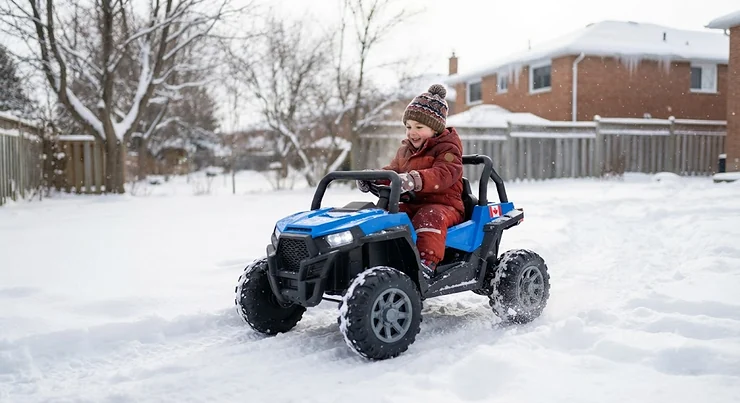
Somewhere between the driveway and the back fence, a kid on a battery-powered UTV becomes a slightly smaller, slightly louder version of every adult who has ever taken a truck off-pavement just because they could. If you’re shopping for a kids electric off road vehicle this year, you’ve probably already discovered the problem: there are hundreds of listings, they all use the words “rugged,” “all-terrain,” and “adventure,” and roughly a third of the photos look suspiciously identical. Somebody has to actually compare the motors, the batteries, and the tires — so that’s what this guide does.
A kids electric off road vehicle is a battery-powered ride-on toy built with reinforced suspension, knobby or EVA foam tires, and a higher-torque motor designed to handle grass, gravel, dirt, and light hills rather than just smooth driveways. Below, we break down seven real models sold through amazon.ca, from entry-level 12V machines to two-seater 24V UTVs, with honest analysis of who each one actually suits — plus what reviewers consistently flag as strengths and weak points. According to Health Canada’s play safety guidance for parents, electric ride-on toys fall under the same Toys Regulations as every other children’s product sold in this country, which is worth knowing before you compare specs.
We’ll cover the full spectrum: budget-friendly single-motor models, mid-range 4WD UTVs, and premium licensed 2-seaters, along with buying criteria, common mistakes, safety context, and a few real-world scenarios so you can match a machine to your actual kid instead of the marketing copy.
Quick Comparison Table
| Product | Voltage / Motor | Top Speed | Seats | Best For |
|---|---|---|---|---|
| Peg Perego Polaris RZR PRO | 24V, dual motor | Up to 7.5 mph | 2 | Best all-around premium pick |
| Best Choice Products Honda Talon | 24V, dual motor | Up to 4.4 mph | 2 | Best value 2-seater |
| Razor Dune Buggy | 24V, 250-350W | Up to 9 mph | 1 | Best for solo thrill-seekers 8+ |
| Peg Perego Polaris RZR 900 | 12V | Up to 5 mph | 1 | Best classic single-seat premium |
| sopbost 24V 2WD/4WD UTV | 24V, quad motor | Up to 5 mph | 1 | Best hidden-gem all-terrain pick |
| Aosom 12V Off-Road UTV Truck | 12V, quad motor | Up to 5 mph | 1-2 | Best budget entry-level |
| Power Wheels Kawasaki KFX | 12V | Up to 5-6 mph | 1 | Best ultra-budget licensed ATV |
Looking at the spread here, voltage tells only part of the story — a 12V machine with four small motors can out-torque a single-motor 24V unit on grass, which is exactly why Peg Perego Polaris RZR 900 still competes with newer 24V trucks despite its lower rated power. Weight capacity and tire type matter just as much as the number on the battery, especially once a driveway turns into a lawn with any kind of slope. If a growing rider or a sibling pair is in the picture, the two-seaters — Peg Perego Polaris RZR PRO and Best Choice Products Honda Talon — buy you more years of use per dollar than a single-seat model that gets outgrown in a season.
💬 Just one click — help other Canadian parents make better buying decisions too!😊
Top 7 Kids Electric Off Road Vehicles: Expert Analysis
1. Peg Perego Polaris RZR PRO — best overall 2-seater for serious backyard trails
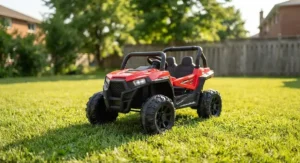
The standout here is the dual-speed drivetrain, which gives it real range between a toddler-safe crawl and a pace that actually feels like driving. Built in Italy on Peg Perego’s licensed Polaris platform, the Peg Perego Polaris RZR PRO runs a 24V system with two selectable speeds up to roughly 7.5 mph, a built-in FM radio, working headlights, and extreme-traction rubber wheels rather than the hollow plastic wheels found on cheaper imports. That rubber matters in practice: on packed dirt or a bumpy lawn, plastic wheels tend to skate and lose grip on turns, while rubber compounds hold a line and absorb small rocks instead of bouncing over them.
Based on the spec comparison across this category, this is the pick for families who want one vehicle to last from age five through nine or ten, since the frame, suspension, and seat are sized for growth rather than a single season. Reviewers of Peg Perego’s Polaris lineup consistently note that the metal-reinforced chassis holds up far better than fully plastic competitors under repeated hard use, though the tradeoff is a heavier unit that two adults will want for assembly and loading into a vehicle.
Pros:
- ✅ Dual-speed drivetrain with genuine trail-worthy top speed
- ✅ Rubber traction tires outperform plastic wheels off-road
- ✅ Reinforced frame built to outlast a single growth spurt
Cons:
- ❌ Among the heaviest 2-seaters to assemble and store
- ❌ Premium pricing puts it well above entry-level UTVs
Expect this one in the C$900-C$1,200 range at the time of research, positioning it as the flagship pick for families prioritizing longevity over upfront cost.
2. Best Choice Products Honda Talon — best value licensed 2-seater
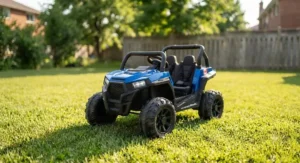
The standout feature is the officially licensed Honda Talon body styling paired with a genuinely long run time for the price bracket. The Best Choice Products Honda Talon runs a 24V battery rated for up to roughly 90 minutes of continuous use, LED lighting, Bluetooth audio, and a parent-operated remote that lets you take over steering and braking from a distance — a detail that matters more than most spec sheets suggest once a toddler discovers the accelerator pedal.
What most buyers overlook about this model is that its lower top speed (around 4.4 mph) is a feature, not a limitation, for the 3-6 age range it’s actually built for; a faster machine at this size and weight capacity would be harder for parents to safely intervene on. Aggregated review sentiment for Best Choice Products’ ride-on lineup commonly points to straightforward assembly and decent battery life as strengths, with occasional notes about plastic panel fit-and-finish on the lower end of their catalogue.
Pros:
- ✅ Long ~90-minute run time relative to price point
- ✅ Officially licensed Honda styling with two-seat layout
- ✅ Parent remote control for hands-off supervision
Cons:
- ❌ Top speed capped low, unsuited to older kids wanting speed
- ❌ Panel plastics feel lighter-duty than premium competitors
Expect this one in the C$300-C$420 range, making it one of the strongest value plays in the 24V 2-seater category.
3. Razor Dune Buggy — best for solo thrill-seekers ages 8 and up
The standout feature is straightforward: this is the fastest, most driving-focused vehicle on this list, built around an actual bucket seat, roll cage, and hand-operated rear disc brake rather than toy-grade styling. The Razor Dune Buggy uses a 24V sealed battery system driving a chain-driven 250-350W motor (output varies slightly by production run) capable of up to 9 mph, paired with 8-inch knobby pneumatic tires and terrain-following rear suspension.
On paper, this means it’s the only vehicle here genuinely built for dirt trails and bumpy backyards rather than flat driveways — the pneumatic tires soak up small rocks and ruts that would jolt a foam-tire competitor. Reviewers consistently point to the buggy’s low centre of gravity and side cage as reassuring safety features at this speed range, while also noting that the 12-18 hour initial charge time and roughly 40-minute run window require some patience compared to lithium-based competitors.
Pros:
- ✅ Fastest top speed of any model in this roundup
- ✅ Real pneumatic tires handle rocks and ruts smoothly
- ✅ Roll cage, bucket seat, and disc brake feel purpose-built
Cons:
- ❌ Long initial charge time versus lithium-battery rivals
- ❌ Single-seat only, with a strict 120 lb weight limit
Expect this one in the C$400-C$500 range — a fair ask for the only true trail-oriented single-rider buggy on this list.
4. Peg Perego Polaris RZR 900 — best classic single-seat premium pick
The standout feature is the sport-truck cargo bed with working tie-downs, a detail that turns imaginative play into an actual hauling exercise. The Peg Perego Polaris RZR 900 runs on a 12V rechargeable battery with a 2-speed shifter (roughly 2.5 and 5 mph) plus reverse, an adjustable bucket seat that grows with the child, and a factory 5 mph speed lockout for younger or newer drivers.
What the spec sheet won’t tell you, but reviewers note, is that Peg Perego’s Fort Wayne, Indiana manufacturing shows up in the durability of the plastic body panels and hinges — this line tends to survive multiple seasons and siblings better than similarly priced imports built with thinner shell plastic. It’s the honest choice for families who want Peg Perego’s build quality without paying for the RZR PRO’s higher voltage and second seat.
Pros:
- ✅ Adjustable seat extends useful life across age ranges
- ✅ Working cargo bed adds real imaginative-play value
- ✅ Speed lockout gives parents a genuine safety buffer
Cons:
- ❌ 12V motor is noticeably slower than 24V UTVs on grass
- ❌ Single seat only, no passenger option
Expect this one in the C$550-C$700 range, sitting between the budget UTVs and the flagship RZR PRO on both price and power.
5. sopbost 24V 2WD/4WD UTV — best hidden-gem all-terrain pick
The standout feature is the switchable 2WD/4WD drivetrain, a genuinely uncommon inclusion at this price point that most shoppers won’t think to look for. The sopbost 24V 2WD/4WD UTV pairs a 24V 7Ah battery with four 35W motors (140W combined), EVA all-terrain tires, and a parental 2.4GHz remote offering three adjustable speed levels independent of the child’s own two-speed manual control.
Based on the spec comparison, switching into 4WD on grass, dirt, or light inclines is exactly what separates a genuinely off-road-capable ride-on from one that’s simply styled to look rugged — most competitors in this price bracket run all four wheels at the same power regardless of terrain, wasting torque on the wheels with the most traction already. As a newer entrant without a long public review history, we’d flag this honestly: verify current buyer feedback before purchase rather than assuming legacy-brand reliability, since it hasn’t built the multi-year track record that Peg Perego or Razor have.
Pros:
- ✅ True switchable 2WD/4WD, rare at this price tier
- ✅ Soft-start and soft-brake protection built in
- ✅ Dual control system balances independence and safety
Cons:
- ❌ Newer brand with a thinner long-term review history
- ❌ Single-seat design limits it for siblings riding together
Expect this one in the C$250-C$350 range, an appealing entry point if the switchable drivetrain matters more to you than brand pedigree.
6. Aosom 12V Off-Road UTV Truck — best budget entry-level pick
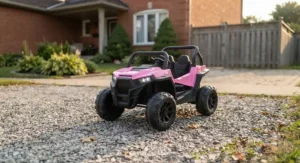
The standout feature is the aggressive off-road-styled tire tread paired with an elevated suspension, unusual details to find on a sub-C$300 machine. The Aosom 12V Off-Road UTV Truck runs four small motors off a 12V battery, offering speeds from roughly 1.8 to 5 mph, working LED headlights and taillights, an illuminated dashboard, wing mirrors, and a parent remote with forward, reverse, and park functions.
Here’s what to weigh: the wear-resistant polypropylene tires won’t puncture or need inflating, which is a genuine maintenance win for parents, but that same solid-tire construction means less shock absorption than the pneumatic tires on the Razor Dune Buggy when the ground gets genuinely rough. Aosom’s outdoor gear reputation (the brand is better known for patio furniture and cycling accessories) means this model leans more toward yard-and-park use than serious trail riding, and it’s honestly the right fit for that use case rather than a limitation to apologize for.
Pros:
- ✅ Puncture-proof tires need zero maintenance
- ✅ Full lighting package and dashboard details at low cost
- ✅ Wide 4-wheel suspension smooths minor bumps
Cons:
- ❌ Lower motor output struggles on inclines or thick grass
- ❌ Less brand history in dedicated off-road ride-ons
Expect this one in the C$200-C$280 range, arguably the strongest entry-level option for parents testing whether their kid will actually use an off-road ride-on before spending more.
7. Power Wheels Kawasaki KFX — best ultra-budget licensed ATV
The standout feature is the officially licensed Kawasaki ATV body on Fisher-Price’s long-running Power Wheels platform, a name-brand pedigree that’s hard to find this cheap. The Power Wheels Kawasaki KFX uses a 12V battery with two forward speeds (roughly 2.5-6 mph depending on production year) plus reverse, a twist-grip throttle instead of a foot pedal, and Fisher-Price’s Monster Traction tire tread designed to bite into wet grass, gravel, and mud.
Here’s what to weigh: the twist-grip throttle is a genuinely different driving mechanic from every pedal-based competitor on this list, and it tends to suit younger riders who haven’t yet built the leg strength or coordination for a foot accelerator. Reviewers consistently flag the high-speed lockout and Power-Lock brake system as reassuring for first-time ride-on owners, while also noting this model rotates in and out of Fisher-Price’s active lineup, so availability and colourways can shift — check current stock before assuming a specific version is guaranteed.
Pros:
- ✅ Twist-grip throttle suits younger, less coordinated riders
- ✅ Monster Traction tires grip mud, grass, and gravel well
- ✅ Recognizable licensed brand at an entry-level price
Cons:
- ❌ Availability and exact specs shift by production run
- ❌ Weight capacity is the lowest of any model here
Expect this one in the C$180-C$260 range when in stock, the cheapest true off-road-styled option on this list.
Top 7 Products: Full Spec Comparison
| Product | Weight Capacity | Tires | Run Time | Price Range |
|---|---|---|---|---|
| Peg Perego Polaris RZR PRO | ~150 lbs | Rubber, extreme-traction | ~1 hr | C$900-C$1,200 |
| Best Choice Products Honda Talon | 132 lbs | EVA foam | ~90 min | C$300-C$420 |
| Razor Dune Buggy | 120 lbs | 8″ pneumatic knobby | ~40 min | C$400-C$500 |
| Peg Perego Polaris RZR 900 | 130 lbs | Super Traction rubber | ~1 hr | C$550-C$700 |
| sopbost 24V 2WD/4WD UTV | ~100 lbs | EVA all-terrain | ~45-60 min | C$250-C$350 |
| Aosom 12V Off-Road UTV Truck | ~90 lbs | Polypropylene tread | ~45 min | C$200-C$280 |
| Power Wheels Kawasaki KFX | 65 lbs | Monster Traction | ~1 hr | C$180-C$260 |
The gap in weight capacity between the Power Wheels Kawasaki KFX at 65 lbs and the Peg Perego Polaris RZR PRO at roughly 150 lbs is the single biggest factor separating “toddler toy” from “grows with your kid,” so match this row to your child’s current weight plus a couple of growth years, not just their age today. Run time is deceptively similar across the lineup at 40-60 minutes, meaning battery chemistry matters less for a single play session than tire type and motor count do for actual terrain handling. If two kids will regularly ride together, the weight-capacity column effectively removes every single-seater from consideration regardless of how good the tires are.
Getting a New Off-Road Ride-On Set Up Right: Practical Usage Guide
Most of the disappointment parents report with a new kids electric off road vehicle traces back to setup, not the machine itself. Before the first ride, fully charge the battery per the included manual — most 12V and 24V lead-acid systems want 8-18 hours on that initial charge, and skipping this step is the single most common reason a battery underperforms in its first month. Check tire pressure or tread seating on pneumatic models like the Razor Dune Buggy, and confirm every bolt on the axles and steering column is torqued down; shipping vibration loosens hardware more often than people expect.
For the first 30 days, keep sessions short and supervised even if the remote control isn’t in use, since kids typically overcorrect on steering before building muscle memory for how quickly a UTV responds compared to a bicycle. A simple monthly habit — wiping down contacts, checking for cracked wiring near the battery compartment, and storing the vehicle out of direct sun and rain — meaningfully extends the life of both the battery and the plastic body panels, which are the two components most likely to degrade first. If the vehicle came with a soft-start feature, resist the urge to disable it even after your child gets comfortable; sudden acceleration is a leading cause of tip-overs on uneven ground.
✨ Explore Our Full 2026 Off-Road Ride-On Lineup!
🔍 Compare every model above side by side and lock in the right fit before backyard season starts — click through to check current pricing and availability on any pick above.
Which Rider Are You Shopping For? Real-World Scenarios
If you’re outfitting a first-time rider around age three or four with limited coordination, the twist-grip simplicity of the Power Wheels Kawasaki KFX or the puncture-proof forgiveness of the Aosom 12V Off-Road UTV Truck removes two of the biggest early frustrations — steep learning curves and maintenance headaches — while keeping speed low enough that a parent can walk alongside comfortably.
If you’ve got two kids close in age who’ll fight over a single-seater regardless of how nice it is, the math favours the Best Choice Products Honda Talon or the Peg Perego Polaris RZR PRO; the extra upfront cost of a second seat is almost always cheaper than buying two separate machines, and it sidesteps the sibling rivalry entirely. For a family with a genuine backyard trail, a sloped lawn, or gravel driveway, the sopbost 24V 2WD/4WD UTV‘s switchable drive mode or the Razor Dune Buggy‘s pneumatic tires and suspension will noticeably outperform flatter-terrain competitors, since active outdoor play research from ParticipACTION consistently links varied, self-directed outdoor movement — not just flat pavement riding — to stronger gross motor development in kids.
Common Off-Road Ride-On Problems, Solved
Problem: the vehicle bogs down on grass or a slight incline. This is almost always a motor-count or torque issue rather than a defect — single-motor 12V trucks weren’t built for anything steeper than a gentle slope, so if hills are a regular feature of your yard, prioritize quad-motor 24V options like the sopbost 24V 2WD/4WD UTV over single-motor budget picks.
Problem: battery life feels shorter than advertised. Rated run times assume flat, easy terrain at moderate speed; grass, inclines, and a heavier rider all draw more current and shorten real-world sessions, so treat the manufacturer’s number as a best-case ceiling rather than a guarantee.
Problem: steering feels twitchy or oversensitive. New riders frequently oversteer before building feel for the vehicle’s actual turning radius; most models improve dramatically after two or three supervised sessions rather than needing a mechanical fix.
Problem: the vehicle was recalled or something feels unsafe. Check the product against Canada’s official recalls and safety alerts database before continuing to use it, and stop use immediately if a listed hazard matches your unit — this is the fastest way to confirm whether an issue is a known defect or a one-off.
Problem: tires losing traction on wet grass. Foam and polypropylene tires grip less than knobby pneumatic tires in damp conditions; if wet-weather riding is common, weight this factor into your pick from the start rather than trying to retrofit better tires later.
Buyer’s Decision Framework
If your yard is mostly flat pavement or a small, tidy lawn, choose a 12V single-motor model, because the extra torque of a 24V UTV goes largely unused and you’ll save several hundred dollars. If your yard includes real grass, gentle slopes, or gravel, choose a 24V quad-motor UTV, because single-motor machines noticeably lose speed and torque the moment the surface stops being flat. If two children will share the vehicle regularly, choose a 2-seater over a single-seat model even at a higher price point, because the cost of a second stand-alone vehicle almost always exceeds the seat upgrade. If your child is under 40 lbs or new to ride-ons entirely, prioritize a speed lockout and twist-grip or simple pedal control over top speed, because coordination — not horsepower — is the limiting factor at that stage.
How to Choose a Kids Electric Off Road Vehicle
Choosing the right kids electric off road vehicle comes down to matching six variables to your actual yard and rider, not chasing the highest spec number on the page:
- Match voltage to terrain, not age. A 24v off road ride on for kids genuinely outperforms a 12V unit on grass, gravel, or any incline, because more motors and higher voltage translate directly into torque, not just top speed.
- Check weight capacity against a two-year growth window, not your child’s current weight, since outgrowing a vehicle in one season is the most common regret reported among ride-on buyers.
- Prioritize tire type for your actual surface. Pneumatic tires absorb rocks and ruts best; EVA foam and polypropylene tires trade some cushioning for zero maintenance.
- Confirm a genuine parent-override remote exists, not just a “steering assist” feature, since a true remote lets you stop or redirect the vehicle instantly if a child heads somewhere unsafe.
- Look for a soft-start or speed-lockout feature, especially for first-time riders, since sudden acceleration is a leading cause of minor tip-overs on uneven ground.
- Weigh single-seat versus two-seat against sibling dynamics, since a two-seater frequently costs less over time than buying two separate machines.
- Verify current availability and price directly on the retailer page before finalizing a decision, since ride-on toy lineups rotate seasonally more than most other toy categories.
24V Off-Road Ride-On for Kids: Why Voltage Actually Matters
The jump from 12V to a 24v off road ride on for kids isn’t just a bigger number on a spec sheet — it’s typically the difference between a toy that handles a sloped lawn confidently and one that stalls out on the same slope. Based on the spec comparison across this roundup, 24V systems generally pair with more motors (commonly four smaller motors rather than one or two larger ones), which distributes torque across all four wheels instead of concentrating it on two. That distributed torque is what actually gets a UTV like the sopbost 24V 2WD/4WD UTV or Peg Perego Polaris RZR PRO through soft grass or a mild grade without bogging down, where a comparable 12V single-motor machine would lose momentum.
The tradeoff is straightforward and worth stating honestly: 24V systems cost more, weigh more, and take longer to fully charge, so a family with a flat driveway and no real terrain to speak of is genuinely better served — and better off financially — sticking with a 12V option rather than paying for capability they won’t use.
All-Terrain Grip Tires: The Feature That Actually Matters
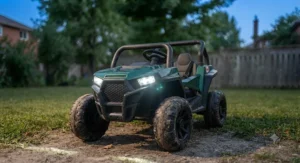
Marketing copy loves the phrase all-terrain grip tires, but the real-world difference between tire types is bigger than most buyers assume. Pneumatic (air-filled) tires, like the ones on the Razor Dune Buggy, flex around rocks and ruts and genuinely absorb shock, which matters most on true dirt or gravel. EVA foam tires — used on the sopbost 24V 2WD/4WD UTV and Best Choice Products Honda Talon — trade some of that cushioning for a tire that never goes flat, which matters more for families who don’t want a maintenance task added to their week. Solid polypropylene tread, as on the Aosom 12V Off-Road UTV Truck, sits in between: no puncture risk, but noticeably less give over sharp bumps than air-filled tires.
What most buyers overlook is that tread pattern matters almost as much as tire material — a deep, aggressive tread grips wet grass and loose dirt significantly better than a shallow tread regardless of whether the tire itself is foam, rubber, or pneumatic, so it’s worth a close look at product photos before assuming “all-terrain” branding guarantees real grip.
Common Mistakes When Buying an Off-Road Electric Vehicle for Kids
The most frequent mistake is buying based on top speed alone, when weight capacity and tire type actually determine whether the vehicle performs on your specific terrain. A close second is assuming any product labelled with off-road electric vehicles for kids branding will handle real grass or gravel — some models are styled to look rugged without the motor count or tire design to back it up, so cross-check the spec sheet rather than the product photography.
Parents also commonly underestimate charge time, expecting a lithium-fast turnaround from what’s often still a sealed lead-acid battery system requiring 8-18 hours initially. Skipping the manufacturer’s assembly torque checklist is another frequent misstep — loose axle bolts are a leading cause of early wobble complaints, and most of it traces back to incomplete assembly rather than a manufacturing defect. Finally, before finalizing any purchase, it’s worth a quick check of Canada’s recalls and safety alerts database for the specific model and importer, since ride-on toys — like any consumer product sold in Canada — occasionally surface there for battery or mechanical issues.
Rugged Terrain Ride On Toys vs Traditional Ride-On Cars
The core difference between rugged terrain ride on toys and a standard battery-powered ride-on car isn’t styling — it’s the drivetrain and suspension engineering underneath. A traditional ride-on car typically runs a single small motor optimized for smooth, flat surfaces like driveways and sidewalks, with soft plastic wheels that offer minimal ground clearance. An off-road-focused UTV or buggy, by contrast, is built around multiple motors, elevated suspension travel, and either pneumatic or aggressively treaded tires specifically engineered to maintain traction on grass, dirt, and light inclines.
| Feature | Rugged Terrain Ride-On (UTV/Buggy) | Traditional Ride-On Car |
|---|---|---|
| Ground clearance | Elevated, off-road tuned | Low, driveway-optimized |
| Motor configuration | Typically 2-4 motors | Usually 1 motor |
| Tire type | Pneumatic, EVA, or treaded | Smooth or lightly grooved plastic |
| Best For | Yards, trails, gravel, mild hills | Pavement, driveways, indoor-outdoor |
Practically speaking, this means a family shopping specifically for grass or backyard-trail use should rule out traditional ride-on cars entirely, since even a modest lawn will expose the limits of a flat-surface motor and wheel setup within the first few rides. The premium that off-road-focused models like the Peg Perego Polaris RZR PRO and Razor Dune Buggy command over a basic ride-on car reflects real engineering differences, not just branding.
What to Expect: Real-World Performance on Grass, Gravel & Trails
Spec sheets rarely translate cleanly into backyard reality, so here’s what actually shifts once these vehicles leave the driveway. On short, dry grass, every model on this list performs reasonably close to its rated speed. Once grass gets longer or slightly damp, single-motor 12V machines like the Power Wheels Kawasaki KFX noticeably lose top speed, while quad-motor 24V units maintain closer to their rated pace. On loose gravel, pneumatic tires clearly outperform foam or polypropylene alternatives in grip and comfort, which is exactly why the Razor Dune Buggy‘s tire choice stands out in this category.
On any real incline — even a gentle 5-10 degree grade — weight capacity and motor count become the deciding factors rather than top speed; a heavier rider on a light-duty motor will feel the vehicle strain audibly before it stalls. The honest takeaway here is that “off-road” is a spectrum, not a single standard, and matching your actual terrain to the right point on that spectrum matters more than chasing the highest headline speed.
Off-Road Electric Vehicles for Kids by Age and Skill Level
For toddlers around ages 2-4, off-road electric vehicles for kids should prioritize low top speed, a twist-grip or simple pedal throttle, and a reliable parent remote — the Power Wheels Kawasaki KFX and Aosom 12V Off-Road UTV Truck both fit this window well. For kids roughly ages 5-7 who’ve outgrown a toddler ride-on but aren’t ready for high speed, mid-range 24V UTVs with a soft-start feature and speed lockout, like the Best Choice Products Honda Talon or sopbost 24V 2WD/4WD UTV, offer meaningful terrain capability without excessive top-end speed.
For older kids ages 8 and up who want a genuinely fast, driving-focused experience, the Razor Dune Buggy stands alone on this list with its 9 mph top speed and true bucket-seat layout. Families spanning a wide age range — say, a five-year-old and an eight-year-old sharing one machine — are usually best served by a 2-seater with adjustable seating and dual speed settings, which is precisely the gap the Peg Perego Polaris RZR PRO and Peg Perego Polaris RZR 900 are built to fill.
Safety, Regulations & Certification Guide for Canadian Families
Every kids electric off road vehicle sold through amazon.ca to Canadian buyers is subject to the Canada Consumer Product Safety Act and its accompanying Toys Regulations, which set mandatory requirements around mechanical, electrical, thermal, and flammability hazards. Health Canada’s own industry guide to toy safety requirements places compliance responsibility on the manufacturer and importer rather than the retailer, which is one reason it’s worth favouring established brands with a track record of responding to safety concerns.
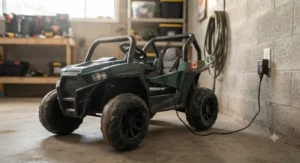
In practice, this means always supervising rides regardless of the vehicle’s built-in safety features, confirming a battery charger includes auto shut-off protection to reduce overheating risk, and keeping ride-on use to private property rather than roadways or shared pathways, since none of these vehicles are designed or rated for public-road use. Helmets aren’t legally mandated for slower-speed ride-on toys the way they are for e-bikes or scooters, but given that the Razor Dune Buggy reaches speeds near 9 mph, a helmet is a reasonable precaution many parents choose to add regardless of the regulatory minimum.
Frequently Asked Questions
❓ What speed is safe for a kids electric off road vehicle?
❓ How long does the battery last on a 24v off road ride on for kids?
❓ Are off-road electric vehicles for kids worth it over a regular ride-on car?
❓ Do all-terrain grip tires need maintenance?
❓ What age is best for rugged terrain ride on toys?
Conclusion
There’s no single best kids electric off road vehicle — there’s a best one for your yard, your kid’s age, and how many riders need a seat. Flat pavement and a cautious first-timer point toward the budget 12V picks like the Power Wheels Kawasaki KFX or Aosom 12V Off-Road UTV Truck. Real grass, gravel, or a gentle slope shift the math toward quad-motor 24V UTVs like the sopbost 24V 2WD/4WD UTV or Best Choice Products Honda Talon. And families wanting one vehicle to last years, handle real terrain, and seat two kids will get the most consistent value from the Peg Perego Polaris RZR PRO, with the Razor Dune Buggy standing out as the clear pick for an older kid who genuinely wants speed.
Whichever you choose, the fundamentals matter more than the marketing: check the weight capacity against a realistic growth window, match tire type to your actual terrain, and confirm a working parent remote before your child is out of arm’s reach on their first ride.
✨ Don’t Miss These Exclusive Deals!
🔍 Take your kids electric off road vehicle search to the next level with the seven models compared above. Click through on any pick to check current pricing and availability, and give your kids an off-road adventure they’ll actually remember.
Recommended for You
- Kids Electric Farm Tractor: 7 Top Picks for Canadian Kids (2026)
- 24v Power Wheels for Older Kids: 7 Rugged Picks for 2026
- Fastest 24V Kids Electric Car 2026: 7 Top Picks Ranked
Disclaimer: This article contains affiliate links. As an Amazon Associate, I earn from qualifying purchases. If you purchase products through these links, we may earn a small commission at no additional cost to you.
✨ Found this helpful? Share it with your friends! 💬🤗
