
In This Article
So you’ve decided your child deserves a serious electric ride-on, and now you’re staring down the classic question every Canadian parent faces come spring: is a 24V electric UTV or a dune buggy the better choice for kids? Both look incredible in the driveway. Both will make your kid the most popular one on the block. But they are absolutely not the same machine, and choosing the wrong one can mean a very expensive regret once the snow finally melts.
I’ve spent considerable time researching both categories specifically on Amazon.ca — because let’s be real, ordering from Amazon.com to Canada means customs delays, surprise duties, and warranty headaches that nobody needs. Here’s the good news: the Canadian market for 24V electric kids’ ride-ons has genuinely exploded in 2026, with excellent choices available from brands that actually ship domestically.
When it comes to the 24V electric UTV vs dune buggy for kids which is better debate, the answer depends almost entirely on how and where your child will be riding. A UTV-style ride-on tends to prioritize enclosed, structured seating with higher side panels, a more truck-like silhouette, and serious load capacity for sibling rides. A dune buggy, on the other hand, leans into the open-air, adventurous aesthetic — lower profile, more visibility, and a design built for outdoor terrain thrills. Both run on 24V systems, meaning real torque and real run times.
This guide breaks down the top 7 models available on Amazon.ca in 2026, walks through real-world Canadian use cases (think gravel driveways in Ontario suburbs, backyard hills in BC, and short prairie summers in Saskatchewan), and gives you a clear decision framework so you aren’t just guessing. Let’s get into it.
Quick Comparison: 24V UTV vs Dune Buggy for Kids — At a Glance
| Feature | 24V Electric UTV | 24V Electric Dune Buggy |
|---|---|---|
| Seating Style | Enclosed cab, higher sides | Open-air, low-profile |
| Best Terrain | Mixed: grass, gravel, pavement | Off-road: dirt, uneven ground |
| Typical Weight Capacity | 45–100 kg (100–220 lbs) | 40–90 kg (88–200 lbs) |
| Speed Range | 4–8 km/h (2.5–5 mph) | 4–10 km/h (2.5–6 mph) |
| Seating Options | 1 or 2 seats standard | Usually 2 seats |
| Best For | Tweens, siblings, yard cruising | Adventurous kids, outdoor play |
| Price Range (CAD) | $350–$900+ | $300–$800+ |
| Amazon.ca Availability | Excellent | Very good |
What this table really tells you: The UTV wins for versatility and sibling-sharing, while the dune buggy wins if your child craves open-air, off-road energy. Dune buggies tend to handle slight inclines and rougher terrain a little more naturally because of their lower centre of gravity. However, if you live somewhere with spring mud or need a ride-on that transitions from the lawn to the driveway easily, the UTV’s enclosed structure handles mixed surfaces better and doesn’t collect as much debris around the seating area — something that genuinely matters when you’re hosing the thing down at the end of a Canadian summer day.
💬 Just one click — help others make better buying decisions too! 😊
✨ Don’t Miss These Exclusive Deals!
🔍 Take your kids’ outdoor adventures to the next level with these carefully selected ride-ons. Click on any highlighted item to check current pricing and availability on Amazon.ca. These vehicles will help your family create unforgettable outdoor memories this season!
Top 7 24V Electric UTVs and Dune Buggies for Kids on Amazon.ca — Expert Analysis
1. VOLTZ TOYS 2 Seater 24V Off-Road Dune Buggy UTV
This is the model I’d confidently recommend to most Canadian families shopping for their first 24V off-road ride-on, and here’s the main reason: Voltz Toys is a brand that actually understands the Canadian market. Founded in 2016 and deeply integrated into the Amazon.ca ecosystem, they’ve built a reputation specifically for durability and after-sales support — two things that matter enormously when the nearest repair shop for a kids’ toy is a long drive away in rural Quebec or northern Ontario.
The VOLTZ TOYS Dune Buggy UTV seats up to 2+1 children and comes with dual buffer spring suspension at the front and rear. In practical terms, this means your 7-year-old won’t be complaining about a sore back after 20 minutes on your gravel path — that suspension actually absorbs the Canadian backyard terrain that cheaper single-spring systems simply rattle through. The speed tops out at 8 km/h via remote (about 5 mph), and the 2.4G parental remote offers real override capability, so you maintain full control when little ones get overconfident on a slope.
What most parents overlook about this model is the opening side doors — they add genuine realism for kids who want the full driving experience, and they also make getting in and out much easier for younger riders who can’t just swing their legs over a wide body. Canadian reviewers on Amazon.ca frequently note that assembly is straightforward, which counts for a lot when you’re putting it together on a Saturday afternoon with a 6-year-old already in full hysterics beside you.
✅ Two side doors with child-safe locks
✅ 24V battery with multi-speed parental remote
✅ Durable PP body, spring suspension front and rear
❌ Slightly bulkier to store during long Canadian winters
❌ Charging takes 8–12 hours (charge overnight for full day play)
Price range: Around $400–$550 CAD — solid mid-range value for the feature set.
2. VOLTZ TOYS 24V Kids UTV Ride-On Car with Bluetooth MP3 and Storage
If the dune buggy above is the adventure pick, this VOLTZ TOYS UTV-style model is the family cruiser. It’s a proper 2-seater with a more upright, truck-inspired cab design, Bluetooth MP3 connectivity, spring suspension, and a rear storage compartment — which sounds like a gimmick until your kid insists on taking their snack outside and suddenly that little trunk is getting used every single day.
The 24V battery system provides a respectable run time for a fully loaded 2-seater, and the spring suspension performs well on mixed surfaces. Where this model really earns its keep is in the dual-drive mode: children can operate it with the foot pedal and steering wheel independently, or parents can take over with the 2.4G wireless remote. The remote’s STOP function is non-negotiable safety kit — if your driveway has even the slightest grade toward the road, you want that override instantly accessible. I’d rate this as the best two-seater UTV under $500 CAD currently on Amazon.ca.
Canadian buyers note the build quality feels a tier above comparably priced alternatives, and Voltz’s customer service team responds in both English and French — important for Quebec families navigating bilingual product support.
✅ Bluetooth MP3 + USB connectivity
✅ Rear storage compartment
✅ Parental remote with emergency STOP function
❌ Seat width may feel snug for two older tweens (10+)
❌ Bluetooth setup can be slightly fiddly on first use
Price range: $450–$580 CAD — one of the better value propositions in its class.
3. VOLTZ TOYS Can-Am Maverick RS 24V 4WD UTV Buggy
Here’s where things get serious. The VOLTZ TOYS Can-Am Maverick RS is an officially licensed model, meaning it has gone through Can-Am’s approval process before hitting the market. That licensing matters more than it sounds: officially licensed ride-ons must meet specific quality and design benchmarks that generic models don’t. You get a vehicle that actually looks like the real Can-Am Maverick in miniature, and that visual authenticity drives kids absolutely wild.
Under the hood (so to speak), this 24V 4WD version uses front and rear suspension with EVA rubber tyres that won’t go flat — critical if you’re storing this outdoors in a Canadian shed where temperature swings between winter storage and summer retrieval can destroy inflatable tyres over time. The 4WD drivetrain provides noticeably better grip on wet grass, which any Canadian parent knows is basically a standard terrain condition from May through September.
The weight capacity sits around 45 kg (100 lbs), making it appropriate for kids roughly aged 3–8. If you have a particularly adventurous 9-year-old at the upper weight range, consider stepping up to the ANPABO option (#6 below). This one shines brightest for families who want a premium-feeling gift with real brand recognition — because when your kid tells their friends they have a Can-Am, they really mean it.
✅ Officially licensed Can-Am Maverick design
✅ 4WD with front and rear suspension
✅ Flat-proof EVA rubber tyres — great for Canadian climate storage
❌ Premium price point may stretch some budgets
❌ 4WD system adds slight noise under load
Price range: $550–$750 CAD — premium tier, but the licensing and 4WD justify it.
4. Voltz Toys 24V 6-Wheel UTV Ride-On Car with Cargo Bed
This one is genuinely unusual in the best possible way. Six wheels on a kids’ ride-on sounds excessive until you see it in action on uneven ground — the extra rear axle dramatically improves stability on soft terrain like lawn or light gravel. For families in suburban Calgary or Halifax with a proper yard that includes the occasional garden edge or mulched bed to navigate around, that stability difference is real.
The Voltz Toys 6-Wheel UTV also comes with a rear cargo bed, which from a practical standpoint means it doubles as a garden helper vehicle — kids can haul small loads of rocks, sticks, or dirt around the yard with purpose, and suddenly outdoor play becomes a two-hour activity instead of twenty minutes. The 4WD system pairs with EVA tyres that handle varied Canadian outdoor surfaces without issue.
Where this model isn’t the right fit: it’s a single-rider design, so if you have two children who’ll be fighting over the same vehicle, you’ll need to look at the 2-seater options. But for a family with one child aged 3–8 who wants maximum outdoor adventure capability in a single package, this is arguably the most distinctive offering on Amazon.ca in 2026.
✅ Six-wheel design for exceptional terrain stability
✅ Rear cargo bed adds play value and utility
✅ 4WD system, EVA tyres, remote control included
❌ Single-seater limits two-kid use
❌ Larger footprint makes winter indoor storage trickier
Price range: $400–$520 CAD — excellent value for a genuinely differentiated design.
5. Kids Republic Off-Road Dune Buggy UTV with 2+1 Seating
The Kids Republic Off-Road Dune Buggy UTV is a strong alternative to the Voltz dune buggy, and it earns its place here because of one standout feature: the 2+1 seating configuration. Most two-seater ride-ons accommodate two children roughly the same size, but the 2+1 design means there’s a small rear perch that a younger sibling can use for shorter, supervised rides — essentially giving you a three-kid configuration when the occasion calls for it.
It comes with multiple speed settings, spring suspension, remote control, and built-in music. The open buggy design is what appeals most to kids in the 5–10 range who want that genuine off-road aesthetic — it looks less like a toy car and more like something you’d actually see on a trail. Canadian reviewers highlight that it performs well on grass and light gravel, though like all open-body buggies, it’s not ideal for very wet conditions since water gets into the seating area more readily than enclosed UTV cab designs.
This is a solid mid-range choice for families who want the dune buggy experience with slightly more passenger flexibility.
✅ 2+1 seating for siblings of different ages
✅ Open-air buggy design kids love
✅ Multiple speeds + parental remote control
❌ Open body collects debris and water in wet conditions
❌ 2+1 third seat is not full-size — supervision required
Price range: $380–$500 CAD — good value for the seating flexibility.
6. ANPABO 24V 4×4 Ride On Toys for Big Kids
Every other model on this list has a weight cap around 45 kg (100 lbs). The ANPABO 24V 4×4 changes the equation: it supports up to roughly 60 kg (130 lbs) and is specifically marketed for kids aged 3–12, meaning it genuinely accommodates tweens and older children who’ve already outgrown the typical ride-on weight limit. That wider age range makes this the best investment if your child is on the older or larger side — you’re not buying a toy they’ll max out in a year.
The specs back up the claims: 4×200W motors, a metal frame (not just plastic), and a wide adjustable seat that grows with your child. The 5 mph top speed is appropriate for older kids who want a bit more thrill than toddler-spec models provide. Metal frame construction also means genuine durability across multiple Canadian summers — this isn’t a one-season toy.
The parental remote has full override capability, and the shock absorbers are independently mounted, which translates to genuine ride comfort over rough ground rather than the token “suspension” stickers some cheaper models slap on for marketing. For families in areas with rougher outdoor terrain — rural Ontario, BC hillsides, Alberta acreage properties — this is the practical choice.
✅ Supports up to ~60 kg (130 lbs) — built for big kids and tweens
✅ Metal frame construction for serious durability
✅ 4×200W motors, independent shock absorbers
❌ Heavier unit to move around/store
❌ No enclosed cab — less protection in rain
Price range: $450–$600 CAD — outstanding long-term value given the extended age range.
7. OLAKIDS 24V 2WD/4WD Switchable Ride On Car with 20″ Wide Seat
The OLAKIDS 24V earns the final spot on this list because it does something almost no other model at this price tier does: it lets you switch between 2WD and 4WD on the fly. In practice, this means you use 4WD mode for off-road and grass terrain, then switch to 2WD on pavement to reduce tyre wear and extend battery life. That kind of real-world adaptability is usually a feature you pay a significant premium for.
The 4×550W motor configuration is the most powerful on this list — that’s 2,200W of combined power, which is exceptional at this price point and means this vehicle handles inclines and heavier loads with ease. The 20-inch wide seat accommodates two children comfortably, and the soft-brake system prevents the abrupt stops that younger children find frightening.
The spec sheet won’t tell you this, but what the 550W-per-motor configuration actually means for Canadian buyers is that battery drain happens faster under full load than lower-powered models — so plan on shorter but more exciting rides, and charge overnight after heavy use. Not a dealbreaker, just a management expectation.
✅ 2WD/4WD switchable — unique practical feature
✅ 4×550W — most powerful motor configuration on this list
✅ 20-inch wide seat for genuine two-child comfort
❌ Higher power draw means shorter per-charge runtime under load
❌ Larger vehicle requires more storage space
Price range: $500–$700 CAD — premium justification comes from that 4WD switchability.
How to Choose Between a 24V UTV and Dune Buggy in Canada: A Practical Framework
This is the section most articles skip, and it’s also where I think the most value is. Choosing between UTV and dune buggy styles isn’t about which is objectively better — it’s about which is better for your specific family situation. Here are the questions that actually determine the right answer:
1. Where will it be ridden? If your primary surface is a finished patio, concrete driveway, or smooth lawn, a UTV or dune buggy both perform equally well. If you have uneven ground, gravel, slight inclines, or mixed terrain — the kind of backyard common across most Canadian properties outside dense urban cores — you want a model with genuine independent suspension and 4WD capability. In this scenario, the ANPABO or OLAKIDS 4WD options pull ahead.
2. How many children will use it? If you have two kids who’ll fight over the same vehicle daily, a 2-seater is non-negotiable. The Voltz Dune Buggy UTV and the Kids Republic 2+1 are your best bets. If it’s a single child, the 6-Wheel Voltz UTV gives you more terrain versatility without the compromise of a wider, heavier two-seater frame.
3. What’s the age and weight range? For kids under 6, any 24V model on this list works well with parental remote supervision. For kids aged 7–12 or above average weight, the ANPABO’s 60 kg (130 lb) capacity and metal frame are essential considerations — you don’t want to buy a vehicle your child physically outgrows in season two.
4. Canadian climate and storage? This is where Canadian buyers need to think differently than American buyers. Virtually all ride-ons should be stored indoors or in a garage during Canadian winters — temperatures below -15°C can damage lead-acid batteries permanently if they’re left discharged in an unheated garage. If indoor storage space is limited (as it often is in condos or townhouses across Toronto, Vancouver, or Ottawa), the more compact single-seat models like the Voltz 6-Wheeler make considerably more sense than the larger 2-seater UTVs.
5. Budget in CAD? Under $450 CAD: Start with the Kids Republic Dune Buggy or the Voltz Dune Buggy UTV base model. $450–$600 CAD: The ANPABO 4×4 or VOLTZ Can-Am RS hits a strong value sweet spot. $600–$750 CAD and above: The OLAKIDS 4WD switchable or the licensed Can-Am RS 4WD deliver premium-tier experiences worth the investment.
Real Canadian Families, Real Scenarios — Who Should Buy What
The Suburban Ontario Family (Two kids, ages 5 and 8, mixed lawn and concrete driveway) This is Canada’s most common ride-on scenario. You want a 2-seater with real suspension and parental remote override. The VOLTZ TOYS Can-Am RS 4WD is the call here — the licensed design means both kids care about it equally (no arguments about “whose car it is”), and the 4WD handles the grass-to-driveway transition without complaint. Budget approximately $600–$700 CAD and plan to store it in the garage from November through March.
The BC Acreage Family (One kid, age 9, rocky outdoor terrain, wants something tough) The ANPABO 24V 4×4 is built for this situation. The metal frame, 60 kg capacity, and independent shock absorbers make it the most genuinely durable option if your property has actual off-road-style terrain. This kid will want speed and traction, and the 4×200W motors deliver both without the fragility concerns of all-plastic alternatives.
The Condo Dweller in Calgary (One child, age 6, rides in building courtyard and nearby park path) Space constraints eliminate the larger models immediately. The Voltz Toys 6-Wheel UTV is compact enough to store on a balcony or in a locker, yet distinctive enough that a 6-year-old thinks it’s the coolest thing alive. The six-wheel stability is actually ideal for the occasional kerb drop or paved transition that courtyard riding involves.
The Budget-Conscious Quebec Family (Two kids, ages 4 and 7, first-time ride-on buyers) Don’t overthink it. The VOLTZ TOYS Dune Buggy UTV base model in the $400–$500 CAD range delivers everything first-time buyers need: 2-seater capacity, remote control, suspension, and a Canadian-supported brand with French-language customer service capability. Start here and upgrade in 2–3 years.
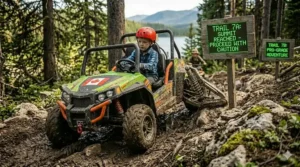
What to Expect: Real-World Performance of 24V Ride-Ons in Canadian Conditions
Canadian parents need to approach 24V ride-on performance expectations differently than American buyers for a few concrete reasons.
Battery performance in cold weather. Lead-acid batteries — which power most of these units — lose roughly 15–20% of their effective capacity when ambient temperatures drop below 10°C. In practical terms, this means a vehicle that provides 60–90 minutes of runtime on a warm summer day may deliver only 45–60 minutes on a cool early-June morning in Edmonton or a September afternoon in Halifax. This isn’t a product flaw; it’s basic battery chemistry. The solution is simple: bring the battery (or the whole unit) indoors overnight during shoulder-season riding months, and always store with a full charge.
Terrain considerations. Most Canadian residential properties — especially outside dense urban cores — have grass, gravel, or interlocking stone as primary outdoor surfaces. All 24V models on this list handle these surfaces competently, but the models with 4WD and independent suspension (ANPABO, OLAKIDS, Voltz Can-Am RS) are meaningfully better on uneven or soft-ground surfaces. The difference becomes noticeable specifically on wet grass after a rain, where 2WD flat-EVA-tyre models can slip slightly under a heavy load (two kids on board).
UV and weather exposure. Canadian summers are short but intense for UV exposure, particularly in the prairie provinces and parts of BC. The PP plastic bodies on all major models are UV-stabilised, but direct, prolonged sun exposure does fade colours over multiple seasons. If you have uncovered outdoor storage, a simple tarp cover extends the cosmetic lifespan considerably.
Health Canada and toy safety compliance. All products imported and sold in Canada — including ride-on electric vehicles for children — must comply with the Canada Consumer Product Safety Act (CCPSA) and the associated Toys Regulations administered by Health Canada. This covers electrical hazards, mechanical safety, and materials toxicology. Before buying any ride-on on Amazon.ca, verify that it lists ASTM F963 or CPC certification — these are the standards that confirm the electrical and mechanical components have been independently tested. All seven models in this guide carry relevant certifications, which is one reason I’ve included them specifically.
You can read more about safe toy standards in Canada via the Health Canada Consumer Product Safety portal.
✨ Don’t Miss These Exclusive Deals!
🔍 Ready to find the perfect electric ride-on for your adventurer? Click on any highlighted product name to check current pricing and Prime availability on Amazon.ca. Stock on popular models can go fast, especially ahead of summer and the holiday season!
Common Mistakes Canadian Parents Make When Buying 24V Kids’ Ride-Ons
Even experienced parents get tripped up by a few recurring purchasing mistakes in this category. Knowing them upfront saves you a lot of frustration.
Mistake #1: Buying based on voltage alone. A 24V sticker doesn’t tell you anything meaningful without knowing the battery capacity (Ah) and motor wattage. A 24V 5Ah battery with a 100W motor is far less capable than a 24V 9Ah battery with 4×200W motors. Always look at the full battery and motor specifications — not just the headline voltage.
Mistake #2: Ignoring weight limits. This is the single most common reason for early product failure in the 24V ride-on category. A child who is at or above the stated weight limit stresses the motors and battery significantly every single ride. Check the weight limit against your child’s current weight plus the weight of any friend who might ride along, and buy conservatively. The ANPABO’s 60 kg capacity is specifically worth considering if your child is solidly in the 30–40 kg range already.
Mistake #3: Assuming Amazon.ca and Amazon.com carry identical products. They don’t. Some models with strong reviews on Amazon.com don’t ship to Canada or carry substantially higher pricing after conversion. Always verify availability and pricing directly on Amazon.ca before adding anything to your wishlist.
Mistake #4: Skipping the charger inspection. Electric toy chargers are not all equal. Reputable brands include auto shut-off chargers to prevent overcharging — a feature that significantly extends battery lifespan. If a product listing doesn’t mention auto shut-off on the charger, contact the seller and ask directly. This is especially important in Canada where ride-ons are often stored for 5–6 months of winter and then charged back up in spring — the charge cycle management matters.
Mistake #5: Neglecting winter storage. Leaving a 24V lead-acid battery in a discharged state in an unheated Canadian garage through winter is the #1 cause of premature battery death in this category. The solution is straightforward: before putting the vehicle away in October or November, charge the battery fully, disconnect it, and store it in a room-temperature space (a closet, basement shelf, or heated garage). Reconnect and check charge levels monthly through the winter. This single habit can double the effective lifespan of your battery.
24V UTV vs Dune Buggy: The Long Game — Maintenance Costs and Durability in Canada
Here’s what the spec sheets genuinely won’t tell you: over a 3-season ownership period, maintenance cost differences between a 24V UTV and a dune buggy are almost entirely driven by where and how hard they’re ridden, not by which style you choose.
Battery replacement is the dominant long-term cost. Lead-acid batteries in 24V ride-ons typically last 2–3 seasons under normal use before capacity noticeably degrades. Replacement batteries generally run $60–$120 CAD depending on the Ah rating. For context, this is lower than a single visit to the indoor play centre — so even factoring in replacement battery costs, these vehicles remain very good value over their lifespan.
Tyre wear is essentially zero on EVA (foam-filled rubber) tyres, which are standard across all models in this guide. EVA tyres don’t go flat, don’t require inflation, and resist punctures from sticks, gravel, and typical backyard debris. This is a meaningful advantage in Canada where gravel driveways and rough garden paths are common.
Motor longevity is where brand quality starts to show. Voltz Toys, ANPABO, and OLAKIDS all use motors with appropriate thermal protection ratings for continuous-use scenarios. Lower-quality alternatives — particularly some no-name imports that occasionally appear on Amazon.ca Marketplace — may use motors that overheat under extended 2-kid loads. Sticking to brands with CPC certification and established Amazon.ca seller histories is meaningful risk reduction.
For Canadian buyers interested in reading more about child product safety standards and regulations, Health Canada’s Consumer Product Safety page and the Competition Bureau of Canada’s advertising standards are the authoritative references.
The bottom line on long-term costs: budget roughly $80–$120 CAD every 2–3 seasons for a replacement battery, and essentially nothing else if you store the vehicle properly during the Canadian off-season. These are genuinely durable toys, not disposable novelties.
Canadian Safety Standards and Certifications: What to Look For on Amazon.ca
This section matters more than most product guides acknowledge. In Canada, all children’s toys — including electric ride-ons — must comply with the Canada Consumer Product Safety Act (CCPSA) and the Toys Regulations. These regulations address electrical hazard standards, mechanical safety requirements, and toxicological standards for all materials. According to Health Canada’s Industry Guide to Toy Safety Requirements, any toy with electrical components — which obviously includes 24V ride-ons — must meet specific electrical hazard criteria before it can be legally sold in Canada.
When shopping on Amazon.ca, look for these certifications in product listings:
- CPC (Children’s Product Certificate): Confirms testing against consumer product safety standards
- ASTM F963: The American standard most widely accepted in Canada for toy safety
- CSA or UL certification on the charger: Particularly important for electrical safety
What most parents overlook: bilingual labelling is also a legal requirement for products sold in Canada under the Official Languages Act and federal consumer labelling regulations. Products that are only labelled in English technically don’t meet Canadian standards — though enforcement is imperfect, purchasing from established brands with proper bilingual packaging protects you if you ever need to process a warranty claim or return through Amazon.ca.
Additionally, the Canada Consumer Product Safety Act gives Health Canada the authority to recall unsafe products — so products sold through Amazon.ca with legitimate CPC certification have an additional layer of accountability that random grey-market imports do not.
Features That Actually Matter (And the Ones That Don’t)
This category has more marketing noise than almost any other kids’ toy segment. Here’s my honest filter after evaluating seven products across both style categories.
Features that genuinely matter:
- Parental remote with emergency STOP — Non-negotiable for children under 7. Not just directional control — you need a dedicated STOP command that overrides child input instantly.
- Independent suspension at all four corners — The difference between a smooth ride and a rough one on real Canadian backyard terrain. Spring suspension front-only is noticeably inferior.
- Battery capacity in Ah (amp-hours) — More Ah = longer runtime. A 24V 9Ah battery significantly outlasts a 24V 5Ah battery under the same conditions.
- Soft-start technology — Prevents abrupt lurching on acceleration, which genuinely frightens young children and also reduces drivetrain wear.
- EVA (flat-proof) tyres — Maintenance-free and cold-weather resilient. Inflatable tyres on kids’ ride-ons are unnecessary and eventually become a headache.
Features that sound impressive but rarely matter:
- Bluetooth music — Kids use it for about three sessions, then forget it exists. It’s nice, not essential.
- USB port and SD card slot — Same category as Bluetooth. Not a differentiator.
- Working headlights and tail lights — Genuinely fun cosmetically, but most ride-on use happens in broad daylight. Don’t pay a premium specifically for light packages.
- Licensed brand names alone — Licensing improves design quality and brand cachet, but an unlicensed model with superior motor and suspension specs is the better buy if the price difference is significant.
FAQ
❓ Is a 24V electric UTV or dune buggy better for a 6-year-old Canadian child?
❓ Can I use a 24V electric ride-on outside in Canadian spring weather?
❓ What Amazon.ca products are best for a tween aged 10–12 who has outgrown standard ride-ons?
❓ Do 24V kids' ride-ons ship free to all Canadian provinces on Amazon.ca?
❓ How do I store a 24V ride-on battery safely during a Canadian winter?
Conclusion
After all the specs, comparisons, and Canadian context, here’s the genuinely useful summary: for most Canadian families in 2026, a quality 24V electric ride-on — whether UTV or dune buggy style — is a completely worthwhile investment that will deliver multiple seasons of real outdoor play value. The 24V electric UTV vs dune buggy for kids which is better question doesn’t have one universal answer, but it does have a clear framework.
Choose a UTV-style if: you have two children who’ll share it, you need an enclosed cab design that stays cleaner in mixed terrain, or you prioritise a more structured driving experience.
Choose a dune buggy style if: your child craves the open-air, adventurous aesthetic, your primary terrain is grass or gravel, and you value that lower-profile outdoor energy that dune buggies uniquely deliver.
Either way, stick to the brands available on Amazon.ca with confirmed CPC certification, legitimate parental remote override capability, and EVA tyres for Canadian climate resilience. The Voltz Toys ecosystem is my top overall recommendation for Canadian buyers — domestically supported, well-reviewed by Canadian parents, and available with consistent Prime shipping nationwide.
Canadian summers are short. Don’t spend them overthinking. Pick the right vehicle and let your kids ride.
✨ Don’t Miss These Exclusive Deals!
🔍 Ready to make your child’s summer unforgettable? Check current pricing and availability on Amazon.ca for all highlighted products in this guide. Stock moves quickly on popular 24V models — especially ahead of the warm-weather season!
Recommended for You
- 7 Best Electric Dune Buggy for Kids Canada 2026
- Best 24V Kids Ride-On Buying Guide Canada 2026
- Best 24V Electric UTV for Kids Canada 2026: 7 Top Picks
Disclaimer: This article contains affiliate links. As an Amazon Associate, I earn from qualifying purchases. If you purchase products through these links, we may earn a small commission at no additional cost to you. All prices are approximate CAD ranges only — actual pricing on Amazon.ca fluctuates and should be confirmed at time of purchase.
✨ Found this helpful? Share it with your friends! 💬🤗
