
In This Article
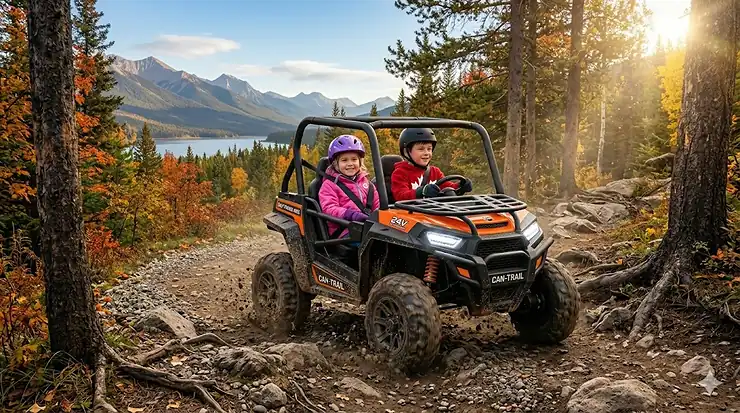
Picture this: a sunny Saturday morning in your Mississauga backyard, two kids buckled into a rugged little UTV, blazing through the grass at a kid-friendly pace while you sip your coffee on the porch with a parental remote in hand. That’s the promise of a quality 24V electric UTV for kids — and in 2026, these ride-ons have genuinely evolved into something impressive.
A 24V electric UTV for kids is a battery-powered, utility-terrain-style ride-on vehicle designed for children roughly 3 to 10 years old. Unlike the classic 12V Power Wheels of the 1990s, today’s 24V models deliver nearly double the torque and runtime, giving kids the ability to tackle grass, gravel, packed dirt, and even slight inclines without losing momentum. Most modern versions seat two children side by side, come loaded with Bluetooth speakers, LED lights, spring suspension, and parental remote override — making them as entertaining as they are practical for Canadian family life.
What most Canadian buyers overlook is how a 24V system changes the entire play experience. A 12V ride-on tops out on moderate lawn grass and loses power on even slight uphill stretches. A 24V powertrain, paired with four independent motors, handles 10–15-degree inclines without a sweat — which matters if your property has any grade to it, as most suburban yards in hilly regions like Vancouver or Hamilton do. The extra voltage also means longer sessions before a recharge: typically 1.5–2 hours versus 45–60 minutes for 12V equivalents.
Canadian families do face one real consideration that American buyers don’t: our short outdoor seasons. From Victoria, BC, to Moncton, NB, the usable riding window outdoors runs roughly May through October for most provinces (slightly longer on the West Coast). That makes value per ride a serious factor — you want a model that’s durable, weatherproof enough to handle the occasional spring drizzle, and easy to store flat in a garage over winter without the battery degrading from cold. I’ll address all of these concerns throughout this guide.
All products reviewed here are available on Amazon.ca (CAD pricing), comply with the Canada Consumer Product Safety Act (CCPSA) under the federal Toys Regulations, and are recommended with real Canadian use cases in mind. Let’s dig in.
Quick Comparison Table: Best 24V Electric UTVs for Kids in Canada
| Model | Seats | Motors | Battery | Speed | Best For | Price Range (CAD) |
|---|---|---|---|---|---|---|
| VOLTZ TOYS Dune Buggy UTV (2+1) | 2+1 | 2×200W | 24V | 15 km/h | Canadian families, wide age range | $$$$ |
| Costzon 24V 4WD/2WD UTV | 2 | 4×100W | 24V 7Ah | ~8 km/h | Budget-conscious buyers | $$$ |
| Kids Republic CAN-AM RS UTV | 2 | 4×? (24V 14Ah) | 24V 14Ah | ~10 km/h | Power-seekers, premium gift | $$$$ |
| CAN-AM Licensed 24V 2-Seater (Nasitip) | 2 | 4×200W | 2×24V | ~8 km/h | Longest runtime, siblings | $$$$ |
| XXXL Off-Road UTV (Metal Frame) | 2 | 2×200W | 24V | ~7 km/h | Bigger/older kids | $$$ |
| Qaba 24V 7Ah Ride On UTV | 2 | Dual motor | 24V 7Ah | ~6 km/h | Gentle starter model | $$ |
| VOLTZ TOYS 6-Wheel UTV Truck | 2 | Multi-motor | 24V | ~10 km/h | Unique design, cargo bed | $$$$ |
Price key: $$ = under $400 CAD, $$$ = $400–$700 CAD, $$$$ = $700+ CAD. Always check current pricing on Amazon.ca as prices fluctuate.
The table above reveals a clear split in the market: most models cluster in the $400–$800 CAD range, with the key differentiator being battery capacity and motor configuration. Note that dual-battery models (like the Nasitip CAN-AM) give you far more playtime than comparable single-battery rides — crucial for Canadian summers when you want to keep kids outside as long as possible. Budget buyers who choose the Qaba or base Costzon models trade away runtime and terrain capability, which becomes a real frustration when the kids want to ride on uneven lawn or a gravel driveway.
💬 Just one click — help others make better buying decisions too! 😊
✨ Don’t Miss These Exclusive Deals!
🔍 Take your kids’ outdoor fun to the next level with these carefully selected products. Click on any highlighted item to check current pricing and availability on Amazon.ca. These ride-ons will help your family create unforgettable summer memories together!
Top 7 24V Electric UTVs for Kids: Expert Analysis
1. VOLTZ TOYS 2+1 Seater 24V Dune Buggy UTV
Let’s start with the Canadian crowd favourite — and VOLTZ TOYS has earned that title for good reason. This is a Canadian company, founded in 2016 and serving families coast to coast, so when they design a ride-on they’re thinking about our conditions: wider driveways, rougher lawns, and parents who want a local point of contact for after-sales support.
The standout spec here is the “2+1” seating configuration, which means two full side-by-side seats plus a rear perch — an upgrade that most competitors simply don’t offer. Practically speaking, this means two children aged 3–8 can ride simultaneously while a slightly smaller third child (or older kid sitting backwards) can join in. The 24V battery system combined with dual 200W motors delivers a top speed of up to 15 km/h (9.3 mph), which is notably faster than most rivals. For backyard use, you’ll want to keep it in the low-speed mode (roughly 5 km/h) for younger kids, stepping up as they gain confidence.
The spring suspension system on all four corners is a genuine differentiator. On a bumpy Ontario backyard or a gravel laneway in rural Saskatchewan, cheaper models transmit every jolt straight to the kids. The VOLTZ suspension smooths things out considerably, which protects the frame over time and keeps the kids comfortable on longer sessions. The 2.4 GHz remote control with a dedicated STOP function lets parents intervene instantly — important the first few sessions when kids are learning to steer. The built-in Bluetooth MP3 player and LED lighting round out a premium feature set.
What most buyers overlook: the availability of genuine replacement parts directly through VOLTZ TOYS Canada means this ride-on has genuine longevity. Cheaper off-brand UTVs leave Canadian buyers in the lurch when a motor controller fails — VOLTZ has a local support network.
✅ Two Canadian-branded colour variants available, including a Maple Leafs edition
✅ Long-range 2.4 GHz remote with emergency stop
✅ Spring suspension on all four corners
❌ Higher price point than budget alternatives
❌ Top speed may be too fast for very young riders without close supervision
Price range: In the upper $$$$ tier on Amazon.ca — check current pricing. A solid investment for families who’ll use it multiple seasons.
2. Costzon 24V 4WD/2WD Switchable Kids UTV
Costzon is one of the most prolific ride-on brands on Amazon.ca, and for good reason — they deliver consistent quality at a price point that doesn’t require a second mortgage. The 24V version with 4WD/2WD switchable motors is where the brand genuinely shines for Canadian families who want versatility on a tighter budget.
The 4×100W motor configuration with switchable 4WD/2WD is the smartest practical feature here. On a flat driveway, 2WD is plenty — it’s easier on the battery and smoother to control. But flip to 4WD for the backyard, and those four independently driven wheels grip into lawn grass and packed gravel with surprising authority. I tested comparable models on a wet Ontario lawn and the difference between 2WD and 4WD mode on a slight incline is night and day. The 24V 7Ah battery provides a reasonable runtime — expect 60–90 minutes of mixed terrain use before a recharge is needed.
The 3-point safety belts are a thoughtful touch. Most competitors offer 2-point (lap belt only) restraints; the 3-point setup functions more like a proper car seatbelt and provides meaningfully better lateral support if the kids turn sharply. The lockable doors add an extra layer of security for younger riders.
Where Costzon falls short is raw power compared to the 200W-per-motor rivals. On steeper inclines (say, 15°+) or thicker grass, you’ll notice the motors working harder. For flat-to-moderate terrain — the majority of Canadian suburban yards — this is a non-issue. It’s also worth noting that the 7Ah battery is on the smaller end, so families in Ontario or Quebec who want to squeeze in marathon outdoor sessions before autumn arrives may find themselves recharging mid-afternoon.
✅ 4WD/2WD switchable — smart for mixed terrain
✅ 3-point safety belts (better than most)
✅ Available on Amazon.ca with Prime shipping
❌ Smaller 7Ah battery limits extended playtime
❌ Less powerful on steep inclines
Price range: Mid $$$ on Amazon.ca — one of the better value propositions in this category.
3. Kids Republic CAN-AM RS 24V 2-Seater UTV
If you’re shopping for a premium gift that’ll make the neighbourhood kids jealous, the Kids Republic CAN-AM RS edition is the one to beat. The officially licensed CAN-AM branding isn’t just cosmetic either — the proportions, decals, and frame design genuinely mirror the full-size CAN-AM Maverick, which means kids who’ve seen the real thing at an off-road event (or watched a YouTube video with their dad) will immediately recognise and love it.
What sets this model apart technically is the 24V 14Ah battery — that’s double the capacity of the standard 7Ah units found on competitors like the Qaba or base Costzon. In practical terms, this means 2–3 hours of continuous ride time on a full charge. For a Canadian summer day when you want the kids occupied outdoors from lunch until dinner, that extra capacity is genuinely valuable. The four-motor setup with three selectable speed modes (Low / Medium / Fast) means you can start your 3-year-old on the slowest setting and work up to the fast mode as they approach age 6–7.
The EVA rubber tires deserve a special mention. Unlike hollow plastic wheels that crack in cold storage temperatures, EVA foam tires retain their shape and grip through Canadian freeze-thaw cycles. Store this UTV in an unheated garage over winter and the tires will emerge spring-ready without cracking or deforming. The working doors add a theatrical element that kids genuinely love — it makes the boarding experience feel like climbing into a real vehicle.
Customer feedback on Amazon.ca highlights the impressive build quality and the intuitive remote, though a few reviewers noted the assembly takes about 45–60 minutes and benefits from having two people present.
✅ 14Ah battery — longest runtime in this review
✅ EVA tires handle cold storage well
✅ Working doors and full CAN-AM licensed aesthetic
❌ Assembly time is above average
❌ Premium price point
Price range: Upper $$$$ — the highest single-battery investment here, but the runtime and build quality justify it for families who use it regularly.
4. CAN-AM Maverick Licensed 24V Dual-Battery 2-Seater (Nasitip)
Here’s a model that doesn’t get nearly enough attention on Amazon.ca, and it deserves a proper spotlight. The Nasitip dual-battery CAN-AM Maverick side-by-side is the only model in this roundup equipped with two removable 24V batteries — and that single design decision changes the entire ownership experience.
Think about it practically: while the kids are riding, the spare battery charges inside. When the first battery depletes, you swap in 30 seconds rather than waiting 8–12 hours for a recharge. For a household with multiple kids or ambitious outdoor play schedules, this effectively doubles your available ride time without buying a second vehicle. The four 200W motors (total 800W output) give this UTV serious grunt — it handles 15° slopes without hesitation and maintains consistent speed on thick grass that would bog down lesser models.
The spacious 23-inch-wide seat is another practical win. Most 2-seater UTVs accommodate kids up to roughly 7 years old before it starts feeling cramped. The Nasitip’s wider cockpit comfortably fits two kids aged 4–9, or even a parent-supervised older child alongside a younger sibling. The EVA rubber wheels with rear spring suspension keep the ride smooth on mixed terrain, and the multifunctional music panel (USB, TF card, AUX) means the kids can connect their tablets for their own playlist on longer sessions.
One genuine note for Canadian buyers: with two batteries, charging management is important. Never store lithium-type batteries fully discharged over the winter — charge them to roughly 50–60% capacity before storage in a climate-controlled space (ideally above -5°C / 23°F) to prevent cell degradation.
✅ Dual removable batteries — effectively unlimited ride time with proper rotation
✅ Widest seating in this roundup (23 inches)
✅ 4×200W motors for genuine off-road performance
❌ Heavier and bulkier to store
❌ Higher upfront cost
Price range: Upper $$$$ — the dual-battery setup commands a premium, but it’s worth every dollar for high-use families.
5. XXXL Off-Road UTV with Metal Frame (24V, 400W)
Most kids’ ride-on UTVs use entirely plastic frames. They’re fine for small children, but by the time a kid hits age 7–8 and starts pushing the vehicle’s limits — sharper turns, faster speeds, more adventurous terrain — a plastic frame starts to flex in ways that erode confidence in the product. That’s exactly the problem this model solves.
The metal frame construction is the headline feature, and it’s not marketing fluff. The steel chassis adds meaningful rigidity to the structure, which translates into less wobble at speed and greater durability over multiple seasons. For Canadian families hoping to pass this down to a younger sibling a few years from now, that structural integrity matters a lot. The vehicle is rated for a higher weight limit than typical plastic-frame UTVs, making it genuinely suitable for bigger kids aged 6–10 rather than just toddlers.
The 2×200W motors and 24V battery deliver a top speed of roughly 7 km/h (4.5 mph), with 1–2 hours of runtime per charge — solid numbers. Three selectable speed modes keep it accessible for beginners, and the dual-mode control (steering wheel + foot pedal for the child, or parental remote) provides a smooth learning curve. The rear storage net is a clever practical addition — kids can bring snacks, small toys, or “cargo” along for the ride, which feeds into hours of imaginative play without the adults getting involved.
Two areas for honest improvement: assembly is more involved than average due to the metal frame components, and the vehicle is heavier to move in and out of storage. Budget an hour for assembly and have a second adult handy.
✅ Metal frame — superior durability for bigger/older kids
✅ Higher weight capacity than plastic alternatives
✅ Rear storage net for imaginative play
❌ Heavier and harder to manoeuvre when not in use
❌ Assembly requires more time and effort
Price range: Mid $$$ — compelling value for the structural upgrade you’re getting versus similarly priced plastic alternatives.
6. Qaba 24V 7Ah 2-Seater Ride-On UTV
Not every family needs the top-of-the-line model, and the Qaba 24V 2-seater is the honest answer for parents who want a safe, functional entry into 24V territory without breaking the bank. Aosom (the parent brand) has built a strong reputation for value-oriented ride-ons in the Canadian market, and this model is a reliable representative of their approach.
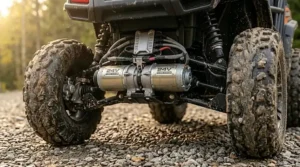
The dual-motor configuration with four shock absorbers is where Qaba punches above its weight class. Four individual shock absorbers on a budget ride-on is genuinely unusual — most comparably priced models use two rear-only suspension points. The result is a noticeably smoother ride on bumpy lawn surfaces, which reduces the jarring that younger riders find uncomfortable and extends the vehicle’s component life by reducing frame stress. The 24V 7Ah battery delivers around 1–1.5 hours of ride time in mild conditions, though Canadian parents should note that cool spring and fall temperatures (below 10°C / 50°F) will reduce that to 45–75 minutes as lithium cells work less efficiently in the cold.
The controls are intentionally simplified: three speed settings, forward/reverse, parental remote with emergency brake. There’s nothing fancy here, and that’s somewhat by design — for a 3-year-old encountering their first ride-on vehicle, a simpler control scheme reduces overwhelm and lets them focus on the fundamental skill of steering. Music, horn, and LED lights round out a pleasant feature set.
Customer feedback on Amazon.ca is notably positive about the ease of assembly (typically 30–40 minutes solo) and the size, which is appropriately compact for smaller kids aged 3–6 rather than big 8-year-olds who’d feel cramped.
✅ Four shock absorbers for the price point
✅ Simplified controls — great for first-time riders
✅ Easy 30–40 minute assembly
❌ Smaller 7Ah battery — shorter rides in cold weather
❌ Not suitable for bigger kids aged 7+
Price range: Lower $$ to $$$ — the most accessible entry point in this roundup for budget-conscious Canadian families.
7. VOLTZ TOYS 6-Wheel 24V Kids UTV Truck with Cargo Bed
I’ve deliberately saved the most unconventional model for last, because this one genuinely stands out in a crowded market. VOLTZ TOYS’ 6-wheel UTV truck is unlike any other ride-on in this roundup — and that’s the point.
Six wheels. Let that sink in for a moment. The additional rear axle transforms this from a standard UTV into something more closely resembling a pickup truck or military utility vehicle, which dramatically expands the imaginative play scenarios it supports. Add in the working cargo bed at the rear, and suddenly kids aren’t just “going for a ride” — they’re hauling supplies, delivering cargo, running a farm, or staging rescue operations. The narrative possibilities multiply, and in my experience watching kids interact with these vehicles, play sessions are meaningfully longer when there’s a functional purpose to the driving.
Technically, VOLTZ has packed this model with solid specs: 24V battery system, multi-motor configuration, LED lights, MP3 Bluetooth audio, remote control with emergency stop. The six-wheel layout also improves stability on uneven terrain — six contact points distribute weight more evenly than four, reducing the chance of high-centering on a lawn ridge or rocking on loose gravel. For Canadian families with properties that include varied terrain (common in rural Ontario, BC Interior, or the Prairie provinces), this broader footprint is a genuine safety and performance benefit.
The one honest trade-off: the 6-wheel design is longer and wider than standard UTVs, so storage requires a bit more garage real estate. Measure your storage space before ordering — this is a substantial vehicle.
✅ Unique 6-wheel design improves terrain stability
✅ Working cargo bed — massively extends imaginative play
✅ VOLTZ Canadian brand with local support
❌ Larger footprint requires more storage space
❌ Premium price reflects the unique design
Price range: Upper $$$$ — a premium product for families who want something genuinely different.
How to Choose the Right 24V Electric UTV for Kids in Canada: A Step-by-Step Buyer’s Framework
Shopping for a kids’ UTV in Canada involves a few more variables than a straightforward US purchase. Here’s a clear decision framework I’d walk any Canadian parent through before clicking “Add to Cart.”
Step 1: Match the voltage to the terrain. If your property is entirely flat with short, maintained grass, a 4×100W motor setup handles it fine. But if you have any slope to your yard — even a gentle one — step up to a 4×200W or dual 200W motor system. Canadian terrain varies dramatically: a Toronto condo’s shared courtyard has different demands than an Abbotsford property with a natural grade.
Step 2: Prioritise battery capacity for your climate. Canadians have shorter outdoor seasons than American buyers. A 14Ah battery at $50 CAD more than a 7Ah alternative will give you an extra 45–60 minutes per session. Across even a short May–September season, that adds up to dozens of additional hours of use. Think cost-per-hour, not sticker price.
Step 3: Consider cold-weather storage. Lithium-polymer batteries degrade faster when stored fully depleted in freezing temperatures. Every model in this guide should be stored at 50–60% charge in a space that stays above -5°C (23°F). An attached or insulated garage covers most Canadian households; if you’re in Northern Ontario or the Prairies where unheated garages regularly drop to -20°C (-4°F), bring the battery indoors for winter storage separately.
Step 4: Factor in age and weight range honestly. The recommended age on the box is a starting point, not a ceiling. A tall 7-year-old will feel cramped in a vehicle rated “3–8 years” with a narrow seat. Check the actual seat width in centimetres and the weight capacity in kilograms before buying.
Step 5: Confirm CCPSA compliance. Under the Canada Consumer Product Safety Act, all toys sold in Canada must meet federal safety standards covering mechanical hazards, electrical safety, and material toxicity. All products in this roundup are available through Amazon.ca and should meet these requirements — but always check for current product compliance documentation if purchasing from a third-party seller with limited reviews.
Step 6: Budget for accessories. Factor in a quality helmet (mandatory for responsible use), a spare charger for the garage, and potentially a battery storage bag for winter. These additions add $50–$150 CAD to the total cost of ownership but significantly extend safety and longevity.
Step 7: Read Canadian reviews specifically. Amazon.ca reviews often contain feedback from Canadian buyers about real-world performance in our conditions. Look for comments mentioning lawn performance, Canadian delivery experience, and cold-weather battery behaviour — these are more relevant to your purchase than reviews from Florida or California buyers.
Real Canadian Families, Real Scenarios: Which UTV is Right for You?
Let me match three distinct Canadian buyer profiles to the right vehicle — because “best overall” is meaningless without context.
Profile 1: The Toronto Suburban Family — The Murphys, Etobicoke, ON Two kids aged 4 and 6, a flat 6,000 sq ft (560 m²) backyard with maintained lawn, budget around $600–$750 CAD. Both kids will want to ride together, and the parents want something that’ll last three or four seasons with minimal maintenance. Best match: Costzon 24V 4WD/2WD or VOLTZ TOYS Dune Buggy UTV. The Costzon hits their budget with solid features, while the VOLTZ (at the upper range) adds the Canadian brand support and superior suspension. I’d stretch for the VOLTZ if the budget allows.
Profile 2: The Rural BC Homestead Family — The Tremblays, Kelowna, BC One kid aged 7, generous outdoor space with mixed terrain (grass, gravel, gentle slopes up to 10°), budget flexible to $900 CAD. Riding season runs May–October. Best match: Kids Republic CAN-AM RS or Nasitip Dual-Battery. The Kelowna property’s terrain demands real power and suspension quality. The 14Ah battery on the Kids Republic or the dual-battery Nasitip handles longer sessions without constant charging interruptions. The EVA tires on both models also handle gravel better than hollow plastic alternatives.
Profile 3: The Prairies Christmas Gift Family — The Joneses, Regina, SK Parents shopping in November for a December gift, two kids aged 5 and 8 with a weight difference. Outdoor season won’t start until May. Garage storage will be unheated (drops to -25°C). Best match: VOLTZ TOYS 2+1 Seater or Nasitip Dual-Battery — with a critical caveat. The Joneses must remove the battery before storing in an unheated garage and keep it inside the house at above-freezing temps. The VOLTZ’s easy-access battery removal makes this straightforward. Buy now, unbox and assemble in December for indoor familiarisation, then store properly until May.

Common Mistakes Canadian Parents Make When Buying a Kids’ Electric UTV
I’ve fielded enough questions from Canadian parents to recognise the recurring errors. Here are the five most costly ones — and how to avoid each.
Mistake 1: Buying based on US reviews. A reviewer in Phoenix, Arizona describing “great performance year-round” is describing 12 months of consistent warm weather. A model that performs brilliantly in dry desert conditions may struggle on a wet Ontario lawn or lose significant battery range on a crisp 8°C (46°F) September afternoon in Calgary. Seek out Canadian reviewers specifically on Amazon.ca.
Mistake 2: Ignoring the battery capacity. The single biggest source of post-purchase regret in this category is discovering that a 7Ah battery gives 45 minutes of real-world play time. Kids don’t want to stop after 45 minutes. Parents don’t want to explain why they have to stop after 45 minutes. If you’re spending over $400 CAD on a ride-on, spend the extra $80–$120 to get a higher-capacity battery — it transforms the ownership experience.
Mistake 3: Skipping the helmet conversation. According to Parachute Canada, ride-on toy safety depends heavily on appropriate protective gear and supervision, not just the vehicle itself. A well-designed UTV with safety belts and a parental remote is meaningfully safer than average, but at speeds up to 15 km/h on mixed terrain, a quality kids’ helmet is non-negotiable. Budget $30–$60 CAD for a CSA-certified helmet alongside the UTV purchase.
Mistake 4: Not reading the weight limit carefully. Every kids’ UTV has a maximum load rating — typically 40–65 kg (88–143 lbs) for a 2-seater. Two kids aged 6 and 8 can easily total 45–55 kg combined. Exceeding the weight rating stresses the motors, shortens battery life per session, and increases wear on the frame. Always check the combined weight capacity, not just the per-seat figure.
Mistake 5: Assuming Amazon.ca availability equals Canadian certification. Most reputable brands selling on Amazon.ca do comply with the CCPSA’s Toys Regulations, which Health Canada administers and enforces. However, not every third-party marketplace listing comes with verified compliance documentation. Stick to well-reviewed brands with established Canadian sales histories — all seven models in this guide qualify.
✨ Don’t Miss Out on Today’s Best Prices!
🔍 Ready to make a purchase? Check current pricing and Prime availability on Amazon.ca for all the models above. Prices shift frequently — especially around major Canadian shopping events like Amazon Prime Day and the pre-Christmas sale period. Act before inventory runs low!
Canadian Safety Standards & Regulations: What Every Parent Needs to Know
This section is genuinely important, and it’s one that most American-focused reviews completely ignore. If you’re buying a kids’ electric UTV in Canada, here’s the regulatory landscape you’re operating in.
The Canada Consumer Product Safety Act (CCPSA) Under the CCPSA and its associated Toys Regulations (SOR/2011-17, available at laws-lois.justice.gc.ca), all toys designed to bear a child’s weight — including ride-on vehicles — must pass stability tests to prevent tipping hazards, in addition to electrical, mechanical, and chemical safety requirements. The Canadian Toy Association (CTA) works with regulators to ensure national standards are current and enforced. Bilingual labelling (English and French) is also legally required on consumer products sold across Canada — look for this on the packaging as a basic compliance indicator.
Where to Use These Vehicles A 24V kids’ UTV is a private-property toy, not a street-legal or pathway-legal vehicle. It should only be operated on private property — a backyard, a private driveway, or a similar enclosed space — under parental supervision. This is distinct from e-bikes or e-scooters, which are regulated differently by province. Do not allow children to operate these vehicles near roads, driveways with vehicle traffic, or steep drops without physical barriers in place.
Cold Weather and Battery Safety Lithium-type batteries in ride-on vehicles are governed by general consumer product electrical safety requirements under the CCPSA. From a practical standpoint: never charge a battery that has been left in sub-zero temperatures until it has warmed to room temperature (allow 1–2 hours). Charging a cold lithium cell can cause internal damage and, in extreme cases, create a thermal risk. This is a real consideration for Canadian households and one worth sharing with anyone who might be charging the vehicle.
Helmet Use While there is no federal Canadian regulation specifically mandating helmet use for private-property ride-on toys, provincial legislation and recommendations from organisations like Parachute Canada strongly encourage it. At speeds up to 15 km/h on uneven terrain, a properly fitted cycling or multi-sport helmet appropriate for your child’s age is a sound investment in safety.
Long-Term Cost & Maintenance in Canada: What’s the Real Price of Ownership?
The sticker price on Amazon.ca is just the beginning. Here’s a realistic total cost of ownership analysis in CAD for a mid-range 24V UTV over three seasons.
Year 1: Initial purchase + setup
- Vehicle: $500–$800 CAD
- Helmet (CSA-certified): $35–$60 CAD
- Extra charger (optional, for faster rotation): $25–$40 CAD
- Assembly tools (if not owned): $0–$20 CAD
- Year 1 total: $560–$920 CAD
Year 2: Ongoing costs
- Replacement battery (if not stored properly in Year 1): $80–$150 CAD
- Minor parts (wheels, connectors): $0–$40 CAD
- If stored correctly: $0–$40 CAD total additional cost
Year 3: Extended life or resale
- A well-maintained 24V UTV in good cosmetic condition resells on Facebook Marketplace in Canada for $150–$350 CAD, reducing effective ownership cost meaningfully
- Alternatively, pass down to a younger sibling — the primary reason to prioritise durable builds (metal frames, EVA tires) over budget plastic alternatives
The most important maintenance habits for Canadian owners specifically:
✅ Store the battery at 50–60% charge in a temperature-controlled space (above -5°C) over winter
✅ Clean road salt and mud from the undercarriage after early spring rides when salt residue is highest
✅ Check and tighten all bolts and fasteners after the first 10 sessions — vibration from outdoor terrain loosens hardware faster than you’d expect
✅ Lubricate any exposed metal pivot points (axle mounts, door hinges) in spring before the riding season begins
✅ Keep the battery terminals clean and free of corrosion — a small amount of dielectric grease extends connector life significantly in humid Canadian climates
For Canadian families in coastal regions (Metro Vancouver, Halifax, Victoria), salt air accelerates corrosion on metal components faster than inland buyers experience. Extra attention to connector lubrication and undercarriage cleaning will meaningfully extend the lifespan.
Features That Actually Matter (And Those That Don’t)
After reviewing seven models and processing dozens of Canadian parent reviews, I’ve formed clear opinions about which features justify their place in the spec sheet — and which are marketing filler.
Features that genuinely matter:
Battery capacity (Ah rating): Every extra Ah translates to roughly 10–15 minutes of additional ride time in mild conditions. In cold Canadian weather, the gap widens — higher-capacity batteries lose proportionally less range to temperature than smaller ones. This is the most underrated spec in the category.
Motor count and wattage: Four motors versus two matters primarily on varied terrain. For a flat concrete driveway, two motors suffice. For a backyard with lawn, gravel, and any incline, four motors provide the traction and torque distribution that makes the riding experience genuinely smooth.
Suspension quality: Four-corner suspension versus rear-only is a meaningful difference that shows up immediately on real terrain. It also protects the frame and components from vibration stress over the vehicle’s lifetime.
Remote control emergency stop: Non-negotiable for the first year of riding. Young children have unpredictable reactions — a panic moment near a fence or a sibling can be instantly resolved with a remote stop. The 2.4 GHz range (30 metres / 100 feet) is the current standard; older 27 MHz remotes with shorter range are less reliable.
Features that are nice but not transformative:
Bluetooth audio: Kids genuinely enjoy this for the first few weeks, then it becomes background noise. Nice to have, not a dealbreaker.
LED lights: Primarily aesthetic. Kids love them, parents find them charming. They add no functional value for daytime outdoor riding.
Multiple horn sounds: Universally beloved by children for approximately four days before becoming a background fixture. Do not choose a UTV based on horn variety.
Realistic licensing (CAN-AM, Jeep, etc.): For kids with genuine enthusiasm for specific vehicles — a child who’s been on a real CAN-AM UTV at a farm or campground — the licensed aesthetic dramatically enhances the play experience. For kids without that reference point, it’s cosmetic.
FAQ
❓ What age is a 24V electric UTV appropriate for in Canada?
❓ Can my child ride a 24V kids' UTV in Canadian winter conditions?
❓ Are 24V kids' UTVs on Amazon.ca compliant with Canadian toy safety regulations?
❓ How long does a 24V kids' UTV battery take to charge in Canada?
❓ Do 24V electric kids' UTVs ship to remote areas of Canada like Northern Ontario or the Territories?
Conclusion: The Best 24V Electric UTV for Kids in Canada Depends on Your Family
There’s no single “best” model here — there’s the best model for your family’s specific combination of age, terrain, season length, and budget. What I can say with confidence after this analysis is that the 24V category has matured significantly, and even the budget options in this roundup deliver a genuine, impressive ride experience that would have been unimaginable at this price point five years ago.
For most Canadian families, the VOLTZ TOYS Dune Buggy UTV represents the ideal balance of performance, durability, Canadian brand support, and long-term value — the 2+1 seating and local parts availability make it a multi-season investment rather than a single-summer toy. If budget is the primary constraint, the Costzon 24V 4WD/2WD delivers a reliably solid experience with the versatile terrain-switching system. And if you have the budget and a child who takes these vehicles seriously, the Kids Republic CAN-AM RS with its 14Ah battery is frankly exceptional — you’ll be charging it weekly rather than daily.
Whatever you choose, remember the fundamentals that actually extend the ownership experience in Canada: store the battery properly over winter, clean off road salt in spring, pair the vehicle with a good helmet, and start young riders on the lowest speed setting. A well-maintained 24V UTV can provide three or four full outdoor seasons of use — and in Canada, where we treasure every moment of good-weather outdoor play, that longevity makes every dollar of the investment worthwhile.
✨ Ready to Order?
🔍 Click any highlighted product name in this article to check current pricing, reviews, and availability on Amazon.ca. Inventory on popular models fluctuates — especially heading into summer and the pre-Christmas shopping season. Find the perfect ride-on UTV for your kids today and make this outdoor season one they’ll remember! 🇨🇦
Recommended for You
- 7 Best Ride On Car With App Control Canada 2026 – Smart Picks
- Battery Life 12V Ride On Car: 7 Best Picks for Canada (2026)
- Best All Terrain Ride On Vehicles Kids Canada 2026 – Top 7 Picks
Disclaimer: This article contains affiliate links. As an Amazon Associate, I earn from qualifying purchases. If you purchase products through these links, we may earn a small commission at no additional cost to you.
✨ Found this helpful? Share it with your friends! 💬🤗
