In This Article
So your kid is finally old enough to graduate from a push scooter — and suddenly every option on the internet looks the same. I get it. I spent weeks researching electric scooters for kids before writing this guide, and I can tell you: not all of them are created equal, especially when you’re shopping in Canada.
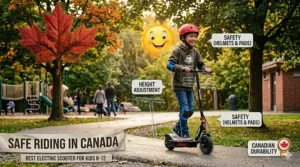
Finding the right electric scooter for kids 8-12 means balancing fun with safety, speed with control, and budget in CAD with long-term durability — all while factoring in the very real Canadian reality of spring mud, October rain, and the occasional October snowfall that catches everyone off guard. A scooter that performs beautifully in San Diego may be underwhelming for a kid in Winnipeg dealing with wet pavement in September.
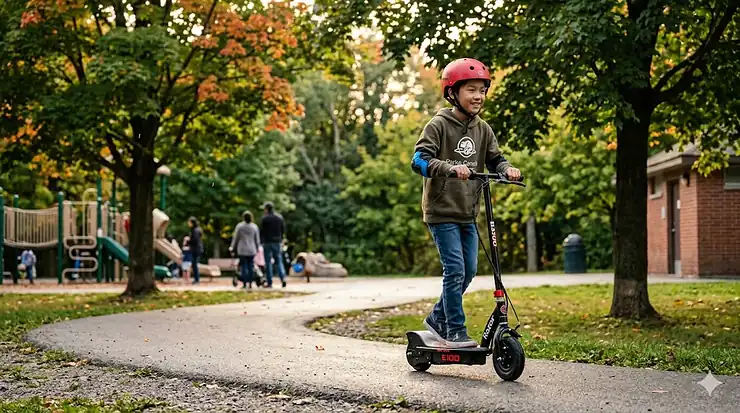
What makes a great kids’ electric scooter for this age group? Think of it as a sweet spot: riders aged 8-12 are past the training-wheel stage but aren’t ready for adult commuter speeds. They need a scooter with a top speed under 20 km/h (12 mph) for beginners, a solid weight capacity (most kids in this range are 30–55 kg / 66–121 lbs), reliable brakes, and something lightweight enough that they can actually carry it up the front steps when they’re done.
In this guide, I’ve researched and reviewed 7 real electric scooters available on Amazon.ca, covering everything from beginner-friendly budget picks to mid-range models that’ll grow with your child. I’ll also walk you through Canadian safety regulations (yes, they vary by province — a lot), cold-weather riding tips, and how to choose the right scooter for your kid’s age, weight, and skill level. Let’s roll. 🛴
Quick Comparison Table: Best Electric Scooters for Kids 8-12 (Canada 2026)
| Model | Top Speed | Range | Weight Limit | Foldable | Price Range (CAD) | Best For |
|---|---|---|---|---|---|---|
| Segway Ninebot C2 Pro | 20 km/h | ~15 km | 50 kg | ✅ | $280–$340 | Best overall, ages 8–12 |
| Razor Power Core E100 | 18 km/h | ~60 min ride | 54 kg | ❌ | $190–$240 | Best beginner, ages 8–10 |
| Gotrax GKS Plus | 12 km/h | ~6 km | 50 kg | ✅ | $150–$190 | Budget-friendly starter |
| Razor E200 | 21 km/h | ~40 min ride | 68 kg | ❌ | $280–$340 | Bigger/older kids, ages 10–12 |
| Hiboy S2 Lite | 24 km/h | ~17 km | 50 kg | ✅ | $320–$380 | Speed-ready 10–12 yr olds |
| NAVEE K100 Kids | 20 km/h | ~11 km | 50 kg | ✅ | $220–$280 | Mid-range value, great lights |
| Segway Ninebot C2 Lite | 16 km/h | ~9 km | 50 kg | ✅ | $200–$260 | Lightweight beginner |
Note: All prices are approximate ranges in CAD and are subject to change. Always check Amazon.ca for current pricing.
The table above tells you the basics, but it can’t tell you why the Razor E200 might make more sense for a tall 11-year-old in BC than the Hiboy S2 Lite, or why a Gotrax GKS Plus is often the smarter buy for parents in Atlantic Canada where pavement quality varies. Let me break it down properly.
💬 Just one click — help others make better buying decisions too! 😊
✨ Don’t Miss These Exclusive Deals!
🔍 Take your kids’ outdoor adventure to the next level with these carefully selected scooters. Click on any highlighted item to check current pricing and availability on Amazon.ca. These picks will get your child outside, active, and grinning from ear to ear!
Top 7 Electric Scooters for Kids 8-12: Expert Analysis 🇨🇦
1. Segway Ninebot Kickscooter C2 Pro — Best Overall for Ages 8–12
The Segway Ninebot C2 Pro is, in my opinion, the gold standard for an electric scooter for kids 8-12 right now — and the Canadian availability on Amazon.ca makes it a convenient top pick.
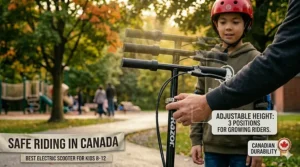
Its 200W motor delivers a max speed of 20 km/h (12.4 mph), which is fast enough to be genuinely fun, but not so fast that parents are white-knuckling it on the driveway. The real-world range hovers around 12–15 km, which in Canadian terms means a solid afternoon of riding around the neighbourhood without needing a mid-ride charge. The adjustable handlebar (three height settings) is a practical win — you won’t be buying a new scooter when your kid grows 5 cm over winter break. It weighs approximately 10.7 kg, which is on the heavier side for carrying up stairs but manageable for kids in this age group.
What I genuinely appreciate about the C2 Pro for Canadian riders is the three-speed mode system. You can lock it to slow mode (10 km/h) when your kid is still building confidence on wet pavement in May, and unlock faster speeds as they develop skill. The built-in Bluetooth speaker is honestly just fun — kids love it. UL 2272 certified, which is the international electrical safety standard you want to see on any e-scooter for children.
Canadian parents reviewing this model consistently mention how well it holds up through spring and fall riding seasons. The front electronic brake and rear drum brake combo gives responsive stopping — critical on the slight grades common in suburban Canadian neighbourhoods.
✅ Adjustable handlebar grows with child
✅ Three speed modes — parent-controlled learning curve
✅ UL 2272 certified, ambient RGB lights kids love
❌ Heavier than some competitors (~10.7 kg)
❌ Battery range drops ~15% in temperatures below 10°C
Price range: $280–$340 CAD — excellent value for a scooter that’ll last 2–3 seasons.
2. Razor Power Core E100 — Best Beginner Electric Scooter
Razor has been making scooters since before most of the kids riding them were born, and the Power Core E100 is a testament to why the brand still leads in this space.
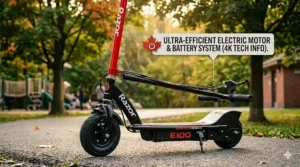
The hub motor (integrated into the rear wheel) is a significant upgrade over older belt-driven Razor designs — there’s virtually no maintenance, no chain to lube, no belt to replace. For a parent who already has enough things to maintain, that matters. The motor is rated at 100W, delivering a top speed of around 18 km/h (11 mph), which makes it genuinely appropriate for first-time riders aged 8-10. Ride time is approximately 60 minutes on a full charge, which is generous for the price range. Weight capacity is 54 kg (120 lbs), covering most kids in the target age group.
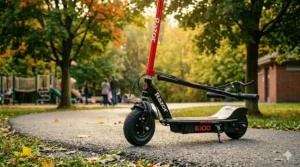
The honest assessment: this is not a foldable electric scooter for children, and it’s slightly bulkier than the Segway C2 series. If your driveway is small or you’ll be loading it into a trunk frequently, that’s worth considering. But if your kid has room to ride and will mostly use it around the home or neighbourhood, the E100’s durability is hard to beat. The steel frame has taken serious Canadian seasons in stride — multiple Canadian reviewers note it handles spring wet conditions well.
What most buyers overlook is that the kick-to-start mechanism actually builds good riding habits from day one. Kids learn to push off before the motor engages, which translates directly to safer riding instincts.
✅ Near-zero maintenance hub motor
✅ 60-minute ride time — generous for the price
✅ Proven durability; Razor’s Canadian warranty coverage is solid
❌ Not foldable — bigger footprint for storage
❌ Single speed; no parent-adjustable speed limit
Price range: $190–$240 CAD — one of the best beginner electric scooters at this price point.
3. Gotrax GKS Plus — Best Budget Pick Under $200 CAD
If you’re working with a tighter budget, the Gotrax GKS Plus is the kids electric scooter under 300 dollars (and well under, in fact) that I’d actually recommend without hesitation.
The GKS Plus uses a foot-activated throttle — the child has to have both feet on the deck to engage the motor, which is a clever passive safety feature that prevents accidental acceleration. Top speed is 12 km/h (7.5 mph), which is deliberately slow and perfect for true beginners or smaller 8-year-olds who are new to motorised riding. Range is approximately 6 km per charge, so it’s suited to short neighbourhood loops rather than long excursions.
At roughly 5.5 kg, it’s one of the lightest kids e-scooters in this guide, which is a practical win for Canadian families who live in multi-storey condos or townhomes where the scooter gets carried inside daily. The foldable design means it fits easily in an apartment hallway or school bag area.
For value-conscious Canadian families, this model consistently appears as the “starter” pick: buy it when your kid is 8, they’ll master it by 9, and then you upgrade to something faster. Think of it as the training wheels of electric scooters — and that’s not an insult, it’s a feature.
✅ Foot-activated safety throttle — excellent for true beginners
✅ Ultra-lightweight (~5.5 kg) and foldable
✅ Most affordable option in this guide
❌ Short range (~6 km) — not ideal for longer rides
❌ Low top speed means older/faster kids will outgrow it quickly
Price range: $150–$190 CAD — outstanding value for a first scooter.
4. Razor E200 — Best for Bigger Kids and Confident Riders Ages 10–12
When your 11-year-old looks at the E100 and says “that’s the one for little kids,” it’s time to look at the Razor E200.
The E200 features a chain-driven 200W motor delivering speeds up to 21 km/h (13 mph) and a generous weight limit of 68 kg (150 lbs) — the highest in this guide, making it ideal for bigger, heavier kids approaching adolescence. The wider, rubberised deck is noticeably roomier, which matters for older riders with larger feet. Ride time is approximately 40 minutes on a full charge.
In practical Canadian terms, the E200 is the best electric scooter for 10 year old kids who already have some riding experience and are ready for more. The larger frame also means better stability at higher speeds, which reduces the wobble factor on gravel driveways or slightly uneven pavement — both of which are common in Canadian suburban and rural settings. It’s not foldable, so storage space matters, but for kids who use it primarily on a driveway or private property, this is rarely a dealbreaker.
One thing the spec sheet won’t tell you: the E200’s chain drive requires occasional lubrication — every 2-3 months of regular use. Keep a bottle of chain lube handy, especially heading into fall when things get wet.
✅ Highest weight capacity (68 kg) in this guide
✅ More powerful motor — real speed for confident riders
✅ Wider deck accommodates older, larger kids
❌ Chain drive requires occasional maintenance
❌ Not foldable; larger storage footprint
Price range: $280–$340 CAD — worth every dollar for kids on the upper end of this age range.
5. Hiboy S2 Lite — Best for Speed-Ready Kids 10–12
The Hiboy S2 Lite sits in the fastest kids electric scooter territory that’s still age-appropriate for 10-12 year olds, with a top speed of 24 km/h (15 mph).
That top speed number needs context: 24 km/h is noticeably faster than most dedicated kids’ models, and this is a scooter for confident riders who understand how to brake progressively, not first-timers. What I like for Canadian riders specifically is the 10.6-mile (17 km) real-world range, which translates to genuine neighbourhood exploration territory — enough to ride to a friend’s place across town and back without anxious battery-watching.
The Hiboy S2 Lite is also foldable and weighs approximately 12 kg, making it manageable for older kids to carry into school or a community centre. The LED headlight is large and highly visible — a feature that matters as Canadian days shorten in September and October. The front disc brake and rear e-brake combination gives superior stopping power compared to most scooters at this price.
A note for Canadian buyers: Hiboy has expanded its Canadian presence, and the S2 Lite is Prime-eligible on Amazon.ca in most provinces. The app connectivity lets parents set speed limits remotely — a genuinely useful parental control feature that the Razor models lack.
✅ Fastest appropriate speed for this age group (24 km/h)
✅ App-based parental speed limiting
✅ Large, visible LED headlight — great for fall riding
❌ Heavier than other options (~12 kg) — less ideal for younger/smaller riders
❌ Too fast for beginners; best for experienced riders 10+
Price range: $320–$380 CAD — premium for a kids’ scooter, but justified for the right rider.
6. NAVEE K100 Kids Electric Scooter — Best Mid-Range Value
The NAVEE K100 is a lightweight kids e-scooter that deserves more attention than it gets, especially in Canada where mid-range options between $200–$280 CAD are often overlooked.
The K100 delivers a top speed of 20 km/h (12.4 mph) with a range of approximately 11 km — respectable numbers that put it squarely in competition with the Segway C2 Pro. What sets it apart is the RGB ambient lighting system, which is genuinely impressive: multi-colour LED lights under the deck that cycle through patterns kids customise via the companion app. In terms of raw fun factor, this scooter punches above its price class.
The three-speed system (slow/medium/fast) and kick-to-start design make it accessible for beginner to intermediate riders in the 8–12 range. At roughly 9 kg and with a foldable stem, it’s a practical lightweight kids e-scooter for families navigating school drop-offs or condo storage. Weight capacity is 50 kg (110 lbs).
For Canadian buyers, what I find most compelling is NAVEE’s improving retail presence: the K100 is available via Amazon.ca and typically ships across Canada including most provinces. It’s a great option when you want something a step above entry-level but aren’t ready to spend $350+ CAD.
✅ RGB light show — huge win with kids
✅ Three speed modes with app control
✅ Excellent value in the $220–$280 CAD range
❌ Brand recognition lower than Razor/Segway (minor warranty concern)
❌ Range slightly shorter than Hiboy S2 Lite at comparable speeds
Price range: $220–$280 CAD — my top recommendation for the mid-range sweet spot.
7. Segway Ninebot C2 Lite — Best Lightweight Beginner Scooter
Rounding out our list is the little sibling of the C2 Pro, and in many ways it earns its own recommendation for the right buyer.
The Segway C2 Lite is built for ages 6–10 officially, but it’s a strong choice for smaller or more cautious 8–9 year olds who are just getting their first electric scooter. Top speed is 16 km/h (9.9 mph), range is approximately 9 km, and the scooter weighs around 7 kg — noticeably lighter than most competitors, which makes a difference for kids who are smaller or who’ll be carrying it regularly.
The solid rubber tyres mean zero flats — no worrying about pressure after a winter of storage. The UL 2272 certification and Segway’s Canadian brand backing (Segway Canada has an official store) give peace of mind on quality and after-sale support. This is the scooter I’d recommend if you’re buying for a smaller, less confident 8-year-old who isn’t ready for the faster C2 Pro.
✅ Lightest scooter in this guide (~7 kg)
✅ Puncture-proof solid tyres — no flat worries
✅ Strong Segway brand support in Canada
❌ Lower top speed (16 km/h) means faster kids will outgrow it
❌ Range is the shortest of the Segway C2 line at ~9 km
Price range: $200–$260 CAD — ideal if the C2 Pro feels like too much too soon.
How to Choose the Best Electric Scooter for Kids 8-12 in Canada
Choosing a kids’ scooter isn’t just about picking the flashiest model. Here’s a numbered framework that cuts through the noise:
1. Match speed to skill, not age. Age is a rough guide, but skill level matters more. A cautious 10-year-old should start on a 12–16 km/h model (Gotrax GKS Plus, Segway C2 Lite) before moving up. A confident 8-year-old who already rides a bike well can likely handle 18–20 km/h. Never start a beginner on the fastest kids electric scooter you can find.
2. Check weight capacity against your child’s current and projected weight. Most models in this guide support 50 kg (110 lbs). If your child is approaching or exceeding that, the Razor E200 (68 kg limit) is the smart choice. Factor in one year of growth.
3. Prioritise fold-ability based on your living situation. Living in a Toronto condo or a Vancouver apartment? A foldable electric scooter for children is essential. Storing it in an attached garage in suburban Oakville? Fold-ability is nice but not critical.
4. Think about Canadian seasons honestly. Most of these scooters perform best on dry pavement. For spring or fall riding in Canada, look for models with sealed bearings, solid rubber tyres (no puncture risk from wet conditions), and avoid riding in temperatures below 5°C — lithium batteries lose 10–20% efficiency in the cold, and wet braking distances increase significantly.
5. Budget in CAD, including accessories. A helmet is non-negotiable — factor in $40–$80 CAD for a quality certified helmet. Knee and wrist pads add another $30–$50. The real cost of a “cheap” $150 scooter is $250+ once you account for safety gear.
6. Verify Amazon.ca availability and shipping to your province. Some models may show on Amazon.ca but have limited shipping to remote areas (northern Ontario, rural Newfoundland, Yukon). Prime membership removes most of these barriers and adds free shipping on qualifying orders.
7. Consider after-sale support in Canada. Segway and Razor have established Canadian support channels and warranty processes. Lesser-known brands may require you to ship products cross-border for warranty claims — a costly and slow process. Buy brand-name when in doubt.
Real-World Scenario Guide: Which Scooter for Which Canadian Family?
Let’s make this concrete with three real Canadian buyer profiles.
🏙️ Profile 1: The Toronto Condo Family Emma, 9, lives on the 14th floor of a downtown Toronto condo. Her parents want a scooter she can ride in the park nearby, but it needs to fold and be carryable on the elevator. Emma is a cautious rider, new to electric scooters.
Best pick: Segway Ninebot C2 Lite. At 7 kg and fully foldable, it fits in a coat closet and an elevator without drama. The slow speed mode keeps things manageable for a beginner, and the solid tyres handle the city’s patchy pavement without fuss.
🏡 Profile 2: The Suburban Ottawa Family Marcus, 11, lives in Kanata. He’s been riding a kick scooter for three years and wants something with real speed. He rides long neighbourhood loops and wants to keep up with his older friends.
Best pick: Hiboy S2 Lite. The 24 km/h top speed and 17 km range are exactly what Marcus needs. The app-based parental speed limit means his parents can start him at 18 km/h and unlock full speed once they’re satisfied with his skills. The bright LED headlight is practical as Ottawa September evenings come early.
🌲 Profile 3: The Kelowna Rural Family Sophie, 10, in West Kelowna has a long private driveway and uses her scooter on quiet residential roads. She wants something durable that doesn’t need constant maintenance.
Best pick: Razor E200. The higher weight limit and powerful motor handle the slight inclines in the Okanagan without straining. The chain drive needs occasional lube, but Sophie’s dad is mechanically inclined. Storage isn’t an issue in their detached garage.
Problem → Solution: Canada-Specific Buying Challenges
Problem 1: “The scooter I want isn’t available on Amazon.ca.” This happens more than it should. Amazon.ca has a smaller selection than Amazon.com, and some models only ship to Canada from US sellers at extra cost. Solution: Filter Amazon.ca results to “Ships from and sold by Amazon.ca” to avoid cross-border delays and customs surprises. All 7 models in this guide are available on Amazon.ca.
Problem 2: “Battery dies after 20 minutes instead of the advertised 60 minutes.” Cold temperatures are the silent scooter killer. Lithium-ion batteries lose 15–25% efficiency below 10°C and can lose up to 40% in freezing temperatures. Solution: Store the battery (or the whole scooter) indoors overnight. Never charge a battery that’s been sitting in a cold car or garage — bring it to room temperature first. Real-world range in Canadian spring/fall conditions will be 60–75% of the manufacturer’s advertised figure.
Problem 3: “My kid outgrew the scooter after one summer.” This is a real concern with entry-level models. Solution: For kids aged 8-9, buy a budget model (Gotrax GKS Plus) knowing it’s a 1–2 season investment. For kids aged 10-12 who are closer to their adult size, invest in a mid-range model (Segway C2 Pro, Hiboy S2 Lite) that can last 3–4 seasons.
Problem 4: “I don’t know if electric scooters are even legal where we live.” This is a genuinely complex question in Canada. Solution: See the dedicated regulatory section below — but for kids using scooters on private property or in supervised park settings, regulations typically don’t apply. Always verify with your local municipality.
Problem 5: “Cross-border warranty issues — the company is American.” Some brands process Canadian warranty claims through US service centres, which can mean 4–8 week turnaround times. Solution: Prioritise brands with established Canadian operations (Segway Canada, Razor Canada). Keep your Amazon.ca receipt — it’s often easier to process a return through Amazon within the return window than through a manufacturer directly.
Canadian Regulations and Safety Standards for Kids’ Electric Scooters
This is the section most Canadian parents need to read carefully, because the legal landscape for e-scooters in Canada is genuinely complicated — and the rules that apply to adults don’t always apply to kids on private property or in supervised settings.
The federal baseline: Transport Canada doesn’t regulate electric kick scooters the same way it regulates motor vehicles. As a result, provincial and municipal governments set their own rules — and they vary enormously.
Key provincial realities for kids’ scooters:
- Ontario: E-scooters are part of a pilot program running until 2029. Toronto has opted out — e-scooters cannot be ridden in public in Toronto. Kids using them on private property (driveways, private parks) are generally unaffected. Other Ontario cities (Ottawa, Mississauga, Hamilton) have opted in under specific rules.
- British Columbia: BC’s pilot program runs until 2028. Participating communities include Vancouver, Kelowna, Victoria, and 30+ others. Maximum speed is 25 km/h; riders must be 16+ on public roads. For kids under 16, private property use is generally the practical option.
- Quebec: A pilot program runs until July 2026 (extension expected). In Montreal specifically, the minimum age is 14 for public road/path use.
- Alberta: Private e-scooters are actually classified as “prohibited miniature vehicles” under the Traffic Safety Act on public roads — only shared rental programs are permitted publicly. Private property use for kids is unaffected.
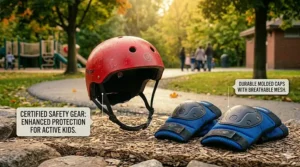
The practical upshot for parents: For children aged 8-12, the safest and most legally clear context for electric scooter use is private property — driveways, private courts, supervised parks. Always equip your child with a CSA-certified bicycle helmet. In provinces where helmets are required for public riding, the standard is typically a bicycle or motorcycle helmet meeting Canadian standards.
Safety gear essentials in Canada: 🇨🇦 Helmet: CSA B220 certified or equivalent 🇨🇦 Knee pads and wrist guards: strongly recommended for ages 8-10 🇨🇦 Reflective gear: required at night in most provinces where riding is legal
What to Expect: Real-World Performance in Canadian Conditions
Here’s what the spec sheet won’t tell you about riding a kids’ electric scooter in Canada:
Cold weather battery reality: Every lithium-ion battery loses efficiency in the cold. At 5°C, expect roughly 75-80% of advertised range. At 0°C, you may see 60% or less. The fix is simple: bring the scooter inside between rides, and never leave a lithium battery in a cold car overnight.
Wet pavement braking: Stopping distance increases on wet pavement — sometimes by 50% or more for mechanical brakes. Teach your child to brake earlier on wet days. Models with disc brakes (Hiboy S2 Lite) perform better in wet conditions than rear fender brakes.
Road salt and corrosion: This is a Canada-specific issue. Road salt used through winter months accelerates corrosion on metal components. Even if your child doesn’t ride in winter, scooters stored in garages can be exposed to salt tracked in on vehicles. Wipe down metal parts with a dry cloth after each fall/spring ride, and apply a light spray of bike chain lube to metal joints before winter storage.
Spring thaw pavement quality: Canadian freeze-thaw cycles are brutal on road surfaces. Small potholes and cracks appear every spring. Models with larger, more forgiving tyres (Razor E200 with wider rear tyre, Hiboy S2 Lite with 10-cm solid tyres) handle patchy spring pavement better than models with narrow, rigid wheels.
Storage for winter: For most Canadian families, e-scooters are a spring-to-fall activity (roughly May to October, depending on province). Before winter storage, charge the battery to 50-60% — not full, not empty — and store indoors at room temperature. A battery stored at 0% charge will degrade significantly over a Canadian winter.

Long-Term Cost and Maintenance in Canada
One thing the initial purchase price in CAD doesn’t show you is total cost of ownership over a 3-year period. Let me break that down honestly.
Entry-level models ($150–$200 CAD): Expect 1–2 seasons of regular use before mechanical wear (brakes, bearings, connectors) or battery degradation makes replacement more cost-effective than repair. Replacement batteries for entry-level brands are often difficult to source in Canada, and cross-border shipping adds cost. Real cost over 3 years: $150–$300 CAD (replacement model in year 2).
Mid-range models ($220–$340 CAD): With proper care (winter storage, battery management, occasional chain lube for relevant models), expect 3–4 seasons of use. Replacement parts are easier to source for Segway and Razor. Real cost over 3 years: $240–$380 CAD (original purchase plus ~$30–$50 in maintenance).
The value verdict: Spending $280–$320 CAD on a quality mid-range model like the Segway C2 Pro or NAVEE K100 often costs less over 3 years than buying a $160 entry-level model and replacing it in season two. Canadian import duties and exchange rate fluctuations mean replacement costs can shift significantly — locking in a good mid-range purchase now is typically smart.
✨ Don’t Miss These Exclusive Deals! 🔍 Ready to choose your child’s perfect ride? Click on any highlighted product to check current pricing and availability on Amazon.ca. With Prime shipping available on most of these models, your kid could be riding within days!
Common Mistakes When Buying a Kids’ Electric Scooter in Canada
Even well-researched parents make these errors. Here’s what to watch for:
Mistake 1: Buying based on top speed alone. Faster is not better for kids 8-12 who are still developing riding instincts. A 24 km/h scooter in the hands of a nervous 8-year-old is a recipe for a bruised knee and a scooter that stays in the garage. Match speed to skill, always.
Mistake 2: Ignoring weight capacity relative to growth. Buying a scooter with a 50 kg limit for a child who is already 47 kg means it’ll be at capacity — and over it — within a year. Always buy with 1-2 years of growth in mind.
Mistake 3: Forgetting to budget for safety gear. A scooter purchase without helmet + pads is incomplete. Canadian safety standards require CSA-certified helmets for on-road use in most provinces. Budget an additional $50–$100 CAD for proper protective gear.
Mistake 4: Assuming Amazon.com prices apply in Canada. Canadian pricing on Amazon.ca typically runs 15–25% higher than US dollar prices, after accounting for exchange rates, import duties, and Canadian GST/HST. This is normal — you’re also avoiding customs delays, cross-border shipping fees, and potential warranty headaches. Budget in CAD from the start.
Mistake 5: Skipping the winter storage step. This is the silent killer of Canadian scooters. Leaving a lithium battery fully discharged in a cold garage from November to April will permanently reduce its capacity. A 10-minute pre-storage routine (charge to 50-60%, store indoors) extends battery life by years.
Mistake 6: Not verifying Amazon.ca availability before deciding. Some models are listed on Amazon.ca but actually ship from third-party US sellers, resulting in customs charges, longer shipping times, and possible voltage compatibility questions. Look for “Ships from Amazon.ca” on the product listing.
FAQ: Electric Scooters for Kids 8-12 in Canada
❓ What is the best electric scooter for kids 8-12 in Canada?
❓ Are kids electric scooters legal to ride in Canada?
❓ Can kids ride electric scooters in Canadian winters?
❓ What is the safest electric scooter for a 10 year old beginner in Canada?
❓ How fast should a kids electric scooter go for ages 8-12?
Conclusion
Finding the right electric scooter for kids 8-12 in Canada comes down to knowing your child: their size, their confidence level, your storage situation, and your budget in CAD. There’s no single “best” answer, but there is a best answer for your family.
For most Canadian families, the Segway Ninebot C2 Pro sits in the sweet spot — it’s available on Amazon.ca, adjustable for growing kids, appropriately fast, and backed by a brand with Canadian support. If budget is tight, the Razor Power Core E100 remains a near-indestructible entry point that will outlast a Canadian winter storage cycle. And if your kid is 11, experienced, and ready to ride faster, the Hiboy S2 Lite gives them the performance headroom to make the most of Canadian summer evenings.
Whatever you choose, invest in proper safety gear — a CSA-certified helmet and pads aren’t optional. And do the five-minute battery prep before winter storage. Your future self (and your child’s future riding season) will thank you.
✨ Don’t Miss These Exclusive Deals!
🔍 Check current pricing and availability on Amazon.ca for all the scooters in this guide. Prime members get free shipping on eligible orders — most of these models qualify! Click any highlighted product name to see today’s price.
Recommended for You 📚
- 7 Best 24V Off-Road Electric Ride-On for Kids in Canada (2026)
- 24V Electric UTV vs Dune Buggy for Kids: Which Is Better in Canada 2026
- 7 Best Electric Dune Buggy for Kids Canada 2026
Disclaimer: This article contains affiliate links. As an Amazon Associate, I earn from qualifying purchases. If you purchase products through these links, we may earn a small commission at no additional cost to you.
✨ Found this helpful? Share it with your friends! 💬🤗
