In This Article
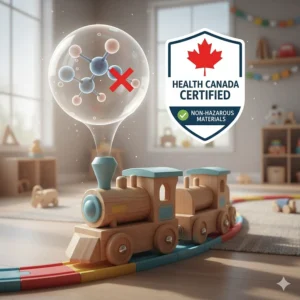
Every Canadian parent wants the best for their little one, and when it comes to ride-on toys, that means more than just fun—it means safety from harmful chemicals. Traditional plastic toys can contain BPA, phthalates, and other endocrine-disrupting compounds that pose serious health risks to developing children. According to Health Canada’s toy safety guidelines, Canada restricted six phthalates in children’s toys back in December 2010, limiting concentrations to no more than 1,000 mg/kg (0.1%) in soft vinyl products.
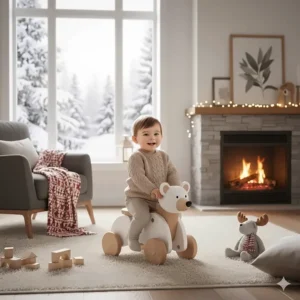
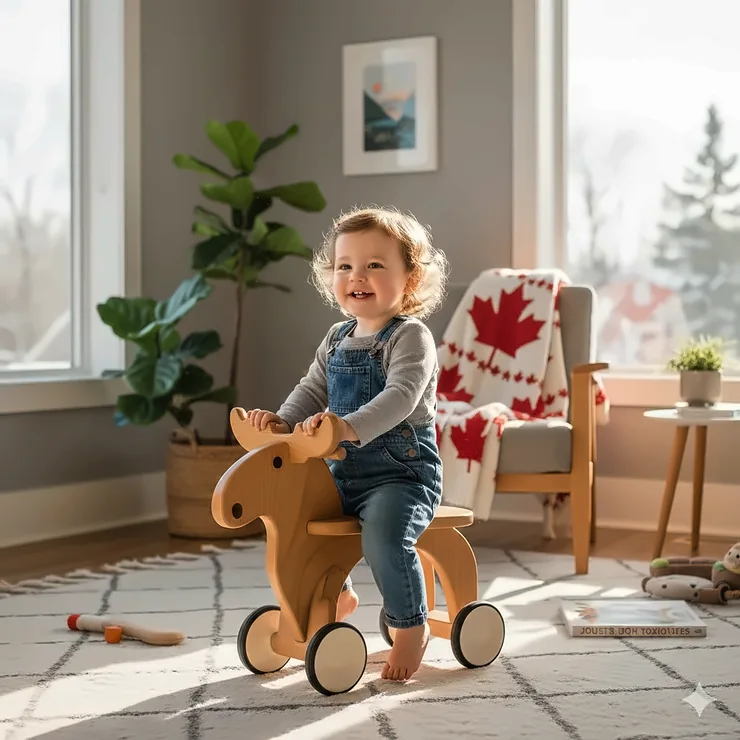
But why should you care about non toxic ride on toys specifically? Think about it: your toddler will spend hours gripping those handles, potentially mouthing the surfaces, and absorbing whatever chemicals lurk in that colourful plastic. Canadian families are increasingly choosing eco friendly toddler ride ons made from recycled materials, sustainable wood, or BPA free ride on toys that meet stringent Health Canada standards. These aren’t just buzzwords—they’re your child’s health insurance policy on wheels.
The good news? The market has exploded with sustainable plastic ride ons and phthalate-free materials that don’t sacrifice durability or fun. From recycled ocean plastic to FSC-certified rubberwood, today’s environmentally conscious parenting choices actually deliver better quality products that last through multiple siblings. Whether you’re browsing Amazon.ca or your local Canadian retailer, knowing what to look for makes all the difference. Let’s explore the safest, most eco-friendly options available across Canada in 2026.
Quick Comparison Table
| Product | Material | Age Range | Price (CAD) | Key Feature | Rating |
|---|---|---|---|---|---|
| Green Toys Dump Truck | 100% Recycled HDPE | 1-5 years | $45-$55 | Dishwasher safe | ⭐⭐⭐⭐⭐ 4.8/5 |
| Wishbone 3-in-1 Original | Sustainable birch/eucalyptus | 1-5 years | $285-$315 | Transforms 3 ways | ⭐⭐⭐⭐⭐ 4.9/5 |
| Radio Flyer Air Ride Balance Bike | Steel frame, air tires | 1.5-5 years | $125-$145 | Adjustable seat | ⭐⭐⭐⭐⭐ 4.7/5 |
| PlanToys Push Car | Rubberwood, water-based dyes | 6 months+ | $38-$48 | Formaldehyde-free | ⭐⭐⭐⭐⭐ 4.6/5 |
| Little Tikes Cozy Coupe | BPA-free plastic | 18 months-5 years | $110-$130 | Made in USA | ⭐⭐⭐⭐½ 4.5/5 |
| Hape Wonder Walker | Maple/birch, non-toxic finish | 12 months+ | $95-$115 | FSC-certified wood | ⭐⭐⭐⭐⭐ 4.8/5 |
| Step2 Whisper Ride II | Durable plastic | 1.5-4 years | $125-$145 | Whisper wheels | ⭐⭐⭐⭐ 4.4/5 |
💬 Just one click – help others make better buying decisions too!😊
✨ Don’t Miss These Exclusive Deals!
🔍 Take your playtime to the next level with these carefully selected products available in Canada. Click on any highlighted item to check current pricing and availability on Amazon.ca. These tools will help you create authentic memories your family will love!
Top 7 Non Toxic Ride On Toys: Expert Analysis
1. Green Toys Dump Truck – Best Budget-Friendly Recycled Option
When it comes to sustainable plastic ride ons that won’t break the bank, the Green Toys Dump Truck leads the pack. Made entirely from 100% recycled plastic milk containers (HDPE #2), this chunky vehicle proves that eco-friendly doesn’t mean expensive. Priced between $45-$55 CAD on Amazon.ca, it’s manufactured right in California using recycled materials that save energy and reduce greenhouse gas emissions by 70% compared to virgin plastic production.
What makes this stand out? Zero BPA, zero phthalates, zero PVC—just pure, food-grade plastic that meets FDA contact standards. The workable dumper bed tilts smoothly, perfect for loading sand at the beach or transporting toy dinosaurs across the living room. Canadian parents rave about its dishwasher-safe construction (yes, you can literally sanitize it), and the lack of metal axles means no rust from Maritime humidity or Prairie winters.
Customer Feedback: Toronto mom Jennifer K. notes, “My twins have been using this for two years straight—through sandbox sessions, bath time, and even snow play. Still looks brand new and I love that it’s made from recycled materials.”
✅ Pros:
- 100% made in USA from recycled materials
- Dishwasher safe for easy cleaning
- No sharp edges or small parts
❌ Cons:
- Limited to push/pull play (no ride-on capability)
- Smaller than traditional ride-on toys
Available: Amazon.ca, Well.ca, Indigo.ca
Best For: Toddlers 1-5 years who love construction play
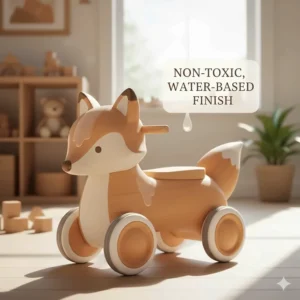
2. Wishbone 3-in-1 Original Bike – Premium Heirloom Investment
If you’re seeking the ultimate in sustainable design, the Wishbone 3-in-1 Original represents environmentally conscious parenting at its finest. Priced at $285-$315 CAD, this award-winning New Zealand design transforms from tricycle to balance bike to full-size runner bike, growing with your child from 12 months to 6 years. That’s nearly five years of use from one product—talk about reducing consumption.
Crafted from sustainably-harvested birch and eucalyptus wood with non-toxic glues and finishes, every component meets the strictest European EN 71 and North American ASTM F963 safety standards. The adjustable seat ranges from 11-18 inches, and weighing just 11.4 pounds, even toddlers can maneuver it independently. What really impresses Canadian buyers? It’s fully repairable with spare parts available for life—a true buy-it-for-life investment that can be passed down through siblings or resold.
Customer Feedback: Vancouver parent Alex M. shares, “We bought this for our daughter’s first birthday. She’s now three and still using it daily. The wood has aged beautifully and we plan to pass it to our newborn son next year. Worth every penny.”
✅ Pros:
- Three modes: tricycle, small balance, large balance bike
- Sustainable birch/eucalyptus from managed forests
- Lifetime spare parts availability
❌ Cons:
- Premium price point ($285-$315 CAD)
- Requires storage indoors to preserve wood finish
Available: Amazon.ca, Balance Bikes Canada, Tikes Bikes
Best For: Families wanting a long-term, sustainable investment
3. Radio Flyer Air Ride Balance Bike – Best All-Terrain Canadian Explorer
Canadian weather demands versatility, and the Radio Flyer Air Ride Balance Bike delivers with genuine rubber 12″ air tires that handle everything from downtown Toronto sidewalks to Rocky Mountain trails. Retailing for $125-$145 CAD, this pedal-free trainer bike features a sturdy steel frame, tool-free adjustable seat (growing from 18 months to 5 years), and grip tape on the frame for no-slip foot placement during those crucial learning moments.
As a Certified B Corporation, Radio Flyer meets rigorous standards for social and environmental performance. While not wooden, the company’s commitment to durability means this bike often outlasts three or four cheaper plastic alternatives. The whitewall tires add vintage charm, and the working bell makes neighbourhood rides extra fun. Canadian reviewers particularly appreciate how well it handles both grass and gravel—essential for cottage country adventures.
Customer Feedback: Calgary dad Michael T. reports, “We live near Fish Creek Park and this bike has handled every trail we’ve tried. The air tires make such a difference compared to foam wheels. My son learned to balance in just two weeks.”
✅ Pros:
- 12″ air-filled tires for smooth all-terrain riding
- Tool-free seat adjustment (11 inches of height range)
- B Corp certified company
❌ Cons:
- Steel frame heavier than wooden alternatives
- Requires occasional tire inflation
Available: Amazon.ca, Toys “R” Us Canada, Canadian Tire
Best For: Active families who ride outdoors year-round
4. PlanToys Wooden Push Car – Best for Youngest Eco-Warriors
For babies just starting to explore mobility (6 months+), the PlanToys Push Car offers a perfect introduction to non-toxic play. Priced affordably at $38-$48 CAD, this compact vehicle is crafted from chemical-free rubberwood—wood reclaimed from rubber trees that no longer produce latex. The entire line uses formaldehyde-free glue, organic pigments, water-based dyes, and meets both German Spiel Gut and US Oppenheim Toy Portfolio standards.
What sets PlanToys apart? Their sustainable manufacturing process in Thailand combines traditional craftsmanship with modern safety testing. The smooth, rounded edges are perfect for teething babies (yes, it’s that safe to mouth), and the simple design encourages open-ended imaginative play. Canadian parents love that it’s virtually indestructible—drop it, throw it, chew it, this toy survives toddlerhood with grace.
Customer Feedback: Montreal parent Sophie L. notes, “J’adore que ce jouet soit fait de matériaux naturels. Mon bébé peut le mâcher sans danger et il a survécu à trois enfants jusqu’à présent.” (Translation: “I love that this toy is made from natural materials. My baby can safely chew on it and it’s survived three kids so far.”)
✅ Pros:
- Sustainably sourced rubberwood from retired trees
- Safe for mouthing (food-grade finishes)
- Compact size perfect for travel
❌ Cons:
- Hand-push only (not a ride-on)
- Limited features compared to larger vehicles
Available: Amazon.ca, Well.ca, Chapters Indigo
Best For: Babies 6-24 months developing motor skills
5. Little Tikes Cozy Coupe – Classic American Icon Goes Green
The Little Tikes Cozy Coupe has been the bestselling ride-on since 1979, and the modern version now features BPA-free, phthalate-free plastic construction. Priced at $110-$130 CAD on Amazon.ca, this iconic red-and-yellow car includes working doors, a clicking ignition switch, opening gas cap, and removable floorboard that transitions from parent-push to independent foot-powered driving. Made in the USA using both domestic and imported components, it meets strict CCPSA requirements for Canadian sale.
While not made from recycled materials like Green Toys, Little Tikes has improved their formula to eliminate the most harmful plastics. The double-walled construction withstands Canadian winters (though storage indoors is recommended), and the colours resist fading even under intense summer sun. At 50-pound weight capacity, most kids enjoy it from 18 months through age 5.
Customer Feedback: Ottawa parent David R. shares, “This is the same car I had as a kid in the ’80s, now safer and cleaner. My daughter pushes it around our neighbourhood and I love the nostalgic connection. Easy to wipe down after messy outdoor play.”
✅ Pros:
- Iconic design kids instantly recognize
- BPA/phthalate-free updated formula
- Large storage trunk for toys and snacks
❌ Cons:
- Plastic construction (not recycled content)
- Requires adult assembly
Available: Amazon.ca, Walmart Canada, Toys “R” Us Canada
Best For: Families wanting time-tested durability with modern safety
6. Hape Wonder Walker – FSC-Certified German Engineering
The Hape Wonder Walker ($95-$115 CAD) combines German precision with environmental responsibility. This award-winning push toy features FSC-certified sustainable wood sourced from environmentally managed forests, solid maple and birch plywood construction, and rubber-lined wheels that protect hardwood floors while providing stability on all surfaces. Designed for 12+ months, it includes movable knobs, spinning gears, and colourful balls that transform it into a “busy box on wheels.”
What Canadian parents appreciate most? The setback wheel design creates a sturdy base for wobbly walkers, preventing the forward-tipping that plagues cheaper alternatives. Non-toxic, child-safe finishes mean it’s safe even for mouthy toddlers, and the roomy storage compartment encourages kids to transport their favourite toys around the house. Assembly takes just 15 minutes, and Hape’s customer service offers replacement parts for any damaged components.
Customer Feedback: Winnipeg mom Lisa K. reports, “This walker helped both my kids learn to walk. The weight distribution is perfect—it doesn’t tip forward like plastic walkers. Plus, the activities kept them engaged when they needed a break from walking practice.”
✅ Pros:
- FSC-certified wood from managed forests
- Setback wheel design prevents forward tipping
- Rubber-trimmed wheels protect floors
❌ Cons:
- Push-walker only (not ride-on capable)
- Higher price than plastic alternatives
Available: Amazon.ca, Well.ca, Mastermind Toys
Best For: Pre-walkers and new walkers (10-24 months)
7. Step2 Whisper Ride II – Quietest Neighbourhood Cruiser
For families living in urban Canadian settings like condos or townhomes, the Step2 Whisper Ride II ($125-$145 CAD) earns its name with proprietary Whisper Wheels that dramatically reduce road noise. This sleek push car features BPA-free durable plastic construction, easy-fold parent handle, working steering wheel with horn, seat belt, and generous under-hood storage. Designed for toddlers 1.5-4 years (50-pound max capacity), it’s made in the USA from US and imported components.
While Step2 doesn’t specifically advertise recycled content, their double-walled plastic construction ensures longevity—many Canadian families report using these cars for 5+ years across multiple children. The sport car styling appeals to older toddlers who’ve outgrown the Cozy Coupe aesthetic, and the roomier interior comfortably fits kids wearing bulky Canadian winter clothing.
Customer Feedback: Halifax parent Emma P. notes, “We have hardwood floors throughout our condo and this is the only ride-on that doesn’t drive me crazy with noise. My son can ‘drive’ it indoors on rainy days without disturbing the downstairs neighbours.”
✅ Pros:
- Whisper Wheels reduce noise by 40-50%
- Easy-fold handle for transport and storage
- Spacious interior fits larger toddlers
❌ Cons:
- Not made from recycled materials
- Cup holders sized for toddler cups only
Available: Amazon.ca, Toys “R” Us Canada, Walmart Canada
Best For: Urban families needing quiet indoor/outdoor play
Understanding Non-Toxic Materials in Ride-On Toys
Not all plastics are created equal, and understanding the difference could protect your child’s health for years to come. When manufacturers use terms like “BPA free ride on toys” or “phthalate-free materials,” they’re referring to specific chemical compounds that Canada and other nations have identified as potentially harmful endocrine disruptors.
BPA (Bisphenol A) is an industrial chemical used to harden plastics and create protective linings in food containers. While not currently on Canada’s List of Toxic Substances under CEPA (Canadian Environmental Protection Act), it appears on the priority substances list requiring assessment. The European Union has gone further, classifying BPA as “of very high concern” and banning it until proven safe. Canadian parents can’t assume “BPA-free” means completely safe—look for products that avoid ALL bisphenols (including BPS and BPF, common replacements that may pose similar risks).
Phthalates are plasticizers that make vinyl and plastics flexible. Canada’s Phthalates Regulations restrict six types (DEHP, DBP, BBP, DINP, DIDP, DNOP) to no more than 1,000 mg/kg in toys for children under 14. However, hundreds of other phthalates exist that aren’t regulated—which is why choosing products certified to European standards (which ban more variants) provides extra protection.
PVC (Polyvinyl Chloride) often contains both phthalates and heavy metals. Quality manufacturers avoid it entirely, opting instead for polyethylene (PE) or polypropylene (PP), which don’t require toxic additives. Green Toys, for example, uses recycled HDPE #2—the same plastic in milk jugs, proven safe for food contact.
Sustainable Wood offers the safest alternative when sourced responsibly. Look for FSC certification (Forest Stewardship Council), which ensures forests are managed to protect wildlife, waterways, and worker rights. Brands like Hape, PlanToys, and Wishbone use rubberwood from retired rubber trees or fast-growing birch/eucalyptus, finished with food-grade oils or water-based stains that contain zero VOCs (volatile organic compounds).
The recycled plastic construction used by Green Toys deserves special mention. By reprocessing post-consumer HDPE, they bypass the chemical treatments required for virgin plastic while diverting waste from landfills. Each Green Toys product contains the equivalent of 25-30 recycled milk jugs, processed locally in California to minimize shipping emissions. This closed-loop manufacturing represents the future of sustainable toy production.
Canadian Safety Standards: What You Need to Know
Health Canada’s toy safety requirements under the Canada Consumer Product Safety Act (CCPSA) establish some of the world’s most rigorous standards for children’s products. Every toy sold in Canada must meet specific criteria covering mechanical hazards, flammability, toxicity, electrical safety, and more.
For ride-on toys specifically, key regulations include:
Weight and Size Limits: Products must clearly state maximum weight capacity and age appropriateness. Most ride-ons max out at 50 pounds (22.68 kg), suitable for children up to age 5-6.
Phthalate Restrictions: Under SOR/2016-188, vinyl parts must contain no more than 1,000 mg/kg of restricted phthalates. Parts that can be placed in a child’s mouth face even stricter limits for three additional phthalates (DINP, DIDP, DNOP).
Lead and Heavy Metals: Surface coatings cannot exceed 90 mg/kg total lead (SOR/2016-193). Children’s jewelry and other accessories have separate, even stricter limits for lead (90 ppm) and cadmium (130 ppm).
Flammability Standards: While less relevant for most ride-ons, any textile components (like seat covers) must meet CAN/CGSB-4.2 No. 27.5 flame resistance standards.
Choking Hazards: Small parts that could fit through a specially designed test cylinder (simulating a child’s throat) are prohibited for children under 3 years. This is why many ride-ons state “18 months+” despite being large products—it’s about detachable components, not the toy’s size.
Mandatory Incident Reporting: Here’s what most parents don’t know: manufacturers, importers, and sellers MUST report incidents involving death, serious injury, or safety hazards to Health Canada within two days. This creates accountability throughout the supply chain.
What about toys imported from the US or Europe? They must still meet Canadian standards even if they comply with similar American (ASTM F963) or European (EN 71) regulations. Smart manufacturers design products that meet all three, which is why you’ll often see “Exceeds ASTM, EN 71, and CCPSA standards” on premium toy packaging.
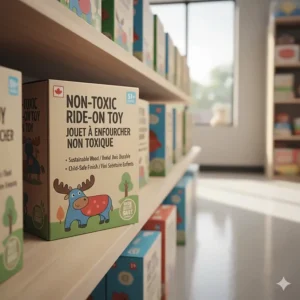
Canadian parents shopping on Amazon.ca should verify that sellers ship products specifically labeled for Canadian distribution. Grey-market imports may not meet our phthalate restrictions or bilingual labeling requirements (yes, toy warnings must appear in both English and French under the Consumer Packaging and Labelling Act).
One more thing: provincial variations exist. Quebec’s Consumer Protection Act provides additional safeguards, and some territories have unique requirements for remote communities. When in doubt, check if a product carries the appropriate age warnings in both official languages—that’s often your first clue it’s been properly imported for Canadian sale.
Eco-Friendly Materials Breakdown
The shift toward environmentally conscious parenting has driven innovation in toy materials that would have seemed impossible a decade ago. Today’s eco-friendly toddler ride ons utilize everything from ocean plastic to mycelium composites, though the most proven sustainable options remain wood and recycled HDPE.
Recycled HDPE (High-Density Polyethylene)
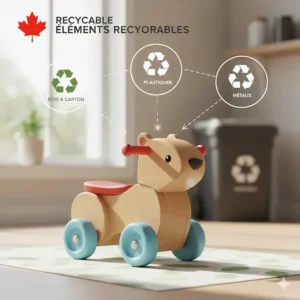
This is the MVP of sustainable plastic ride ons. HDPE #2 is the same food-safe plastic used in milk jugs, making it ideal for children’s products. When recycled, it requires 88% less energy than producing virgin plastic and diverts thousands of tons of waste from landfills annually. Green Toys processes post-consumer HDPE in California, where strict environmental regulations ensure minimal chemical treatment. The material is naturally BPA-free and phthalate-free—no additives needed for flexibility since HDPE is already semi-rigid. Best of all? It’s recyclable again at end-of-life, creating a true circular economy.
FSC-Certified Rubberwood
PlanToys pioneered the use of rubberwood in the 1980s, transforming what was previously agricultural waste into premium toy material. Rubber trees (Hevea brasiliensis) produce latex for 25-30 years before productivity declines. Rather than burning these “retired” trees (releasing carbon), they’re harvested for lumber. The wood is kiln-dried to remove any remaining latex, then crafted into toys using formaldehyde-free glues. FSC certification ensures new rubber trees are planted to replace harvested ones, creating sustainable timber plantations that also serve as carbon sinks.
Sustainable Birch and Eucalyptus
Wishbone bikes combine New Zealand birch with eucalyptus, both fast-growing hardwoods from managed forests. Birch grows prolifically in cool climates (perfect for Scandinavia and Canada), reaching harvest size in 30-40 years versus 100+ for slower hardwoods like oak. Eucalyptus grows even faster—some species add 2-3 meters of height annually. Both resist warping and provide the strength needed for structural ride-on toys, and their natural oils reduce the need for chemical preservatives.
Water-Based Finishes
Traditional wood stains often contain toxic VOCs (volatile organic compounds) that off-gas for months or years. Premium manufacturers like Hape and PlanToys use water-based dyes and paints that meet EN 71-3 standards for toy safety—essentially food-grade pigments mixed with water rather than petroleum solvents. Some, like PlanToys, go further with E-Zero technology that combines sawdust with organic pigments and natural binders, creating a wood composite that’s denser and more durable than regular wood.
Natural Rubber
Hape’s Wonder Walker uses rubber wheel linings harvested from living rubber trees—a truly renewable resource. The trees are tapped (like maple syrup production), yielding latex without harming the tree. This natural rubber provides excellent grip on hardwood floors while remaining completely biodegradable.
Post-Consumer Recycled Plastic Blends
Wishbone’s RE2 bike represents the cutting edge: post-consumer recycled plastic bottles and carpet fibers transformed into a composite stronger than steel (pound-for-pound). The manufacturing process minimizes material degradation through precision injection molding, and the bikes are designed for disassembly—at end-of-life, you can ship them back to Wishbone for reprocessing into new bikes. This closed-loop system achieved recognition as Best Green Product Design on three continents.
What to Avoid:
❌ Virgin PVC (often contains lead stabilizers and phthalate plasticizers)
❌ Polycarbonate plastics (may contain BPA)
❌ “Eco-friendly” claims without third-party certification
❌ Toys painted with coatings not specifically labeled as EN 71 or ASTM compliant
❌ Products with strong chemical smells (indicating off-gassing VOCs)
Canadian families have the added advantage of strong labeling laws. Any toy sold here must identify materials clearly, allowing you to make informed choices between a $40 conventional plastic ride-on and a $120 FSC-certified wooden alternative.
Health Benefits of Chemical-Free Play
The decision to choose non toxic ride on toys extends far beyond environmental virtue signaling—it’s about protecting your child during their most vulnerable developmental windows. Research continues to emerge on how early chemical exposures shape lifelong health outcomes, and the findings should give every parent pause.
Endocrine Disruption in Developing Bodies
Children’s endocrine systems are exquisitely sensitive to chemical interference. Phthalates and BPA mimic natural hormones, binding to cellular receptors and triggering inappropriate biological responses. A 2023 study in Environmental Health Perspectives found that prenatal exposure to phthalates correlated with altered thyroid function in children through age 7, potentially affecting metabolism and brain development. Since toddlers spend 6-8 hours daily with their toys (touching, mouthing, absorbing chemicals through skin), choosing phthalate-free materials dramatically reduces cumulative exposure.
Reduced Respiratory Issues
Conventional plastics off-gas VOCs (volatile organic compounds) for months after manufacture—that “new toy smell” is literally toxic fumes. Indoor air quality studies show that children’s playrooms with conventional toys can have VOC levels 5-10 times higher than adult living spaces. Canadian children already face elevated asthma rates (1 in 5 kids according to the Asthma Society of Canada), and reducing VOC exposure from toys represents one controllable risk factor parents can address immediately.
Neurodevelopmental Protection
Lead restrictions in toy paint exist because even minimal exposure can lower IQ and impair executive function. But lead is just the tip of the iceberg. The Canadian Public Health Association has criticized federal inaction on regulating BPA and certain phthalates, noting that “exposure threatens to alter growth in young children and change reproductive mechanisms.” European research suggests that early phthalate exposure may contribute to ADHD symptoms and behavioral problems in school-age children.
Allergen Reduction
Natural materials like untreated wood and natural rubber trigger fewer allergic reactions than synthetic plastics containing unknown chemical additives. Canadian children with sensitive skin or chemical sensitivities often tolerate wooden toys better than plastic alternatives. Parents report fewer contact dermatitis incidents with brands like PlanToys and Hape compared to conventional toy brands.
Safer Mouthing and Teething
Every toddler explores the world orally—it’s neurologically hardwired development, not “bad behavior.” Toys finished with food-grade oils or water-based stains are literally safe enough to eat (not that you should encourage it, but accidents happen). Compare this to conventional plastic ride-ons where surface chemicals can leach into saliva during mouthing. A University of British Columbia study found that children aged 6-24 months spend an average of 4-6 hours weekly with objects in their mouths, making material safety paramount.
Long-Term Cancer Prevention
While definitive long-term studies are still emerging, concerning links exist between childhood chemical exposures and adult cancer rates. The precautionary principle suggests minimizing exposure to known carcinogens and probable carcinogens during critical developmental windows. Choosing toys that meet European standards (often stricter than North American requirements) reduces exposure to chemicals like formaldehyde (present in some wood glues and pressed-wood products) that the International Agency for Research on Cancer classifies as carcinogenic.
Mental Health Benefits of Natural Materials
Here’s something rarely discussed: natural materials provide different sensory experiences than plastic. Wood’s variable texture, temperature responsiveness, and weight distribution engage more sensory receptors, supporting neural development. Occupational therapists increasingly recommend natural toys for children with sensory processing differences, noting that wooden toys’ predictable, uncluttered designs reduce sensory overwhelm compared to electronic plastic toys with flashing lights and synthetic sounds.
For Canadian families, these health considerations carry extra weight during long winters when children spend more time indoors with their toys. Investing in chemical-free options isn’t expensive—it’s insurance against health costs we can’t yet fully quantify.
Buying Guide: Choosing the Right Non-Toxic Ride-On
Selecting the perfect eco friendly toddler ride on requires balancing safety, developmental appropriateness, climate considerations, and budget. Here’s how to navigate the decision like a pro:
Age and Developmental Stage Matching
6-12 Months (Pre-Walkers):
Look for push cars like the PlanToys Wooden Push Car that babies can grasp and scoot while building core strength. The toy should be lightweight enough for them to manipulate independently but stable enough not to tip during exploratory mouthing sessions.
12-18 Months (Early Walkers):
Push walkers like the Hape Wonder Walker provide crucial balance support. Prioritize setback wheel designs that prevent forward tipping—this is a safety feature worth paying extra for. The walker should have enough weight to stay grounded but be light enough for wobbly toddlers to redirect.
18 Months-3 Years (Confident Walkers):
This is prime ride-on territory. Options like the Little Tikes Cozy Coupe or Step2 Whisper Ride II work well for parent-assisted neighborhood walks. Look for seat belts, parent push handles, and storage for snacks/water during longer outings.
2-5 Years (Independent Riders):
Balance bikes shine in this category. The Radio Flyer Air Ride or Wishbone 3-in-1 teach balance and coordination without the complexity of pedals. Adjustable seats are crucial—kids grow fast at this age, and you want 2-3 years of use from a quality bike.
Material Prioritization for Canadian Climate
Wood:
Beautiful and sustainable, but requires indoor storage in humid Maritime provinces or during harsh Prairie winters. Wood can warp with moisture fluctuations, and extreme temperature changes may crack cheaper finishes. If choosing wood, verify water-based sealants that resist moisture damage.
Recycled Plastic:
Virtually climate-proof. Green Toys products handle -40°C Alberta winters and +35°C Ontario summers without brittleness or fading. The colours are molded into the plastic (not painted), so they won’t chip with exposure. Ideal for families who want toys that live in the garage or covered porch.
Steel Frame Balance Bikes:
Durable and weather-resistant when powder-coated. Radio Flyer’s steel construction handles Canadian weather well, though you should dry off rain/snow to prevent rust. Not as eco-friendly as wood, but far more durable in rough conditions.
Safety Certification Verification
Don’t just trust the packaging—verify certifications:
✅ CCPSA Compliance: Mandatory for Canadian sale, ensures basic safety
✅ ASTM F963: American standard often stricter than CCPSA in some areas
✅ EN 71: European standard, typically most stringent for chemical restrictions
✅ FSC Certification: For wood products, ensures sustainable forestry
✅ B Corp Certification: Companies meeting social/environmental standards (like Radio Flyer)
Look for toys displaying multiple certifications—it indicates manufacturers going beyond minimum requirements.
Price-to-Value Calculation
Budget Option ($40-$80 CAD):
Green Toys and PlanToys offer genuine safety and sustainability without premium pricing. You’re getting quality materials but simpler designs with fewer features. Expect 2-3 years of use before outgrowing.
Mid-Range ($100-$150 CAD):
Little Tikes, Step2, Hape, and Radio Flyer occupy this sweet spot. These toys typically last 4-5 years and can be resold for 40-50% of purchase price on Facebook Marketplace or Kijiji. Better construction means they survive multiple siblings.
Premium ($250-$350 CAD):
Wishbone bikes represent heirloom investments. Yes, $300+ seems steep for a kid’s toy, but consider: it transforms three ways, lasts 5 years, can be fully repaired, and resells for $150-$200 even after heavy use. Cost per year? About $60—comparable to mid-range toys that can’t be resold.
Red Flags to Avoid
❌ Strong Chemical Smell: Quality non-toxic toys smell like wood, rubber, or nothing. Plastic chemical smell indicates off-gassing VOCs.
❌ Missing Age Labels: If packaging lacks clear age recommendations in English AND French, it may not be properly imported for Canadian sale.
❌ Vague “Eco-Friendly” Claims: Look for specific certifications, not marketing buzzwords.
❌ Rock-Bottom Prices: $25 ride-on cars from unknown brands often use the cheapest, most toxic plastics available.
❌ No Contact Info: Legitimate manufacturers provide customer service details and replacement part options.
Special Considerations for Canadian Families
Bilingual Labeling: Federal law requires toy warnings in English and French. Missing French text suggests grey-market imports that may not meet CCPSA standards.
Shipping Costs: Amazon.ca often offers free shipping on orders $35+, but bulky ride-ons may incur oversized item fees. Compare Amazon’s total cost versus Canadian retailers like Well.ca or Mastermind Toys who sometimes offer free pickup.
Provincial Tax Variations: Remember to factor in PST/GST/HST when comparing prices. That $99.99 toy becomes $114.99 in Ontario (13% HST) versus $104.99 in Alberta (5% GST only).
Winter Storage: If space is tight in your Canadian home, consider collapsible or multi-function designs. The Step2 Whisper Ride II folds for storage; the Wishbone transforms rather than requiring separate toys.
Environmental Impact: Beyond Your Child
Choosing sustainable plastic ride ons isn’t just about your family—it’s about the world your children will inherit. Let’s examine the broader environmental implications with actual data instead of vague feel-good statements.
Plastic Production’s True Cost
Manufacturing one kilogram of virgin plastic requires 2 kilograms of petroleum and releases 6 kilograms of CO₂. A typical plastic ride-on car weighs 5-8 kg, meaning 30-48 kg of greenhouse gases generated before it even ships. Green Toys’ recycled HDPE production cuts this by 70%, saving approximately 21-34 kg of CO₂ per toy. Multiply that by the 12 million ride-on toys sold annually in North America, and we’re talking about preventing 252,000-408,000 metric tons of CO₂ emissions—equivalent to removing 54,000-88,000 cars from roads for one year.
The Deforestation Connection
Wooden toys seem obviously “greener,” but only if sourced responsibly. Illegal logging contributes to 15% of global CO₂ emissions (more than all cars, trucks, and planes combined). This is why FSC certification matters so profoundly. FSC-certified forests in Canada, Scandinavia, and New Zealand maintain biodiversity corridors, protect watersheds, and ensure carbon-sequestering trees replace harvested ones. Brands like Hape and PlanToys trace wood from certified plantations to finished product, providing transparency that mass-market toy companies can’t match.
Ocean Plastic Reclamation
Some manufacturers now use ocean-recovered plastic for ride-on toys, though it’s still a small percentage of the market. The challenge? Ocean plastic is contaminated with salt, barnacles, and degraded by UV exposure, requiring extensive processing. Despite these difficulties, companies like 4ocean (primarily marine cleanup) are partnering with toy manufacturers to incorporate recovered ocean plastic into products. While no major ride-on toy brand exclusively uses ocean plastic yet, the technology is advancing rapidly.
Lifecycle Carbon Footprint
Let’s compare apples to apples:
Conventional Plastic Ride-On:
- Manufacturing: 48 kg CO₂
- Shipping (China to Canada): 12 kg CO₂
- Use Phase: 0 kg (no electricity)
- End-of-Life: 5-8 kg in landfill (500+ years to decompose)
Total Impact: 60+ kg CO₂, permanent plastic waste
Recycled Plastic Ride-On (Green Toys):
- Manufacturing: 14 kg CO₂ (70% reduction)
- Shipping (California to Canada): 8 kg CO₂
- Use Phase: 0 kg
- End-of-Life: 100% recyclable, 5-8 kg recaptured
Total Impact: 22 kg CO₂, zero permanent waste
FSC-Certified Wooden Ride-On (Hape):
- Manufacturing: 8 kg CO₂ (wood processing is low-energy)
- Shipping (varies by origin): 10-15 kg CO₂
- Use Phase: 0 kg
- End-of-Life: Biodegradable or burnable (carbon-neutral)
Total Impact: 18-23 kg CO₂, zero permanent waste
The Resale and Hand-Me-Down Economy
Here’s where circular economy principles shine. A $300 Wishbone bike used by three siblings over 10 years has a per-child environmental cost that’s 67% lower than buying three separate conventional ride-ons. Canadian buy-and-sell groups on Facebook Marketplace show robust markets for quality used toys:
- Little Tikes Cozy Coupe (used): $40-$60 (retains 45-55% of value)
- Radio Flyer balance bikes (used): $60-$90 (retains 50-65% of value)
- Wishbone bikes (used): $150-$220 (retains 55-75% of value)
This secondary market extends product lifespans significantly. The average conventional plastic toy gets 2.3 years of use before landfill; quality sustainable toys average 6.8 years (often across multiple families).
Manufacturing Transparency
Few parents realize that toy manufacturing produces significant hazardous waste. Cheap plastic toys from non-certified factories often generate chemical byproducts dumped into waterways. Canada’s CEPA (Canadian Environmental Protection Act) requires domestic manufacturers to follow strict waste disposal protocols, but imported toys face minimal scrutiny. Brands manufacturing in California (Green Toys), Germany (Haba/Hape European plants), or countries with strict environmental laws provide greater assurance of responsible production.
Microplastics and Water Contamination
When conventional plastic toys degrade in landfills or waterways, they release microplastics—particles smaller than 5mm that persist indefinitely. A 2024 study by McGill University found microplastics in 97% of Canadian freshwater samples, with higher concentrations near urban areas. Every conventional plastic toy that landfills eventually contributes to this contamination. Choosing recyclable or biodegradable materials breaks this cycle.
Canadian Context: The Northern Perspective
Canada’s vast geography creates unique environmental challenges. Shipping toys to Yukon, Northwest Territories, or Nunavut generates significantly higher carbon costs than shipments to Toronto or Vancouver. Remote communities already face elevated costs for consumer goods—choosing durable toys that last multiple children and ship less frequently provides both economic and environmental benefits. This is where the Wishbone 3-in-1’s longevity really shines: one shipment serves 5+ years versus three separate purchases.
The bottom line? Every eco-friendly toddler ride on you choose casts a vote for the kind of manufacturing practices we want normalized. Market forces work—as demand for sustainable toys grows, even mass-market manufacturers are reformulating products to reduce harm.
Maintenance and Longevity Tips
Quality non toxic ride on toys justify their price through longevity, but only with proper care. Here’s how Canadian families can maximize lifespan and resale value:
Wood Toy Care for Canadian Climates
Indoor Storage is Non-Negotiable
Wood naturally absorbs moisture, and Canadian weather swings are brutal. Storing a Wishbone bike outside exposes it to 40°C summer-to-winter temperature differentials plus humidity extremes. This causes warping, finish cracking, and joint loosening. Dedicate garage or basement space, or disassemble for seasonal storage.
Immediate Drying After Rain/Snow
Caught in an unexpected downpour during a neighbourhood stroll? Dry your wooden ride-on thoroughly with old towels as soon as you get home. Pay special attention to joints and crevices where water pools. Bonus tip: stand it upside-down for 30 minutes to drain accumulated moisture from wheel assemblies.
Annual Re-Oiling
Wooden toys finished with food-grade oils (like PlanToys’ beeswax/jojoba blend) benefit from annual re-application. Use mineral oil or specialized toy wax available at Canadian stores like Lee Valley Tools. This maintenance takes 10 minutes and extends finish life by years.
Tightening Hardware Quarterly
Wood naturally expands and contracts with humidity changes, loosening screws and bolts over time. Check all fasteners every 3 months, tightening with the original hex key or screwdriver. This simple step prevents catastrophic failures and extends structural integrity.
Plastic Toy Maintenance
UV Protection
Even UV-stabilized plastics degrade with constant sun exposure. If your Little Tikes Cozy Coupe lives on the patio, cover it with a breathable tarp when not in use. Canadian summer UV indices reach 10+ (Very High) in southern regions, and continuous exposure fades colours and makes plastic brittle.
Winter Storage Wisdom
Plastics can become brittle below -10°C. While quality brands like Green Toys use cold-resistant formulations, it’s still wise to store ride-ons indoors during January-February deep freezes. If you must leave them out, ensure they’re not under snow load that could stress joints.
Cleaning Without Degrading
Avoid harsh chemicals that strip protective coatings:
✅ Good: Mild dish soap + warm water
✅ Better: White vinegar solution (1:10 ratio) for disinfection
✅ Best: Dishwasher for small Green Toys components (top rack only)
❌ Avoid: Bleach, ammonia cleaners, abrasive scrubbers
Wheel and Axle Lubrication
Ride-ons with spinning wheels benefit from annual silicone spray on axles. This prevents rust (on metal axles) and reduces friction that wears plastic bushings. Use food-grade silicone spray (available at Canadian Tire) if you’re concerned about children contacting treated areas.
Balance Bike-Specific Care
Tire Pressure Checks (Air-Filled Tires)
Radio Flyer’s air-filled tires require monthly pressure checks. Proper inflation (usually 20-25 PSI) provides the smooth ride parents love and prevents sidewall damage. Under-inflated tires wear unevenly; over-inflated tires provide a harsh ride and risk blowouts. Canadian temperature changes affect pressure—tires lose ~1 PSI per 5°C drop, so re-check after seasonal transitions.
Brake Maintenance (If Equipped)
Some balance bikes include hand brakes for older kids transitioning to pedal bikes. Brake cables stretch with use; adjust tension using barrel adjusters every 6 months. Brake pads should show visible tread—replace when worn smooth (check monthly if your child brakes aggressively).
Frame Inspection
Examine the frame for cracks or stress marks, particularly near joints or welds. Wooden frames can develop hairline cracks; metal frames may show stress fractures. Catching these early allows repair before catastrophic failure.
Extending Resale Value
Document Everything
Keep original packaging, assembly instructions, and receipts. Toys with complete documentation sell for 15-25% more on Canadian resale markets. Store paperwork in a labeled envelope taped inside a storage bin.
Photograph Before First Use
Take detailed photos of your new ride-on from multiple angles when it arrives. These “before” shots prove excellent condition history when listing on Kijiji or Facebook Marketplace years later.
Minor Repairs Immediately
Don’t let small issues become big problems. A $5 replacement bolt (available at most hardware stores) prevents a cracked joint that renders the toy useless. Canadian weather accelerates degradation—that small crack from last summer becomes a structural failure by next spring.
Consider Protective Coatings
For wood toys in active use, consider food-safe polyurethane sealant after initial break-in. This provides waterproofing superior to natural oils, though it changes the aesthetic slightly. Apply only to high-wear surfaces like seat tops and handlebar grips.
Storage Between Kids
If you’re done with toddlerhood but plan more children, proper long-term storage matters. Clean thoroughly, apply protective coatings/oils, disassemble to reduce storage space, and store in climate-controlled areas (not attics or garden sheds). Include silica gel packets to control moisture.
When to Replace vs. Repair
Replace If:
❌ Structural cracks in weight-bearing components
❌ Wheels wobbling despite tightened axles (worn bushings)
❌ Plastic showing brittleness (pieces snap easily)
❌ Wood showing extensive rot or delamination
❌ Any sharp edges that can’t be sanded smooth
Repair If:
✅ Loose screws/bolts (tighten or replace)
✅ Flat tires (patch or replace inner tube)
✅ Faded colours (can often be restored with plastic polish)
✅ Minor scratches (sand and re-oil for wood; plastic polish for plastics)
✅ Missing accessories (replacement parts available from manufacturers)
Contact manufacturer customer service before discarding expensive toys—many offer replacement parts for years after purchase. Hape, PlanToys, and Wishbone maintain extensive parts inventories and will ship components to Canada.
By investing 15-20 minutes monthly in basic maintenance, most quality non toxic ride on toys will serve 5-7 years and retain 40-60% resale value. That’s smart economics and smart environmentalism.
FAQ: Your Top Questions Answered
❓ Are non-toxic ride-on toys actually safer than regular plastic toys?
❓ What's the price range for quality non-toxic ride-on toys in Canada?
❓ How do I verify a toy is truly phthalate-free when shopping online?
❓ Can wooden ride-on toys survive Canadian winters if stored in a garage?
❓ Which non-toxic ride-on toy offers the best value for multiple children?
Conclusion: Making the Healthier Choice
Choosing non toxic ride on toys isn’t about perfection—it’s about progress. Every conventional plastic toy replaced with a BPA free ride on toys option reduces your child’s chemical exposure and votes with your wallet for better manufacturing practices. The Canadian market has evolved dramatically, giving families across all provinces access to sustainable plastic ride ons, FSC-certified wooden balance bikes, and phthalate-free materials that were specialty items just five years ago.
The seven products featured in this guide represent the best balance of safety, sustainability, and value available on Amazon.ca in 2026. From the budget-friendly Green Toys Dump Truck ($45-$55 CAD) to the premium Wishbone 3-in-1 bike ($285-$315 CAD), each option meets or exceeds Health Canada’s stringent CCPSA standards while offering environmental benefits that extend beyond your family.
Remember: price alone doesn’t determine value. A $300 wooden bike that serves three children for 5 years each costs $20 per child per year. A $50 conventional plastic ride-on that breaks after one Canadian winter and ends up in a landfill costs $50 plus the environmental toll. Factor in resale value, health protection, and environmental impact, and the premium option often proves more economical.
Canadian families have the added advantage of strong regulatory frameworks that protect children from the worst chemical exposures. But regulations set minimum standards—we can do better by choosing products that eliminate problematic materials entirely rather than simply meeting legal limits. Brands like Green Toys, PlanToys, Hape, and Wishbone demonstrate that eco friendly toddler ride ons can be safer, more durable, and even more fun than their conventional competitors.
Start small if budget is tight. Replace one conventional toy with a non-toxic alternative this year. Notice the difference in materials quality, construction durability, and your own peace of mind knowing your child isn’t absorbing hormone-disrupting chemicals during play. Then make it a habit: research certifications, verify materials, support companies that prioritize both child safety and environmental responsibility.
Your child’s health and the planet’s future are worth the investment. Make 2026 the year you choose non toxic ride on toys that protect both.
Recommended for You
- 7 Best Affordable Ride On Toys Under $100 CAD in Canada (2026 Guide)
- 7 Best Rocking Horse for Toddlers in Canada (2026 Guide)
- Foot to Floor vs Tricycle Toddler: 7 Best Rides Canada 2026
Disclaimer: This article contains affiliate links to Amazon.ca. If you purchase products through these links, we may earn a small commission at no additional cost to you.
✨ Found this helpful? Share it with your friends! 💬🤗
