In This Article
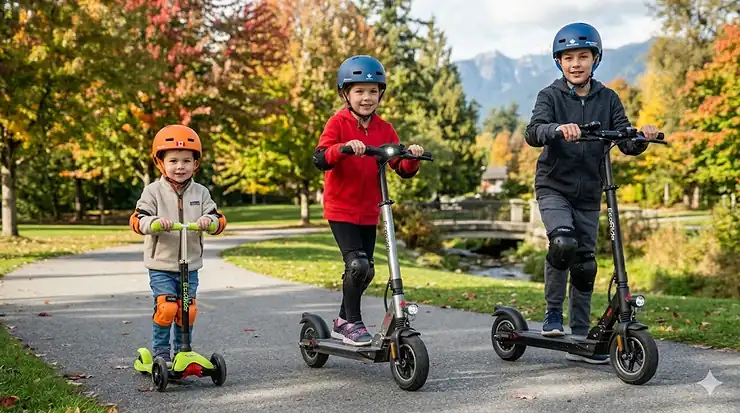
In short: an electric scooter is the better all-round pick for most Canadian kids, because it has handlebars and a hand or foot brake, which makes it easier to control and safer for road, park, and driveway riding. A hoverboard is the better choice if your child already has strong balance (think skateboard or snowboard experience) and you mainly want a backyard or basement toy, since it has no handlebar and a steeper learning curve.
That one-line answer hides a lot of nuance, though — age, weight, your local bylaws, and how cold your winters get all change the calculation. Let’s get into it.
If you’ve stood in the Toys aisle (or scrolled Amazon.ca at 11 p.m.) trying to decide between a self-balancing board and a kick-style electric scooter for your kid, you’re not alone. Both promise hours of driveway fun, both show up on every birthday wish list from October onward, and both come with a slightly nerve-wracking safety conversation you’ll need to have before the wheels touch pavement.
This guide breaks down seven real, currently sold models, walks through Canadian-specific safety rules and winter considerations, and gives you a simple framework for matching the right ride to your kid.
Quick Comparison: Hoverboard vs Electric Scooter for Kids
| Factor | Hoverboard (Self-Balancing) | Electric Scooter |
|---|---|---|
| Learning curve | Steep — no handlebar, relies on weight shifting | Gentle — handlebar gives instant stability |
| Best age | 8+ with good balance | 5+ depending on model |
| Typical top speed | 10–13 km/h | 10–20 km/h depending on model |
| Crash risk for beginners | Higher (falls backward/forward) | Lower (can put a foot down, has a brake) |
| Cold-weather grip/traction | Poor on snow or wet pavement | Better, especially models with larger or textured wheels |
| Storage | Compact, no folding needed | Most models fold flat |
| Best For | Confident, balance-savvy kids; flat, smooth surfaces | First-timers, sidewalks, driveways, parks |
A hoverboard rewards kids who already have good proprioception — skaters, gymnasts, snowboarders — but punishes first-timers with a brake-free, handlebar-free learning curve that often ends in a few tailbone-first falls before it clicks. A scooter’s handlebar and footbrake mean most 6-to-10-year-olds are confidently riding within an afternoon, which is part of why scooters dominate the “first electric ride” category in Canada. Both device types need a flat, dry, paved surface to perform as advertised — neither is built for slush, gravel, or hard-packed snow, a detail that matters more here than in warmer markets.
💬 Just one click — help others make better buying decisions too! 😊
✨ Don’t Miss These Exclusive Deals!
🔍 Take your kid’s next ride to the next level with the picks below. Click through to check current pricing and availability on Amazon.ca — these are genuinely good starting points for Canadian families this season.
Top Picks: Real Hoverboards & Electric Scooters Available in Canada
These are real, currently sold models from established brands with a track record on Amazon.ca and at Canadian retailers like Best Buy Canada. Prices below are rough CAD ranges only — always confirm the current price on Amazon.ca before buying, since pricing shifts with promotions and exchange rates.
1. Hover-1 Evolution Hoverboard
This is Hover-1’s mainstream kids’ hoverboard, capped around 10 km/h with LED headlights and a few colour options aimed squarely at the 8–13 age range. The speed cap matters more than it sounds — a board limited to roughly 10 km/h is far more forgiving for a first-time rider than the off-road 13+ km/h boards aimed at teens and adults, because it gives a falling kid more reaction time. What the spec sheet won’t tell you is that the lower top speed also means shorter braking distances when a kid panics and tries to bail, which is the single biggest factor in driveway falls. Online buyer feedback for this line consistently centres on ease of use for younger riders, with thousands of positive reviews on Amazon backing that up.
- ✅ Easy for first-time riders to balance
- ✅ Capped top speed reduces fall severity
- ✅ Widely stocked, easy to find replacement parts
- ❌ Not designed for snow, gravel, or wet leaves
- ❌ No handlebar — full balance dependence
- Price range: roughly $200–$300 CAD.
- Verdict: the safest entry point if your child is set on a hoverboard specifically.
2. Gotrax Glide Hoverboard
The Glide pairs a 6.5-inch wheel with a Bluetooth speaker and LED underglow, and it’s one of the better-reviewed kids’ boards on the market, with well over a thousand reviews averaging around 4.5 stars. The dual-motor self-balancing system here is tuned for indoor/driveway use rather than rough terrain — practically, that means it handles smooth garage floors and paved driveways well but bogs down the moment it hits a pebble or expansion joint in the sidewalk, a real consideration in older Canadian neighbourhoods with cracked concrete. For a Calgary or Winnipeg family, that means this board lives a short, mostly fair-weather life — plan on roughly May through September of actual use.
- ✅ Strong self-balancing for the price tier
- ✅ Bluetooth speaker is a genuine kid-pleaser
- ✅ Good aggregate review history
- ❌ Struggles on rough or cracked pavement
- ❌ Bluetooth speaker drains battery faster
- Price range: roughly $180–$280 CAD.
- Verdict: great value if your driveway and sidewalks are smooth.
3. Gyroor Warrior All-Terrain Hoverboard
Built with 8.5-inch wheels and a notably stronger motor than entry boards, the Warrior is positioned for slightly older kids and lighter teens who want to ride on grass or light gravel, not just pavement. The larger wheel diameter is the real story here: bigger wheels roll over small rocks and lawn bumps that would stall a 6.5-inch board completely, which is genuinely useful if your “driveway” is actually a gravel laneway, common in rural Ontario and the Prairies. The trade-off is weight — this board is noticeably heavier to carry in from the garage, which matters when it’s a 9-year-old doing the carrying.
- ✅ Handles grass, gravel, and light off-road use
- ✅ More stable at speed than smaller-wheel boards
- ✅ Stronger motor copes better with hills
- ❌ Heavier — harder for younger kids to carry/store
- ❌ Premium price tier for a kids’ board
- Price range: roughly $280–$400 CAD.
- Verdict: the pick for rural or acreage properties with imperfect terrain.
4. Razor Power A2 Electric Scooter
Razor’s Power A2 is built to look and feel like a familiar kick scooter, just with a throttle added — at roughly 6 kg lighter than Razor’s older E100, it’s genuinely manageable for a smaller kid to fold and carry, and it still works as a plain kick scooter once the battery is flat. That fallback mode is an underrated feature for Canadian parents: when a battery dies mid-ride in October at -2°C (lithium batteries lose efficiency fast in the cold), your kid isn’t stranded — they just kick-scoot home instead.
- ✅ Lightest electric scooter in its class
- ✅ Still usable as a manual scooter with a dead battery
- ✅ Adjustable handlebar height for growing kids
- ❌ Lower top speed than pricier Razor models
- ❌ Less powerful on inclines
- Price range: roughly $180–$260 CAD.
- Verdict: the best first electric scooter for ages 5–8.
5. Gotrax GKS Electric Scooter
Frequently recommended as a starter scooter for the 5–7 age bracket, the GKS keeps its top speed deliberately low and pairs it with a wide, low deck that’s hard to fall off sideways from. The low deck height is the detail that matters in practice — a lower centre of gravity means less drama when a 6-year-old leans too far into a turn, compared to taller-decked scooters built for older riders. It’s also one of the more affordable electric scooters with real brand backing and parts availability, rather than an unbranded import.
- ✅ Very low deck — harder to tip
- ✅ Speed capped appropriately for young riders
- ✅ Strong brand support and parts availability
- ❌ Not built for riders over roughly 50 kg
- ❌ Shorter range than mid-tier models
- Price range: roughly $150–$230 CAD.
- Verdict: the safest first electric scooter for kindergarten-to-Grade 2 riders.
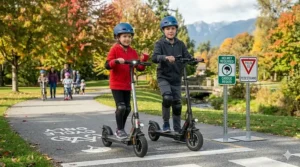
6. Segway Ninebot eKickScooter C2 Lite
Segway’s kids’ line brings adult-scooter engineering — better build quality, more refined braking — down to a child-appropriate speed and weight class, and independent testers have rated it among the better-performing kids’ scooters currently sold. The standout in practice is the braking feel: many budget scooters have a binary on/off footbrake that can pitch a kid forward, while the C2 Lite’s brake modulates more like a bicycle’s, giving a nervous parent (and a nervous kid) real stopping confidence on a slight downhill, which is common on suburban driveways.
- ✅ More refined, progressive braking than most budget scooters
- ✅ Solid build quality backed by a major brand
- ✅ Underbody LEDs improve visibility at dusk
- ❌ Premium price compared to Razor/Gotrax entry models
- ❌ No front or rear headlight/taillight for actual road use
- Price range: roughly $280–$380 CAD.
- Verdict: worth the premium if braking confidence is your top priority.
7. Razor E100 Electric Scooter
The long-running E100 remains one of the most recognizable kids’ electric scooters in North America, with a rear-wheel motor and a simple twist-or-thumb throttle that’s genuinely easy for a first-time rider to understand. Its heavier frame (around 11 kg) is actually a small upside for Canadian families: a heavier scooter sits more confidently on a slightly uneven driveway or sidewalk seam than featherweight models, at the cost of being a bit more to carry up porch steps. It’s also the model most likely to have aftermarket tires and parts available years from now, given how long it’s been on the market.
- ✅ Simple, beginner-proof throttle
- ✅ Long track record and easy-to-find parts
- ✅ Stable ride thanks to heavier frame
- ❌ Heaviest scooter on this list to carry
- ❌ Charging takes longer than newer models
- Price range: roughly $170–$250 CAD.
- Verdict: the dependable, no-surprises choice for ages 8+.
Top Products Compared
| Model | Type | Best Age | Top Speed | Best For |
|---|---|---|---|---|
| Hover-1 Evolution | Hoverboard | 8–13 | ~10 km/h | First hoverboard |
| Gotrax Glide | Hoverboard | 8–13 | ~10 km/h | Smooth driveways |
| Gyroor Warrior | Hoverboard | 10+ | ~13 km/h | Gravel/rural terrain |
| Razor Power A2 | E-scooter | 5–8 | ~10 km/h | Lightest, first scooter |
| Gotrax GKS | E-scooter | 5–7 | ~10 km/h | Youngest beginners |
| Segway C2 Lite | E-scooter | 6–10 | ~13–20 km/h | Best brakes |
| Razor E100 | E-scooter | 8+ | ~16 km/h | Long-term durability |
Looking across the table, the pattern is clear: every scooter on this list tops out with a brake and a handlebar, while every hoverboard relies entirely on the rider’s balance — which is the core reason most safety-conscious Canadian parents of younger kids lean scooter first. Within the scooter category, the spread is really about deck height and weight (lower and lighter favours younger kids), while within hoverboards, wheel size is the deciding factor between smooth-driveway boards and gravel-tolerant ones.
Real-World Canadian Scenarios: Which Ride Fits Your Family?
The Toronto condo family with a 6-year-old and one shared elevator ride down to the lobby. A folding scooter like the Razor Power A2 or Gotrax GKS wins easily here — it folds flat to fit in an elevator and a front hall closet, where a hoverboard’s rigid shape is awkward to store and impossible to fold.
The suburban Calgary family with a long, smooth driveway and a confident 10-year-old skateboarder. This is the hoverboard’s best-case scenario — a kid with existing balance skills, a flat paved surface, and no need to travel further than the driveway and sidewalk in front of the house.
The small-town Manitoba or rural Ontario family with a gravel laneway. Skip the hoverboard entirely; gravel is its worst environment. The Gyroor Warrior’s bigger wheels help somewhat, but a scooter with pneumatic or larger wheels, like the Segway C2 Lite, copes far better with loose surfaces.
The Ottawa or Montreal family riding mostly in parks and on multi-use paths. Check your municipal e-scooter and hoverboard bylaws first (more on this below) — both cities have active micromobility pilot programs that can restrict where powered ride-ons are allowed, even toy-class ones in some parks.
Common Problems (and Canada-Specific Fixes)
Problem: the battery barely lasts through a ride in cold weather. Lithium-ion batteries lose a meaningful chunk of usable range as temperatures drop — it’s not a defect, it’s basic battery chemistry. Bring the board or scooter inside between rides rather than leaving it in an unheated garage, and charge it at room temperature.
Problem: no Canadian service centre for repairs. Razor, Segway, and Gotrax all have Canadian-facing support and, in Gotrax’s case, a Canadian warehouse in Ontario — check the manufacturer’s Canadian site before assuming you’ll need to ship a board across the border for warranty work.
Problem: the device isn’t legal where you planned to ride it. This trips up more families than any mechanical issue — see the regulations section below before you buy.
Problem: salt and slush residue corroding parts after a fall shoulder-season ride. Wipe wheels, axles, and the deck down after any ride on salted pavement; road salt left on metal components overnight is a fast track to rust.
Problem: the board or scooter “feels different” once the weather turns cold. Tire pressure (on pneumatic-wheel scooters) drops in cold air just like a bicycle tire, which changes how the ride feels and handles — a quick top-up restores normal performance.
How to Choose: A Simple Decision Framework
- Does your child already have strong balance (skating, gymnastics, skiing)? If yes, a hoverboard is realistic. If no, start with a scooter.
- Where will they actually ride — driveway, sidewalk, park, or gravel? Smooth pavement opens up hoverboards; anything rougher points to a scooter with larger wheels.
- What’s your child’s age and weight versus the model’s stated limits? Every model on this list has a maximum rider weight; exceeding it shortens battery life and increases fall risk.
- Check your municipality’s rules before you buy, not after — see below.
- Budget in CAD, including a helmet and pads if you don’t already own them — these add roughly $40–$80 CAD and shouldn’t be treated as optional.
- Storage space: scooters fold; hoverboards don’t. If you’re tight on hall closet space, that alone may decide it.
- Season: if you’re buying in late fall for a Canadian winter, manage expectations — neither device performs well on snow or ice, and most families get five to seven months of real outdoor use per year.
Canadian Regulations & Safety Standards
This is the section most buying guides skip, and it’s the one that actually changes what you should buy.
Safety certification: look for UL 2272 certification on any hoverboard or e-scooter battery system — it’s the standard that emerged directly from a wave of lithium-ion battery fires in 2015–2016. It’s since been formally recognized for Canada as a National Standard via the Standards Council of Canada, and remains the clearest signal that a board’s battery, charger, and wiring have been independently tested for overheating and short-circuit risk.
Health Canada has issued recall warnings tied to e-mobility battery misuse, including modified or third-party battery packs in hoverboards and e-scooters, which it links to overheating and fire incidents across North America. Always charge with the original charger and never use a swapped or aftermarket battery.
More broadly, hoverboards and electric ride-on toys sold to children fall under the Canada Consumer Product Safety Act — the federal law that gives Health Canada the authority to order recalls of any consumer product that poses a danger to health or safety, and the same legal basis behind the lithium-battery warnings above.
Provincial e-scooter laws are written for adult-style “kick-scooter” commuting devices, not toy-class kids’ ride-ons — but the line can blur. Ontario’s e-scooter pilot program, for instance, sets a minimum rider age and helmet rules for road-legal kick-scooters, and several other provinces and cities run similar pilots with their own age, speed, and helmet requirements. The low-speed Razor- and Gotrax-style scooters reviewed above are generally intended for private property, driveways, and parks rather than public roads — but municipal bylaws on parks, trails, and sidewalks vary, so it’s worth a quick check with your city before assuming a backyard toy is fine everywhere.
Hoverboards occupy a legal grey zone in most provinces — they’re not clearly classified as bicycles, mobility devices, or motor vehicles, and several jurisdictions restrict or ban their use on public roads and sidewalks while permitting them on private property. When in doubt, keep hoverboard use to your own driveway, yard, or an indoor space.
Helmets are non-negotiable. Whatever province you’re in, treat a CSA- or CPSC-approved bicycle helmet as a purchase you make at the same time as the board or scooter, not an optional add-on for later.
Long-Term Cost & Maintenance in Canada
Beyond the upfront price, budget for a charger replacement eventually (most run $20–$40 CAD), occasional tire or wheel replacement on scooters that see real outdoor mileage, and a helmet/pad set if you don’t already have one. Canadian winters effectively cut the usable riding season to roughly five to seven months for most families, which is worth factoring into whether a pricier, more durable model is worth it versus a lower-cost board your child may outgrow before it wears out.
Features That Actually Matter (and Marketing Hype That Doesn’t)
Matters: brake type and feel, wheel size and material, stated weight limit versus your child’s actual weight, UL 2272 certification, and fold/storage size.
Mostly hype for younger kids: Bluetooth speakers (fun, but the first thing to drain a battery), top speed claims well above what a beginner should ever reach, and “off-road” branding on boards that still have small, hard plastic wheels unsuited to anything but pavement.
FAQ
❓ Is a hoverboard or electric scooter safer for a 7-year-old?
❓ Can my child legally ride a hoverboard on the sidewalk in Canada?
❓ Do hoverboards and electric scooters work well in Canadian winters?
❓ What certification should I look for before buying a hoverboard in Canada?
❓ Is a kid's electric scooter the same thing as the e-scooters covered by provincial pilot programs?
Conclusion
For most Canadian families, an electric scooter is the more practical, more forgiving choice for a kid’s first powered ride — the handlebar and brake genuinely change how fast a child gets comfortable and how badly a fall hurts when it happens. A hoverboard makes more sense for an older kid with real balance skills and a smooth driveway to ride on, but it’s the riskier pick for a true beginner.
Whichever you choose, build in the cost of a proper helmet, confirm UL 2272 certification, and take five minutes to check your municipality’s rules before the first ride — that one step solves more headaches than any spec on the box.
✨ Don’t Miss These Exclusive Deals!
🔍 Ready to pick one? Check current pricing and availability on Amazon.ca for the models above before they’re back-ordered for the season.
Recommended for You
- How to Choose an Electric Scooter for Kids: 7 Canadian Picks (2026)
- Best Electric Scooter for Kids 8-12 in Canada 2026: Top 7 Picks
- 7 Best 24V Off-Road Electric Ride-On for Kids in Canada (2026)
Disclaimer: This article contains affiliate links. As an Amazon Associate, I earn from qualifying purchases. If you purchase products through these links, we may earn a small commission at no additional cost to you.
✨ Found this helpful? Share it with your friends! 💬🤗
