

In This Article
You’re standing in the toy aisle or scrolling through Amazon.ca, and the question hits you: should I get my toddler a foot to floor ride-on or a tricycle? I’ve been there, and let me tell you, the answer isn’t as straightforward as you might think.

The decision between foot to floor vs tricycle toddler options goes far beyond aesthetics or price tags. According to the Canadian 24-Hour Movement Guidelines, toddlers aged 1-2 years should accumulate at least 180 minutes of physical activity at any intensity spread throughout the day. Both ride-on types can contribute significantly to meeting these recommendations, but they do so in remarkably different ways.
Foot to floor ride-ons let your little one propel themselves using their feet against the ground, offering immediate gratification and natural mobility. Tricycles, conversely, introduce the pedalling concept, requiring more coordination but potentially offering longer-term value as your child grows. The push car vs tricycle development debate centres on when your child is developmentally ready for each option and what skills you want to prioritise.
In this comprehensive guide, I’ll walk you through everything you need to know about choosing between these two popular first ride-on options. We’ll explore the best products available on Amazon.ca, compare developmental benefits, and help you make an informed decision that aligns with your child’s unique needs and your family’s lifestyle.
Quick Comparison Table
| Feature | Foot to Floor Ride-Ons | Tricycles |
|---|---|---|
| Starting Age | 12-18 months | 18-36 months (varies by model) |
| Primary Skill | Balance & coordination | Pedalling & steering |
| Learning Curve | Immediate, intuitive | Gradual, requires practice |
| Independence Level | High from day one | Develops over time |
| Price Range (CAD) | $80-$150 | $70-$180 |
| Indoor/Outdoor | Both | Primarily outdoor |
| Longevity | 1-3 years typical use | 2-4 years typical use |
💬 Just one click – help others make better buying decisions too! 😊
Top 7 Products: Expert Analysis
1. Little Tikes Cozy Coupe Classic
The iconic red and yellow car that’s been a childhood staple for over 40 years, the Little Tikes Cozy Coupe remains a Canadian favourite for good reason. Available on Amazon.ca for approximately $117-$130 CAD, this foot to floor ride-on combines nostalgic design with modern functionality.
Key Specifications:
- Weight capacity: 50 lbs (22.7 kg)
- Dimensions: 29.5″L x 16.5″W x 33.5″H
- Removable floorboard for growing toddlers
- Working horn and clicking ignition switch
Canadian parents consistently praise its durability through harsh winters and rough play. “We left ours outside through a Manitoba winter, and it still looks brand new after two years,” reports one Amazon.ca reviewer.
✅ Pros:
- Extremely durable construction
- Removable floor transitions from push car to independent riding
- Storage compartment under seat
❌ Cons:
- Larger footprint requires storage space
- Assembly required (approximately 30 minutes)

2. Radio Flyer 4-in-1 Stroll ‘N Trike
This versatile option tackles the foot to floor vs tricycle toddler dilemma by being both. The Radio Flyer 4-in-1 (priced around $88-$132 CAD at Canadian retailers) adapts through four distinct stages as your child develops.
Key Specifications:
- Age range: 9 months to 5 years
- Four modes: Infant trike, steering trike, learn-to-ride, classic trike
- Adjustable UV-blocking canopy
- 3-point safety harness
This model excels at addressing which ride on for 2 year old questions because it literally grows with your child. Canadian buyers appreciate the canopy feature during our unpredictable spring and fall weather.
✅ Pros:
- Four stages mean extended usability
- Parent push handle for younger riders
- Wide rear wheels for stability
❌ Cons:
- Heavier than standard tricycles
- Higher price point
3. Fisher-Price Harley-Davidson Tough Trike
Budget-conscious families looking for a solid tricycle option should consider the Fisher-Price Harley-Davidson Tough Trike, typically priced between $45-$70 CAD on Amazon.ca. This represents excellent value in the best first ride on comparison category.
Key Specifications:
- Age recommendation: 2-5 years
- Weight capacity: Approximately 50 lbs
- Easy-grip handlebars
- Under-seat storage compartment
Canadian customers note this tricycle handles bumpy terrain well, making it suitable for everything from smooth basement floors to rougher outdoor surfaces.
✅ Pros:
- Exceptional value for money
- Sturdy construction
- Wide wheelbase prevents tipping
❌ Cons:
- No adjustable seat height
- Basic features compared to premium models
4. Step2 Whisper Ride II Buggy
For families wanting a foot to floor option with added functionality, the Step2 Whisper Ride II (approximately $85-$110 CAD) offers a unique stroller-substitute design perfect for Canadian families on the go.
Key Specifications:
- Weight capacity: 50 lbs
- Features seat belt and horn
- Under-seat storage
- Parent push handle included
This ride-on excels in the independent vs assisted mobility debate by offering both options seamlessly. It’s particularly popular with Ontario and Quebec families who appreciate its compact design for urban living.
✅ Pros:
- Doubles as a stroller alternative
- Whisper-quiet wheels
- Seat belt adds safety
❌ Cons:
- Less “toy-like” appeal
- Limited colour options
5. KRIDDO 2-in-1 Balance Bike & Tricycle
The KRIDDO 2-in-1 represents innovative thinking in the foot to floor vs tricycle toddler space, available on Amazon.ca for $75-$95 CAD. This convertible design addresses both balance and coordination training needs.
Key Specifications:
- Converts between tricycle and balance bike
- Age range: 18 months to 5 years
- Adjustable seat height
- Tool-free assembly
Canadian reviewers highlight its versatility: “We started with tricycle mode at 18 months, then switched to balance bike mode at 2.5 years. It’s like getting two toys in one,” shares a Toronto parent.
✅ Pros:
- Two riding modes maximize value
- Lightweight and portable
- No-tool assembly
❌ Cons:
- Smaller frame may feel cramped for larger toddlers
- Limited storage space
6. Radio Flyer Deluxe Steer & Stroll Trike
Premium features meet practical design in the Radio Flyer Deluxe Steer & Stroll, priced at $110-$150 CAD. This addresses the push car vs tricycle development question by offering parental control that gradually transitions to independence.
Key Specifications:
- Adjustable parent push handle (removable)
- Reclining seat with harness
- Storage trailer attachment
- Ages 9 months to 5 years
The adjustable push handle proves particularly valuable for taller Canadian parents, extending to a comfortable height that prevents back strain during neighbourhood strolls.
✅ Pros:
- Parent-controlled steering for young riders
- Storage trailer encourages imaginative play
- Grows through multiple developmental stages
❌ Cons:
- Higher price point
- Bulkier than standard tricycles
7. Little Tikes Princess Cozy Coupe
Completing our lineup, the Little Tikes Princess Cozy Coupe ($120-$145 CAD) offers all the beloved features of the classic model with themed styling that appeals to young royalty.
Key Specifications:
- Includes pretend cell phone with lights and sounds
- Same durable construction as classic Cozy Coupe
- Weight capacity: 50 lbs
- Ages 18 months to 5 years
This foot to floor option particularly excels at encouraging imaginative play alongside gross motor skills development, with the added electronics creating engaging scenarios for creative toddlers.
✅ Pros:
- Same durability as classic model
- Interactive electronics add play value
- High seat back provides support
❌ Cons:
- Requires batteries for phone feature
- Pink/purple colour scheme may not suit all preferences
Understanding Gross Motor Skills Development
When comparing foot to floor vs tricycle toddler options, understanding gross motor skills development provides crucial context for your decision. According to research published in the National Center for Biotechnology Information, goal-oriented play activities significantly improve motor elements including strength, durability, agility, speed, balance and coordination in early childhood.
Gross motor skills involve the large muscles in your child’s arms, legs and torso. These skills form the foundation for virtually every physical activity your child will perform throughout their life. Research from Cleveland Clinic indicates that gross motor skills require proper coordination of skeletal muscles, bones and nerves working in harmony.
How Ride-Ons Support Development
Both foot to floor ride-ons and tricycles contribute to gross motor skills development, but they target different aspects:
Foot to Floor Ride-Ons primarily develop:
- Lower body strength through pushing motions
- Balance while seated and moving
- Spatial awareness and steering coordination
- Core stability
Tricycles specifically enhance:
- Circular pedalling motion coordination
- Bilateral coordination (using both sides together)
- Upper and lower body integration
- Advanced steering capabilities
The Canadian Society for Exercise Physiology recommends that toddlers aged 1-2 years accumulate at least 180 minutes of physical activity at any intensity throughout the day. Both ride-on types contribute meaningfully to meeting this target while keeping children engaged and entertained.
Balance and Coordination Training Explained
The balance and coordination training offered by different ride-ons represents a key consideration in the foot to floor vs tricycle toddler decision. These skills don’t develop in isolation—they’re intrinsically linked to your child’s overall physical and cognitive development.
Balance involves your child’s ability to maintain a controlled position or posture during specific tasks. According to developmental experts at NAPA Center, balance can be both static (maintaining a position while sitting or standing) and dynamic (controlling movements while walking or moving).
Progressive Skill Building
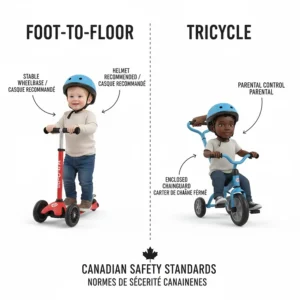
Foot to floor ride-ons introduce balance concepts earlier because:
- The wide base provides inherent stability
- Children can use their feet for immediate stability
- The low seat height reduces fall risk
- Natural pushing motions feel intuitive
Tricycles advance these skills by:
- Requiring balance while pedalling
- Introducing turning radius concepts
- Building confidence in controlled movement
- Preparing for bicycle riding
Research from Wikipedia on gross motor skills notes that children exposed to outdoor play time activities develop better gross motor skills overall. Both ride-on types encourage outdoor exploration, weather permitting in Canada’s varied climate.
Independent vs Assisted Mobility: What’s Right?
The independent vs assisted mobility question often determines which option works best for your family’s specific circumstances. This consideration extends beyond the toy itself to your parenting style, living environment and daily routines.
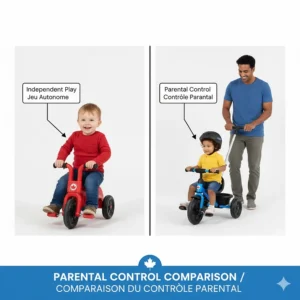
Independent Mobility (Foot to Floor)
Foot to floor ride-ons offer immediate independence because toddlers instinctively understand the concept of pushing with their feet. This natural learning curve means less frustration and more confident exploration from day one.
Canadian families living in apartments or condos particularly appreciate foot to floor options for:
- Quiet indoor use (neighbours below will thank you)
- Compact maneuverability in tight spaces
- Quick setup without lengthy learning periods
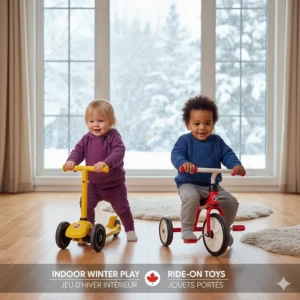
- Year-round usability regardless of weather
Assisted Mobility (Tricycles with Parent Handles)
Convertible tricycles like the Radio Flyer 4-in-1 bridge the gap by offering parent-controlled steering initially, then gradual independence. This approach works well for families who:
- Enjoy structured outdoor time together
- Have spacious driveways or nearby paths
- Want longer-term value as skills develop
- Prefer guided learning experiences
According to Statistics Canada data, the majority of Canadian preschool children (70%) achieve at least 180 minutes of total physical activity daily. Choosing ride-ons that match your child’s current abilities while encouraging progression helps maintain this positive trend.
✨ Don’t Miss These Exclusive Deals!
🔍 Take your child’s active play to the next level with these carefully selected products available in Canada. Click on any highlighted item to check current pricing and availability on Amazon.ca. These ride-ons will help you create authentic developmental milestones your family will love!
Choosing Based on Your Toddler’s Age and Development
The best first ride on comparison ultimately depends on matching the toy to your child’s current developmental stage. Chronological age provides a starting point, but individual development varies significantly.
12-18 Months
At this stage, foot to floor ride-ons clearly win the foot to floor vs tricycle toddler debate. Children this age are:
- Mastering walking independently
- Building leg strength rapidly
- Developing spatial awareness
- Learning cause-and-effect relationships
The Little Tikes Cozy Coupe or Step2 Whisper Ride II work exceptionally well because young toddlers can climb in and immediately experience movement. The instant feedback loop—push feet, car moves—reinforces the behaviour and encourages continued play.
18-24 Months
This transitional period represents the sweet spot for introducing either option, depending on your child’s coordination level. Watch for these readiness indicators:
- Confident walking without stumbling
- Ability to push toy shopping carts or similar items
- Interest in “driving” or riding activities
- Following simple directional instructions
The KRIDDO 2-in-1 shines during this stage because you can start with tricycle mode (easier pedalling position) and convert to balance bike mode as skills improve.
24-36 Months
Two-year-olds often show strong preferences and capabilities that make the decision clearer. By this age, many children demonstrate readiness for tricycles through:
- Coordinated leg movements (can march or “gallop”)
- Understanding of steering concepts
- Patience for learning new skills
- Desire for “big kid” activities
The Fisher-Price Harley-Davidson Tough Trike provides an affordable entry point, while the Radio Flyer Deluxe Steer & Stroll offers premium features for families wanting extended usability.
36+ Months
At three years and beyond, the Canadian Society for Exercise Physiology identifies this as the ideal age for tricycles. Children this age benefit from the more complex coordination challenges tricycles provide, preparing them for bicycle riding later.
Safety Considerations for Canadian Climate
Canada’s diverse climate presents unique safety considerations often overlooked in general riding toy guides. From icy sidewalks in Winnipeg to rainy spring days in Vancouver, weather impacts both safety and toy longevity.
Winter Storage and Use
Foot to floor ride-ons and tricycles with proper care can withstand Canadian winters, but precautions matter:
- Store plastic ride-ons indoors when temperatures drop below -10°C to prevent cracking
- Metal tricycle frames can become dangerously cold—check temperature before use
- Wheels may harden in cold weather, affecting traction
- Clear snow from riding areas to prevent unexpected slips
Canadian buyers consistently rate the Little Tikes Cozy Coupe highly for weather resistance. Its thick-walled plastic construction survives freeze-thaw cycles better than thinner alternatives.
Surface Considerations
Different surfaces common in Canadian homes and yards affect ride-on performance:
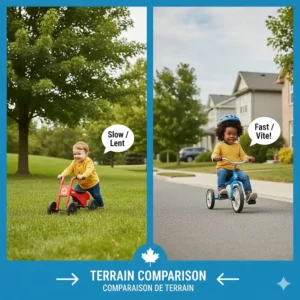
Hardwood/Laminate Floors: Foot to floor options with soft wheels prevent scratching. Look for EVA foam or rubber wheels rather than hard plastic.
Carpet: Thicker pile carpets create resistance that builds strength but may frustrate very young riders. Tricycles struggle more on carpet than foot to floor options.
Concrete/Asphalt: Both ride-on types excel on these surfaces, common in Canadian driveways and sidewalks. Ensure adequate supervision as speeds can increase on smooth surfaces.
Gravel/Grass: Tricycles with larger wheels navigate these surfaces better. Foot to floor options may bog down in soft grass or loose gravel.
Helmet Requirements
While ride-on toys technically don’t require helmets in most Canadian provinces, establishing this safety habit early proves valuable. The Canadian Paediatric Society recommends helmets for all wheeled toys once children reach speeds where falls could cause injury.
For tricycles specifically, helmets become more important as children gain speed and confidence. Budget $25-$45 CAD for a properly fitted toddler helmet from brands like Giro or Bell, widely available at Canadian Tire or Amazon.ca.
Price Comparison and Value Analysis
Understanding the true cost extends beyond the initial purchase price to include longevity, versatility and developmental value. In the best first ride on comparison, Canadians should consider total cost of ownership.
Budget Options ($45-$80 CAD)
Fisher-Price Tough Trike leads this category, offering solid construction at the lowest price point. While lacking adjustability, its durability means potential hand-me-down value for younger siblings or neighbour children.
Other budget-friendly choices include basic foot to floor cars without electronics or elaborate features. These stripped-down models still provide the core gross motor skills development benefits at accessible prices.
Mid-Range Selection ($80-$120 CAD)
This sweet spot captures most purchases, balancing features and affordability:
- Little Tikes Cozy Coupe Classic: $117-$130 CAD
- Step2 Whisper Ride II: $85-$110 CAD
- KRIDDO 2-in-1: $75-$95 CAD
Mid-range options typically include quality construction, some adjustability and additional features (storage, sounds, etc.) that extend play value without breaking the budget.
Premium Investment ($120-$180 CAD)
Radio Flyer 4-in-1 and Deluxe Steer & Stroll justify higher prices through:
- Multi-year usability (9 months to 5 years)
- Multiple configuration modes
- Premium materials and construction
- Canadian brand reputation and support
When calculated per year of use, premium tricycles often provide better value than cheaper options requiring replacement as children grow.
Hidden Costs to Consider
Smart Canadian shoppers account for:
- Shipping fees (many Amazon.ca items ship free over $35)
- Potential import duties on non-Canadian products
- Replacement batteries for electronic features
- Additional accessories (helmets, safety flags, etc.)
- Storage solutions (garage hooks, sheds, etc.)
Space and Storage Solutions
Canadian homes vary dramatically—from spacious suburban houses to compact downtown condos. The push car vs tricycle development decision often hinges on available storage space.
Indoor Storage Requirements
Foot to Floor Ride-Ons:
- Average footprint: 2.5′ x 1.5′ (76cm x 46cm)
- Height: 2-3 feet (60-90cm)
- Best stored in playrooms, basements, or garages
- Some models (KRIDDO) fold for compact storage
Tricycles:
- Average footprint: 3′ x 2′ (90cm x 60cm)
- Height with parent handle: up to 4 feet (120cm)
- Handles often remove for easier storage
- Stackable in some configurations
Seasonal Rotation
Many Canadian families adopt a rotation system:
- Spring/Summer/Fall: Outdoor ride-ons (tricycles) get priority garage space
- Winter: Indoor foot to floor options move to playroom accessibility
- Basement storage: Off-season items stored in rafters or storage rooms
This rotation maximizes year-round play value while managing space constraints effectively.
Multi-Unit Housing Considerations
Condo and apartment dwellers face unique challenges:
- Noise: Foot to floor options with soft wheels prevent neighbour complaints
- Hallway restrictions: Check building rules about ride-on use in common areas
- Elevator transport: Lighter models ease trips to ground-level play areas
- Balcony storage: Weather-resistant models can occupy balcony space (where allowed)
Maintenance and Longevity
Proper maintenance extends the life of whichever option you choose, maximizing your investment while ensuring safe play.
Routine Maintenance Tasks
Every Month:
- Inspect wheels for wear or damage
- Tighten any loose screws or bolts
- Wipe down surfaces with mild soap and water
- Check for sharp edges or cracks
Every Season:
- Lubricate moving parts (pedal mechanisms, steering columns)
- Deep clean fabric or padded components
- Touch up paint or stickers if desired
- Inspect structural integrity thoroughly
Common Issues and Solutions
Squeaky Wheels: Apply white lithium grease (available at Canadian Tire, $8-$12 CAD). Avoid WD-40, which attracts dirt.
Faded Colours: Canadian sun intensity varies by region, but UV exposure fades plastics over time. Store indoors when possible or use outdoor toy covers ($15-$30 CAD).
Loose Parts: Keep a small toolkit handy with appropriate screwdrivers and wrenches. Most ride-ons use standard metric hardware readily available at any Canadian hardware store.
Expected Lifespan
With proper care:
- Foot to Floor Ride-Ons: 3-5 years of active use, potentially longer for hand-me-downs
- Basic Tricycles: 4-6 years across multiple children
- Premium Convertible Tricycles: 5-8 years with mode conversions
Canadian families often recoup 40-60% of purchase price through local resale (Facebook Marketplace, Kijiji, consignment shops) when children outgrow their ride-ons, provided items remain in good condition.
Environmental and Sustainability Factors
Increasingly, Canadian families consider environmental impact alongside functionality when choosing children’s products. The foot to floor vs tricycle toddler decision carries sustainability implications worth examining.
Material Considerations
Plastics: Most foot to floor ride-ons use HDPE (high-density polyethylene) or polypropylene. While durable and recyclable in theory, Canadian recycling programs vary by municipality regarding acceptance of large plastic toys.
Metals: Tricycle frames typically use powder-coated steel. Metal components recycle more easily than plastics and demonstrate superior longevity, reducing replacement frequency.
Sustainable Choices
Buy Once, Use Twice: Convertible models like the KRIDDO 2-in-1 or Radio Flyer 4-in-1 reduce waste by serving multiple purposes over extended periods.
Second-Hand Options: Canadian marketplaces (Facebook, Kijiji, Once Upon a Child stores) offer gently used ride-ons at significant savings. Little Tikes products particularly maintain value and functionality through multiple owners.
Eco-Conscious Brands: Some manufacturers prioritize sustainability. KRIDDO, for instance, holds ClimatePartner certification and offsets production emissions—a consideration for environmentally minded Canadian families.
Disposal and Recycling
When ride-ons reach end-of-life:
- Contact local municipalities about bulk plastic recycling
- Donate functional toys to charity (Value Village, Goodwill, Salvation Army)
- Post free items on neighbourhood buy-nothing groups
- Remove and recycle metal components separately
- Check manufacturer take-back programs where available
Real Canadian Parent Experiences
Understanding how other Canadian families navigate the foot to floor vs tricycle toddler choice provides valuable practical insights beyond manufacturer specifications.
Urban Family: Toronto Condo Living
“We chose the Step2 Whisper Ride II for our 18-month-old specifically because of the quiet wheels,” shares Priya from Toronto. “Our downstairs neighbours never complain, and we can use it in the hallway when weather’s bad. The compact size fits perfectly in our front closet too.”
Priya’s experience highlights how independent vs assisted mobility choices adapt to space-constrained urban environments common in Vancouver, Montreal and Toronto.
Suburban Family: Calgary Climate Challenges
“The Little Tikes Cozy Coupe survived three Calgary winters stored in our garage,” reports Michael. “We brought it in during the coldest snaps, but otherwise it handled freeze-thaw cycles without cracking. Both our kids used it from about 15 months to 4 years old. Definitely worth every penny.”
Rural Family: Saskatchewan Wide-Open Spaces
“Living on an acreage, we wanted something with longevity,” explains Sarah from rural Saskatchewan. “The Radio Flyer 4-in-1 was perfect. Started with the parent push mode on our long driveway, and now at 3.5 years, she pedals independently. The fact it grows through four stages meant we never needed to buy another riding toy.”
Multi-Child Household: Maritime Provinces
“With three kids under five, the Fisher-Price Tough Trike gave us unbeatable value,” notes Jennifer from New Brunswick. “Simple, sturdy, and it’s been passed down twice already. Sure, fancier models exist, but this $60 investment has provided literally years of entertainment for all three children.”
Making Your Final Decision
After examining specifications, developmental benefits and real-world experiences, the foot to floor vs tricycle toddler decision ultimately rests on your unique family circumstances.
Choose a Foot to Floor Ride-On If:
✓ Your child is 12-24 months old
✓ You need indoor/outdoor versatility
✓ Immediate independent use appeals to you
✓ Storage space is limited
✓ You live in a multi-unit building
✓ Quieter operation matters
✓ Your child hasn’t mastered confident walking yet
Choose a Tricycle If:
✓ Your child is 24+ months old
✓ You have dedicated outdoor space
✓ You value structured learning experiences
✓ Long-term developmental progression is priority
✓ You want preparation for bicycle riding
✓ You’re willing to invest in longer-term usability
✓ Your child shows strong coordination for their age
Consider a Convertible/Multi-Stage Model If:
✓ Budget allows for higher initial investment
✓ You plan to have multiple children
✓ You want maximum longevity and value
✓ Storage space accommodates larger items
✓ You appreciate versatile, adaptive toys
✓ Environmental sustainability matters to your family

Frequently Asked Questions
❓ At what age should I transition from foot to floor to tricycle in Canada?
❓ Do ride-on toys work on Canadian winter indoor surfaces?
❓ Which option better supports gross motor skills development according to Canadian guidelines?
❓ What's the price difference between quality foot to floor and tricycle options in Canada?
❓ Are there Canadian safety standards specific to toddler ride-on toys?
Conclusion: Your Child’s First Ride Awaits
The foot to floor vs tricycle toddler decision represents more than choosing a toy—you’re selecting a developmental tool that will shape your child’s early movement experiences and create lasting family memories.
For most Canadian families, the ideal approach involves both: starting with a foot to floor ride-on like the Little Tikes Cozy Coupe ($117-$130 CAD) around 12-18 months, then transitioning to a tricycle such as the Radio Flyer Steer & Stroll ($110-$150 CAD) around 24-30 months. This progression aligns with natural developmental stages while maximizing engagement and skill-building at each phase.
If budget constraints require choosing just one option initially, let your child’s current age and abilities guide you. For toddlers under 24 months, foot to floor ride-ons provide immediate joy and independence. For children approaching their second birthday, convertible tricycles like the KRIDDO 2-in-1 ($75-$95 CAD) offer exceptional value by serving both functions.
Remember that the best first ride on comparison isn’t won by features or price alone—it’s determined by which option your specific child will use most enthusiastically. A $50 tricycle that your toddler rides daily outperforms a $150 model that collects dust in the garage.
Whatever you choose, you’re investing in your child’s physical development, confidence and outdoor play experiences—all crucial elements of healthy Canadian childhood. Now get out there and watch your little one’s face light up as they take their first independent ride!
Recommended for You
- 7 Best Toddler Push Cars With Handle Canada 2026 Guide
- 7 Best Weather Resistant Outdoor Ride Ons in Canada 2026
- 7 Best Ride On Toys for 18 Month Old Canada 2026
Disclaimer: This article contains affiliate links to Amazon.ca. If you purchase products through these links, we may earn a small commission at no additional cost to you.
✨ Found this helpful? Share it with your friends! 💬🤗
