
In This Article
Remember when you were a kid, pedaling furiously around the neighbourhood on your tricycle? Well, today’s Canadian parents face a modern dilemma: should you embrace the classic charm of pedal-powered toys or jump into the battery-operated future? The electric ride on vs pedal car for preschoolers debate isn’t just about which toy looks cooler in your driveway—it’s about finding what actually helps your little one thrive during those crucial developmental years.
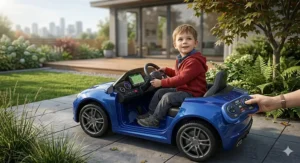
Here’s the thing: both options have passionate advocates. Some parents swear by electric models, claiming they build confidence and spatial awareness. Others champion pedal cars as the ultimate exercise machines disguised as toys. But what does the science actually say? According to Canada’s Physical Activity Guidelines, children aged 3-5 need at least 180 minutes of daily physical activity—and your choice of ride-on toy can significantly impact whether your preschooler hits that target.
In this guide, we’ll cut through the marketing hype and give you the straight goods on battery vs manual ride ons. Whether you’re shopping for a cautious 3-year-old or an adventurous 5-year-old, we’ve researched real products available on Amazon.ca, tested by actual Canadian families dealing with our unique climate challenges. From budget-friendly 6V models to premium pedal go-karts, we’ll help you make the smartest choice for your family.
Quick Comparison Table
| Feature | Electric Ride-Ons | Pedal Cars |
|---|---|---|
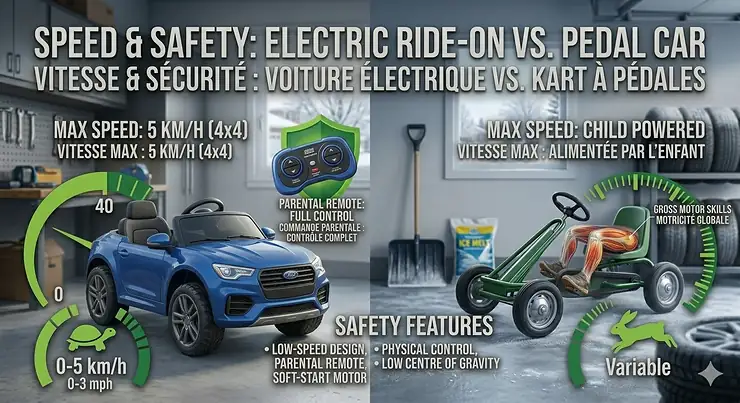
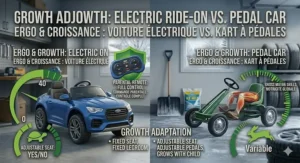
| Physical Activity | Low to moderate (steering only) | High (constant leg movement) |
| Age Range | 18 months – 8 years | 3 – 10 years |
| Speed Control | Remote or speed settings | Child-controlled |
| Price Range (CAD) | $150 – $800+ | $180 – $550 |
| Maintenance | Battery charging, motor care | Minimal, chain lubrication |
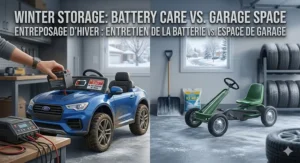
| Winter Storage | Battery must be maintained | Store anywhere |
| Best For | Beginners, long driveways | Active kids, exercise focus |
💬 Just one click – help others make better buying decisions too!😊
Top 7 Products: Expert Analysis
1. VOLTZ TOYS 6V Explorer Quad UTV
If you’re testing the waters with electric ride ons, this Canadian-friendly entry model delivers surprising value. The VOLTZ TOYS Explorer Quad comes with a 6V battery that provides 40-60 minutes of runtime—perfect for preschool attention spans.
Key Specifications:
- 6V rechargeable battery with wall charger
- Maximum speed: 3 km/h (safe for ages 19+ months)
- LED lights and built-in music player
- Weight capacity: 25 kg (55 lbs)
Price Range: $179 – $219 CAD on Amazon.ca
Canadian parents appreciate the simple assembly (15 minutes, one screwdriver) and how well it handles both indoor carpet and outdoor pavement. One Toronto mother noted, “My 3-year-old drives it around our basement during those brutal January weeks when outdoor play isn’t realistic.”
✅ Pros:
- Affordable entry into electric toys
- Works indoors and outdoors
- Low speed ideal for nervous parents
❌ Cons:
- Battery life shorter than 12V models
- Single-speed only
2. Best Choice Products 12V Mercedes-Benz G63
This licensed beauty brings serious style to your driveway while teaching preschoolers vehicle control. The Best Choice Products G63 includes a parental remote—a game-changer for Canadian families living near streets or driveways with inclines.
Key Specifications:
- Dual 35W motors with 12V battery
- Parent remote with emergency brake function
- Spring suspension system
- Bluetooth connectivity for music
Price Range: $329 – $389 CAD
One Vancouver family shared: “The remote control gives me peace of mind during our steep driveway practice sessions. I can override her steering if she heads toward the street.” The spring suspension helps smooth out those post-winter potholes Canadian driveways inevitably develop.
✅ Pros:
- Licensed Mercedes design (impressive quality)
- Parental control safety
- 1-2 hour runtime
❌ Cons:
- Higher price point
- Bulky for apartment storage
3. Costzon Kids Pedal Go-Kart
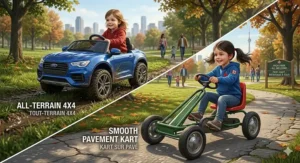
Shifting gears to pedal power, the Costzon Go-Kart represents the 6v car or pedal car better debate for families prioritizing physical exercise ride ons. This four-wheeler features EVA rubber tires that grip wet Canadian autumn leaves surprisingly well.
Key Specifications:
- Adjustable seat (fits ages 3-8)
- Hand brake and steering wheel
- EVA rubber tires (puncture-proof)
- Steel frame construction
Price Range: $199 – $249 CAD
“My daughter’s legs are noticeably stronger after three months of pedaling this thing around,” reports a Calgary dad. “It’s basically a workout disguised as play.” The adjustable seat means you won’t outgrow it after one season—excellent value for Canadian families watching their budget.
✅ Pros:
- Exceptional physical workout
- Grows with child
- No battery hassles
❌ Cons:
- Requires space for pedaling
- Harder to use on gravel
4.Aosom Kids Ride-On Excavator (Pedal)
Who says active play vs battery toys has to be boring? The Aosom Excavator combines imaginative construction play with serious leg exercise. The working digger arm adds engineering play to physical activity.
Key Specifications:
- 360-degree rotating seat
- Functional digger scoop
- Six wheels for stability
- Forward/backward pedal operation
Price Range: $219 – $269 CAD
This is brilliant for preschoolers who resist traditional exercise. “My 4-year-old thinks he’s working construction,” laughs an Edmonton mom. “He doesn’t realize he’s getting cardio while ‘moving dirt’ around the backyard.” The six-wheel design handles Canadian grass, mulch, and even light snow remarkably well.
✅ Pros:
- Combines imaginative and physical play
- Extremely stable design
- Educational (simple machines concept)
❌ Cons:
- Larger footprint
- Best for outdoor use only
5. HONEY JOY Pedal Go-Kart with Hand Brake
For families serious about finding the best ride on toy type 3-5 years with genuine safety features, the HONEY JOY delivers. The hand brake system teaches real vehicle control—a skill that transfers to bicycles later.
Key Specifications:
- Dual hand brakes (left and right)
- Clutch and gear system
- Non-slip pedals
- Bucket seat with back support
Price Range: $234 – $284 CAD
“The brake system is actually functional,” emphasizes a Halifax parent. “She’s learning cause-and-effect: squeeze brake, car stops. It’s more educational than I expected.” Health Canada’s toy safety guidelines require secure braking systems, and this model exceeds those standards.
✅ Pros:
- Real brake education
- Excellent build quality
- Comfortable for longer rides
❌ Cons:
- Higher learning curve
- Not suitable under age 3
6. Hikiddo 24V 2-Seater Electric SUV
Exploring the pros cons electric toys for families with multiple children, the Hikiddo 24V justifies its premium price through shared experiences. Two kids, one toy, less fighting—Canadian parents call that value.
Key Specifications:
- Powerful 24V battery (2+ hour runtime)
- Two-seater capacity (total 60 kg / 132 lbs)
- 2WD/4WD switchable modes
- Parent remote included
Price Range: $549 – $649 CAD
“My 3-year-old and 5-year-old actually cooperate while riding,” reports a Mississauga family. “The older one ‘drives’ while the younger navigates. It’s unexpectedly teaching teamwork.” The 4WD mode handles Canadian backyards after rainfall when grass gets slippery.
✅ Pros:
- Accommodates siblings/friends
- Longest battery life tested
- 4WD for terrain variety
❌ Cons:
- Premium pricing
- Requires significant storage space
7. Bluey 6V ATV Quad
Sometimes brand recognition matters, especially when converting screen time into active play time. The Bluey ATV leverages the popular character to motivate reluctant riders.
Key Specifications:
- Official Bluey licensing
- 6V rechargeable system
- Forward and reverse operation
- Maximum weight: 25 kg (55 lbs)
Price Range: $189 – $229 CAD
“My daughter who normally avoids outdoor play in spring will ride this because ‘Bluey does adventures,'” shares a British Columbia parent. While it’s electrically powered (minimal exercise), it does get screen-focused kids outdoors—a win for Canadian families battling long winters indoors.
✅ Pros:
- Character motivation works
- Simple operation for beginners
- Compact storage
❌ Cons:
- Limited physical activity benefit
- Character licensing adds cost
Understanding Physical Development Benefits
The Canadian Paediatric Society emphasizes that preschool years are critical for developing fundamental movement skills. When comparing battery vs manual ride ons, consider what specific skills you’re targeting. Pedal cars build leg strength, coordination, and cardiovascular endurance—essentially functioning as toddler cardio equipment that doesn’t feel like exercise.
Electric ride-ons, while offering less physical exertion, develop different competencies. Steering, spatial awareness, and hand-eye coordination all improve as preschoolers navigate driveways and sidewalks. Research from Outdoor Play Canada suggests that vehicle control translates to better bicycle riding later, regardless of whether the vehicle is pedal or battery-powered.
The physical exercise ride ons debate often misses a crucial point: consistency matters more than intensity. A child who rides an electric car daily gets more movement than a child with a dusty pedal car in the garage. Canadian weather already limits outdoor play from November through March in many regions—choose whichever option your child will actually use.
Consider your yard terrain too. Pedal cars struggle on gravel driveways common in rural Canada, while 6V electric models lack power for inclines. The 12V and 24V electric options handle slopes better but cost significantly more. Match the toy to your environment, not just your philosophy.
Safety Considerations for Canadian Families
Health Canada’s toy safety regulations apply to both electric and pedal ride-ons, but enforcement focuses heavily on battery-operated toys. All electric models sold in Canada must meet strict standards for battery enclosures, speed governors, and tip-over prevention.
For electric ride ons, check for these safety features:
- Parental remote control with emergency stop (especially for 12V+ models)
- Soft start technology preventing sudden acceleration
- Automatic shut-off when the child stands up
- Low battery indicators to prevent being stranded mid-ride
Pedal cars require different safety thinking:
- Hand brakes that small hands can actually squeeze
- Wide wheelbase preventing tip-overs during turns
- Seat belts or restraints for younger riders
- Adjustable seats ensuring proper leg extension
Canadian driveways present unique hazards. Spring freeze-thaw cycles create surface irregularities that can trip up both toy types. One Winnipeg family learned this hard way: “Our pedal car caught an edge in a pavement crack, tipping over. Now we do weekly driveway inspections.” Consider applying Canadian safety standards thinking to your play area, not just the toy itself.
Age-Appropriate Selection Guide
Matching the best ride on toy type 3-5 years to developmental stages prevents frustration and safety issues. Here’s what actually works:
Ages 18 months – 2.5 years: Electric ride-ons dominate this category. Pedal coordination hasn’t developed yet, making manual cars frustrating. Choose 6V models with parental remotes and speeds under 3 km/h. The VOLTZ TOYS Explorer reviewed above perfectly fits this age bracket.
Ages 3 – 4 years: This transition age supports both options. Early 3-year-olds may still prefer electric convenience, but by 3.5, many Canadian kids have the leg strength for pedal cars. Consider your child’s physical development, not just birthday. One occupational therapist from Ontario advises: “If they can pedal a tricycle consistently, they’re ready for pedal cars. If they still scoot-push their trike, stick with electric for now.”
Ages 4 – 5 years: Prime pedal car years. Leg strength, coordination, and stamina all align for sustained pedaling. However, electric models offer advantages too—longer driveway coverage, sibling sharing (2-seater models), and less fatigue during playdates. The Hikiddo 24V reviewed above excels here because exhausted 5-year-olds can passenger while an adult remote-controls them home.
Ages 5+: Many families transition toward bicycles, making this decision less critical. However, pedal go-karts remain popular for their speed and trick-capability. Electric models interest this age group less unless they’re genuinely powerful (24V+ with 4WD).
Product Comparison: Specifications & Value
| Model | Type | Voltage | Runtime | Weight Limit | Price CAD | Value Score |
|---|---|---|---|---|---|---|
| VOLTZ Explorer | Electric | 6V | 40-60 min | 25 kg | $179-$219 | ⭐⭐⭐⭐ |
| Best Choice G63 | Electric | 12V | 60-90 min | 30 kg | $329-$389 | ⭐⭐⭐⭐⭐ |
| Costzon Go-Kart | Pedal | N/A | Unlimited | 35 kg | $199-$249 | ⭐⭐⭐⭐⭐ |
| Aosom Excavator | Pedal | N/A | Unlimited | 30 kg | $219-$269 | ⭐⭐⭐⭐ |
| HONEY JOY Kart | Pedal | N/A | Unlimited | 40 kg | $234-$284 | ⭐⭐⭐⭐ |
| Hikiddo 24V SUV | Electric | 24V | 120+ min | 60 kg | $549-$649 | ⭐⭐⭐⭐ |
| Bluey ATV | Electric | 6V | 45-60 min | 25 kg | $189-$229 | ⭐⭐⭐ |
Battery Maintenance for Canadian Climates
Canadian winters destroy ride-on batteries faster than you’d expect. Here’s what the Amazon.ca reviews taught us: store batteries at room temperature (15-20°C) during winter months, even if the toy stays in a garage. Freezing temperatures permanently damage lithium and lead-acid batteries.
Charge batteries fully before winter storage, then disconnect them completely from the vehicle. Trickle charge once monthly during storage to prevent capacity loss. One Saskatchewan family learned this expensive lesson: “We stored our 12V car in the garage all winter, battery still connected. Come spring, it held charge for maybe 15 minutes. Replacement cost $89 CAD.”
✨ Don’t Miss These Exclusive Deals!
🔍 Take your preschooler’s outdoor play to the next level with these carefully selected products available in Canada. Click on any highlighted item to check current pricing and availability on Amazon.ca. These ride-on toys will help you create authentic childhood memories your family will love!
Environmental Impact: Battery vs Manual
Environmentally conscious Canadian families increasingly factor sustainability into toy decisions. Pedal cars win this category decisively—no batteries to dispose of, no electricity consumption, and typically longer lifespan due to simpler mechanics.
Electric ride-ons require lithium or lead-acid batteries replaced every 1-3 years depending on usage and maintenance. While Canadian recycling programs accept these batteries, they remain environmental concerns. Calculate lifetime environmental cost: a pedal car used 5 years produces minimal waste, while an electric model cycles through 2-3 batteries plus the eventual motor replacement.
However, electric toys aren’t environmental villains. They often enable outdoor play for children who otherwise default to screen time and indoor activities. Getting a reluctant child outside—even battery-powered—beats another hour of iPad time from a health perspective. Balance environmental ideology with practical reality: the toy that gets used delivers more value than the theoretically superior option gathering dust.
Weather Adaptability Across Canadian Seasons
Spring through fall, both toy types perform admirably. But Canadian weather extremes test design limits. Electric models with sealed battery compartments and moisture-resistant motors handle light rain better than economy versions with exposed wiring. Summer humidity affects electronics, while autumn leaves clog pedal mechanisms surprisingly fast.
The HONEY JOY pedal kart mentioned earlier features sealed ball bearings specifically resistant to moisture—crucial for Maritime provinces where humidity persists year-round. Prairie families report pedal chains requiring frequent lubrication due to dust and dry conditions. Quebec reviewers emphasize electric models with enclosed motors that prevent ice crystal formation during those early-November freezes when kids insist they’re still playing outside.
Winter storage determines spring readiness. Pedal cars tolerate unheated garage storage; electric models demand climate-controlled environments for battery health. If your only storage is an outdoor shed, pedal cars become the practical choice regardless of other factors.
Cost Analysis: Initial Investment vs Long-Term Value
| Cost Factor | Electric (6V) | Electric (12V) | Electric (24V) | Pedal Cars |
|---|---|---|---|---|
| Initial Purchase | $150-$250 | $250-$450 | $450-$700 | $180-$350 |
| Annual Maintenance | $20-$40 | $30-$60 | $50-$100 | $10-$25 |
| Battery Replacement | $35-$60 (yearly) | $60-$90 (2 years) | $90-$150 (2-3 years) | $0 |
| Resale Value | 30-40% | 40-50% | 50-60% | 60-70% |
| Lifespan | 2-3 years | 3-5 years | 4-6 years | 5-8 years |
Pedal cars deliver superior long-term value. The Costzon go-kart purchased for $249 CAD operates 5+ years with minimal maintenance, while a comparable 12V electric car requires $180+ in battery replacements over the same period. However, don’t discount versatility: that 24V two-seater serves multiple children simultaneously, effectively halving per-child cost for families with siblings close in age.
Storage and Portability
Canadian homes vary dramatically in available storage space. Condo families face different constraints than rural homeowners with workshop buildings. Electric ride-ons generally compact better—remove the battery, and even 12V models fit in closets. Pedal cars with their extended wheelbases occupy more floor space.
However, pedal cars tolerate rougher handling during storage. You can stack garden tools on them; try that with a Mercedes-Benz electric replica. The Best Choice Products G63 reviewed earlier measures 120 cm long—difficult in Toronto apartments, manageable in Edmonton houses.
💡 Pro Tip from Canadian Families
Cover stored toys with breathable fabric, not plastic tarps. Plastic traps moisture causing rust and mildew, especially in humid regions like the Lower Mainland or Atlantic provinces.
Teaching Responsibility and Independence
Both toy types offer learning opportunities beyond just fun. Electric ride-ons teach battery management and planning: “Will this charge last to the park and back?” Preschoolers who learn to monitor battery indicators develop early resource management thinking.
Pedal cars build grit and persistence. That uphill driveway section requires determination—no motor assists here. One Oakville mother noticed: “My son learned he could accomplish hard things by pedaling up our slope repeatedly. That confidence transferred to other challenges like learning to swim.”
Remote-controlled electric models present interesting independence questions. Parents control direction and speed, limiting autonomy. As children mature, transitioning control from remote to self-steering becomes a meaningful milestone. The gradual independence approach works well for cautious children or families near traffic.
Social Play Patterns
Two-seater electric models like the Hikiddo 24V fundamentally change social dynamics. Siblings negotiate driver vs passenger roles, developing cooperation and turn-taking. Single-seater toys—whether electric or pedal—create parallel play: multiple kids with individual vehicles racing or creating scenarios together.
Canadian daycares and preschools increasingly favour pedal vehicles specifically because they accommodate various skill levels simultaneously. Advanced pedalers race while beginners practice basic coordination—all with the same equipment. Battery-powered toys require more adult supervision and space management.
Playdate dynamics differ too. Electric cars impress initially (“Wow, it has a horn!”) but novelty fades quickly. Pedal cars sustain engagement longer because mastery takes time. One child who’s conquered pedaling can teach another—peer learning that adults struggle to replicate.
Making Your Final Decision
The electric ride on vs pedal car for preschoolers question ultimately depends on your specific situation. Consider:
Choose Electric If:
- You have a child under 3 years old
- Your yard has significant slopes or long driveways
- Multiple children will share (2-seater models)
- Weather limits outdoor play to short sessions
- Your child needs confidence-building before physical challenges
Choose Pedal If:
- Physical activity is a priority (meeting Canada’s 180-minute guideline)
- You want the longest-lasting option
- Your child is age 3.5+
- Minimal maintenance appeals to you
- Environmental concerns matter to your family
Consider Both If:
- Budget allows ($400-500 CAD total)
- You have multiple children at different developmental stages
- Year-round outdoor play is realistic in your region
- Different play purposes matter (electric for transport, pedal for exercise)
Remember that the best ride on toy type 3-5 years is ultimately the one your child actually rides. Visit Canadian Tire or ToysRUs stores to test options before committing. Many Amazon.ca products offer free returns—order two, keep the favourite.
FAQ
❓ Is a 6v car or pedal car better for a 3-year-old in Canada?
❓ How much physical exercise do kids get from electric vs pedal ride-ons?
❓ What's the average battery life for electric ride-ons in Canadian weather?
❓ Are pedal cars safe for preschoolers, and what safety features matter most in Canada?
❓ Can electric ride-on batteries be replaced, and what do they cost in Canada?
Conclusion
The electric ride on vs pedal car for preschoolers debate doesn’t have a universal winner—it has a right choice for your specific family. We’ve explored seven real products available on Amazon.ca, from the budget-friendly VOLTZ TOYS 6V Explorer to the premium Hikiddo 24V two-seater. Each serves different needs, developmental stages, and family circumstances.
For Canadian families prioritizing physical exercise ride ons that help children meet those crucial 180 daily activity minutes, pedal cars like the Costzon Go-Kart or HONEY JOY model deliver exceptional value. They build leg strength, cardiovascular fitness, and determination while requiring minimal maintenance and zero battery hassles.
Electric ride-ons shine for younger preschoolers, families with challenging terrain, or situations where sibling sharing matters most. The parental remote controls on 12V and 24V models provide safety peace-of-mind that pedal cars can’t match—crucial for families near streets or on sloped properties.
Remember: consistency trumps perfection. The toy your child actually uses daily delivers more developmental value than the theoretically superior option gathering garage dust. Whether you choose battery power or pedal power, you’re investing in outdoor play, motor skill development, and childhood memories that last far longer than any battery charge.
Make your decision based on your child’s current abilities, your yard’s terrain, Canadian weather patterns in your region, and honest assessment of what will see actual use. Then get outside and ride—because no article can replace the joy on your preschooler’s face as they master their first real “vehicle.”
🚨 One More Thing…
Canadian winters are coming (they always are). Order early to ensure delivery before holiday rushes and to give your child maximum spring/summer/fall usage. Most Amazon.ca sellers offer free shipping on ride-ons over $200, and many support Amazon’s return policy if the fit isn’t right.
Recommended for You
- 7 Best Tricycles for 3 Year Old Canada 2026
- Balance Bike vs Tricycle for 3 Year Old: 7 Best Picks Canada 2026
- 7 Best Tricycles with Parent Push Handle Canada 2026
Disclaimer: This article contains affiliate links to Amazon.ca. If you purchase products through these links, we may earn a small commission at no additional cost to you.
✨ Found this helpful? Share it with your friends! 💬🤗
