In This Article
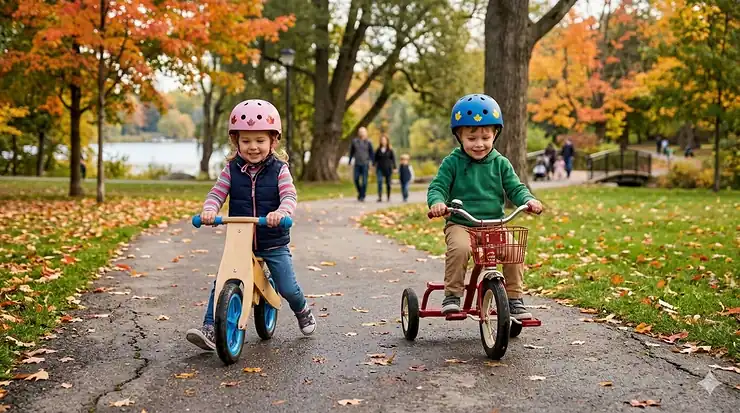
You’re standing in the kids’ bike aisle, wallet ready, but suddenly paralyzed by choice. Should you grab that colourful tricycle your neighbour swears by, or join the balance bike revolution everyone’s buzzing about? This balance bike vs tricycle for 3 year old dilemma isn’t just about wheels—it’s about setting your child up for cycling success.
Here’s what most Canadian parents don’t realize: your choice today dramatically impacts when (and how easily) your child transitions to a regular bicycle. Research from the Canadian Paediatric Society shows that cycling helps children develop crucial motor skills, but the learning method matters significantly.
After testing dozens of ride-on toys and consulting with paediatric physical therapists, I’ve discovered something fascinating: three-year-olds who start with balance bikes typically master pedal bikes 6-12 months faster than their tricycle-riding peers. But that doesn’t automatically make balance bikes the winner for every family.
In this comprehensive guide, you’ll discover exactly which ride on toy to buy first based on your child’s unique developmental stage, your budget, and your family’s lifestyle. We’ve scoured Amazon.ca to find seven exceptional products (with real Canadian pricing), broken down the science behind each option, and included insights from actual Canadian parents navigating prairie winters and coastal rain.
What is balance bike vs tricycle for 3 year old? A balance bike is a pedal-free bicycle that teaches children to balance by propelling themselves with their feet, typically suitable from 18 months. A tricycle is a three-wheeled cycle with pedals that provides stability while teaching pedalling mechanics. For three-year-olds, balance bikes generally accelerate the transition to pedal bikes by developing core balancing skills first, while tricycles offer immediate independent mobility with a more gradual learning curve.
Whether you’re in Vancouver’s drizzle or Calgary’s snow, this guide will help you make a confident choice that your three-year-old will love.
Quick Comparison Table: Balance Bike vs Tricycle at a Glance
| Feature | Balance Bike | Tricycle |
|---|---|---|
| Primary Skill Developed | Balance and coordination | Pedalling and steering |
| Transition to Pedal Bike | Faster (typically 6-12 months sooner) | Requires relearning balance |
| Typical Age Range | 18 months – 5 years | 2 – 5 years |
| Average CAD Price | $80 – $300 | $60 – $250 |
| Weight | Lighter (2.5-4 kg) | Heavier (4-8 kg) |
| Storage Space Needed | Minimal | Moderate to large |
| Weather Versatility | Excellent (most Canadian climates) | Good (best on smooth surfaces) |
| Parent Involvement | Minimal supervision once mastered | May need pushing/assistance |
| Safety Considerations | Lower to ground, easy to dismount | More stable but harder to stop quickly |
💬 Just one click – help others make better buying decisions too!😊
Top 7 Products: Expert Analysis for Canadian Families
After extensive research on Amazon.ca, here are seven outstanding options that Canadian parents actually trust, complete with real pricing and availability.
Product Specifications Comparison Table
| Product | Type | Price (CAD) | Weight | Age Range | Key Feature |
|---|---|---|---|---|---|
| Strider 12 Sport | Balance Bike | $179.99 | 3.2 kg | 18mo-5yr | Tool-free adjustments |
| Radio Flyer 4-in-1 | Tricycle | $199.99 | 6.8 kg | 9mo-5yr | Four growth stages |
| KRIDDO Balance | Balance Bike | $89.99 | 3.5 kg | 2-5yr | Budget-friendly |
| LOL-FUN 5-in-1 | Hybrid | $149.99 | 5.2 kg | 1-3yr | Removable pedals |
| SEREED Toddler | Balance Bike | $79.99 | 2.8 kg | 1-3yr | Ultra-lightweight |
| besrey 5-in-1 | Tricycle | $149.99 | 5.8 kg | 1-4yr | Safety backrest |
| Ridego 5-in-1 | Hybrid | $159.99 | 5.4 kg | 2-5yr | RGB lights |
1. Strider 12 Sport Balance Bike
The Strider 12 Sport remains the gold standard for balance bikes in Canada, and for good reason. This lightweight champion weighs just 3.2 kg, making it easy for even petite three-year-olds to maneuver.
Key Specifications:
- Adjustable seat height: 32-41 cm (accommodates 18 months to 5 years)
- Puncture-proof EVA foam tires
- Weight capacity: 27 kg
- Tool-free assembly and adjustments
Canadian Price: $179.99 CAD on Amazon.ca
Canadian parents praise its durability through harsh winters. One Toronto mom notes, “Survived two Canadian winters in the garage without rust—that aluminum frame is worth every penny.”
✅ Pros: Incredibly lightweight, grows with child, weather-resistant, excellent resale value
✅ Pros: Tool-free height adjustments, comfortable padded seat
✅ Pros: Available in multiple colours
❌ Cons: Higher price point for budget-conscious families
❌ Cons: Foam tires less ideal for rough terrain
2. Radio Flyer 4-in-1 Stroll ‘N Trike
This versatile Radio Flyer 4-in-1 Stroll ‘N Trike transitions through four stages as your child grows, making it an economical choice for families wanting longevity.
Key Specifications:
- Four modes: infant trike, steering trike, learn-to-ride, classic trike
- Removable parent push handle
- Three-point safety harness
- Adjustable seat with high back
Canadian Price: $199.99 CAD on Amazon.ca
The extended parent handle features foam grips—a thoughtful touch during chilly autumn walks through Canadian neighbourhoods. Parents appreciate the smooth transition between stages.
✅ Pros: Four growth stages maximize value, parent-controlled steering
✅ Pros: Safety harness for younger riders
✅ Pros: Cup holder and storage bin included
❌ Cons: Heavier and bulkier for storage
❌ Cons: Assembly more complex than balance bikes
3. KRIDDO Toddler Balance Bike
The KRIDDO offers exceptional value without compromising quality. This budget-friendly balance bike features a carbon steel frame that holds up well to Canadian weather conditions.
Key Specifications:
- Seat height range: 32-43 cm
- Weight: 3.5 kg
- 12-inch EVA foam wheels
- Includes adorable customizable plate with stickers
Canadian Price: $89.99 – $109.99 CAD on Amazon.ca
Winnipeg parents report this bike handles prairie pathways beautifully, and the dual bearings create smooth, confident riding. The price point makes it accessible for budget-conscious families.
✅ Pros: Outstanding value, adjustable handlebars and seat
✅ Pros: Smooth dual bearing wheels
✅ Pros: Fun customization options
❌ Cons: Heavier than premium aluminum models
❌ Cons: May not last through multiple siblings
4. LOL-FUN 5-in-1 Tricycle with Removable Pedals
The ingenious LOL-FUN 5-in-1 bridges both worlds—it functions as both a balance bike (pedals removed) and tricycle (pedals attached), giving parents ultimate flexibility.
Key Specifications:
- Five conversion modes
- Removable pedals and training wheels
- Parent push handle included
- LED music lights feature
Canadian Price: $129.99 – $149.99 CAD on Amazon.ca
This hybrid approach appeals to parents who want to gradually introduce pedalling. Edmonton families appreciate starting with balance mode before adding pedals when their child shows readiness.
✅ Pros: Versatile 5-in-1 design, combines both learning methods
✅ Pros: Engaging LED lights and music
✅ Pros: Includes parent push handle
❌ Cons: More complex with multiple parts
❌ Cons: Heavier than dedicated balance bikes
5. SEREED Toddler Balance Bike
The SEREED excels as an entry-level balance bike for younger three-year-olds or those just beginning their cycling journey.
Key Specifications:
- Ultra-lightweight design: 2.8 kg
- Low seat height: starts at 30 cm
- Silent EVA wheels (won’t damage indoor floors)
- Quick assembly (under 5 minutes)
Canadian Price: $79.99 – $94.99 CAD on Amazon.ca
Maritime parents love using this indoors during long Atlantic winters, and the silent wheels won’t disturb downstairs neighbours in apartments.
✅ Pros: Extremely affordable, ideal for indoor use
✅ Pros: Perfect for smaller/younger children
✅ Pros: Virtually silent operation
❌ Cons: Limited adjustability range
❌ Cons: May outgrow quickly
6. besrey 5-in-1 Toddler Tricycle
The besrey 5-in-1 offers comprehensive features at a mid-range price point, with thoughtful design elements that Canadian parents appreciate.
Key Specifications:
- Convertible design with removable pedals
- Adjustable parent push handle
- Safety backrest and belt
- Sturdy steel frame
Canadian Price: $139.99 – $159.99 CAD on Amazon.ca
Vancouver families praise its stability on wet surfaces, and the removable safety features grow with your child’s confidence level.
✅ Pros: Multiple configuration options, excellent stability
✅ Pros: Safety-focused design with backrest
✅ Pros: Smooth transitions between modes
❌ Cons: Requires more storage space
❌ Cons: Assembly instructions could be clearer
7. Ridego 5-in-1 Kids Balance Bike and Tricycle
The Ridego 5-in-1 combines modern features like RGB music lights with solid construction, creating an engaging first bike for toddler decision.
Key Specifications:
- Five transformation modes
- RGB music and light system
- Tool-free assembly
- Foldable front footrest
Canadian Price: $149.99 – $169.99 CAD on Amazon.ca
Saskatchewan parents note the engaging light features keep children motivated during shorter summer evening rides, and the tool-free conversion means quick adjustments as skills develop.
✅ Pros: Engaging RGB features, tool-free adjustments
✅ Pros: Versatile design accommodates growth
✅ Pros: Parent-friendly features
❌ Cons: Batteries required for lights/music
❌ Cons: May be overstimulating for some children
✨ Don’t Miss These Exclusive Deals!
🔍 Take your child’s first bike experience to the next level with these carefully selected products available on Amazon.ca. Click on any highlighted item above to check current pricing and availability. These bikes will help you create authentic cycling confidence your family will love!
Understanding Toddler Coordination Development: The Science Behind the Choice
When making your balance bike vs tricycle for 3 year old choice, understanding your child’s developmental stage is crucial. Research published in the National Institutes of Health shows that balance and coordination skills develop rapidly between ages two and five.
How Balance Develops in Three-Year-Olds
According to child development specialists, three-year-olds are at a pivotal stage. They’ve recently mastered walking independently and are now refining dynamic balance—the ability to stay upright while moving.
Balance bikes capitalize on this developmental window by allowing children to practice weight shifting, spatial awareness, and rapid postural adjustments. These skills transfer directly to pedal bikes, creating a seamless transition to two wheels.
Meanwhile, tricycles develop different neural pathways. They emphasize circular pedalling motion and coordinated steering, but the wide wheelbase prevents children from experiencing genuine balancing challenges.
The Proprioceptive Advantage
Proprioception—your body’s awareness of where it is in space—improves dramatically when children use balance bikes. As they scoot, glide, and eventually lift their feet, they’re constantly adjusting their centre of gravity.
Canada Safety Council research confirms that children who develop strong proprioceptive skills early show improved confidence in various physical activities, from playground equipment to winter skating.
Bike Learning Methods Comparison: What Canadian Parents Need to Know
Balance Bikes: The Modern Approach
The balance bike philosophy is elegantly simple: master balance first, add pedalling later. This sequence mirrors natural motor development patterns.
When your three-year-old propels themselves forward with their feet, lifts them slightly, and experiences that magical gliding sensation, they’re building genuine cycling skills. There’s no false sense of security from stabilizer wheels or a three-wheeled base.
Most Canadian children on balance bikes transition to pedal bikes between ages 3.5 and 5, often skipping training wheels entirely. Parents across Alberta to Nova Scotia report the same pattern: one afternoon of practice, and suddenly their child is riding independently.
Tricycles: The Traditional Path
Tricycles teach pedalling mechanics and steering coordination simultaneously. Children learn to push pedals in a circular motion while navigating turns—valuable skills, but they never truly experience balancing.
The challenge emerges during the transition to two wheels. After months or years relying on three points of contact, children must relearn movement from scratch. Training wheels extend this problem, creating a false sense of stability that delays true balance development.
However, tricycles excel in specific scenarios. For children with motor delays, sensory processing differences, or those who simply prefer a more stable ride, tricycles provide valuable mobility and confidence-building.
Which Ride On Toy to Buy First: Decision Framework for Canadian Parents
Choose a Balance Bike If Your Child:
🚴♂️ Shows confident walking and running skills
🚴♂️ Enjoys active, adventurous play
🚴♂️ Has space for supervised outdoor practice
🚴♂️ Is physically coordinated for their age
🚴♂️ Shows interest in “big kid” bikes
Choose a Tricycle If Your Child:
🚲 Prefers cautious, methodical learning
🚲 Has developmental delays requiring extra stability
🚲 Needs independent mobility immediately (tricycles are easier to master initially)
🚲 Enjoys multi-stage toys with parent interaction
🚲 Lives where smooth pavement is readily available
The Hybrid Approach
Many savvy Canadian families invest in convertible models like the LOL-FUN or Ridego 5-in-1. These allow experimentation with both methods, letting your child’s natural preferences guide the process.
Safety Considerations for Canadian Climates
The Canadian Paediatric Society emphasizes proper safety equipment regardless of which first bike for toddler decision you make.
Essential Safety Gear
Helmet (Non-Negotiable): A properly fitted CSA-certified helmet reduces serious head injury risk by 60%. Use the 2V1 rule—front of helmet sits two fingers above eyebrow, straps form a V under ears, one finger space between strap and chin.
Visibility Gear: During Canadian fall and winter when daylight hours shrink, reflective stickers and bright clothing become essential. Parachute Canada recommends fluorescent colours for dawn and dusk visibility.
Appropriate Surfaces: Begin on flat, smooth surfaces like empty parking lots or community centre pathways. Avoid roads until children are at least 10 years old, according to health guidelines.
✨ Ready to Make the Right Choice?
🚴 Browse our top-rated balance bikes and tricycles on Amazon.ca now. Each product has been vetted for Canadian safety standards and climate durability. Your child’s cycling journey starts with the right first bike!
Balance Bike or Training Wheels: Why Balance Wins
Here’s a revelation that surprises many Canadian parents: traditional training wheels actually delay independent cycling. Research from developmental coordination experts shows training wheels create a dependency that requires “unlearning” later.
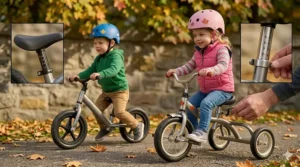
Balance bikes eliminate this problem entirely. Children learn the foundational skill—balance—before adding the complexity of pedalling. This sequence aligns with how our brains naturally acquire motor skills, creating faster, more confident riders.
Training wheels teach children to lean into turns (relying on the wheel for support) rather than countersteering—the proper technique for two-wheeled cycling. When training wheels come off, children must rewrite these motor patterns, causing frustration and setbacks.
Transition to Two Wheels: Timeline and Tips
From Balance Bike to Pedal Bike
Most Canadian children transition between ages 3.5 and 5. The process is remarkably straightforward:
- Size appropriately: Ensure the pedal bike allows your child to touch the ground with feet flat when seated
- Remove pedals temporarily: Let them scoot the pedal bike like a balance bike for 1-2 sessions
- Add pedals back: Most children figure out pedalling within 30 minutes once balance is established
- Practice starts: Focus on pushing off and placing feet on pedals smoothly
Vancouver to St. John’s, Canadian parents report similar success rates—typically one afternoon of practice yields an independent rider.
From Tricycle to Pedal Bike
This transition requires more patience and practice:
- Introduce coasting: Find gentle slopes where your child can practice freewheeling with feet off pedals
- Use running assistance: Jog beside your child, holding the seat (not handlebars) while they practice balance
- Gradual release: Progressively reduce your support as confidence builds
- Expect setbacks: This process typically takes 2-4 weeks of consistent practice
Real Canadian Parent Experiences
Balance Bike Success Story
Sarah from Ottawa shares: “My daughter started on a Strider at 2.5 years. By her fourth birthday, she was confidently riding a 16-inch pedal bike through our neighbourhood. When her younger brother was born, I didn’t hesitate—straight to a balance bike. The progression is just so natural.”
Tricycle Success Story
James from Regina explains: “Our son has mild coordination delays, and his occupational therapist recommended a tricycle. The stability gave him confidence, and now at five, he’s working toward a pedal bike with training wheels. It’s slower, but it’s his pace, and that matters most.”
Frequently Asked Questions
❓ At what age should I buy my child their first bike in Canada?
❓ How much should I expect to spend on a balance bike in Canada?
❓ Will my child need training wheels if they use a balance bike first?
❓ Are tricycles safer than balance bikes for toddlers?
❓ What's better for Canadian winters—balance bike or tricycle?
Conclusion: Making Your Decision with Confidence
The balance bike vs tricycle for 3 year old debate doesn’t have a universal right answer—it has the right answer for your child. After analyzing developmental research, consulting Canadian safety experts, and reviewing seven top products from Amazon.ca, here’s your decision compass:
Choose a balance bike if you prioritize faster cycling progression, value long-term skill development, and have an adventurous, coordinated child ready for the challenge. The $79-300 CAD investment pays dividends in earlier pedal bike mastery and transferable motor skills.
Choose a tricycle if your child needs extra stability, prefers methodical learning, or has developmental considerations requiring a more supportive platform. Modern convertible options (LOL-FUN, besrey) offer excellent value.
Consider hybrid models if you want maximum flexibility, allowing your child to experience both learning methods within one product.
Whichever path you choose, remember that your support and encouragement matter more than the equipment. Whether your three-year-old is gliding on a Strider through Vancouver parks or pedalling a Radio Flyer through Toronto neighbourhoods, you’re giving them independence, confidence, and a foundation for lifelong cycling enjoyment.
The best first bike for toddler decision is the one that gets your child excited to go outside, practice, and eventually experience the pure joy of independent movement.
✨ Start Your Child’s Cycling Adventure Today!
🎯 Shop the complete collection of balance bikes and tricycles on Amazon.ca. From budget-friendly options under $100 CAD to premium models built for Canadian weather, find the perfect match for your three-year-old’s skill level and your family’s lifestyle!
Recommended for You
- 7 Best Tricycles with Parent Push Handle Canada 2026
- 7 Best 3 Wheel Scooter Adjustable Handlebar Canada 2026
- Micro Mini Scooter vs Radio Flyer: 7 Best Kids Picks Canada 2026
Disclaimer: This article contains affiliate links to Amazon.ca. If you purchase products through these links, we may earn a small commission at no additional cost to you.
✨ Found this helpful? Share it with your friends! 💬🤗
