In This Article
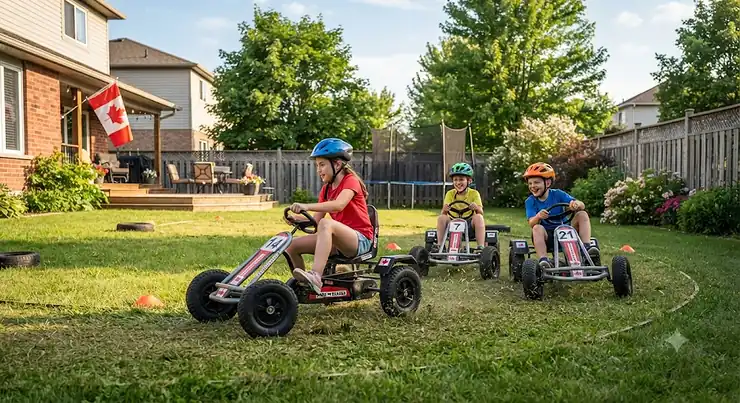
Somewhere between “just go play outside” and an actual driveway grand prix sits the humble pedal go-kart, and if you’ve got a kid who treats the backyard like a personal Nürburgring, you already know the appeal. Pedal go-karts for backyard racing turn ordinary patios, cul-de-sacs, and side yards into a track, no batteries, no charging cables, no screaming when the fun runs out mid-afternoon because the motor died. A pedal go-kart is a foot-powered, low-slung ride-on vehicle with a steering wheel, a seat, and a drivetrain that the rider powers entirely with their own legs — the modern descendant of the classic soapbox racer, built for kids roughly 3 to 12 years old depending on the model.
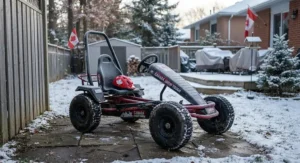
We dug into real product listings, verified specs, and aggregated customer-review sentiment across the current crop of pedal karts sold to Canadian families to find seven models worth your attention. This isn’t a rehash of manufacturer marketing copy. It’s a side-by-side look at what separates a C$150 backyard toy from a C$450 machine that’ll survive three siblings and five winters in the garage. Along the way we’ll cover how pedal go-karts differ from pedal cars, which premium features are worth paying extra for, what racing-style models actually change versus casual cruisers, and how to match a single-rider design to the kid who’s going to be driving it.
One quick housekeeping note before the karts: prices on Amazon.ca shift constantly, sometimes daily, so every figure below is a rough range in Canadian dollars based on research at the time of writing — always check current pricing before you buy. And because active outdoor play is genuinely good for kids, it’s worth grounding this guide in something bigger than toy shopping: Canada’s own movement guidelines exist because the evidence linking daily physical activity to healthier kids is strong enough that public health agencies built national recommendations around it. A pedal go-kart won’t single-handedly fix a sedentary afternoon, but it’s a pretty effective bribe to get a kid outside. Toy safety itself is federally regulated too, and it’s worth a quick read through Health Canada’s own guidance on safe outdoor play before your kart arrives.
Quick Comparison Table
Before the deep dive, here’s the shape of the field. All seven products below are pedal-powered (no batteries), rated for outdoor use, and built with a steel or reinforced-composite frame.
| Pedal Go-Kart | Tier | Age Range | Best For |
|---|---|---|---|
| BERG Buddy Cross | Premium | 3-8 years | All-terrain backyard racing with premium features |
| hauck Cyclone Junior Racing Go Kart | Premium | 4-8 years | Racing style pedals and pavement speed |
| BERG Rally NRG | Premium | 4-12 years | Older kids and multi-year growth |
| hauck Sirocco | Mid-range | 4-8 years | Low-profile racing looks on a mid budget |
| Little Tikes Jett Car Racer | Mid-range | 3-10 years | Single-rider design and rear-wheel drifting fun |
| Costzon 4-Wheel Pedal Go Kart | Budget | 3-7 years | Families testing the waters on a tight budget |
| Aosom Ergonomic Pedal Go Kart | Budget | 5-12 years | Taller riders who need more leg room |
Looking at the spread, the split isn’t really “cheap versus expensive” so much as “how long do you need this thing to last, and how many kids will fight over it.” The premium tier from BERG and hauck buys you steel construction rated for years of abuse and, in some cases, adult riders too, while the budget tier from Costzon and Aosom gets a genuinely fun kart into the yard for well under C$200. The mid-range picks from Little Tikes and hauck split the difference nicely for most single-kid households.
Just one click — help other Canadian parents make better buying decisions too! 😊
Top 7 Pedal Go-Karts for Backyard Racing: Expert Analysis
We picked these seven because they cover every price point, age range, and riding style a Canadian backyard could realistically need — from toddler-friendly cruisers to genuine racing-style karts for the 8-and-up crowd. Each entry below breaks down real specs, what those specs mean once a kid is actually pedaling, and honest aggregated review sentiment.
1. BERG Buddy Cross — best all-terrain premium features
The BERG Buddy Cross leads this list because it’s one of the few pedal go-karts genuinely built to handle grass, gravel, and uneven backyard terrain without the kart tipping or the chain skipping. That’s not marketing fluff; it comes down to the specific hardware BERG built in.
The standout is BERG’s BFR system — Brake, Freewheel, and Reverse — controlled through the pedals themselves rather than a separate hand lever. In practice, that means a kid can coast without pedaling (freewheel), stop by pedaling backward (brake), and reverse out of a corner they’ve boxed themselves into, all without letting go of the steering wheel. Pair that with pneumatic (air-filled) tires and a swing axle that keeps all four wheels planted on bumpy ground, and you’ve got a kart that behaves more like a small all-terrain vehicle than a driveway toy. The adjustable seat covers a genuinely wide range, officially ages 3 to 8, which is unusual generosity for a single frame size.
Based on the spec comparison against every other kart on this list, the Buddy Cross is the clear pick for families with a yard that isn’t a flat concrete pad — sloped lawns, gravel driveways, and mixed terrain are exactly where the swing axle and air tires earn their keep. It’s also the rare pedal kart marketed for adult riders too, so it survives being commandeered by an older sibling or a good-humoured parent at the block party.
Reviewers consistently report that assembly is more involved than the budget karts on this list, generally 45 minutes to an hour with two people, and that the BFR system has a learning curve for kids under 4 who haven’t yet mastered the “pedal backward to stop” motion. Once that clicks, though, feedback on ride quality and durability skews strongly positive, with several buyers noting the kart held up through multiple seasons outdoors.
Pros:
- ✅ BFR pedal-brake-reverse system controls speed without a hand lever
- ✅ Pneumatic tires and swing axle handle grass and gravel
- ✅ Seat adjusts across a wide 3-8 year age range
Cons:
- ❌ Assembly takes noticeably longer than budget competitors
- ❌ BFR braking has a learning curve for younger toddlers
At around C$400-C$480, the BERG Buddy Cross sits at the top of this list’s price range, but the terrain versatility and multi-year age span make a strong case for cost-per-year of use rather than sticker price alone.
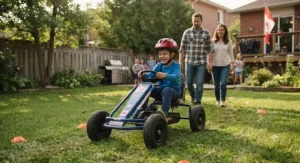
2. hauck Cyclone Junior Racing Go Kart — best racing style pedals and brake feel
If the goal is a genuine racing style pedal go-kart rather than a general ride-on toy, the hauck Cyclone Junior Racing Go Kart is built specifically around that brief. Everything about its design borrows from actual go-kart racing rather than the softer “kiddie car” aesthetic.
The kart runs on 12-inch rims, noticeably larger than the small plastic wheels found on most budget models, paired with race-style pedals positioned for a proper heel-toe pedaling motion instead of a flat-footed shuffle. Braking comes from an 8 Ball-style hand brake mounted on the steering column, a detail borrowed straight from real karting, which gives more precise, progressive stopping power than the pedal-reverse braking found on some competitors. What most buyers overlook about this model is how much that bigger wheel diameter changes the ride: larger wheels roll over pavement seams and small cracks more smoothly, which matters a lot once a kid is actually racing at speed rather than cruising.
This is the pick for the 4-to-8 crowd who’ve outgrown a basic pedal car and want something that looks and handles like an actual racing machine — sharper steering response, a lower seating position for a more “in the kart” feel, and visual styling (checkered flag graphics, bold colourways) that leans into the racing theme rather than away from it.
Aggregated review sentiment on similar hauck racing models points to strong marks for build quality and steering precision, with a recurring theme that the low-profile seat position suits confident, slightly older riders better than nervous first-timers who may prefer a higher, more enclosed seat.
Pros:
- ✅ 12-inch rims roll smoother over pavement seams and cracks
- ✅ Race-style pedals and 8 Ball hand brake mimic real karting
- ✅ Low seating position gives an authentic racing feel
Cons:
- ❌ Lower seat height suits confident riders more than nervous beginners
- ❌ Narrower age sweet spot (roughly 4-8) than all-terrain rivals
Expect to pay in the C$260-C$320 range, in the mid-C$200s to low C$300s depending on retailer promotions — solid value for a kart that’s purpose-built for racing rather than general play.
3. BERG Rally NRG — best for older kids and multi-year growth
The BERG Rally NRG is the option to reach for when the rider is already 6, 7, or 8 and a standard pedal kart frame is going to be outgrown within a season. It uses BERG’s XL frame platform, which is longer and taller than the Buddy Cross, specifically engineered for riders up to roughly 12 years old.
Key here is the extended seat-to-pedal distance and a taller frame geometry that keeps an 8-year-old’s knees from hitting the steering wheel, a real complaint on smaller karts once kids hit that growth spurt around age 6-7. The steel frame construction and freewheel drivetrain carry over BERG’s reputation for durability, and the adjustable seat still has meaningful range even at the top of the frame’s size class. Reviewers consistently note that this is one of the few pedal karts that genuinely lasts multiple growth years rather than being outgrown within 12-18 months.
Here’s what the spec sheet won’t tell you, but real-world use does: because the frame is longer, the Rally NRG needs more clear runway to really open up — it’s happiest on a driveway or a wide path rather than a tight, obstacle-filled patio. For families with the space, that’s a feature, not a limitation, since the extra length also improves stability at higher pedaling speeds compared to shorter-wheelbase karts.
The trade-off, honestly, is that younger siblings in the 3-4 age range will find the frame oversized and the pedals a stretch, so this isn’t the right first kart for a toddler — it’s the right second kart for the kid who’s outgrown one.
Pros:
- ✅ XL frame accommodates riders up to roughly age 12
- ✅ Extended geometry prevents knee-to-wheel contact for taller kids
- ✅ Steel construction built for multi-year, multi-season use
Cons:
- ❌ Oversized for riders under about age 5
- ❌ Needs more open space than compact karts to feel right
Pricing typically lands around C$450-C$550, positioning it as a longer-term investment rather than a first backyard kart — worth it specifically for households planning to get several years out of one frame.
4. hauck Sirocco — best low-profile racing looks on a mid budget
The hauck Sirocco earns its spot as the mid-range racing-style pick, delivering a lot of the visual and handling character of pricier racing karts without the premium-tier price tag. Its low-profile silhouette and rubber (not hard plastic) tires are the two details that separate it from budget karts wearing similar racing graphics.
Rubber tires grip pavement noticeably better than the EVA foam or hard plastic wheels common on entry-level karts, which translates directly into tighter cornering before a wheel breaks traction — a meaningful difference once a kid starts actually racing siblings or friends rather than just cruising. The auto-clutch, free-ride pedal mechanism lets the rider coast without pedaling, similar in spirit to BERG’s freewheel, and the adjustable seat covers a comfortable range for the stated 4-8 age bracket.
Based on the spec comparison, the Sirocco slots in as the “I want it to look and feel fast, but I don’t need BERG’s terrain-handling hardware” choice — it’s built with pavement, driveways, and smooth patios in mind rather than gravel or lawn. Aggregated reviews describe pedaling as notably smooth for the price point, with one recurring theme being how quickly younger kids reach a comfortable top speed and confidently work the hand brake to stop.
Pros:
- ✅ Rubber tires grip pavement better than plastic-wheeled rivals
- ✅ Auto-clutch free-ride pedal lets kids coast without pedaling
- ✅ Low-profile racing look at a genuinely mid-range price
Cons:
- ❌ Rubber tires wear faster on rough or gravel surfaces
- ❌ Seat range is narrower than the BERG XL-frame options
Typical pricing sits around C$220-C$270, making it one of the better value-to-style ratios in this whole lineup for pavement-focused backyard racing.
5. Little Tikes Jett Car Racer — best single-rider design for tight turns
The Little Tikes Jett Car Racer takes a genuinely different mechanical approach than every other kart here, and that’s exactly why it earns a spot on this list. Instead of steering the front wheels like a car, it uses rear-wheel steering controlled by dual handles on either side of the seat.
That single detail changes the entire riding experience. Rear-wheel steering means tighter, sharper turns than front-wheel systems allow, closer to how a real go-kart or even a forklift pivots, and it rewards kids who like sliding into corners rather than cruising in wide arcs. The trade-off is a genuine learning curve: what most buyers overlook is that rear-wheel steering feels backwards at first to a kid used to tricycles or front-steer pedal cars, so expect a wobbly first few sessions before it clicks. Once it does, reviewers describe kids doing intentional tight spins and drift-style turns that a standard front-steer kart simply can’t replicate. The off-road-style tires and 90-kg (200-lb) weight capacity also mean this single-rider design comfortably outlasts most kids’ pedal-kart years, easily supporting an adult for driveway demonstrations.
This is the pick specifically for a lone backyard racer who wants maximum manoeuvrability over top-end speed, or for a kid who’s shown interest in actual drift-style riding. It’s less ideal as a first-ever pedal vehicle for a cautious 3-year-old, where the steering learning curve can be frustrating before it’s fun.
Pros:
- ✅ Rear-wheel steering enables sharper, tighter turns
- ✅ Adjustable seat back and high weight capacity extend usable years
- ✅ Off-road-style tires handle grass, gravel, and pavement equally well
Cons:
- ❌ Rear-wheel steering has a real learning curve for first-timers
- ❌ Assembly has been flagged by some reviewers as fiddly
Expect a price range around C$160-C$210, which puts genuinely novel handling within reach of most family budgets.
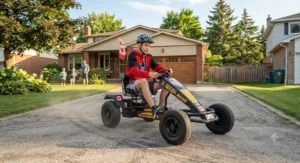
6. Costzon 4-Wheel Pedal Go Kart — best budget option with a gear shifter
For families who want to test whether their kid is even into pedal karting before committing to a premium frame, the Costzon 4-Wheel Pedal Go Kart is the sensible entry point. It undercuts nearly every other kart on this list on price while still including features you wouldn’t expect at that tier.
The gear shifter (a forward/neutral lever) combined with a separate handbrake gives young riders two distinct controls to learn, closer to how the premium karts operate than most budget competitors that rely on pedal-only braking. The fully enclosed chain cover is a small but genuinely useful safety detail, keeping fingers, shoelaces, and loose clothing away from a moving chain, something not every budget kart bothers with. Weight capacity runs around 25-30 kg (55-66 lbs) depending on the specific variant, which comfortably covers the stated 3-7 year age range.
Here’s the honest trade-off: the frame mixes a steel base with polypropylene plastic body panels, so it doesn’t feel as bomb-proof as the all-steel BERG karts, and reviewers note the ride is noticeably less smooth on grass or gravel than on flat pavement. For a first kart, though, or a second unit for a younger sibling, it delivers real functional pedal-go-kart features at a price that doesn’t require a serious financial commitment.
Pros:
- ✅ Gear shifter plus separate handbrake teach two real controls
- ✅ Fully enclosed chain cover protects fingers and clothing
- ✅ Among the most affordable karts with genuine features
Cons:
- ❌ Plastic body panels feel less durable than all-steel frames
- ❌ Handles rough or grassy terrain noticeably worse than pavement
At roughly C$130-C$170, this is the lowest financial commitment on the list for a kart with a real gear-and-brake control setup rather than a single pedal-only mechanism.
7. Aosom Ergonomic Pedal Go Kart — best for taller riders needing more room
The Aosom Ergonomic Pedal Go Kart rounds out the list as the budget pick built specifically for bigger kids, and the numbers back that up clearly: its overall footprint and 50-kg (110-lb) weight capacity are noticeably larger than most other entries here, including several of the premium options.
That extra size matters because a lot of pedal go-karts quietly max out around 25-30 kg, which means a sturdy 9 or 10-year-old can outgrow the weight rating well before they’ve outgrown the desire to ride. Aosom’s model is rated for ages roughly 5 to 12 and includes a shock-absorbing suspension system on the wheels, an unusual inclusion at this price point that smooths out pavement cracks and curb transitions better than the rigid axles on comparably priced competitors. The handbrake, freewheel coasting, and reverse drive combination also gives it more functional overlap with the premium tier than the price tag suggests.
What most buyers overlook about this model is that it’s genuinely marketed and built toward the older end of the pedal-kart age range, where most competitors taper off around age 8. For a family with a tween who still wants pedal power rather than jumping straight to an electric kart, this is one of the few pedal options actually sized for them. Reviewers consistently mention that assembly is straightforward and the suspension makes a noticeable difference on cracked driveways and sidewalks.
Pros:
- ✅ 50-kg weight capacity accommodates bigger, older riders
- ✅ Shock-absorbing suspension smooths pavement cracks and curbs
- ✅ Handbrake, freewheel, and reverse cover premium-tier functions
Cons:
- ❌ Larger footprint needs more storage space than compact karts
- ❌ Less suited to smaller riders under about age 5
Typical pricing runs around C$170-C$220, which is excellent value for a kart specifically sized to keep older kids in pedal-powered fun a couple of extra years.
Setting Up Your Backyard Racetrack
Buying the kart is the easy part; getting real, repeated backyard-racing value out of it takes a bit of setup thinking most Amazon listings skip entirely.
Start with the surface. A flat, obstacle-free stretch of driveway or patio at least 6 metres (20 feet) long gives most karts room to reach a real top speed and still stop safely, while anything shorter turns every ride into a series of aborted starts. If your only option is a sloped driveway, mark a clear stopping zone at the bottom well before the street or sidewalk, since pedal go-karts for backyard racing rely entirely on the rider’s own braking, and gravity on a slope adds speed a young rider may not expect.
First-use setup should include a quick fit check: seat position adjusted so knees have a slight bend at full pedal extension (a fully straight leg means the seat’s too far back), and hands should reach the wheel without hunching. Loose or overly tight seat straps, on karts that include them, are one of the more common first-week complaints in aggregated reviews, and it’s a five-minute fix most parents skip on day one.
For a maintenance schedule, plan on checking chain tension and lubricating it every three to four weeks of regular use — a dry, squeaky chain isn’t just annoying, it measurably increases pedaling effort for a small rider. Tighten any wheel bolts or axle nuts monthly, since vibration on pavement works fasteners loose over time, and store the kart under cover or in a garage between rides if possible; UV exposure is the single biggest cause of cracked plastic components on budget-tier karts specifically.
Common first-30-days mistakes worth flagging: letting an excited kid ride before the frame bolts are fully torqued down (a rattling kart is an unfinished-assembly kart, not a defective one), skipping the manufacturer’s recommended weight limit “just this once” for an older sibling, and leaving the kart out in the rain, which accelerates chain rust faster than almost any other single factor.
✨ Don’t Miss These Exclusive Deals! 🔍
Take your backyard racing setup to the next level with these carefully selected pedal karts. Click on any highlighted item to check current pricing and availability. These picks will help you build real outdoor fun your family will love!
Which Rider Are You? Real-World Backyard Racing Scenarios
Specs only mean so much until you match them to an actual kid, an actual yard, and an actual budget. Here are three profiles that cover most of the families reading this.
The toddler testing the waters. A 3-to-4-year-old riding their first pedal vehicle needs low weight, a low seat, and forgiving controls over raw speed. The Costzon 4-Wheel Pedal Go Kart or the entry-level Aosom Ergonomic Pedal Go Kart variants sized for younger riders fit here, since both keep the frame compact and the pedal resistance light enough for developing leg strength. Budget C$130-C$220, expect the kart to last one to two growth seasons, and don’t be surprised if the first few sessions involve more steering-wheel confusion than actual pedaling.
The solo speedster (single-rider design explained). Some kids don’t want a family activity; they want their own machine and their own lap times. This is where a single-rider design really earns its keep, and it’s worth understanding what that term actually means in this category: unlike two-seat wagons or tandem ride-ons, every kart on this list seats exactly one driver, with all controls built around solo operation rather than a passenger sharing the ride. For the kid chasing personal bests around the driveway, the hauck Cyclone Junior Racing Go Kart or the rear-steering Little Tikes Jett Car Racer deliver the sharpest, most individually responsive handling in this lineup, rewarding a rider who’s fully focused on their own line through the “course.”
The multi-kid, multi-year household. If two or three kids of different ages and sizes will share one kart over several years, durability and adjustability matter more than top speed. The BERG Buddy Cross and BERG Rally NRG are built for exactly this, with wide seat-adjustment ranges and steel frames rated for years of shared use across siblings. Yes, the upfront cost is higher, around C$400-C$550, but spread across three kids and four seasons, the cost-per-ride drops well below what a budget kart replaced twice would run.
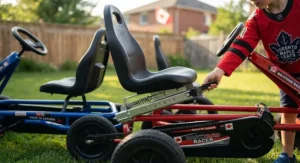
Your Buyer’s Decision Framework
If you’re still narrowing things down, run through this simple priority checklist:
If your yard has grass, gravel, or slopes, choose an all-terrain kart like the BERG Buddy Cross because pneumatic tires and a swing axle are the difference between a fun ride and a stuck one. If your rider is under 4 and this is their first pedal vehicle, choose a lightweight, low-seat option like the Costzon 4-Wheel Pedal Go Kart because oversized frames and complex braking systems frustrate beginners. If your rider is 8 or older and outgrowing everything you’ve tried, choose the BERG Rally NRG or the Aosom Ergonomic Pedal Go Kart because both are specifically sized and rated for bigger, older kids. If racing style and pavement speed matter more than terrain versatility, choose the hauck Cyclone Junior Racing Go Kart or hauck Sirocco because both prioritize wheel quality and braking precision over off-road hardware. And if budget is the deciding factor above all else, choose the Costzon 4-Wheel Pedal Go Kart, since it delivers a real gear shifter and handbrake at the lowest price point on this list.
On long-term cost, it’s worth thinking in cost-per-year rather than sticker price alone. A C$150 budget kart that gets replaced after 18 months works out to roughly the same annual cost as a C$450 premium kart that lasts three growth seasons across two siblings — the premium option just requires the bigger cheque up front. Maintenance costs stay low across the board (a bit of chain lubricant and the occasional bolt tightening), which is one of pedal power’s quiet advantages over battery-powered ride-ons that eventually need a replacement battery pack.
How to Choose a Pedal Go-Kart for Backyard Racing
Here’s a fast, five-step framework for narrowing down the field, based on the criteria that actually separate a good match from a frustrating one.
- Match the frame to your rider’s age and height first. Every other spec is secondary if the seat-to-pedal distance is wrong; an oversized or undersized frame makes even the best kart miserable to ride.
- Check the weight capacity against your rider’s actual weight, with room to grow. Karts rated closer to their limit tend to feel sluggish and put more strain on the drivetrain.
- Match tire type to your terrain. Pneumatic or rubber tires handle grass, gravel, and cracks better; hard plastic or EVA wheels are fine for smooth pavement only.
- Evaluate the braking system for your rider’s age. Younger kids generally do better with a simple pedal-reverse brake; older, more confident riders can handle a hand-operated brake lever with more precision.
- Weigh frame material against budget realistically. Steel frames cost more but last longer and hold up better outdoors; composite or plastic-panel frames save money but need gentler handling and covered storage.
Pedal Go-Kart vs Pedal Car for Kids
This is one of the most common points of confusion for first-time buyers, and it genuinely changes which product you should shop for. A pedal go-kart, like every model reviewed above, sits low to the ground with an open frame, exposed wheels, and a driving position built around cornering and speed — mechanically closer to an actual go-kart than a toy car. A pedal car, by contrast, has an enclosed or semi-enclosed body styled to look like a real vehicle (a classic roadster, a fire truck, a race car shell), generally sits higher, and is built more for role-play and cruising than aggressive cornering.
The practical differences matter more than the aesthetic ones. Go-karts typically have a lower centre of gravity, which makes them more stable at speed and harder to tip during sharp turns, exactly why racing-style models emphasize low-profile seating. Pedal cars, with their higher, enclosed bodies, are generally more stable at low speeds and better suited to younger, less coordinated riders, but they’re more prone to tipping if pushed into a fast, tight turn. Go-karts also tend to have simpler, more exposed mechanical systems, which makes maintenance (chain lubrication, bolt checks) more straightforward, while pedal cars’ enclosed bodywork can make basic upkeep more fiddly.
For backyard racing specifically, where cornering speed and stability actually matter, a pedal go-kart is almost always the better mechanical fit. A pedal car remains the better choice for younger kids who want imaginative, role-play-driven cruising rather than competitive speed, or for families prioritizing a higher, more enclosed seating position for a cautious first-time rider.
Premium Features Worth Paying For
Not every extra dollar on a premium pedal kart buys something meaningful, so it’s worth being specific about which premium features genuinely change the riding experience versus which ones are mostly cosmetic.
Pneumatic (air-filled) tires are worth the upgrade if your terrain includes anything beyond smooth pavement; they absorb bumps and maintain grip on grass and gravel in a way that solid rubber or plastic wheels simply can’t replicate, as seen on the BERG Buddy Cross. A swing axle, which lets each wheel move somewhat independently over uneven ground, is a genuine functional upgrade rather than a marketing term, keeping all four wheels in contact with the ground on rough terrain and directly improving both traction and tip resistance.
Combined pedal-based systems like BERG’s BFR (brake-freewheel-reverse) are worth paying for if you want a rider to eventually operate the kart with minimal separate hand controls to learn, though they do add a short learning curve upfront. A dedicated hand brake, as seen on the racing-style hauck models, is worth the premium if your rider is old enough (generally 5+) to coordinate a hand lever, since it offers more precise, progressive stopping than pedal-only braking.
On the other hand, premium paint jobs, elaborate graphics packages, and marginal weight-capacity bumps within the same age bracket rarely justify a significant price jump on their own. Reviewers consistently note that the functional hardware — tires, axle design, and braking system — drives satisfaction far more than cosmetic details, so if budget is tight, prioritize function over flash every time.
What to Expect: Real-World Performance on Racing-Style Karts
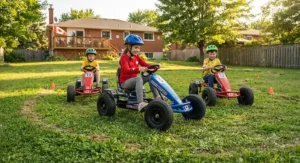
Racing style is more than a marketing label on karts like the hauck Cyclone Junior Racing Go Kart and hauck Sirocco — it reflects a genuinely different set of engineering choices than a general-purpose pedal kart, and it’s worth knowing what actually changes once a kid is riding.
Larger wheel diameters, generally 12 inches versus the 7-to-9-inch wheels common on budget karts, roll over small pavement cracks and seams with far less jolt, which matters once speed picks up. Race-style pedals, positioned for a more natural heel-toe motion rather than a flat pushing stroke, reduce fatigue on longer rides and let a rider maintain a higher cadence, translating directly into more sustained speed rather than short energetic bursts followed by tired legs. Lower seating positions improve stability during hard cornering by keeping the centre of gravity closer to the ground, though they do reduce visibility slightly and can feel less secure to a nervous first-time rider compared to the taller seats on general-purpose karts.
What the spec sheet won’t tell you is how much these changes shift the actual experience: racing-style karts reward a rider who’s already comfortable pedaling and steering and wants to go faster and corner harder, while a beginner still building basic coordination often does better starting on a general-purpose kart with a higher seat and gentler steering response, then graduating to a racing-style model a season or two later.
Common Mistakes When Buying a Pedal Go-Kart
A handful of buying mistakes come up repeatedly across aggregated review data and buyer feedback, and most are easy to avoid once you know to look for them.
Buying strictly by age range printed on the box, without checking actual height and weight against the kart’s real dimensions, is the single most common misstep — kids grow unevenly, and a “tall for their age” 4-year-old may need the next size up regardless of what the packaging says. Skipping the terrain check is another frequent regret; buyers who purchase a pavement-optimized racing kart for a grassy or gravel yard often end up disappointed by wheels that struggle to grip or roll smoothly.
Underestimating assembly time is a recurring theme in negative reviews, particularly for premium steel-frame karts that can take close to an hour with two adults; ordering the week of a birthday and assuming a 15-minute build is a common setup for last-minute stress. Ignoring the weight capacity margin is another one worth flagging: buying a kart rated right at a child’s current weight, rather than with meaningful headroom, shortens the usable lifespan considerably as the child grows through a single season. Finally, several buyers report regret over not checking chain-cover design before purchase — an exposed chain on a budget kart is a real pinch-point risk for small fingers and loose shoelaces that a fully enclosed chain guard, like the one on the Costzon 4-Wheel Pedal Go Kart, avoids entirely.
Safety, Regulations & Compliance for Backyard Racing
Toy safety in Canada isn’t left to manufacturer discretion. Children’s toys and related products manufactured, imported, or sold in Canada must comply with the Canada Consumer Product Safety Act and the associated Toys Regulations, which cover a wide range of mechanical, flammability, and structural hazards, with Health Canada acting as the enforcing regulatory body for these standards. In practice, that means legitimate pedal go-karts sold through established Canadian retailers have already cleared mechanical hazard testing covering things like pinch points, sharp edges, and structural stability before they reach a store shelf.
That said, regulatory compliance covers manufacturing, not supervision, and a handful of practical safety habits matter more than any spec sheet. A properly fitted bicycle or multi-sport helmet is worth using for backyard racing at meaningful speed, even though pedal karts sit lower and generally move slower than bikes; a fall at any speed onto pavement can cause head injury, and helmet habits formed early carry over well once kids graduate to bikes. Supervision matters most near driveways that open onto streets — pedal karts have no motor to cut power automatically, so a rider building speed toward an open driveway needs either a physical barrier or consistent adult supervision at that boundary. Regular bolt and chain-tension checks, covered earlier in the maintenance section, double as a safety measure, since a loose wheel or slipped chain at speed is a genuine fall risk rather than just an inconvenience.
Weight capacity limits deserve one more mention here specifically as a safety issue, not just a durability one: riding well over a kart’s rated capacity measurably increases frame stress and can affect braking distance and steering response, particularly on the plastic-panel budget models.
Frequently Asked Questions
❓ What age is right for a pedal go-kart for backyard racing?
❓ How fast can a pedal go-kart actually go?
❓ Do pedal go-karts work on grass or only pavement?
❓ Is a pedal go-kart safer than an electric ride-on kart?
❓ How long do pedal go-karts typically last before being outgrown?
Conclusion
There’s no single “best” pedal go-kart for backyard racing, and honestly, that’s a good thing — it means there’s a genuinely strong option whether your priority is terrain toughness, racing-style speed, a tight budget, or a kart sized for a kid who’s already outgrowing everything else on the shelf. The BERG Buddy Cross earns the top overall spot for families who want premium features and real all-terrain capability in one frame, while the hauck Cyclone Junior Racing Go Kart is the sharper pick for a rider chasing actual racing style and pavement speed. Budget-conscious families shouldn’t feel like they’re settling with the Costzon 4-Wheel Pedal Go Kart either; it delivers real functional controls at a genuinely accessible price.
Whichever kart ends up in your driveway, the bigger win is simple: pedal power gets kids outside, moving, and building coordination without a battery, a charger, or a motor doing the work for them. That matters more than it might seem — national data has repeatedly shown Canadian kids falling short of daily activity targets, and a backyard racetrack is a genuinely low-effort way to close some of that gap. Check current prices before you commit, since they shift often, and match the frame to your rider’s actual size rather than the age printed on the box — that one habit alone prevents most of the buying regrets covered above.
✨ Don’t miss these exclusive deals on this year’s top backyard racing karts — check current pricing on your favourite pick before availability changes! 🏁
Recommended for You
- 7 Best Off-Road Pedal Go-Karts for Rural Yards 2026
- 7 Best Two-Seater Pedal Go-Karts for Siblings in 2026
- 7 Best Pedal Go-Karts for Kids in 2026 (Backyard Tested Picks)
Disclaimer: This article contains affiliate links. As an Amazon Associate, I earn from qualifying purchases. If you purchase products through these links, we may earn a small commission at no additional cost to you.
✨ Found this helpful? Share it with your friends! 💬🤗
