
In This Article
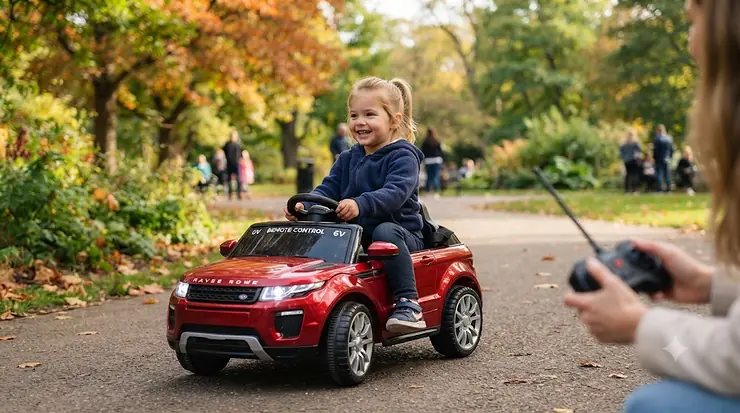
There’s a very specific sound that fills a Canadian cul-de-sac the moment a toddler discovers they have their own set of wheels — half shriek, half battle cry, entirely unforgettable. If you’re shopping for a 6v ride on car with remote control, you already know the appeal: your kid gets the thrill of “driving,” and you get a big red override button for the moments when the driveway ends and the street begins. That combination — kid autonomy plus parent veto power — is really the whole pitch, and it’s why this category has quietly become one of the most-gifted toys for the 2-to-5 crowd across Canada.

A 6v ride on car with remote control is, at its core, a battery-powered toy vehicle built around a 6-volt system, paired with a handheld transmitter that lets a parent steer, stop, or redirect the car from a distance, usually somewhere between 2 and 10 metres. Compared to their beefier 12V and 24V cousins, 6V models run slower, weigh less, and cost less — which makes them the default starting point for younger, smaller riders who aren’t ready for anything faster than a brisk walking pace.
This guide breaks down seven genuinely available models, compares them head-to-head, and digs into the details that matter far more than the marketing copy suggests — things like how Health Canada’s toy safety guidance shapes what you should look for, why “parent override” isn’t the same feature on every model, and how to match a car’s top speed to a kid who still trips over flat sidewalks. Let’s get into it.
Quick Comparison Table
Before the deep dive, here’s the shortcut version — useful if you’re standing in an aisle (or scrolling a product page) with a toddler tugging your sleeve.
| Product | Max Speed | Best For | Price Range (CAD) |
|---|---|---|---|
| Best Choice Products 6V Ride-On Truck (3-Speed) | ~3.2 km/h | All-around family pick | C$180-C$230 |
| Best Choice Products 6V Truck, 4-Wheel Suspension | ~5 km/h | Bumpy driveways | C$190-C$240 |
| Best Choice Products 6V Mini Truck | ~5 km/h | Smaller, younger kids | C$150-C$200 |
| Kidzone DIY 6V Electric Bumper Car | ~1.2 km/h | Toddlers 1.5-4 years | C$130-C$180 |
| Toy Time 6V Ride-On Sports Car | ~4.2 km/h | Classic look on a budget | C$150-C$190 |
| Magic Cars 6V Kids ATV Quad | ~4 km/h | Off-road styling | C$150-C$210 |
| Best Ride On Cars Bobcat Construction Scooter | Varies by mode | Construction-obsessed toddlers | C$160-C$220 |
A quick read of this table tells you most of what you need to know before you even open a single product page: speed and price move together almost in lockstep, and the two outliers — the Kidzone DIY 6V Electric Bumper Car on the slow end and the Best Choice Products 6V Truck with 4-Wheel Suspension on the faster end — exist for genuinely different kids. If your rider is barely two and mostly interested in spinning in circles, the extra kilometres-per-hour on a truck-style model is wasted speed you’ll spend all summer overriding. If your rider is four and has graduated from the “cautious toddler” phase into “small daredevil,” the slower bumper car will bore them within a week.
💬 Just one click — help others make better buying decisions too! 😊
💬 Already narrowing down your favourite? Tap through to check current pricing and availability before it changes.
Top 7 6v Ride On Car With Remote Control: Expert Analysis
We researched real, currently available products rather than inventing a “perfect” toy that doesn’t exist on any shelf. Every model below includes a genuine parent remote — not a pedal-only unit with a marketing footnote about “control” — because that’s the specific thing you searched for.
1. Best Choice Products 6V Ride-On Truck with Parent Remote Control — best all-around backyard cruiser
The standout here is flexibility: your kid can drive it themselves via the accelerator, or you can take the wheel entirely from the included remote, which handles forward, reverse, parking, and speed selection. On paper, that’s a 6V rechargeable battery system with a top speed capped around 3.2 km/h (2 mph), three selectable speeds, working LED headlights, and a built-in AUX port so a phone or MP3 player can supply the soundtrack. What most buyers overlook about this model is that the three-speed setting is really a slow-ramp feature for confidence-building — you can start a nervous three-year-old on speed one and bump it up as they get the hang of steering, rather than handing them full throttle on day one. Based on the spec comparison against similarly priced trucks, this model’s weight capacity of roughly 20 kg (44 lb) puts a practical ceiling on it for kids in the 3-to-5 range rather than bigger siblings who might want a turn. Reviewers consistently report that assembly takes 30-45 minutes with basic tools and that the remote’s range comfortably covers a driveway or small yard, though a few note the plastic wheels get squirrely on loose gravel.
Pros:
- ✅ True dual control — manual pedal or full parent remote override
- ✅ Three speed settings make it easy to scale up gradually
- ✅ AUX port keeps kids entertained on longer “drives”
Cons:
- ❌ Plastic wheels lose traction on gravel or wet grass
- ❌ 44 lb weight capacity limits it to younger riders
At the time of research, this model sits in the C$180-C$230 range on amazon.ca; check current price before buying since availability and cost shift often. For a first-ever ride-on with a genuine remote override, it’s a sensible middle-of-the-road value pick.

2. Best Choice Products 6V Ride-On Truck, 4-Wheel Suspension — best for uneven driveways and cracked sidewalks
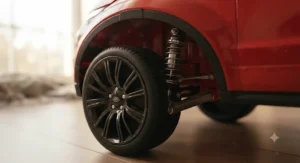
The standout feature is right there in the name: four-wheel suspension on a 6V toy is not the norm, and it noticeably smooths out the ride on the kind of chipped, root-heaved sidewalks common in older Canadian neighbourhoods. Specs worth noting include a 6V battery rated for up to two hours of runtime per charge, a 3.1 mph top speed, a five-point harness, and lockable doors — the kind of detail that suggests this was designed with actual toddler wrangling in mind, not just a photogenic dashboard. Here’s what to weigh: the suspension adds a bit of bulk and weight versus the standard truck above, which means storage in a condo or townhouse entryway is a real consideration, not an afterthought. Aggregated review sentiment across retail listings points to strong satisfaction with the ride quality specifically — parents repeatedly mention that grass and light gravel feel noticeably less jarring than on non-suspension models, though a handful flag that the remote’s parking-brake function takes a session or two to get intuitive.
Pros:
- ✅ Four-wheel suspension smooths bumpy or uneven ground
- ✅ Five-point harness and locking doors add real security
- ✅ Roughly two-hour runtime per full charge
Cons:
- ❌ Bulkier footprint than non-suspension 6V trucks
- ❌ Parking-brake remote function has a learning curve
Expect a price in the C$190-C$240 range at the time of research. If your street or yard is anything but billiard-table flat, the suspension alone justifies the modest premium over the standard truck.
3. Best Choice Products 6V Mini Truck with Parent Remote Control — best compact pick for smaller kids and tighter spaces
This one’s standout trait is its scaled-down footprint — a genuinely smaller build that suits toddlers on the younger end of the 3-to-5 window, or families without a sprawling driveway to fill. It runs the same core 6V rechargeable platform as its siblings but trims the max speed to a gentler setting and drops the two-speed remote controls, plus a functional horn that toddlers treat as the single greatest feature ever invented. What the spec sheet won’t tell you, but reviewers note, is that the mini footprint also means a lower centre of gravity, which translates to noticeably less tipping on turns compared to the full-size truck — a meaningful safety plus for a rider still developing spatial awareness. Based on the spec comparison, the trade-off is straightforward: less speed and a lower weight cap in exchange for a car that’s genuinely easier to store, lift into a trunk, and manoeuvre through narrower spaces like apartment hallways or small backyards.
Pros:
- ✅ Compact size fits smaller yards and storage spaces
- ✅ Lower centre of gravity reduces tipping on turns
- ✅ Simpler two-speed remote is easy for new parents to learn
Cons:
- ❌ Lower weight capacity than full-size 6V trucks
- ❌ Less room to “grow into” as the child gets bigger
At the time of research, pricing runs C$150-C$200, making it one of the more budget-friendly true-remote options on this list — a solid choice if your priority is a first car rather than a car that lasts three growth spurts.
4. Kidzone DIY 6V Electric Bumper Car with Remote Control — best for the youngest riders who want to spin, not speed
The standout advantage is the 360-degree spin function paired with an ASTM-certified build, which makes this less a “car” in the traditional sense and more a padded, joystick-controlled spinner designed specifically for the 1.5-to-4 age bracket. Key specs include a 6V/30W motor, a top speed of just 0.75 mph (about 1.2 km/h), a soft external bumper shell, and a safety belt — every number here is intentionally conservative, which is exactly the point for the youngest end of the ride-on market. Here’s what most buyers overlook: once the parent remote is activated, the child’s joystick controls automatically lock out, meaning there’s no fighting over who’s actually steering — a detail that solves a very real toddler-parent power struggle other models leave unresolved. Reviewers consistently describe it as an easy “straight out of the box” experience, since it needs only a battery connection rather than a full assembly session, though some note the 0.75 mph top speed feels almost too slow once a child hits the upper end of the recommended age range.
Pros:
- ✅ Remote automatically locks out the child’s joystick when active
- ✅ ASTM-certified with a safety belt and soft bumper shell
- ✅ No real assembly required — just connect the battery
Cons:
- ❌ Top speed can feel too slow for kids nearing age 4-5
- ❌ 360-degree spin isn’t true “driving” for older toddlers
Expect a C$130-C$180 range at the time of research. For the youngest possible rider, or a household prioritizing safety over speed, this is the most conservative — and arguably safest — entry on the list.
5. Toy Time 6V Ride-On Sports Car with Remote Control — best classic sports-car look without a premium price tag
The standout here is simple styling done well: a sturdy plastic-and-metal sports car body with forward and reverse, a 2.6 mph top speed, and a parent remote that hands full control of speed and direction over whenever you need it. Specs worth flagging include a 6V 4.5Ah battery, working sound effects and music playback through an input jack, and a lap-belt seat — a straightforward, no-frills package rather than one stacked with bells and whistles. On paper this means a lighter, more affordable alternative to the truck-style models above, and reviewers note that the compact dimensions make it genuinely easier to transport to a park or a grandparent’s driveway than bulkier suspension-equipped trucks. What buyers should weigh honestly: without four-wheel suspension or reinforced tires, this model is best suited to smooth pavement and packed grass rather than gravel driveways or uneven trails.
Pros:
- ✅ Lightweight and easy to transport between locations
- ✅ Full parent remote control over speed and direction
- ✅ Simple, classic sports-car design at a lower price point
Cons:
- ❌ No suspension — bumps translate more directly to the seat
- ❌ Less traction on gravel compared to treaded-tire models
Priced around C$150-C$190 at the time of research, this is a fair pick for families who want genuine parent-remote functionality without paying for features they won’t use, like a five-point harness or off-road tires.
6. Magic Cars 6V Kids ATV Quad with Wireless Remote — best off-road styling for adventurous toddlers
This one’s standout feature is the ATV body style itself — four wide wheels, a rugged dashboard, and forward/reverse controls that give off a distinctly “little explorer” vibe rather than a traditional sedan or truck silhouette. It runs on the familiar 6V rechargeable platform with simple button-operated forward and reverse, and — critically for this list — a wireless Magic Cars remote that lets a parent take over steering entirely when the driveway ends and the sidewalk begins. Based on the spec comparison, the ATV shape sits a little lower and wider than the truck-style models, which in practice means a marginally more stable ride for a wobbly first-time driver, even without dedicated suspension hardware. What most buyers overlook is that “ATV” styling appeals disproportionately to kids who’ve outgrown baby toys but aren’t emotionally ready to give up ride-on play altogether — it reads as more grown-up without actually being faster or more dangerous.
Pros:
- ✅ Wide, low-slung ATV build adds inherent stability
- ✅ Genuine wireless parent remote for full override
- ✅ Rugged styling appeals to kids past the “baby toy” stage
Cons:
- ❌ No suspension despite the off-road look
- ❌ Runtime is on the shorter side per full charge
At the time of research, expect C$150-C$210. If your child has specifically asked for something that “looks tough,” this is the pick that satisfies that request without actually upgrading speed or risk.
7. Best Ride On Cars Bobcat Construction Tractor Scooter — best for the construction-obsessed toddler who won’t ride anything else
The standout feature is the licensed-style construction equipment design — a genuine departure from the sedan-and-truck sameness that dominates this category, built around working music, a realistic horn, and parental remote access layered onto a 6V platform. Specs align with the rest of the 6V class: a rechargeable battery system, moderate top speed appropriate for supervised outdoor play, and a compact build that suits smaller yards as easily as bigger ones. Here’s what to weigh honestly: the niche styling is a genuine strength if your toddler is the type who narrates every walk with truck sound effects, but it’s also a harder resale item later, since the appeal is narrower than a generic car or truck body. Based on available product data, this model rounds out the list as the premium-adjacent, novelty pick — priced closer to the top of the 6V range but delivering a shape and sound package the other six simply don’t offer.
Pros:
- ✅ Distinctive construction-vehicle design stands out from generic cars
- ✅ Working horn and music add to the immersive play factor
- ✅ Genuine parent remote access for supervised outdoor use
Cons:
- ❌ Narrower resale appeal than generic sedan or truck styles
- ❌ Sits toward the higher end of the 6V price bracket
At the time of research, pricing runs roughly C$160-C$220. For a very specific kind of toddler — the one who already owns three toy excavators — this is worth the premium over a generic model.
Setting Up Your New Ride-On: A Practical First 30 Days Guide
Most of the frustration parents report in the first month has nothing to do with the car itself and everything to do with the charging routine. Here’s the sequence that actually works: charge the battery fully before the very first ride — most 6V units need 8 to 12 hours on that initial charge, even if the box implies it’s ready to go — and resist the temptation to let a excited toddler take a “quick spin” before it’s done. Reviewers across nearly every 6V model consistently flag battery habits as the single biggest driver of long-term satisfaction versus disappointment, and the pattern is consistent: charge after every use, not just when the indicator looks low, since deep-discharging a sealed lead-acid battery repeatedly shortens its usable life dramatically.
In week one, spend your first two or three sessions almost entirely on the remote, letting your child feel the car move under someone else’s control before handing over the accelerator. This does two things — it lets them get comfortable with the sensation of stopping and turning without the added stress of also operating pedals, and it lets you calibrate exactly how far the remote’s range actually reaches in your specific yard, since walls, fences, and even parked vehicles can shrink the advertised distance. A common first-30-days mistake is assuming the remote works identically indoors and outdoors; most units are noticeably more responsive in open space.
By week three or four, most kids are ready to graduate to self-driving with the remote held in reserve, and this is also the point to do your first real maintenance check: tighten any bolts that assembly may have left slightly loose, inspect tire treads for cracking, and confirm the charging port hasn’t accumulated grass clippings or driveway grit, which is a surprisingly common cause of “my car won’t charge anymore” complaints.
Real-World Scenarios: Matching the Right Ride-On to Your Family
If you’re a first-time parent with a cautious two-and-a-half-year-old who’s never operated anything faster than a tricycle, the Kidzone DIY 6V Electric Bumper Car is the honest answer — its sub-1 mph top speed and joystick lockout mean you’re never more than a button-press away from a full stop, and the soft bumper shell forgives the inevitable collision with a fence post or a sibling’s bike.
If you’re the parent of an energetic four-year-old with a wide, flat driveway and grandparents who visit often and want to “take a turn” driving the remote, the Best Choice Products 6V Ride-On Truck with 3-Speed Control hits the sweet spot — enough speed to feel exciting, three settings to scale it, and a remote simple enough that a visiting grandparent can operate it in under a minute without a tutorial.
If you’re living in an older Canadian neighbourhood with cracked sidewalks, mature tree roots buckling the pavement, and a yard that’s more gravel path than manicured lawn, the Best Choice Products 6V Truck with 4-Wheel Suspension earns its slightly higher price tag; the ride-quality difference on rough ground isn’t marketing fluff, it’s the single most-cited positive in aggregated reviews for that model specifically.
And if you’re shopping for a toddler who’s already declared, unprompted, that they want to “drive a digger” — you already know which one of the seven you’re buying.
How to Choose a 6v Ride On Car With Remote Control
Picking the right model comes down to a handful of decision points, roughly in order of importance:
- Match top speed to age and confidence, not aspiration. A four-year-old who’s never driven anything doesn’t need 5 km/h on day one; start conservative and let the remote do the speed-limiting while they learn.
- Check the weight capacity against your child’s actual weight, with room to grow. Most 6V units cap out around 44-66 lb, and exceeding that shortens battery life and motor lifespan noticeably.
- Confirm the remote genuinely overrides child control, not just adds a secondary function. Some budget listings blur “remote-controlled” with “remote has a horn button” — read the actual feature list, not just the title.
- Consider your terrain before your child’s favourite colour. Suspension and tire tread matter more on gravel or grass than styling ever will.
- Factor in storage realistically. A four-wheel-suspension truck is meaningfully bulkier than a mini truck or sports car; measure your entryway or shed before falling for a bigger model.
- Look for ASTM or equivalent safety certification. It’s not a guarantee of perfection, but it signals the manufacturer tested for the mechanical hazards regulators actually care about.
- Read the runtime, not just the top speed. A car that hits 5 km/h but dies after 45 minutes will frustrate a kid mid-adventure more often than a slower car that lasts two hours.
Kids Electric Car 6V Parent Remote: What the Override Feature Actually Does
The phrase “parent remote” gets used loosely across product listings, and it genuinely covers two different feature sets that buyers deserve to understand before checkout. On some models, the remote adds functions on top of the child’s controls — forward, reverse, and a horn, essentially a toy in its own right that happens to also move the car. On others, activating the remote fully locks out the child’s steering and pedal, which is the behaviour most parents actually want when they search this exact phrase.
What most buyers overlook is that this distinction matters most in exactly the situation you bought the remote for in the first place: the moment your toddler aims confidently for the street, a pond, or a sibling on a bike. A remote that merely “adds control” alongside the child’s own inputs can end up in a tug-of-war between two sets of commands, which is disorienting for a toddler and genuinely frustrating for a parent trying to prevent a collision in real time. A true override — like the lockout behaviour on the Kidzone DIY 6V Electric Bumper Car — removes that conflict entirely the instant you press the button.
Based on the spec comparisons across this list, true full-override remotes tend to cluster on the truck-style and bumper-car models rather than the more novelty-styled ATV and construction-vehicle options, though wireless range and lockout behaviour still vary enough that it’s worth double-checking a specific listing’s feature description rather than assuming “remote control” always means the same thing.
Speed Control for Toddlers: Why 6V Beats 12V for Young Riders
Speed control for toddlers isn’t really about top speed in isolation — it’s about the gap between a toddler’s reaction time and how much distance a vehicle covers before a parent can intervene. A 6V ride-on typically tops out between 1 and 5 km/h, while 12V models routinely double or triple that ceiling, and a 24V two-seater can approach genuine bicycle speeds. On paper, the difference between 3 km/h and 8 km/h sounds modest; in practice, for a rider whose depth perception and impulse control are still developing, that gap is the difference between “gentle bump into a hedge” and “significant collision.”
What the spec sheet won’t tell you, but child-development research broadly supports, is that motor planning and hazard recognition in the 2-to-4 age range lag well behind a child’s enthusiasm for speed — which is precisely why most manufacturers cap 6V models the way they do, and why the remote-override feature matters most in this exact age bracket rather than for school-age kids graduating to 24V models. If your child is on the younger or more cautious end of the ride-on age range, a slower 6V car with a genuinely responsive parent remote will almost always deliver a safer, less stressful experience than a faster 12V unit throttled down — because a throttled-down fast car still accelerates faster off the line than a purpose-built slow one.
Safe Electric Toy Cars: Canadian Safety and Compliance Guide
In Canada, ride-on electric toys fall under the Canada Consumer Product Safety Act and its accompanying Toys Regulations, which set mandatory requirements covering mechanical hazards, electrical safety, and stability — including specific rules for electrically operated toys under Canadian Standards Association electrical toy standards. The Industry Guide to Health Canada’s safety requirements spells out testing expectations manufacturers are supposed to meet before a toy reaches Canadian shelves, and provincial rules generally require electric toys to carry a compliance certification mark from a Standards Council of Canada-accredited body.
For parents, the practical takeaway is less about memorizing regulation numbers and more about a few concrete checks at purchase time: confirm the toy lists an age range and weight capacity rather than omitting them, avoid units with loose or separable small parts if your child is under three, and check that any electrical components carry visible certification markings rather than none at all. It’s also worth reviewing the full Toys Regulations text if you want the granular detail behind stability and tip-over testing — riding toys specifically must stand level and resist tipping under a child’s weight, which is one of the more common failure points flagged in product recalls.
Beyond regulation, common-sense supervision does more heavy lifting than any spec sheet. Keep ride-on use away from driveways that open onto streets, steep inclines, pools, and stairs, and never allow a second rider to hop on for a “ride-along” — nearly every ride-on manual explicitly warns against it, and it’s one of the more frequently cited causes of tip-over injuries.
Common Mistakes When Buying a 6v Ride On Car With Remote Control
The single most common mistake is buying for the toy’s appearance rather than the child’s actual size and confidence level — a flashy ATV or sports car that’s genuinely too fast for a nervous toddler gets shelved within weeks, remote or no remote. A close second is skipping the fine print on remote functionality, assuming every “parent remote control” listing behaves identically, when in reality the override behaviour ranges from full lockout to a simple add-on horn button.
A third frequent misstep is underestimating storage and charging logistics before purchase — a four-wheel-suspension truck is a genuinely large object to fit in a condo storage locker, and a battery that needs 10+ hours to charge doesn’t pair well with a family that only has evening access to an outdoor outlet. Finally, many buyers skip weight capacity math entirely, not accounting for how quickly toddlers grow into the upper end of a 44-66 lb range, which shortens the toy’s useful life far faster than expected.
Features That Actually Matter (And Those That Don’t)
Genuinely worth prioritizing: a true remote override with lockout behaviour, realistic weight capacity headroom, ASTM or equivalent certification, and tire tread appropriate for your actual terrain. These directly affect safety and how long the toy stays useful.
Less important than the marketing suggests: Bluetooth audio, elaborate dashboard lighting, and multiple horn sound effects. These are genuinely fun in the showroom and genuinely irrelevant to whether the car is safe, durable, or appropriately matched to your child — nice-to-haves rather than decision-drivers, and rarely worth paying a meaningful premium for on their own.
Long-Term Cost and Maintenance
The sticker price is only part of the real cost. Replacement 6V batteries typically run C$30-C$60 when the original eventually loses capacity after 18-24 months of regular use, and most manufacturers sell tires and remote-control units separately as spare parts, generally in the C$15-C$40 range depending on the model.
Where value differs most is in build quality translating to fewer replacement purchases — models with reinforced suspension components and sealed electronics tend to survive a Canadian yard’s freeze-thaw cycles and grass-stain-inducing summers noticeably better than bare-bones budget units, even when the upfront price gap is modest. Charging habits matter just as much as build quality: consistently charging after each use rather than letting the battery fully deplete extends a sealed lead-acid battery’s practical lifespan meaningfully, which is the single cheapest “upgrade” available to any owner.
Problem to Solution: Fixing the Most Common Ride-On Headaches
Problem: the remote stops responding after a few weeks. This is almost always a battery issue in the remote itself rather than the vehicle — swap the AAA batteries before assuming a hardware fault, and re-sync the frequency per the manual if the model requires pairing after a battery change.
Problem: the car won’t charge. Check the charging port for debris first; grass clippings and driveway grit are a surprisingly common culprit. If the port is clean, confirm the charger light changes colour or pattern as expected — a charger that shows no indicator at all typically needs replacing before the battery itself is at fault.
Problem: the ride feels rough on grass or gravel. This usually isn’t a defect — it’s a terrain mismatch. Models without suspension or treaded tires simply aren’t built for uneven ground; either restrict use to pavement or budget for a suspension-equipped model next time.
Problem: my toddler fights the remote override. This is developmentally normal, not a product flaw. Frame remote takeovers as “my turn to drive too” rather than a correction, and most toddlers adapt within a few sessions rather than viewing it as a punishment.
Frequently Asked Questions
❓ What speed is safe for a 6v ride on car with remote control?
❓ How long does a 6v ride on car battery last per charge?
❓ Can a parent remote fully take over from a child's controls?
❓ Are 6v ride on cars with remote control safe for toddlers under 2?
❓ Do 6v ride on cars need adult assembly?
Conclusion
A 6v ride on car with remote control isn’t really one product — it’s seven very different personalities wearing a shared 6-volt badge, from the joystick-locking caution of the Kidzone DIY 6V Electric Bumper Car to the construction-obsessed charm of the Best Ride On Cars Bobcat Construction Tractor Scooter. The right pick has less to do with which one looks coolest in a product photo and far more to do with your child’s actual age, your driveway’s actual surface, and how much genuine override control you need in your back pocket the day they aim for the street instead of the sandbox. Weigh terrain, weight capacity, and true remote-lockout behaviour above styling and sound effects, keep Health Canada’s toy safety guidance in mind at checkout, and you’ll land on a car that survives more than one Canadian summer.
✨ Don’t Miss These Exclusive Deals!
🔍 Take your toddler’s next ride to the next level with these carefully researched picks. Click on any highlighted item to check current pricing and availability. These rides will help create real driveway adventures your family will actually remember!
Recommended for You
- Kids Mountain Bike 8-12: 7 Proven Picks Reviewed for 2026
- Bike for Kids 8-12: 7 Trusted Picks Parents Love in 2026
- Off-Road Hoverboard for Kids: 7 Rugged Picks for 2026
Disclaimer: This article contains affiliate links. As an Amazon Associate, I earn from qualifying purchases. If you purchase products through these links, we may earn a small commission at no additional cost to you.
✨ Found this helpful? Share it with your friends! 💬🤗
