
In This Article
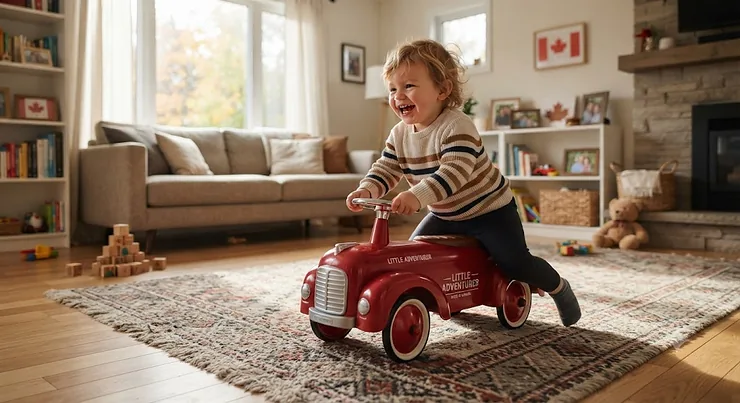
A foot-to-floor ride-on car is a low, non-motorized toddler vehicle that a child sits on and pushes along the ground with both feet. It has no pedals, no batteries to charge and no motor to outrun. Most are built for roughly 10 months to 3 years, which makes them the friendliest first “vehicle” a small child can own.

Here’s the appeal in one sentence: a foot-to-floor ride-on car turns “I can stand!” into “I can go somewhere!” That is a big upgrade in a child’s sense of independence. The Canadian Paediatric Society’s Caring for Kids development guide treats walking, running and balance as gross motor skills. Those skills grow through repetition, and a toy that rewards repetition is worth a spot on the shopping list.
This guide is written for anyone searching for a foot-to-floor ride-on car for toddlers, from a first-birthday gift to a hand-me-down upgrade. I researched seven real models sold in Canada (or through amazon.ca listings). For each one I’ve translated the spec sheet into what it means on your hardwood, your patio, or your condo hallway. I couldn’t personally test any of them, so what follows is spec analysis and aggregated review themes, not hands-on claims. I’ll also flag where the evidence is thin, because a confident guess helps nobody.
You’ll also find sections on toddler leg strength development, indoor ride-on toy safety, and first ride-on toy milestones. There’s also a plain-spoken look at value under $60 CAD.
Quick Comparison Table: 7 Foot-to-Floor Ride-On Cars at a Glance
| Model | Listed Age / Capacity | Standout | Best For |
|---|---|---|---|
| Radio Flyer Scoot About Sport | 1–3 yrs, 42 lb (19 kg) | Wide front wheels, clear kick path | Stability-first first-timers |
| Little Smoby Ride-On Car & Walker | 10 months+ | Walker mode plus ride-on | Early walkers, small homes |
| Aosom Vintage Sliding Car | 18–36 months | Retro styling, under-seat storage | Gift-givers who care about looks |
| Aosom Police Sliding Car | Toddler range (check listing) | Megaphone, anti-dumping device | Role-play fans |
| Qaba Mercedes-Benz C-Class 2-in-1 | 18–36 months | Parent handle plus guardrail | Families who also want a push option |
| CAT Play and Ride Steel Dump Truck | 18 months+ (Amazon) / 3+ (maker) | Steel dump bed, lights and sounds | Construction-obsessed preschoolers |
| OLAKIDS 4-in-1 Ride-On Push Car | Toddler range (check listing) | Convertible push/slide design | Multi-stage, long-use buyers |
Looking at the table, the Radio Flyer Scoot About Sport and the Little Smoby Ride-On Car & Walker cover the widest developmental window between them. The Qaba Mercedes-Benz C-Class 2-in-1 and OLAKIDS 4-in-1 Ride-On Push Car trade simplicity for parent-push flexibility. The CAT Play and Ride Steel Dump Truck has an age-label discrepancy worth reading carefully before you buy, which I unpack below.
💬 Just one click — help others make better buying decisions too!😊
Top 7 Foot-to-Floor Ride-On Car Picks: Expert Analysis
Prices below are ballpark bands in Canadian dollars. Marketplace prices swing week to week and I couldn’t lock live amazon.ca prices for every listing, so check current price before you decide.
1. Radio Flyer Scoot About Sport — stability-first design with a clear kick path
The standout here is geometry. Wide-set front wheels and narrow rear wheels give a broad base up front and leave room for little legs to swing freely behind.
The listing puts capacity at 42 lb (about 19 kg) for ages 1–3, with working front steering, easy-glide wheels and a lift-up seat that hides a storage cavity. That footprint (roughly 60 × 37 × 42 cm, or 23.5″ × 14.5″ × 16.5″) is compact enough for a hallway but big enough that a 90-cm toddler won’t look cramped.
Based on the specs, this is the pick for a child who’s nervous about wobbly things. The wide front stance resists side-tipping, and real steering lets a toddler learn cause and effect (turn wheel, change direction) instead of just going straight until a wall intervenes.
Reviews on the manufacturer’s own pages skew warm. Grandparents describe first-birthday gifts that survived storage-compartment “treasure hiding” and didn’t tip easily. Manufacturer-site reviews tend to be positive, so weigh them accordingly.
Pros:
- ✅ Wide front wheels resist tipping
- ✅ Clear kick path for easy scooting
- ✅ Lift-up seat storage for small treasures
Cons:
- ❌ No horn, lights or sound effects
- ❌ 19 kg cap means outgrowing near age three
Typically a mid-range spend, in the C$40–C$80 band. Radio Flyer Scoot About Sport is a safe, sensible bet for anyone who values proven design over gimmicks.
2. Little Smoby Ride-On Car & Walker — the earliest starter in the group
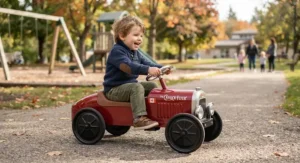
Its trick is being two toys in one. A baby uses the high backrest as a walking support from around 10 months, then sits and pushes off with their feet from about 12 months.
Front and rear anti-topple devices keep it from flipping in either direction, and the steering turns about 30 degrees, so a novice can’t yank the wheel into a spin. The soft-plastic wheels suit both indoor and outdoor use, and it measures about 54 × 27 × 40 cm. That’s genuinely tiny, which matters in a Toronto condo or a Montréal walk-up where every square metre counts. The French-made build is a quiet selling point too.
What the spec sheet won’t tell you is that “10 months+” is an invitation, not a deadline. Children walk at different ages, so the walker-first stage is where this model earns its keep, and the ride-on stage follows when your child is ready.
The review pool I found is small and international. One parent of a 10-month-old described a few days of hesitation before the child settled in and stayed on longer. That’s a useful reminder that not every baby falls in love on day one.
Pros:
- ✅ Works as walker, then ride-on
- ✅ Front and rear anti-topple protection
- ✅ Compact footprint suits small homes
Cons:
- ❌ Small frame outgrown sooner by taller toddlers
- ❌ Limited extras beyond a horn
Expect a budget-to-mid band of roughly C$40–C$75. It’s the strongest choice for early walkers.
3. Aosom Kids Ride On Sliding Car (Vintage, Cream White) — retro looks with under-seat storage
If a toddler ride-on can be handsome, this one is. The cream-white vintage styling suits a Scandinavian nursery better than a neon plastic tractor does.
It’s a foot-to-floor slider with a steering wheel, a horn and storage tucked beneath the seat. It’s listed for ages 18–36 months. In practice, that upper bound is a soft guide, since leg length matters more than the birthday cake count.
At the time of research, the amazon.ca listing showed a 4.9-out-of-5 average from 19 reviews. That’s a lovely number but a small sample. Fewer than two dozen reviews can be swung by a couple of enthusiastic gift-givers, so treat it as encouraging rather than conclusive.
Analytically, this is a gift choice for anyone who wants photo-friendly design without paying a premium brand tax. It also suits toddlers who want to “drive”, because the horn and wheel reward pretend play. For a first-time ride-on, though, the lack of published details on stability features means I’d read the listing’s photos and Q&A section closely.
Pros:
- ✅ Handsome retro design
- ✅ Under-seat storage for toys
- ✅ Strong early rating (small sample)
Cons:
- ❌ Only 19 reviews to lean on
- ❌ Fewer safety features listed than rivals
Likely a budget-to-mid pick, in the C$50–C$90 band. Good value if styling matters as much as function.
4. Aosom Kids Ride On Sliding Car (Police, with Megaphone) — anti-dumping device for wobbly beginners
This model’s hook is a feature many rivals skip: an anti-dumping device, which is engineered to resist backwards tipping when a child leans hard.
It also offers hidden under-seat storage, a removable backrest and a megaphone, and it comes in white, blue and black. Why does the removable backrest matter? A toddler who can’t yet sit upright confidently benefits from support, and a more coordinated one may prefer freedom to twist and turn.
The amazon.ca listing showed a 4.3-out-of-5 average from 111 reviews at the time of research. That larger sample is more trustworthy than a handful of five-star scores, and the moderate average suggests some buyers hit snags (typical culprits in this category are assembly fiddliness and sound quality). Since I couldn’t verify the specific complaint themes, read the low-star reviews before purchasing.
Analytically, this is a solid roleplay choice for kids drawn to sirens and uniforms. The megaphone gives a toddler a “voice”, which older toddlers love. The tipping protection makes it reasonable for cautious parents.
Pros:
- ✅ Anti-dumping device for backward tipping
- ✅ Removable backrest as skills grow
- ✅ Larger review pool than sister model
Cons:
- ❌ Moderate 4.3 rating hints at some snags
- ❌ Megaphone may test parents’ patience
A likely budget-to-mid pick, in the C$50–C$90 band. Solid role-play value.
5. Qaba Mercedes-Benz C-Class 2-in-1 — foot-to-floor plus parent-push handle
Flexibility is the point here. It slides under toddler power indoors, then converts to a parent-guided push car for longer outings.
The listing highlights a parent control handle, a safety guardrail, a horn and under-seat storage for 18–36 months. The parent handle matters in real life because toddlers hit a wall. Their legs give out halfway around the park, and being able to steer from behind rescues the walk home.
The licensed Mercedes-Benz badge is a novelty, not a performance feature, so don’t pay extra for it. What counts is whether the guardrail and handle feel sturdy in your hands when the box arrives.
Buyer evidence is thinner here. I didn’t find a robust set of verified reviews to summarize, so I can’t offer aggregated sentiment. Read the current amazon.ca review count and recent one-star complaints before you commit.
This model suits a family that wants a foot-to-floor ride-on car for toddlers without giving up the option of pushing. If you’ll mainly use it indoors, though, the handle and guardrail add bulk you may not need.
Pros:
- ✅ Parent handle for tired legs
- ✅ Guardrail adds a sense of security
- ✅ Horn and storage add play value
Cons:
- ❌ Verified review evidence is thin
- ❌ Extra hardware adds bulk indoors
Typically a mid-range spend, in the C$60–C$100 band. Good value if you’ll use both modes.
6. CAT Play and Ride Steel Dump Truck — steel dump bed and real construction-site swagger
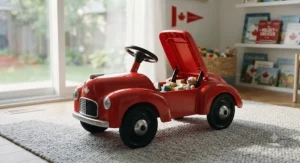
This is the toy for the kid who points at every excavator. It transforms from a dump-truck toy to a rideable vehicle: lift the top, pull the handles up and slide the bed back.
In foot-to-floor mode the truck is free-wheeling and non-motorized, with easy-grip handles. A light-and-sound knob on the handle triggers job-site effects, and the dump bed is heavy-duty steel.
Here’s the flag: Amazon’s listing describes it for ages 18 months, while the manufacturer’s site recommends ages 3 and up. That’s a big gap. It suggests the truck is really a preschooler’s toy, and a younger toddler may find the heavy steel construction awkward. One buyer noted the weight made it hard for their younger child to move alone. I’d default to the manufacturer’s guidance.
Analytically, this suits an older toddler or preschooler who’s outgrown a “first” car and wants role-play with a real working dump bed. It’s not the softest landing for an 18-month-old.
Pros:
- ✅ Steel dump bed built for rough play
- ✅ Transforms between toy and ride-on
- ✅ Handle-mounted lights and sounds
Cons:
- ❌ Conflicting age guidance between listings
- ❌ Heavy for smaller toddlers to manoeuvre
Likely a mid-range spend, in the C$50–C$90 band. Great for the right age, less so for the youngest.
7. OLAKIDS 4-in-1 Ride-On Push Car — one toy, several stages
The pitch is longevity. It’s described as a stroller, sliding and walking toy in one, with horn, music, lights, removable guardrails and handle, and storage underneath.
More modes should mean more months of use, since a car that works as a parent-push vehicle at 14 months and a foot-to-floor slider at 20 months keeps earning its floor space. The removable guardrail handle means the car can “grow up” and lose its training wheels, so to speak.
The trade-off is that convertible toys can feel over-engineered. More parts mean more things to loosen, lose or squeak, and music-and-lights features tend to be either endearing or ear-splitting depending on your tolerance.
I didn’t find a robust sample of verified reviews I could summarize, so I’ll stay honest and say I can’t quote aggregated sentiment. Check the live rating and read the most recent critical reviews.
This one suits families who want a single purchase to cover the wobble-to-walk-to-wheel arc, and who don’t mind assembling a few more parts.
Pros:
- ✅ Multiple modes stretch usable months
- ✅ Removable guardrails and handle
- ✅ Under-seat storage included
Cons:
- ❌ More parts means more to check
- ❌ Sounds may grate on parents
Likely a mid-range spend, in the C$60–C$100 band. Best for long-horizon buyers.
Top 7 Comparison: Value at a Glance
| Model | Stability Features | Extras | Best For |
|---|---|---|---|
| Radio Flyer Scoot About Sport | Wide-set front wheels | Storage | Nervous first-timers |
| Little Smoby Ride-On Car & Walker | Front and rear anti-topple | Walker mode, horn | Early walkers |
| Aosom Vintage Sliding Car | Not detailed in listing | Horn, storage | Style-conscious gifts |
| Aosom Police Sliding Car | Anti-dumping device | Megaphone, removable backrest | Role-play fans |
| Qaba Mercedes-Benz C-Class 2-in-1 | Guardrail | Parent handle, horn | Push-and-slide families |
| CAT Play and Ride Steel Dump Truck | Heavy steel build | Lights, sounds | Older toddlers/preschoolers |
| OLAKIDS 4-in-1 Ride-On Push Car | Removable guardrails | Music, lights, handle | Long-term convertible use |
The comparison shows that only a few models advertise specific anti-tip engineering, so if your child is unsteady, that’s a legitimate tie-breaker. Radio Flyer Scoot About Sport and Little Smoby Ride-On Car & Walker win on stability, while Aosom Police Sliding Car wins on tipping protection with role-play flair. Convertible options like Qaba Mercedes-Benz C-Class 2-in-1 and OLAKIDS 4-in-1 Ride-On Push Car trade simplicity for flexibility.
Practical Usage Guide: Your First 30 Days With a Foot-to-Floor Ride-On Car
Amazon listings won’t tell you how to make the toy work in a real house, so here’s a routine.
Week 1: assemble and stage. Assemble on the floor where it will live, and check every screw or clip twice. Choose a hard, flat, uncluttered route of about 3–4 metres. Don’t start in the kitchen, where rugs and table legs turn a fun scoot into a pinball game.
Week 1–2: match seat height to legs. Your toddler should sit with feet flat on the floor and knees comfortably bent. If they’re on tiptoe, wait a few weeks or pick a lower model. If the knees rise above the hips, the car is too small.
Week 2–3: teach “push, push, glide”. Sit beside them and model the motion. Don’t push them at first, since letting them discover the rhythm is the whole developmental point. A foot-to-floor ride-on car for toddlers works best when the child owns the movement.
Week 3–4: add a mission. Ask them to “drive to the kitchen door” or “park by the bookshelf”. Goals turn scooting into steering practice.
Ongoing maintenance: wipe the seat and steering wheel weekly, check for loose fasteners monthly, and pick hair and lint from the wheel axles. Replace sound-module batteries only when the unit is switched off, and keep screwdriver-secured battery compartments closed.
Common first-month mistakes: starting on carpet (too much drag), leaving the car near stairs, and expecting instant enthusiasm. As the Smoby reviewer noted, some children need several sessions to warm up.
Real-World Scenarios: Matching Cars to Canadian Households
Scenario 1: The condo family (Toronto, hardwood floors, winter). Baby is 11 months and cruising the furniture. Space is limited, and from November to April nearly all play happens indoors. The Little Smoby Ride-On Car & Walker fits: its small footprint and walker mode match a child who isn’t scooting yet, and its soft-plastic wheels suit indoor floors. Budget: roughly C$40–C$75. Use: daily, in short bursts.
Scenario 2: The suburban house with a patio (Calgary, 2-year-old, dry summers). A confident toddler wants speed and a bit of outdoor adventure. The Radio Flyer Scoot About Sport and its clear kick path suits patios and smooth sidewalks. The larger wheels and wide stance give a steadier ride across slight bumps. Budget: mid-range. Use: several times weekly, indoors and outdoors.
Scenario 3: The grandparent gift for an obsessed 3-year-old. The child talks trucks all day and has outgrown basic scooters. The CAT Play and Ride Steel Dump Truck, with age 3+ guidance from the maker, lets them scoot and haul. A grandparent buying it should keep the box, since returns are simpler if the fit is off. Budget: mid-range. Use: weekend visits and rainy afternoons.
How to Choose a Foot-to-Floor Ride-On Car: 6 Steps
- Check your child’s inseam first. Feet must sit flat with knees bent. Measure from crotch to floor and compare with the seat height in the listing photos or specs.
- Read the stated weight limit and age. Most toddler models cap around 19–23 kg (42–50 lb). If your child is tall for their age, the cap arrives sooner than the age range.
- Look for anti-tip engineering. Front and rear anti-topple parts, a wide wheelbase or an anti-dumping device matter more than a licensed badge.
- Match wheels to floors. Soft plastic or rubberized wheels are gentler on hardwood, while hard plastic can be noisy and skid on smooth tile.
- Decide on parent-push features. A removable handle adds flexibility for walks but also adds bulk and parts.
- Skip the gimmicks you don’t need. Sounds and lights are fun for a week; steering, stability and seat height matter for years.
Features That Actually Matter (And Those That Don’t)
Marketing loves lights, music and licensed logos. Toddlers care about whether they can push off without the car fighting them.
Matter: stable wheelbase, correct seat height, steering that turns freely but not wildly, a wheel material suited to your floors, and storage that’s easy to reach. Storage sounds trivial, but toddlers love carrying things, and a hidden compartment turns a ride into a mission.
Don’t matter much: engine sounds, licensed brand names and elaborate paint. A horn is fun, but it’s not developmental, and a licensed emblem won’t improve stability.
Worth a second look: removable backrests and guardrails. They help beginners now and older riders later, provided they feel firmly attached.

Toddler Leg Strength Development: What a Foot-to-Floor Ride-On Car Actually Trains
The push-and-glide motion recruits hips, thighs and calves in a repeated, alternating pattern. That’s basic reasoning about how the movement works, not a clinical claim about any specific toy.
Researchers at Western University note that children build gross motor skills through repeated physical activity, and they point to scooters and bikes as ways of practising those skills. A foot-to-floor ride-on car sits earlier on the same ladder, because it rewards balance, steering and controlled leg pushes before a child ever touches pedals.
There’s a subtler benefit too: reciprocal pushing (left, right, left, right) trains the coordination that later shows up in running and stair climbing. It also builds the endurance to keep going, which is why gradually longer “drives” make sense.
A few honest caveats. No toy replaces free play, crawling, climbing and walking. If your toddler seems consistently unable to bear weight, drags a leg or shows persistent delays, speak to your family doctor or paediatrician rather than trying to fix it with a toy. Used as intended, the toy is a fun way to practise, not a therapy device.
Indoor Ride-On Toy Safety: What Canadian Parents Should Check
Indoor ride-on toy safety starts with the rules that apply before the toy reaches your door. Health Canada’s Toys Regulations set mandatory requirements for toys sold in Canada, addressing hazards such as choking, strangulation, lacerations, flammability and toxic exposure. The regulator’s own Toys Regulations FAQ explains that industry is responsible for compliance. That means you still need to read labels, since a listing isn’t a certificate.
Practical checks that go beyond the regulations:
- Stairs are the big one. Install gates at the top and bottom, and keep the ride route away from steps. A toddler on wheels moves faster than most parents expect.
- Small parts. Toys for children under three shouldn’t have small, detachable components. Inspect stickers, sound-module covers and knobs periodically.
- Battery doors. If the toy has a sound module, confirm the compartment is secured and stays closed.
- Cords and hazards. Keep the ride path clear of blind cords, curtains and charging cables.
- Supervision. A foot-to-floor ride-on car isn’t a road vehicle. Keep it away from driveways and streets, and stay within arm’s reach until your child has good control.
- Recalls. Check Health Canada’s recall database before buying used or accepting a hand-me-down.
First Ride-On Toy Milestones: A Realistic Timeline
Children develop on their own schedules, and the range for “normal” is wide. Most children take their first independent steps around the first birthday, but plenty do so a bit earlier or later. The Caring for Kids development guide I mentioned earlier offers a helpful general reference.
Around 9–12 months (cruising and standing): A walker-style model like the Little Smoby Ride-On Car & Walker can offer support for first steps. Treat it as a gentle play prop and supervise closely.
12–18 months (sit and scoot): Many toddlers begin experimenting with pushing off the floor. Expect awkward, sideways scoots and lots of stopping.
18–24 months (steering and intent): Children start choosing where to go. Models with real steering, like the Radio Flyer Scoot About Sport, reward this.
24–36 months (speed and pretend play): Confidence grows. Role-play models like the Aosom Police Sliding Car come into their own, and preschoolers may graduate to the CAT Play and Ride Steel Dump Truck.
Around 3 and beyond: Many children move on to balance bikes or tricycles. A foot-to-floor ride-on car has done its job by then, teaching balance, steering and leg coordination.
Top Foot-to-Floor Cars Under $60 CAD: How to Find Real Value
If your target is top foot-to-floor cars under $60 CAD, I’ll be straight with you. Prices on marketplace listings swing constantly, and I couldn’t verify live Canadian prices for every model, so I won’t claim any specific car is under that line today.
What I can offer is a strategy. Value-brand listings from sellers such as Aosom, OLAKIDS and Qaba often sit toward the lower end of this category, while the Radio Flyer Scoot About Sport and Little Smoby Ride-On Car & Walker tend to sit in the mid-range but sometimes drop during sales. Compare current prices across these before deciding.
What corners get cut at low prices? Typically, thinner plastic, louder and less pleasant sound modules, and fewer safety features. Where should you refuse to compromise? Stability, seat height and clear age labelling.
A tip: price per month of use matters more than sticker price. A C$55 car that works from 12 to 30 months costs less per month than a C$40 one your child outgrows at 24. Never treat “on sale” as a guarantee. Check current price and confirm any discount is genuine.
Foot-to-Floor Ride-On Car Review Canada: What Listings and Reviewers Reveal
Any honest foot-to-floor ride-on car review Canada readers can trust has to start with the limits of the data.
Here’s what I could verify at the time of research. The amazon.ca listings for Aosom sliding cars showed averages of 4.9 (19 reviews), 4.6 (94 reviews), 4.3 (111 reviews) and 4.2 (186 reviews) across different models. The pattern is instructive: the highest score has the smallest sample, and the more heavily reviewed models cluster in the low-to-mid 4s. In practice, it suggests the category delivers “good, not perfect”, with recurring frustrations likely around assembly and durability.
Canadian context matters too. Winter means most play is indoors from roughly November through April, so wheel material and floor protection matter more than off-road ability. Condo living means compact footprints and quiet wheels earn extra credit. And if you’re buying from a third-party seller, confirm return windows and who handles warranty claims.
The most useful review habit is to read the two-, three- and one-star reviews first. They tell you what breaks, what’s fiddly and what gets old fast.
Foot-to-Floor Ride-On Car vs Alternatives: Which Wheels Suit Which Stage?
| Option | Powered By | Best Age Window | Best For |
|---|---|---|---|
| Foot-to-floor ride-on car | Toddler’s feet | ~10 months to 3 years | Balance, steering, first independence |
| Parent-push car | Adult | ~6 months to 3 years | Long walks, tired legs |
| Balance bike | Toddler’s feet | ~2 to 5 years | Riding skills, outdoor confidence |
| Pedal tricycle | Pedals | ~2.5 to 5 years | Pedalling coordination |
A foot-to-floor ride-on car sits between a baby walker’s support and a balance bike’s freedom. Compared with parent-push cars, it gives the child agency, though push models win when you need to cover distance. Compared with balance bikes, it’s lower, more stable and easier for very young children, but it lacks the lean-and-steer skill transfer that helps with cycling.
The blend of options suits many families: a Qaba Mercedes-Benz C-Class 2-in-1 or OLAKIDS 4-in-1 Ride-On Push Car for flexibility, or a simple Radio Flyer Scoot About Sport if independence is the goal.
✨ Ready to Pick Your Toddler’s First Set of Wheels?
🔍 Take your search for the perfect foot-to-floor ride-on car to the next level. Click any highlighted product name to check current pricing and availability, then match seat height, stability and stage to your child. These picks will help your little one build confidence, balance and a big grin!
FAQ
❓ What age can a toddler start using a foot-to-floor ride-on car?
❓ Can a foot-to-floor ride-on car be used outdoors in Canada?
❓ Do foot-to-floor ride-on cars need batteries?
❓ How much should I spend on a foot-to-floor ride-on car?
❓ Is a foot-to-floor ride-on car worth it compared with a balance bike?
Conclusion
A foot-to-floor ride-on car is one of the few toddler toys that works with your child’s development, not against your patience. It rewards balance, steering and leg coordination, and it costs less than most gadgets that promise the same thing.
If I had to boil this guide down, I’d say: for stability-first buyers, the Radio Flyer Scoot About Sport is the safe, sensible choice. For early walkers in compact homes, the Little Smoby Ride-On Car & Walker is the strongest fit. For role-play fans, the Aosom Police Sliding Car brings personality and anti-tipping features. For flexibility, the Qaba Mercedes-Benz C-Class 2-in-1 and OLAKIDS 4-in-1 Ride-On Push Car stretch further. For older toddlers who love trucks, the CAT Play and Ride Steel Dump Truck delivers, provided you respect the age guidance. And the Aosom Vintage Sliding Car is a stylish gift, if you’re comfortable with its small review pool.
Whichever you pick, measure the inseam, read the label, gate the stairs and stay close. For broader guidance on child product safety in Canada, Parachute’s product safety resource is a solid next stop.
🚗 Ready to roll?
Click any highlighted product above to check current pricing and availability, and give your little explorer the freedom to scoot! 🌟
Recommended for You
- 7 Best Push Ride-On Toys For Toddlers In Canada 2026
- Ride-On Toy For Toddler Online: 7 Proven Picks For Canada 2026
- 7 Best First Pedal Bikes For Preschoolers In Canada (2026)
Disclaimer: This article contains affiliate links. As an Amazon Associate, I earn from qualifying purchases. If you purchase products through these links, we may earn a small commission at no additional cost to you.
✨ Found this helpful? Share it with your friends! 💬🤗
