In This Article
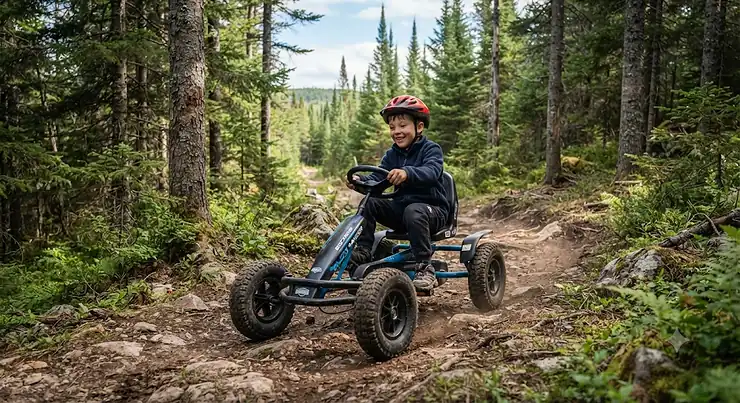
Grass that grows sideways. Gopher holes that swallow a wheel whole. A gravel driveway that chews up cheap plastic tires like it’s got a personal vendetta. If you live somewhere with actual terrain — not a smooth suburban cul-de-sac, but a real rural yard — you already know that most pedal karts sold online were designed for a driveway in a subdivision, not for your acreage. An off-road pedal go-kart changes that equation. Built with pneumatic or reinforced all-terrain tires, wider wheelbases, and frames that shrug off bumps instead of buckling under them, these karts are meant for exactly the kind of lumpy, root-strewn, mud-splattered ground that stops a standard model dead in the first five metres.
This guide breaks down the top rated off-road pedal karts for uneven yards on the Canadian market right now, based on real specs, real aggregated review sentiment, and honest side-by-side comparison — not marketing copy dressed up as advice. We’ll walk through seven genuine products spanning budget to premium, explain what rugged build actually means when the rubber meets the dirt, and help you figure out which kart survives a summer on rural yards instead of becoming a driveway ornament by July.
What is an off-road pedal go-kart? It’s a human-powered, four-wheeled ride-on vehicle built with reinforced frames, wider stance, and pneumatic or thick-tread tires designed to handle grass, gravel, and uneven ground — as opposed to standard pedal karts, which use narrow EVA foam tires meant strictly for pavement.
Quick Comparison Table
| Kart | Tire Type | Best For | Price Range (CAD) |
|---|---|---|---|
| BERG XL X-Plore BFR | Full pneumatic, chunky off-road tread | Serious rural terrain, teens/adults | C$900-C$1,100 range |
| BERG Buddy Lua | Pneumatic front & rear | Ages 4-8, growing farm kids | C$400-C$500 range |
| BERG Reppy Racer | Small pneumatic wheels | Toddlers 2.5-6, gentle grass | around C$300 |
| hauck Sirocco | Low-profile rubber, 8-spoke rim | Budget hard-pack yards | under C$250 |
| Costzon 4-Wheel Off-Road Pedal Kart | EVA rubber, wide tread | Budget-conscious families | C$150-C$220 range |
| HONEY JOY Quad Off-Road Pedal Kart | EVA rubber, knobby pattern | Small kids, light off-road | under C$200 |
| DORTALA Off-Road Pedal Kart | EVA rubber, adjustable seat | Mixed-terrain backyards | C$160-C$230 range |
Looking at the spread above, the pattern is pretty clear: pneumatic (air-filled) tires cluster at the top of the price range because that rubber-and-air construction genuinely absorbs bumps rather than just riding over them. The EVA foam-tired models at the bottom are lighter on the wallet but trade away suspension comfort on rough ground. If your “uneven yard” means the occasional gopher mound in otherwise mowed grass, EVA can work fine; if it means a genuine rural yards situation with ruts, roots, and gravel, the pneumatic-tired options earn their premium fast.
💬 Just one click — help others make better buying decisions too!😊
Top 7 Off-Road Pedal Go-Karts: Expert Analysis
1. BERG XL X-Plore BFR — biggest tires in this roundup, built for real acreage
The oversized, chunky pneumatic tires on this kart are the first thing you notice, and they’re not just for looks. Berg specifically engineers the X-Plore line with deep-tread air tires because, as the company explains on its own site, off-road tread is deep enough to grip rough terrain while flatter “slick” tires are meant for pavement. That distinction matters enormously on rural yards where a narrow-tread tire will simply spin out on wet grass or sink into soft dirt.
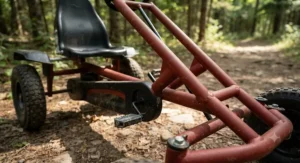
Key specs with real-world meaning: the frame uses a swing axle, which lets each wheel move somewhat independently over bumps instead of forcing the whole chassis to twist — this is the difference between a jarring ride and a smooth one when you cross a rut. The BFR (Brake-Freewheel-Reverse) hub lets riders coast without pedalling and reverse by back-pedalling, which sounds like a small thing until a kid is trying to back out of a ditch on a slope. Berg rates this frame for a wide age and height range thanks to the adjustable seat, which is a genuine cost-saver since you’re not buying a new kart every two years.
Who should buy this: families with genuine acreage — pasture, orchard rows, long gravel driveways — where a standard pedal kart would bog down within the first ten metres. Casual backyard users on flat, mowed lawns don’t need this much kart; the extra cost buys capability you won’t use on smooth ground.
Reviewers of Berg’s larger pedal karts consistently mention the steering feels notably lighter than expected thanks to the double ball-bearing steering mechanism, and multiple owners note the swing axle noticeably smooths out rutted ground compared to rigid-axle competitors. The main recurring caution in aggregated feedback is that assembly takes real tools and roughly 45-60 minutes, so budget the time before the big reveal.
Pros:
- ✅ Chunky pneumatic tires built specifically for rough terrain
- ✅ Swing axle noticeably smooths out rutted, uneven ground
- ✅ BFR hub allows coasting and reverse via back-pedalling
Cons:
- ❌ Highest price point in this roundup
- ❌ Assembly is more involved than budget alternatives
Price sits in the C$900-C$1,100 range at the time of research, which is a real investment — but for a kart that’s genuinely built to handle rural yards for years across multiple kids, the cost-per-use math works out favourably compared to replacing a cheaper kart annually.
2. BERG Buddy Lua — pneumatic comfort at a mid-range price
The standout here is that Berg brings its pneumatic-tire comfort down to a friendlier price bracket without gutting the build quality. Front and rear air-filled tires mean this kart actually absorbs small bumps — pebbles, root ridges, the odd toy left in the grass — rather than transmitting every jolt straight to the seat.
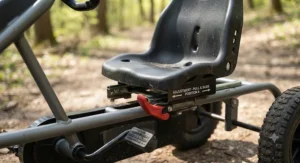
The adjustable seat accommodates a genuine growth window, roughly ages 4 through 8, which stretches the useful life of the purchase considerably. The freewheel function lets a tired kid coast downhill or across a slope without pedalling, a small feature that matters more on sloped rural yards than on flat driveways. Berg’s own age-and-length guide notes their karts are tested for ergonomic fit across that range, so sizing surprises are less likely than with generic import brands.
This is the kart for parents who want genuine off-road capability — not just a marketing label — but don’t need the largest, priciest frame in the lineup. Based on the spec comparison against the budget EVA-tired models further down this list, the pneumatic tires alone justify roughly double the price if your yard has any meaningful texture to it.
Aggregated reviewer sentiment on Berg’s mid-size pedal karts points to consistent praise for build sturdiness and steering precision, with occasional notes that taller kids near the top of the age range find the pedal reach gets snug before they fully age out of it.
Pros:
- ✅ True pneumatic front and rear tires at mid-range pricing
- ✅ Adjustable seat spans a genuine multi-year growth window
- ✅ Freewheel coasting eases pedalling on slopes
Cons:
- ❌ Taller kids may outgrow pedal reach before seat adjustment runs out
- ❌ Costs meaningfully more than EVA-tired competitors
Expect a price in the C$400-C$500 range, positioning it as the sweet spot between the budget EVA karts and Berg’s flagship X-Plore.
3. BERG Reppy Racer — smallest footprint, gentlest introduction to off-road
The standout advantage is scale: this kart is purpose-built for the 2.5-to-6 age bracket, with a lower centre of gravity and a soundbox that turns pedalling into a game rather than a chore. Small pneumatic tires still give a noticeably softer ride on grass than the hard EVA tires found on comparably priced toddler karts.
At this size, “off-road” mostly means “won’t get defeated by a lumpy lawn” rather than serious acreage work — and that’s exactly the right expectation for the age group. The adjustable seat allows some growing room, though this remains fundamentally a toddler-scale kart rather than something that will last into the grade-school years.
Parents comparing entry-level pedal karts should weigh this against harder-wheeled toddler models: the pneumatic tires here add real ride comfort for a child just learning to steer and pedal simultaneously, which reduces the frustration of getting stuck on minor bumps. What most buyers overlook about small pneumatic-tire karts is that they also reduce noise on hard surfaces like a garage floor or concrete patio, since air tires damp vibration that hard plastic wheels transmit directly.
Reviewer sentiment on Berg’s entry-level pedal karts skews positive on durability for the price point, with the soundbox and playful styling frequently cited as a hit with younger riders, while a handful of reviews mention the kart feels appropriately sized only for the lower half of its stated age range.
Pros:
- ✅ Pneumatic tires smooth out minor bumps for new riders
- ✅ Low centre of gravity suits first-time pedallers
- ✅ Playful soundbox keeps toddlers engaged with pedalling
Cons:
- ❌ Limited useful lifespan before a child outgrows it
- ❌ Not built for serious acreage or steep terrain
Priced around C$300 at the time of research, this is a reasonable entry point for families wanting genuine pneumatic comfort without the acreage-grade price tag of the larger Berg models.
4. hauck Sirocco — budget rubber tires with a racing look
The standout feature is the low-profile rubber tire and eight-spoke rim styling, which gives this kart a genuine “racer” look at a fraction of the price of pneumatic-tired competitors. The auto-clutch, free-ride pedal system means there’s no separate clutch lever to fumble with — riders just pedal forward and the mechanism engages automatically.
Reviewers of the Sirocco frequently mention the rubber tires perform well on hard-packed dirt and short grass but lose some of that composure on genuinely soft or rutted ground, which lines up with the fact that these are solid rubber rather than air-filled tires. The steel tube frame with a powder-coat finish resists rust reasonably well, though several owners note storing it outdoors through wet seasons accelerates wear on the fasteners.
This is a strong pick for families whose “uneven yard” leans more toward hard-packed dirt paths and mildly bumpy lawns rather than deep ruts or gravel. One frequently cited real-world fix from owners: several reviewers mention swapping the stock front sprocket for a smaller one to make pedalling through grass noticeably easier for younger riders, a low-cost tweak worth knowing about before you buy replacement parts you don’t need.
Aggregated sentiment consistently highlights easy assembly — often well under 30 minutes — alongside occasional mentions that the hardware benefits from a re-tightening pass with sturdier bolts after the first few weeks of hard use.
Pros:
- ✅ Auto-clutch free-ride system needs no manual clutch
- ✅ Fast, tool-light assembly out of the box
- ✅ Racer-style low-profile tires and adjustable seat
Cons:
- ❌ Solid rubber tires give less cushioning than pneumatic
- ❌ Some hardware benefits from re-tightening after early use
At under C$250, the Sirocco delivers a lot of visual polish and decent hard-pack performance for buyers who don’t need full pneumatic suspension.
5. Costzon 4-Wheel Off-Ral Koad Pedart — budget EVA build with genuine wide tread
The standout here is tread width relative to price: Costzon’s EVA rubber tires are noticeably wider than typical entry-level pedal karts, which spreads weight over more surface area and reduces the chance of sinking into soft grass. The two-position adjustable bucket seat accommodates a real growth window without tools, a nice touch at this price tier.
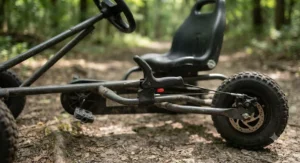
EVA (ethylene-vinyl acetate) foam tires never go flat, which is a genuine practical advantage on rural properties where a stray nail, thorn, or sharp gravel edge could otherwise end an afternoon with a pneumatic tire’s air leaking out. The trade-off, and it’s worth being honest about it, is that EVA tires transmit more bump impact than air-filled ones — you feel the ground more than you would on a Berg pneumatic model.
The handbrake and forward/backward gear lever give young riders genuine mechanical controls to learn on, which builds real coordination skills beyond just pedalling in a straight line. Based on the spec sheet, the steel-frame construction with polypropylene detailing is aimed squarely at durability without chasing a premium price tag.
Aggregated reviewer sentiment describes the kart as sturdy for its price bracket and praises the ease of assembly, while a recurring theme in feedback is that the ride firms up noticeably on rougher patches compared to pricier pneumatic-tired competitors — exactly what you’d expect from foam versus air tires.
Pros:
- ✅ Puncture-proof EVA tires with unusually wide tread
- ✅ Tool-free two-position adjustable seat
- ✅ Functional handbrake and gear lever for skill-building
Cons:
- ❌ Firmer ride than pneumatic-tired models on rough ground
- ❌ Less suspension comfort over deep ruts
In the C$150-C$220 range, this is one of the stronger value plays for families who want real off-road styling and wide tread without the pneumatic price premium.
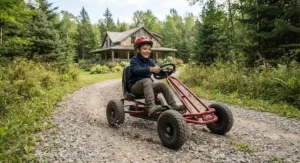
6. HONEY JOY Quad Off-Road Pedal Kart — knobby tread and a genuine clutch feature
The standout feature is the inclusion of an actual clutch mechanism alongside the pedal drive, letting kids engage and disengage the drivetrain the way a real vehicle would — a small detail that adds meaningful play value beyond simple pedal-and-go designs. The knobby EVA tread pattern is visually aggressive and does provide decent grip on grass compared to smoother budget tires.
What most buyers overlook about knobby-tread EVA tires is that the aggressive pattern helps more with grip than with cushioning — so this kart handles traction on grass and light gravel reasonably well, but riders will still feel bumps more than they would on a pneumatic-tired model. The dual safety brake system is a genuine plus for parents of younger riders still building coordination, offering redundancy if one brake input is missed.
This kart suits younger children in the early stages of outdoor pedal-kart use, where the appeal of engaging a “clutch” and steering around the yard outweighs the need for serious rough-terrain suspension. Families with truly bumpy rural yards should treat this as a starter option rather than the long-term solution.
Aggregated review sentiment frequently praises the value for money and the novelty of the clutch feature for young drivers, while some feedback notes the plastic detailing feels less substantial than the metal-frame competitors in this list.
Pros:
- ✅ Working clutch mechanism adds genuine play value
- ✅ Knobby tread grips grass better than smooth budget tires
- ✅ Dual brake system adds a safety redundancy layer
Cons:
- ❌ Less structural heft than steel-frame competitors
- ❌ Firm ride on genuinely rutted or rocky ground
Typically found under C$200, this is a reasonable pick for younger kids where novelty features and light off-road grip matter more than heavy-duty suspension.
7. DORTALA Off-Road Pedal Kart — balanced all-rounder for mixed terrain
The standout feature is genuine balance: DORTALA doesn’t lean hard into any one specialty, but delivers a two-position adjustable bucket seat, safety brakes, and wide EVA rubber tires in one reasonably priced package that handles mixed terrain — part lawn, part gravel path, part hard-packed dirt — without excelling or failing badly at any of it.
The steel-and-polypropylene build follows the same durability logic as other budget entries on this list: metal frame for structural integrity, plastic detailing to keep weight and cost down. The wide EVA tires resist punctures entirely, a genuine advantage on properties with thorny brush or loose gravel where a pneumatic tire would be more vulnerable.
This kart is a sensible pick for families whose rural yards aren’t uniformly rough — a mix of mowed lawn, a gravel turnaround, and maybe a dirt path to a barn or shed — where a kart doesn’t need to specialize in deep-rut performance but does need to handle variety without complaint. Based on the spec comparison against the Costzon and HONEY JOY models above, DORTALA sits in a similar tier with slightly different styling and seat ergonomics, so the choice often comes down to fit and colour preference as much as capability.
Aggregated customer sentiment on similar DORTALA ride-on models points to straightforward assembly and solid value, with occasional notes that the plastic steering wheel components feel less premium than the metal-and-rubber steering assemblies on pricier pneumatic karts.
Pros:
- ✅ Balanced performance across mixed lawn, gravel, and dirt
- ✅ Puncture-proof wide EVA tires suit brushy properties
- ✅ Two-position adjustable seat with no tools required
Cons:
- ❌ Plastic steering components feel less premium than metal
- ❌ No single standout capability versus specialized competitors
Priced in the C$160-C$230 range, DORTALA is a solid, unremarkable-in-a-good-way choice for yards that don’t demand a specialist.
Practical Usage Guide: Setting Up and Maintaining Your Off-Road Pedal Kart
Getting a new kart right in the first 30 days sets the tone for the whole season, so it’s worth doing properly rather than rushing to the “ride now” part. Start by fully tightening every bolt after assembly, then re-check that same hardware after the first week of use — vibration from rough terrain loosens fasteners faster than on pavement, and this single habit prevents most of the rattling and wobble owners complain about. If your kart has pneumatic tires, check pressure monthly using a standard bike pump gauge; underinflated air tires bog down in soft grass and wear unevenly on gravel.
For EVA-tired models, periodically hose off packed mud and grass clippings from the wheel wells, since debris buildup around the axle is the most common cause of a suddenly “sluggish” pedal feel that owners mistake for a mechanical fault. Store the kart under cover when possible — a tarp or shed corner works fine — because UV exposure and moisture are the two biggest long-term threats to both the frame’s paint and any exposed steering linkages, regardless of tire type. A common first-30-days mistake is over-tightening the seat adjustment mechanism, which can strip the plastic locking tabs on budget models; snug is sufficient, and forcing it rarely improves the fit.
Real-World Scenario: Which Off-Road Pedal Kart Fits Your Family?
If you’re a family on five acres with a mowed yard, a gravel driveway, and a path down to a pond, the BERG XL X-Plore BFR is the realistic answer — its chunky pneumatic tires and swing axle are engineered for exactly that terrain variety, and the higher upfront cost pays off across years of genuinely rough use rather than months.
If you’re a suburban-adjacent family with a slightly bumpy backyard, a couple of kids aged 4 to 8, and a budget that needs to stretch, the BERG Buddy Lua or Costzon 4-Wheel Off-Road Pedal Kart both make sense depending on whether pneumatic comfort or puncture-proof EVA tires matter more to you — the Buddy Lua for smoother rides on real bumps, the Costzon for worry-free tires around thorny brush or nails in an older barn.
If you’re a grandparent buying for a toddler who visits on weekends and mostly plays on grass that’s a little uneven but not genuinely rough, the BERG Reppy Racer or HONEY JOY Quad Off-Road Pedal Kart cover that lighter-duty need without overspending on capability the child won’t use for years.
How to Choose an Off-Road Pedal Go-Kart
- Match tire type to your actual terrain. Pneumatic tires win on comfort over ruts and roots; puncture-proof EVA tires win on properties with thorns, nails, or sharp gravel where a flat would be a real risk.
- Check the age and height range against your child’s growth trajectory, not just their current size — an adjustable seat that spans several years saves a repurchase down the road.
- Look at the axle design. A swing axle handles uneven ground more gracefully than a rigid axle, which matters more the rougher your yard gets.
- Weigh frame material honestly. Steel-tube frames generally outlast composite or heavily plastic frames under sustained rough-terrain stress.
- Confirm brake type suits the rider’s age. Handbrakes require more hand strength and coordination than pedal-brake or BFR systems, which matters for younger children.
- Factor in assembly time and tools required, especially for larger premium karts, so the big reveal isn’t derailed by a missing Allen key.
- Set a realistic price range around your actual terrain needs rather than the highest-spec option available — a toddler on mowed grass doesn’t need acreage-grade suspension.
Common Mistakes When Buying an Off-Road Pedal Kart
The single most common mistake is buying based on marketing language rather than tire construction — plenty of budget listings use “off-road” and “all-terrain” in the title while shipping standard EVA foam tires with a slightly knobby pattern, which is a real but modest upgrade over smooth tires, not a genuine rough-terrain solution. Reading the actual tire material (pneumatic/air versus EVA foam versus solid rubber) tells you far more than the marketing copy does.
A second frequent error is under-buying on age range for a growing family, which forces a repurchase within a year or two. Since Berg and similar manufacturers explicitly test and rate their karts across specific age and height windows, checking that range against your child’s growth curve — not just their current age — avoids this trap. A third mistake is ignoring axle design entirely; a rigid axle on a genuinely rutted rural yard will produce a noticeably harsher, twitchier ride than a swing axle, regardless of how good the tires are.
Off-Road Pedal Karts vs Traditional Pavement Karts
The core difference comes down to tire construction and axle geometry, and it shows up immediately once you leave pavement. Traditional pedal karts use narrow, hard EVA or solid-rubber tires optimized for smooth, low-friction rolling on driveways and sidewalks — efficient there, but prone to getting stuck, bouncing harshly, or losing traction the moment the ground gets soft, bumpy, or loose. Off-road models widen the tire footprint, often switch to pneumatic construction, and frequently add a swing or independent-feeling axle specifically to keep all four wheels in reasonable contact with uneven ground.
| Feature | Traditional Pavement Kart | Off-Road Pedal Kart |
|---|---|---|
| Tire type | Narrow EVA or hard rubber | Wide EVA, solid rubber, or pneumatic |
| Axle | Usually rigid | Often swing axle |
| Best surface | Pavement, driveways | Grass, gravel, dirt, rural yards |
| Typical price | Lower | Moderate to higher |
Interpreting that table honestly: a pavement kart on a bumpy rural yard isn’t just less comfortable — it can genuinely get stuck or tip more easily on side-slopes, which is a real safety consideration, not just a comfort one. The extra cost of an off-road build buys both performance and a meaningful reduction in that risk on textured ground.
✨ Don’t Miss These Exclusive Deals! 🔍
Take your outdoor play setup to the next level with these carefully selected off-road pedal karts. Click on any highlighted item to check current pricing and availability. These rugged rides will help you create authentic outdoor adventures your family will love!
What to Expect: Real-World Performance on Uneven Ground
Specs on a page don’t tell you what it actually feels like to pedal across a lumpy pasture, so here’s the translation. On a pneumatic-tired kart like the BERG XL X-Plore BFR or BERG Buddy Lua, small bumps — root ridges, gopher mounds, gravel — get noticeably absorbed rather than transmitted straight up through the seat; riders describe it as a “softer,” more forgiving ride, closer to a mountain bike than a toy. On EVA-tired models like the Costzon, HONEY JOY, and DORTALA karts, that same terrain produces a firmer, choppier ride — you feel more of what’s under the wheels, though the wider tread on models like Costzon’s does meaningfully improve traction over narrower budget tires.
Steering response also shifts with terrain: on loose gravel, karts with double ball-bearing steering (as on the Berg lineup) stay noticeably more predictable, while cheaper steering linkages can feel vague or require more correction. Slopes matter too — a kart with a freewheel or BFR system lets a rider coast down a grade without frantic pedalling, which is both more fun and, frankly, safer than a fixed-gear setup where the pedals keep spinning whether the rider wants them to or not.
Long-Term Cost & Maintenance: What Ownership Actually Looks Like
Looking at total cost of ownership rather than sticker price changes the math on these karts considerably. A budget EVA-tired kart in the C$150-C$220 range has essentially zero ongoing tire cost since foam tires don’t puncture or need inflation — but the trade-off is that the overall frame and plastic components on entry-level models tend to show wear faster under sustained rough-terrain use, sometimes shortening the kart’s useful life to a season or two of heavy off-road use.
A pneumatic-tired kart in the C$400-C$1,100 range carries a small ongoing maintenance cost — occasional inflation, and eventually a tube or tire replacement if punctured — but the steel-frame construction and more robust hardware on models like the Berg lineup generally outlasts budget alternatives by a wide margin, particularly when the kart gets handed down between siblings. Cost-per-year, a premium pneumatic kart used across three or four seasons and two children often ends up cheaper than replacing two or three budget karts over the same span, even though the upfront number looks larger.
Safety, Regulations, and Compliance for Ride-On Toys in Canada
Ride-on toys sold in Canada, including pedal go-karts, fall under the Canada Consumer Product Safety Act and the associated Toys Regulations, which set requirements addressing mechanical, structural, and other hazards for children’s products. Health Canada’s guidance for industry outlines the mechanical hazard testing manufacturers are expected to meet before these products reach store shelves, which is worth knowing if you’re comparing a well-known brand against an unfamiliar import.
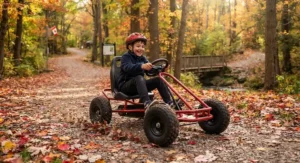
Beyond the regulatory baseline, practical safety still comes down to supervision and site choice. Health Canada’s consumer safety materials note that a child on a wheeled ride-on toy can move quickly and should be kept away from hazards like driveways with vehicle traffic, ditches, or steep unguarded slopes. On rural properties specifically, that means checking a planned riding area for holes, low-hanging branches, and any standing water or wells before letting a child loose with a new off-road kart. A helmet, while not always legally mandated for pedal-only karts, is a sensible addition given the higher speeds and uneven footing these vehicles are designed to handle.
Features That Actually Matter (And Those That Don’t)
Tire construction matters enormously — it’s the single biggest driver of how a kart handles rural yards, full stop. Axle design matters almost as much, since a swing axle versus a rigid axle changes the ride quality dramatically on rough ground. Adjustable seating matters for value, since it extends the useful ownership window across a child’s growth.
What matters less than the marketing suggests: top-end styling extras like sound effects or elaborate paint jobs affect how excited a kid is on day one but have zero bearing on how the kart performs three months into a rutted, muddy spring. Similarly, high seat counts (some multi-passenger karts exist) sound appealing but often come at the cost of manoeuvrability on genuinely uneven ground, where a single, well-balanced rider setup tends to handle better.
Off-Road Pedal Karts for Rural and Acreage Families
Families dealing with genuine acreage — pasture, long driveways, tree-lined paths — should prioritize the pneumatic-tired, swing-axle end of this list, specifically the BERG XL X-Plore BFR or BERG Buddy Lua, since these are the two builds genuinely engineered for sustained rough-terrain use rather than occasional bumps. Statistics Canada’s research on outdoor time and physical activity has found that Canadian children who spend more time outdoors show measurable benefits in peer relationships and activity levels, which makes a genuinely capable outdoor toy — one that doesn’t get abandoned after getting stuck in a rut twice — a worthwhile investment rather than an impulse buy.
Rural families should also factor in seasonal storage: a shed or covered porch protects both frame and tires from the freeze-thaw cycles that accelerate rust and cracking, extending the kart’s working life by a meaningful margin compared to leaving it exposed year-round.
Buyer’s Decision Framework
If your yard has ruts, roots, or a genuine grade change, choose a pneumatic-tired model because air tires absorb impact that foam tires simply transmit. If your property has thorny brush, loose nails, or sharp gravel, choose a puncture-proof EVA-tired model because a flat pneumatic tire mid-summer is a genuine inconvenience. If you’re outfitting a toddler for light backyard use, choose a smaller-scale kart like the BERG Reppy Racer rather than overspending on acreage-grade capability a small child won’t exploit. If you’re buying for a family that will hand the kart down between two or three kids over several years, weigh the higher upfront cost of a steel-frame pneumatic model against the total cost of replacing a budget kart multiple times.
Frequently Asked Questions
❓ What tires are best for an off-road pedal go-kart on grass?
❓ Are off-road pedal go-karts safe for rural yards?
❓ How much does a good off-road pedal kart cost in Canada?
❓ What age is appropriate for an off-road pedal go-kart?
❓ Do off-road pedal karts need much maintenance?
Conclusion
Choosing the right off-road pedal go-kart really comes down to being honest about your terrain rather than chasing the flashiest listing. A rural yard with genuine ruts and slopes rewards the extra investment in a pneumatic-tired, swing-axle build like the BERG XL X-Plore BFR; a moderately bumpy backyard does perfectly well with a wide-tread EVA model like the Costzon or DORTALA; and a toddler just learning to pedal doesn’t need acreage-grade capability at all. What all seven picks in this guide share is a genuine rugged build — reinforced frames, wider tread, and features specifically chosen to handle uneven ground rather than just look tough in a product photo. Match the kart to the terrain, check the age range against your child’s growth curve, and you’ll get years of actual outdoor use instead of a driveway ornament by August.
Recommended for You
- 7 Best Two-Seater Pedal Go-Karts for Siblings in 2026
- 7 Best Pedal Go-Karts for Kids in 2026 (Backyard Tested Picks)
- Best Pedal Tractor Picks for Outdoor Play in 2026
Disclaimer: This article contains affiliate links. As an Amazon Associate, I earn from qualifying purchases. If you purchase products through these links, we may earn a small commission at no additional cost to you.
✨ Found this helpful? Share it with your friends! 💬🤗
