In This Article
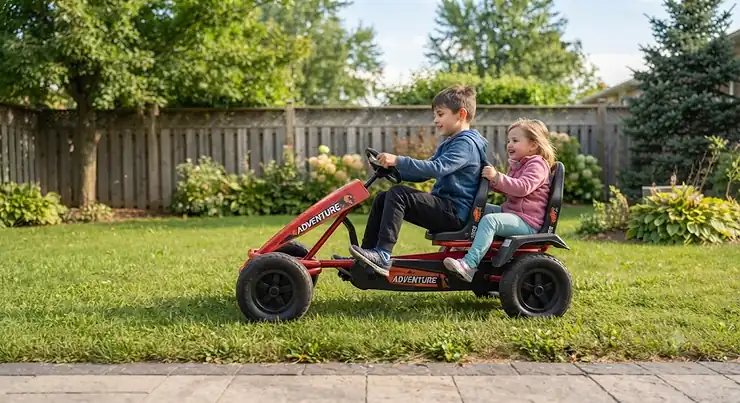
A two-seater pedal go-kart for siblings solves a very specific kind of chaos: the driveway standoff where two kids want the same ride-on toy at the same time. You know the scene. One kid is already pedaling away, the other is standing there with arms crossed, and somehow this always happens five minutes before you need to leave for soccer practice. A tandem kart — one where both kids climb into the same frame — turns that standoff into a shared adventure instead of a tug-of-war.
At the time of research, the Canadian market for these karts splits into two honest categories: purpose-built tandem frames with two real seats, and popular single-seat Berg karts paired with an official passenger accessory that lets a younger sibling ride along. Both routes genuinely work for sibling play, and which one fits your driveway depends on the age gap, budget, and how much storage space you’re willing to give up in the garage.
In practice, a two-seater pedal go-kart is a four-wheeled, pedal-powered ride-on vehicle built to carry two children at once, either through a shared bench-style seat or a driver’s seat plus a rear passenger position, typically rated for riders between roughly 2.5 and 12 years old depending on the model. Unlike a scooter or a single-seat kart, the whole point is cooperative play — one kid usually pedals while the other rides, or they trade off — which is exactly why families with siblings close in age keep searching for one. Health Canada’s consumer safety guidance on children’s play equipment is a useful starting point before any ride-on toy purchase, since it outlines what parents should check for age-appropriateness and supervision regardless of brand.
Whether you land on a true built-in tandem or a single-seat kart with a passenger add-on, the right two-seater pedal go-kart for siblings is the one matched to both kids’ ages, not just the older one’s. This guide covers seven real, currently available products — from a C$200 toddler starter kart to a commercial-grade tandem frame pushing C$3,400 — with honest analysis of specs, aggregated review themes, and exactly which sibling pairing each one suits best.
Quick Comparison Table: Top Picks at a Glance
Before digging into the full lineup, here’s the short version for parents who want the highlights without scrolling through seven detailed write-ups.
| Kart | Age Range | Seating | Price Range (CAD) | Best For |
|---|---|---|---|---|
| BERG Buzzy Aero | 2.5–5 years | Single seat + optional tow trailer | Around C$220–C$280 | Budget starter for toddlers |
| BERG Reppy Rider | 2.5–6 years | Single seat + rear standing step | C$300–C$380 range | Preschool siblings close in age |
| BERG Toys Buddy Fendt Go-Kart | 3–8 years | Single seat, passenger seat sold separately | C$430–C$540 range | Adding a bolt-on second seat later |
| BERG Duo Chopper BF | 5+ years | True two-seat, removable co-rider seat | C$1,450–C$1,700 range | Growing siblings sharing one frame |
| BERG Duo Coaster BFR | 6+ years | True two-seat, commercial-grade | C$3,100–C$3,400 range | Families wanting a premium, heavy-use tandem kart |
Looking at this table, the split is obvious: three of the five are single-seat karts from Berg’s Buddy and Reppy platforms that become sibling-friendly through an add-on trailer or step, while the BERG Duo Chopper BF and BERG Duo Coaster BFR are genuine built-in two-seaters. Budget-conscious families land on the left side of this table; families who want zero assembly compromises and don’t mind paying for it land on the right. Either path is legitimate, and which one wins mostly comes down to how far apart your kids are in age.
💬 Just one click — help others make better buying decisions too!😊
Single Rider vs Two Seater Pedal Go-Kart: Which Should You Buy?
This is the question that actually decides your purchase, so it deserves more than a quick table row. A single rider vs two seater pedal go-kart decision usually comes down to three factors: the age gap between your kids, how often they’ll ride together versus solo, and your available storage space.
If your children are more than three years apart in age, a single-seat kart with an add-on passenger accessory — like the official Berg trailer or passenger seat compatible with the BERG Toys Buddy Fendt Go-Kart and BERG Choppy Neo — tends to work better in practice. The younger child rides passively while the older one pedals, and you’re not asking a four-year-old to match pedal cadence with an eight-year-old. Based on the spec comparison, these accessory-based setups also cost noticeably less upfront, since you’re buying one kart plus a trailer rather than a purpose-built dual-seat frame.
If your kids are within two years of each other, a true two-seater like the BERG Duo Chopper BF or BERG Duo Coaster BFR makes more sense. Both seats are built into one rigid frame, both kids can pedal (the Duo Chopper’s co-rider seat is removable for a standing position, letting the second child help push), and the weight rating — up to 100 kg total on the Duo Chopper — comfortably covers two kids in a similar size range. What most buyers overlook here is that a dedicated two-seater also solves the “who gets to drive” argument more permanently, since the driver’s seat position is fixed and taking turns is a simple swap rather than a full toy handoff.
Top 7 Two-Seater Pedal Go-Karts for Siblings: Expert Analysis
Here’s the full lineup, ranked from most budget-friendly to premium commercial-grade, with honest commentary on where each one fits into a sibling household.
1. BERG Buzzy Aero — best budget starter for toddler siblings
The standout here is the EVA foam tires, which never go flat and need zero maintenance — a genuinely practical feature when a toddler is dragging this thing across a gravel driveway. The direct-drive pedal system has no gears and no chain, which keeps the learning curve low for kids around two and a half to five years old, and Berg’s swing-axle suspension keeps all four wheels planted on uneven backyard terrain rather than tipping on a curb.
Based on the spec comparison against pricier Berg karts, the Buzzy Aero is intentionally the entry point of the lineup: it’s a single-seat kart, so sibling play here means pairing it with Berg’s official Trailer S accessory (sold separately, with its own tow bar) so a younger brother or sister can ride behind rather than walk. Reviewers across major retailers consistently flag the tool-free seat adjustment and puncture-proof tires as the standout points, while a recurring theme in aggregated feedback is that the trailer accessory isn’t included and needs to be ordered on its own to make this a true sibling setup.
Pros:
- ✅ EVA foam tires never go flat or need air
- ✅ No-gear direct drive suits first-time toddler riders
- ✅ Compact frame fits small driveways and patios
Cons:
- ❌ Sibling trailer accessory is sold separately
- ❌ Weight allowance suits only the smallest of siblings
Price sits around C$220–C$280 at the time of research, and for a first pedal toy shared between toddlers via the trailer add-on, it’s a genuinely reasonable entry point.
2. BERG Reppy Rider — best all-rounder for preschool siblings
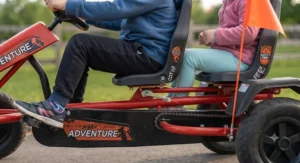
The standout feature is the tool-free adjustable bucket seat, which slides to fit riders as they grow without a single screwdriver — something parents juggling two kids of slightly different heights will appreciate immediately. The swing-axle suspension and EVA tires carry over from the Buzzy line, and the direct-drive pedal system means there’s no chain to lube or gears to strip.
Here’s what to weigh: Berg lists this kart for roughly ages 2.5 to 6, with a maximum rider weight around 40 kg (88 lb), which comfortably fits two closely-aged preschoolers taking turns rather than one bigger and one much smaller sibling. The rear of the frame also has a small standing step, so a sibling can hop on for a short ride while the other pedals — not a full second seat, but a genuinely useful built-in feature this price tier doesn’t always include. Aggregated review sentiment across retailer sites points to the seat comfort and stable ride as consistent strengths, with occasional comments about the plastic body panels feeling less substantial than the metal-frame Buddy series.
Pros:
- ✅ Tool-free adjustable seat grows with the child
- ✅ Rear standing step lets a sibling hop on for short rides
- ✅ Swing-axle suspension handles uneven ground smoothly
Cons:
- ❌ Standing step isn’t a true second seat for long rides
- ❌ Plastic components feel less premium than metal-frame Berg karts
Expect to pay in the C$300–C$380 range, which is honestly one of the better value plays here for families with two kids under six.
3. BERG Reppy Rebel — best for imaginative play with sound effects
The standout is the built-in soundbox, which adds four different engine, acceleration, and braking sound effects — a small detail that reviewers consistently mention makes a real difference in how long younger kids stay engaged with pedaling rather than asking to be pushed. It shares the same rugged swing-axle chassis and EVA tires as the Reppy Rider, so the ride quality and durability are essentially identical.
What most buyers overlook about this model is that it’s really the Reppy Rider with a personality upgrade rather than a mechanically different kart — same 2.5 to 6 age range, same roughly 40 kg weight ceiling, same direct-drive pedals. For sibling households, that means the Rebel and Rider pair up nicely as matching-but-different karts for two similarly aged kids, letting each pick their own colour and sound profile instead of fighting over one toy. Aggregated feedback across retailers flags the soundbox as a genuine hit with kids in the 3-5 range, while a common complaint is that the sound effects run through batteries faster than parents expect.
Pros:
- ✅ Built-in soundbox adds engine and brake sound effects
- ✅ Identical rugged chassis and EVA tires to the Reppy Rider
- ✅ Direct-drive pedals need no chain maintenance
Cons:
- ❌ Soundbox batteries reportedly drain faster than expected
- ❌ Same weight ceiling as the Reppy Rider limits use for older kids
Price runs close to the Rider, generally in the C$310–C$390 range, and pairing one Rider with one Rebel is a popular way to give siblings their own kart without spending on a full tandem frame.
4. BERG Toys Buddy Fendt Go-Kart — best platform for adding an official passenger seat
The standout advantage is the wider Buddy-series frame, which is specifically built to accept Berg’s official passenger seat and trailer accessories — turning what starts as a single-seat kart into a genuine two-child setup down the line. The Fendt tractor-branded colourway rides on the same steel-reinforced platform as the rest of the Buddy line, rated for kids roughly 3 to 8 years old.
Based on the spec comparison, this is the kart to buy if you want to start with one child riding solo and add a sibling seat once budget allows, rather than committing to a full tandem frame upfront. The adjustable seat and steering column stretch to fit a wide age range, so it’s genuinely one kart that can serve an older sibling as primary rider while a younger one eventually joins via the passenger accessory. Reviewers consistently note the branded styling and steel frame hold up well to years of driveway use, though the heavier build (compared to the plastic Reppy line) makes it noticeably harder for a small child to push or steer uphill without pedaling.
Pros:
- ✅ Wider Buddy platform accepts an official passenger seat accessory
- ✅ Steel-reinforced frame built for years of daily use
- ✅ Adjustable seat and steering fit a 3–8 age range
Cons:
- ❌ Passenger seat accessory is an added cost, sold separately
- ❌ Heavier frame is harder for small drivers to push solo
At the time of research, pricing lands in the C$430–C$540 range for the base kart, with the passenger accessory adding to that total.
5. BERG Choppy Neo — best chopper-style pick with real pedal-brake control
The standout here is Berg’s BFR system, which lets the rider brake by pedaling backward and then reverse immediately from a standstill — a genuinely more advanced control scheme than the simple direct-drive of the Reppy and Buzzy lines. The single front-wheel chopper design and motorbike-style handlebars give it a distinct look that tends to appeal to kids aging out of toddler karts.
Here’s what the spec sheet won’t tell you outright: the BFR braking system has a real learning curve, so while it’s rated for the same 3-to-8 age range as the Buddy Fendt, younger siblings in that range may need a few sessions to get comfortable stopping with pedal-reverse instead of a simple hand brake. That said, once mastered, it teaches genuinely transferable go-kart control habits that carry over well to the larger Duo models later. Like the Buddy platform, the Choppy Neo is compatible with Berg’s passenger seat accessory line, so it follows the same single-kart-plus-add-on path to sibling use. Aggregated review themes point to the tight turning radius as a strong point for smaller yards, alongside some comments about the learning curve for younger riders.
Pros:
- ✅ BFR pedal-brake-reverse system teaches real go-kart control
- ✅ Single front-wheel design turns tightly in small yards
- ✅ Compatible with Berg’s official passenger seat accessory
Cons:
- ❌ BFR braking has a learning curve for younger siblings
- ❌ No built-in second seat; accessory required for sibling use
Expect a price in the C$480–C$600 range, positioning it just above the Buddy Fendt for families who want the more advanced braking system.
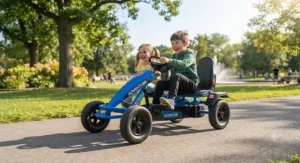
6. BERG Duo Chopper BF — best true two-seater for siblings sharing one frame
The standout feature is the honest one: this is a genuine built-in two-seater, not a single kart with an accessory bolted on. The co-rider seat sits behind the driver and is fully removable, converting into a standing platform so a sibling can either sit and ride or stand and help push, and the frame carries a combined weight rating up to 100 kg.
Based on the spec comparison, the triple braking system — coaster brake, hand brake, and parking brake — is a meaningful upgrade over anything in the single-seat Berg lineup, and it makes sense given two kids’ combined weight and momentum need more stopping power than one small rider ever would. The adjustable steering column and seat let the kart grow with both children over several years rather than being outgrown by the older sibling first. At roughly 170 x 106 x 99 cm and weighing close to 59 kg, this is a genuinely large piece of equipment, and Berg backs the frame with a 2-year warranty. Aggregated feedback across specialty go-kart retailers consistently praises the triple-brake stopping power and the tight turning circle for something this size, while the recurring caution is that it’s meaningfully heavier to move and store than any single-seat model on this list.
Pros:
- ✅ True built-in two-seat design purpose-built for siblings
- ✅ Triple braking system suited to two-rider combined weight
- ✅ Removable co-rider seat converts to a standing platform
Cons:
- ❌ Premium pricing puts it well above every single-seat Berg kart
- ❌ Nearly 59 kg frame makes storage and transport a two-person task
Pricing generally falls in the C$1,450–C$1,700 range at the time of research, reflecting its position as a genuine dual-seat vehicle rather than a converted single-seater.
7. BERG Duo Coaster BFR — best premium, commercial-grade tandem kart
The standout advantage is the commercial-grade build quality, evidenced by 18-inch all-terrain pneumatic tires and an integrated swing axle designed for higher-traffic use — think large families, farm properties, or shared community spaces rather than just an average backyard. The BFR pedal-brake-and-reverse system carries over from the Choppy Neo but is scaled up for two riders, letting the kart stop and back up smoothly even under combined weight.
On paper this means Berg built the Duo Coaster to survive the kind of daily, multi-child use that would wear out a lighter kart within a season. Reviewers and retailers alike note the extremely robust frame, and Berg also offers an E-BFR variant with a 250W electric mid-motor and torque sensor for families who want pedal-assist on inclines — a genuinely useful option if your property has any real grade to it. Rated from age six and up, it’s positioned as the top of this entire lineup, and the price reflects that positioning clearly. Aggregated sentiment from go-kart specialty retailers consistently highlights the all-terrain tires and smooth BFR reverse as standout points, with the main caution being that its size and weight make it a genuinely permanent backyard fixture rather than something you tuck away easily.
Pros:
- ✅ Commercial-grade frame built for heavy, frequent use
- ✅ 18-inch all-terrain pneumatic tires handle grass and gravel
- ✅ Optional E-BFR electric-assist variant helps on inclines
Cons:
- ❌ Highest price point in this entire roundup
- ❌ Large footprint requires significant dedicated storage space
Pricing lands around C$3,100–C$3,400 at the time of research, firmly positioning it as the splurge option for families who want zero compromises on a shared sibling kart.
Full Comparison Table: Specs, Price Range & Best For
| Product | Age Range | Weight Limit | Price Range (CAD) | Best For |
|---|---|---|---|---|
| BERG Buzzy Aero | 2.5–5 years | Suits smallest riders | C$220–C$280 | Toddler starter with optional trailer |
| BERG Reppy Rider | 2.5–6 years | ~40 kg (88 lb) | C$300–C$380 | Preschool siblings close in age |
| BERG Reppy Rebel | 2.5–6 years | ~40 kg (88 lb) | C$310–C$390 | Matching kart pairs for two kids |
| BERG Toys Buddy Fendt Go-Kart | 3–8 years | Steel-frame Buddy rating | C$430–C$540 | Adding an official passenger seat later |
| BERG Choppy Neo | 3–8 years | Steel-frame Buddy rating | C$480–C$600 | Advanced pedal-brake control |
| BERG Duo Chopper BF | 5+ years | Up to 100 kg combined | C$1,450–C$1,700 | True two-seat sibling sharing |
| BERG Duo Coaster BFR | 6+ years | Commercial-grade rating | C$3,100–C$3,400 | Premium, heavy-use tandem kart |
Reading across this table, the price jump between the Buddy-platform karts and the two Duo models is the single biggest decision point in this whole category — you’re paying roughly three to six times more for a built-in second seat versus an accessory-based one. The BERG Reppy Rider and BERG Reppy Rebel remain the sweet spot for households with two kids under six who don’t need a true tandem frame yet. Families with a wider age gap or a genuine need for two kids riding simultaneously should budget for the BERG Duo Chopper BF rather than trying to make a single-seat kart do a two-seater’s job.
Benefits of Tandem Karts vs Traditional Alternatives
| Option | Sibling Interaction | Price Range (CAD) | Best For |
|---|---|---|---|
| Two-seater pedal go-kart (Duo series) | Both kids ride together on one frame | C$1,450–C$3,400 | Close-in-age siblings, daily shared play |
| Single-seat kart + passenger trailer | One pedals, one rides passively | C$220–C$600 | Wider age gaps, budget-conscious families |
| Traditional wagon or tandem tricycle | Passive towing, no pedal cooperation | C$100–C$300 | Very young toddlers not ready to pedal |
| Two separate single-seat karts | Parallel play, not shared | C$400–C$1,200 (for two) | Kids who each want full independent control |
This table makes the trade-off explicit: a true tandem kart is the only option here where both children are actively participating in the same ride at the same time, which is exactly the “sibling play” experience most parents are actually shopping for. Buying two separate single-seat karts avoids any sharing conflict but also skips the cooperative element entirely, and it typically costs more in total than a single accessory-based setup. For families prioritizing genuine shared play over pure economy, the math tips toward the Duo series or a Buddy-platform kart with the passenger accessory rather than doubling up on single-seat karts.
How to Choose a Two-Seater Pedal Go-Kart for Siblings
Picking the right kart comes down to matching the product to your specific kids rather than chasing the highest-rated model in isolation. Here’s the process worth following, step by step.
- Measure the age and size gap between your children. A gap under two years usually favours a true two-seater like the Duo Chopper; a gap over three years usually favours a single-seat-plus-trailer setup.
- Check the combined weight rating against both kids’ current and near-future weight. Berg’s Duo Chopper rates up to 100 kg total, so don’t just check one child’s weight — check both, since kids grow fast.
- Confirm the age minimum matches your younger child, not just your older one. A kart rated 6+ isn’t the right first purchase if your younger sibling is three, even if the older one is old enough.
- Measure your actual storage space before buying a Duo model. At roughly 170 cm long and nearly 59 kg, these aren’t karts you casually tuck behind a shed door.
- Decide whether both kids need to pedal or if one riding passively is fine. This single decision is what separates the budget accessory route from the premium tandem route.
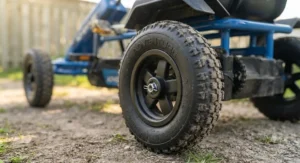
- Factor in surface type. Pneumatic tires (Duo series, Choppy Neo) handle gravel and grass better than the EVA foam tires on entry-level Buzzy and Reppy karts, which are better suited to smooth driveways.
- Set a total budget that includes accessories. A Buddy Fendt plus passenger seat can end up costing more than expected once the add-on is priced in separately.
Sibling Play: Real-World Scenarios and Case Studies
Consider a family with a five-year-old and a seven-year-old, roughly two years apart, both already confident walkers and used to sharing outdoor toys. For this pairing, the BERG Duo Chopper BF is the more sensible investment: both kids fall within its 5+ age rating, both fit comfortably within the combined 100 kg weight limit, and the removable co-rider seat lets them trade the standing-and-pushing role without needing a second purchase entirely.
Now consider a household with a two-year-old and a six-year-old — a four-year age gap that changes the calculus completely. Here, a BERG Reppy Rider or BERG Reppy Rebel for the older child, paired with the younger sibling riding along on a shorter session using the rear standing step, or a BERG Toys Buddy Fendt Go-Kart with its passenger seat accessory, makes more practical sense than forcing a toddler into a kart rated from age five or six.
A third scenario: a larger family with three kids spanning toddler to pre-teen, where budget stretches further than storage space. Here, staggering purchases — a BERG Buzzy Aero for the youngest now, with a BERG Duo Chopper BF added later once the two older kids are closer in riding ability — often works better than trying to solve every age range with a single product. If you’re the parent of kids who fight constantly over one ride-on toy but live in a smaller townhouse driveway, the case for prioritizing the Duo Chopper over the larger Duo Coaster becomes clear once you actually measure your available space.
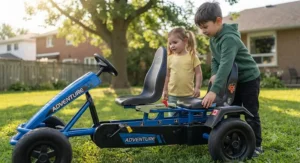
Practical Usage Guide: Setup, Safety Checks & Maintenance
Most Berg pedal karts arrive partially assembled, and the first 30 minutes matter more than people expect. Start by checking every bolt on the seat, steering column, and axle with the included tools before the first ride — shipping vibration can loosen fasteners even on a brand-new kart. For the Duo series specifically, test the co-rider seat’s locking mechanism before letting a second child climb on, since a loose connection here is the most common early complaint in aggregated feedback.
For ongoing maintenance, EVA foam tires (Buzzy, Reppy lines) need essentially no upkeep, but the pneumatic tires on the Choppy Neo and both Duo models should be checked monthly for proper inflation, especially after a Canadian winter in storage. Wipe down the swing axle and any exposed metal joints before long-term storage to prevent rust, particularly if the kart lives outside near coastal or humid regions. A common first-30-days mistake is skipping the seat and steering adjustment reset as kids grow — recheck sizing every few months rather than assuming a one-time setup lasts the whole ownership period. For the BFR-equipped Choppy Neo and Duo Coaster, spend one supervised session teaching the pedal-brake-reverse motion specifically, since kids coming from a simple coaster-brake kart often instinctively try to hand-brake instead.
Turning a Single-Seat Kart into a Two-Seater: The Trailer & Passenger-Seat Route
This is the section Amazon listings never quite spell out clearly, so it’s worth a dedicated look. Berg sells official accessories — a tow-behind trailer for the Buzzy platform, and a passenger seat for the wider Buddy and Choppy platforms — specifically designed to convert a single-seat kart into a genuine two-child setup without buying a full Duo frame.
The trade-offs are real and worth stating honestly. A tow-behind trailer means the passenger sibling rides but doesn’t pedal, which works well for a toddler too young to contribute anyway. A passenger seat bolted onto the Buddy or Choppy Neo frame sits the second child behind the driver in a fixed position, closer to true tandem riding but still not a shared-pedal setup like the Duo Chopper. If your main goal is solving the “only one of them can ride at a time” problem rather than getting both kids actively pedaling together, this accessory route is genuinely the more budget-sensible solution, often saving C$800 to C$1,000+ compared to jumping straight to a Duo model. The catch is compatibility: always confirm the specific accessory is rated for your exact kart model and current model year before ordering, since Berg’s platform generations have changed frame dimensions over time.
Common Mistakes When Buying a Two-Seater Pedal Go-Kart
The single most common mistake is buying based on the older child’s age and size while ignoring the younger sibling’s fit entirely — a kart rated 6+ with a heavy frame can genuinely intimidate or exclude a four-year-old who was supposed to be the co-rider. A second frequent error is underestimating storage space; the Duo Coaster‘s footprint surprises plenty of buyers who measured their patio but not the path to get it there.
Parents also commonly overlook the passenger accessory’s separate cost when budgeting for a Buddy-platform kart, only realizing after checkout that the add-on isn’t bundled in. Another honest pitfall: assuming EVA foam tires are fine for all terrain, when in practice they’re really built for smooth pavement and struggle on loose gravel or thick grass compared to the pneumatic tires on pricier models. Finally, skipping the weight-limit math for both kids combined — not just checking today’s weight but projecting six months to a year ahead — leads to karts being outgrown faster than expected, especially on the lighter single-seat frames.
Safety, Regulations & Compliance for Pedal Karts in Canada
Ride-on toys sold in Canada fall under Health Canada’s Canada Consumer Product Safety Act framework, and Health Canada’s industry guidance on children’s toy safety requirements outlines the structural, choking-hazard, and labelling standards manufacturers must meet before a product like a pedal kart reaches Canadian shelves or Amazon.ca. Practically speaking, this means age labelling on Berg karts isn’t just marketing — it reflects testing against these federal requirements, and it’s worth taking the age minimum seriously rather than assuming a mature younger sibling can skip ahead.
Beyond product-level compliance, supervision matters more than any spec sheet. The Canadian Paediatric Society’s position on outdoor risky play makes the case that supervised active outdoor play — including wheeled ride-on toys — carries real developmental benefits that outweigh manageable risk, provided a responsible adult is present and the equipment matches the child’s ability. For pedal karts specifically, that translates to a few concrete habits: ride on flat, enclosed areas away from driveways with car traffic, keep helmets on for anything beyond a slow walking pace (especially on the BFR-equipped models capable of more speed), and check the co-rider seat lock on Duo models before every ride, not just the first one.
Long-Term Cost & Maintenance
A budget Reppy Rider or Rebel at roughly C$300-C$390 carries almost no ongoing cost — EVA tires never need replacing, there’s no chain to lubricate, and the direct-drive system has few parts that wear out. Over a two-to-three-year ownership window before a child outgrows it, the effective cost per season lands well under C$150, which is hard to beat for genuine outdoor play value.
The Duo Chopper and Duo Coaster carry a much higher sticker price but also a much longer usable lifespan, since the adjustable frame and higher weight rating mean two children can realistically use the same kart for five-plus years as they grow, sometimes handed down to younger siblings or cousins afterward. Factor in occasional pneumatic tire maintenance (a spare tube or two over that period, generally under C$30 each) and the total cost of ownership on a per-year basis actually narrows the gap with the cheaper single-seat karts more than the upfront price suggests. Where the Duo models lose ground is resale value relative to purchase price in a niche market, and the passenger-seat accessory route sits in between — a moderate upfront cost with genuinely minimal upkeep afterward.
Family Outdoor Toys: Where Two-Seater Karts Fit In Your Backyard Lineup
A two-seater pedal go-kart isn’t meant to replace every other outdoor toy in rotation — it earns its place alongside bikes, scooters, and a backyard trampoline as the option specifically suited to cooperative, side-by-side play rather than solo speed or skill-building. Compared to a family activity like a shared wagon or a tandem tricycle, a pedal kart asks more of the kids physically, which is exactly the point for families trying to build actual leg strength and coordination rather than just passive towing.
CBC News coverage on the importance of unstructured outdoor play for Canadian kids reinforces why this category keeps growing: cooperative outdoor toys that get two kids moving together, rather than each staring at separate screens, remain one of the more reliable ways to fill unstructured after-school time. For larger families needing to seat more than two, it’s worth knowing that Berg also makes larger multi-seat family karts in its GranTour range, though those move into a different size and price bracket entirely and are worth researching separately if two seats genuinely isn’t enough.
Features That Actually Matter (And Those That Don’t)
Weight rating and age minimum matter enormously — they’re not just legal boilerplate, they determine whether your actual kids fit the actual product. Braking system matters too: the jump from a single coaster brake to Berg’s triple-brake Duo system is a genuine safety upgrade once two kids’ combined momentum is involved, not marketing fluff. Tire type matters for your specific terrain — pneumatic if you’ve got any grass or gravel, EVA foam if it’s all smooth driveway.
What matters less than the marketing suggests: exact top speed claims, since these are pedal-powered and realistically capped by a child’s leg strength regardless of what a listing implies. Colour-matched branding and licensed tie-ins (like the Fendt tractor styling) are genuinely just aesthetic — they don’t affect ride quality or durability one bit. And while a built-in soundbox is a nice touch for engagement, it’s not a functional safety or performance feature, so it shouldn’t be a tie-breaker between two otherwise similar karts if budget is tight.
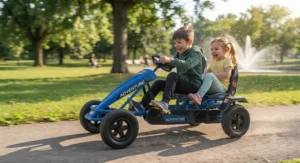
FAQ
❓ What age can kids start on a two-seater pedal go-kart?
❓ Is a two-seater pedal go-kart safer than two single-seat karts for siblings?
❓ How much does a two-seater pedal go-kart cost in Canada?
❓ Can one child pedal while the sibling just rides along?
❓ Do two-seater pedal go-karts work on grass and gravel driveways?
Conclusion
Choosing the right two-seater pedal go-kart for siblings really comes down to one honest question: do your kids need to ride together right now, or can one ride while the other rides along? For siblings within a couple of years of each other, the BERG Duo Chopper BF earns its price tag as a genuine two-seat solution built to grow with both kids for years. For wider age gaps or tighter budgets, pairing a BERG Reppy Rider or BERG Toys Buddy Fendt Go-Kart with an official passenger accessory solves the same sibling-sharing problem for a fraction of the cost.
Families wanting the absolute top of the category, with commercial-grade durability and an electric-assist option for hilly properties, should look at the BERG Duo Coaster BFR — just budget the storage space to match the price tag. And for the smallest siblings just starting out, the BERG Buzzy Aero and BERG Reppy Rebel remain sensible, low-maintenance entry points that won’t break the bank if a toddler loses interest after one summer.
Whichever route you choose, the underlying goal is the same: two kids, one shared outdoor toy, and a lot fewer driveway standoffs.
✨ Don’t miss these picks while current stock and pricing hold steady! 🔍
Take your family’s outdoor playtime to the next level with a kart matched to both your kids’ ages and your actual driveway space. Click through on any highlighted model above to check current pricing and availability before deciding.
Recommended for You
- 7 Best Pedal Go-Karts for Kids in 2026 (Backyard Tested Picks)
- Best Pedal Tractor Picks for Outdoor Play in 2026
- Pedal Tractor With Trailer: 7 Top Picks for Canadian Kids
Disclaimer: This article contains affiliate links. As an Amazon Associate, I earn from qualifying purchases. If you purchase products through these links, we may earn a small commission at no additional cost to you.
✨ Found this helpful? Share it with your friends! 💬🤗
