
In This Article
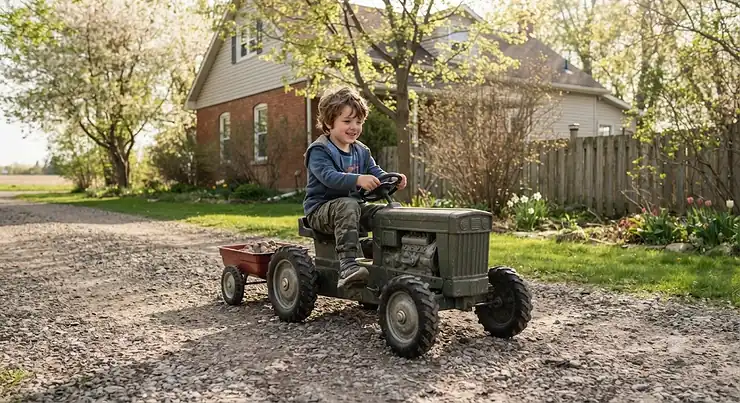
Somewhere between the sandbox and the actual riding lawnmower sits a machine that has quietly outlasted three generations of flashier toys: the pedal tractor. No batteries, no charging cable snaking across the patio, no dead motor two summers in. Just a chain, two pedals, and a kid who suddenly believes they’re hauling the whole harvest home. A pedal tractor for outdoor play is a child-powered, non-electric ride-on vehicle styled after a farm tractor, typically built from steel, reinforced plastic, or a hybrid of both, and designed to develop leg strength, steering coordination, and imaginative role-play in the backyard.
Here’s the thing nobody tells you at the toy aisle: not all pedal tractors are built the same, and the difference between a happy Saturday afternoon and a rusted-out disappointment by August often comes down to two things — what the frame is actually made of, and whether it matches the ground your kid is going to ride it on. Gravel driveway? Soggy backyard grass? Smooth basement floor for rainy days? Each terrain punishes a different design flaw.
We dug into seven real pedal tractors sold in Canada right now, pulled apart their specs, cross-referenced aggregated review sentiment, and weighed them against what actually matters once the toy leaves the box and meets a Canadian backyard. This isn’t a repackaged spec sheet. It’s the analysis you’d want from a friend who’s already read every one-star review so you don’t have to.
Quick Comparison Table
| Pedal Tractor | Build | Best For | Price Range (CAD) |
|---|---|---|---|
| Rolly Toys John Deere Pedal Tractor with Front Loader | Plastic body, steel chassis | All-around farm play, ages 3+ | C$320–C$420 |
| Rolly Toys John Deere Farmtrac Pedal Tractor | Plastic body, reinforced steel axle | Accessory expansion, ages 4+ | C$400–C$550 |
| John Deere 4440 Pedal Tractor | Full steel | Rough play, durability-first buyers | C$450–C$600 |
| Aosom Kids Ride-On Farm Tractor with Trailer | Metal frame, plastic shell | Budget-conscious toddler play | C$110–C$150 |
| Aosom Ride On Front Loader Tractor | Metal frame, plastic shell | Sandbox and bucket play | C$150–C$200 |
| Tricam 22″ Steel Ride-On Tractor Tricycle | Full steel | First-time toddler riders, ages 2-5 | under C$100 |
| Rolly Toys John Deere 3-Wheel Trac | Plastic body, steel axle | Retro styling, smaller yards | C$150–C$220 |
A few things jump out here before we even get into the weeds. Notice how price doesn’t track cleanly with build quality — the Tricam 22″ Steel Ride-On Tractor Tricycle is the cheapest option on this list and one of only two with a genuinely all-steel frame. Meanwhile, the plastic-bodied Rolly Toys John Deere Farmtrac Pedal Tractor commands a premium not because of what it’s made of, but because of what you can bolt onto it later. If your backyard is mostly flat lawn, the mid-tier options do the job; if you’re dealing with gravel, tree roots, or a sloped yard, lean toward the steel-frame entries.
💬 Just one click — help other golf parents make better buying decisions too!😊
Top 7 Pedal Tractors for Outdoor Play: Expert Analysis
1. Rolly Toys John Deere Pedal Tractor with Front Loader — best all-rounder for realistic farm play
The standout here is the working front loader, which sounds like a gimmick until you watch a four-year-old spend forty-five minutes scooping mulch instead of asking to go inside. This is a licensed John Deere design with a plastic body wrapped around a genuinely sturdy chassis: a 12mm-thick rear axle, a chain-driven pedal system with a tensioning mechanism (so the chain doesn’t go slack and skip after a few weeks), and a detachable rear trailer that turns the whole rig into a two-piece hauling unit. On paper, “chain-driven” and “12mm axle” don’t mean much, but in practice it means this tractor tolerates driveway curbs and backyard divots that would rattle apart a cheaper toy within a season. Based on the spec comparison against other licensed pedal tractors in this price bracket, the Rolly Toys John Deere Pedal Tractor with Front Loader earns its reputation as the safe default pick — it’s neither the cheapest nor the flashiest, but it rarely disappoints. Reviewers consistently report that the front loader lever mechanism holds up well over multiple seasons, though a handful note the plastic hood can crack if the tractor takes a hard fall down concrete steps — worth flagging if your yard has a steep entry point.
Pros:
- ✅ Working front loader adds genuine imaginative-play value
- ✅ 12mm rear axle handles rough terrain confidently
- ✅ Detachable trailer doubles as a hauling toy
Cons:
- ❌ Plastic hood can crack under hard impacts
- ❌ Assembly takes longer than most competitors here
At the time of research, this model sits in the C$320–C$420 range, and given the front loader plus trailer combo, it’s a fair value verdict for families who want one tractor to do double duty as a construction toy.
2. Rolly Toys John Deere Farmtrac Pedal Tractor — best for adding accessories over time
What sets this one apart is the front and rear hitch system, purpose-built so you can bolt on additional Rolly Toys accessories — trailers, ploughs, even a sandbox scoop — as your child’s interests evolve. The blow-molded seat adjusts across three positions, which matters more than it sounds like it should, because a tractor that fits a three-year-old and stops fitting them by five is a tractor you’re buying twice. Here’s what most buyers overlook about this model: the heavy-duty front axle includes actual suspension, a detail almost no other pedal tractor at this tier bothers with, and it’s the reason this tractor rides noticeably smoother over lumpy grass than its siblings. What the spec sheet won’t tell you, but user reports suggest, is that the hitch system is genuinely compatible across several accessory generations, so this isn’t a toy you outgrow so much as one you keep building onto. The trade-off is cost — this is one of the pricier picks here — and a few reviewers mention the accessories themselves are sold separately and add up quickly.
Pros:
- ✅ Modular hitch system for future accessory expansion
- ✅ Adjustable seat grows with your child for years
- ✅ Front suspension smooths out bumpy backyard rides
Cons:
- ❌ Premium price compared to similar plastic-bodied models
- ❌ Accessories sold separately, adding to total cost
Expect this one in the C$400–C$550 range at the time of research, and if you’re planning to expand the setup over multiple birthdays, the value case holds up better than the sticker price suggests.
3. John Deere 4440 Pedal Tractor — most authentic all-steel construction
This is the pedal tractor for the parent who grew up on an actual farm and wants their kid’s toy to reflect that heritage honestly — full steel construction, narrow front axle styling that echoes the real 4440 tractor line, and two-piece wheels built more like scale-model hardware than mass-market plastic. The steel build means this thing survives outdoor storage far better than plastic-bodied competitors; rain, temperature swings, and the odd rock underfoot don’t warp or crack steel the way they eventually stress plastic seams. Based on the spec comparison, this is less a toy and more a durable good — the kind of pedal tractor that could plausibly be handed down to a younger sibling or even a grandchild, provided it gets a wipe-down after wet play to prevent surface rust. Aggregated review sentiment for this style of collector-grade metal pedal tractor tends to split along two lines: enthusiasts who prize the authentic detailing and durability, and parents who find the ride slightly stiffer and heavier than a plastic model, since steel doesn’t flex the way moulded plastic does over uneven ground.
Pros:
- ✅ Full steel body resists warping and cracking outdoors
- ✅ Authentic scale detailing appeals to tractor enthusiasts
- ✅ Genuinely durable enough to hand down later
Cons:
- ❌ Heavier and stiffer ride than plastic alternatives
- ❌ Requires occasional rust prevention after wet play
This sits toward the top of our range at C$450–C$600, and for a family that wants one pedal tractor to last a decade, the value case is arguably the strongest on this list.
4. Aosom Kids Ride-On Farm Tractor with Trailer, Shovel & Rake — best budget pick for toddlers
The standout feature is simply the price-to-content ratio: for a fraction of what the John Deere-licensed options cost, you get a metal-framed tractor with a full accessory kit — trailer, shovel, and rake — right in the box. The frame itself is metal (rated to support up to 77 lbs), with a plastic body shell keeping the overall weight manageable for a small child to actually pedal. On paper, “77 lb weight capacity” sounds generous, and in practice it means this tractor comfortably outlasts the toddler stage and into early school years before a child physically outgrows the seat position. What most buyers overlook is that the four anti-slip wheels genuinely help on smooth patio or driveway surfaces, though they’re less forgiving on loose gravel where a bigger wheel would roll through debris more easily. Reviewers consistently note that assembly is straightforward — a real advantage for parents assembling toys at 9pm before a birthday — and that the trailer attachment is sturdy enough for actual sand and dirt hauling, not just decoration.
Pros:
- ✅ Full accessory kit included at a budget price point
- ✅ Metal frame supports growth well past toddlerhood
- ✅ Straightforward assembly praised in aggregated reviews
Cons:
- ❌ Smaller wheels struggle on loose gravel terrain
- ❌ Plastic shell shows scuffs faster than steel builds
At C$110–C$150 at the time of research, this is the easiest entry point on our list, and the value verdict is straightforward: hard to beat if budget is the deciding factor.
5. Aosom Ride On Front Loader Tractor with Detachable Trailer — best working bucket for sandbox play
This model’s calling card is the controllable front bucket — a lever-operated dumping mechanism that turns sandbox time into genuine excavation play rather than pretend scooping. Constructed with the same metal-frame-plus-plastic-shell approach as its sibling above, it holds the same 77 lb capacity but adds a functional bucket that tilts and dumps like a real front loader. Here’s what the spec sheet won’t tell you: the bucket mechanism is manually operated by rotating a handle, not a one-touch button, which means it requires a bit more fine motor coordination than younger toddlers may have — something to weigh if your child is on the younger end of the 3-6 age range. Based on the spec comparison with pricier licensed alternatives, this model delivers similar sandbox functionality at a meaningfully lower cost, though the trade-off shows up in overall polish; a few reviewers mention the bucket arm has slightly more play (as in looseness, not fun) than the licensed competitors.
Pros:
- ✅ Functional dumping bucket adds real excavation play
- ✅ Detachable trailer for combined hauling and digging
- ✅ Meets ASTM and CPSIA safety certification standards
Cons:
- ❌ Bucket handle requires developed fine motor skills
- ❌ Bucket arm has more mechanical play than pricier rivals
Priced around C$150–C$200, it lands squarely as the mid-tier value pick for families prioritizing sandbox and dirt play over farm-styling authenticity.
6. Tricam 22″ Steel Ride-On Tractor Tricycle — lightest option for first-time riders
The standout advantage is simplicity: this is a genuinely steel-built tricycle-style tractor sized specifically for ages two to five, without the added mechanical complexity of loaders, buckets, or trailers to distract a first-time rider. Steel construction at this price point is unusual — most budget options cut corners with all-plastic frames — and it means the tractor holds its shape and resists the kind of stress-cracking that plagues cheaper toys after a hot Canadian summer in direct sun. What most buyers overlook about a stripped-down design like this is that fewer moving parts means fewer things to break; there’s no loader lever to snap off, no trailer hitch to bend. Reviewers consistently frame this as the right first pedal toy before a child graduates to a bigger farm-style tractor, praising the low seat height and simple steering for building confidence. The honest trade-off is that a two-year-old will outgrow this faster than a larger model, so treat it as a stepping stone rather than a long-term investment.
Pros:
- ✅ Full steel frame at an unusually low price point
- ✅ Simple design means fewer mechanical failure points
- ✅ Low seat height builds confidence for young toddlers
Cons:
- ❌ No trailer or loader accessories included
- ❌ Children outgrow the compact frame relatively quickly
At under C$100 at the time of research, this is the lowest-cost steel option on the list and a smart first purchase before committing to a larger tractor.
7. Rolly Toys John Deere 3-Wheel Trac with Trailer — best retro three-wheel design
The three-wheel layout is the hook here — a deliberately old-school silhouette that echoes vintage pedal tractors from decades past, built through a high-precision blow-mould process for weather resistance. It includes a working electronic horn and a detachable trailer, and the oversized resin tires are designed to roll smoothly across a range of terrain without the narrow-wheel wobble you sometimes see on retro-styled toys. Based on the spec comparison, the three-wheel design trades a small amount of stability (three contact points versus four) for a noticeably tighter turning radius, which matters in smaller urban backyards or narrow side-yard paths where a standard four-wheel tractor struggles to manoeuvre. What the spec sheet won’t tell you, but aggregated review sentiment suggests, is that the horn and engine-sound features are a genuine hit with younger kids, adding sensory feedback that plain pedal tractors lack — though a few reviewers note the sound module can wear out faster than the mechanical components.
Pros:
- ✅ Tight turning radius suits smaller backyard spaces
- ✅ Weather-resistant blow-mould body construction
- ✅ Working horn adds sensory play value for toddlers
Cons:
- ❌ Three-wheel base is less stable than four-wheel rivals
- ❌ Sound module reliability lags mechanical components
Expect a price range around C$150–C$220, making it a solid mid-tier pick for families with tighter outdoor spaces who still want personality-packed design.
✨ Don’t Miss These Exclusive Deals!
Take your backyard playtime to the next level — click any highlighted pick above to check current pricing and availability before it changes.
Practical Usage Guide: Setup, First 30 Days & Maintenance
Getting a pedal tractor right starts before your kid ever sits on it. Most models arrive partially disassembled, and the single biggest first-30-days mistake is skipping the manufacturer’s torque guidance on the rear axle bolts — over-tighten and you’ll bind the pedal crank; under-tighten and the whole assembly develops a wobble within weeks. Set aside a genuine 45 minutes for assembly, not the rushed 15 minutes birthday mornings tend to allow.
Once it’s built, the maintenance routine is refreshingly low-effort compared to anything battery-powered. Wipe down metal components after wet-weather play to prevent surface rust, particularly around axle joints where moisture pools. Check pedal-crank tension monthly; a chain-driven system will loosen gradually, and catching it early prevents the skipping-chain problem that’s a common complaint in user reviews of budget models. For plastic-bodied units, keep an eye on hairline cracks near hinge points — these rarely appear from normal riding and usually trace back to a specific hard impact, like a curb drop or a sibling standing on the hood.
One optimization trick Amazon listings won’t mention: rotate where the tractor sits on your driveway or patio seasonally. Constant UV exposure in one spot accelerates plastic brittleness on sunnier sides of a yard, something particularly relevant during long Canadian summer daylight hours.
Real-World Scenarios: Matching a Pedal Tractor to Your Backyard Terrain
Picture three different Canadian backyards. First, a suburban Ontario family with a flat, well-kept lawn and a smooth interlock driveway — here, almost any of our seven picks performs well, and the deciding factor becomes accessories and price rather than terrain toughness; the Aosom Kids Ride-On Farm Tractor with Trailer is an easy, budget-friendly fit.
Second, a rural Alberta acreage with a gravel driveway, uneven grass, and the occasional gopher hole. This is where wheel size and frame rigidity actually matter — the John Deere 4440 Pedal Tractor‘s full-steel build and the Rolly Toys John Deere Farmtrac‘s front suspension both handle this kind of backyard terrain far better than lighter plastic-bodied models, which tend to bottom out or flex uncomfortably on ruts.
Third, a Vancouver townhouse with a small, paved patio and limited turning space. Manoeuvrability trumps ruggedness here, and the Rolly Toys John Deere 3-Wheel Trac‘s tight turning radius is the practical winner, letting a child navigate a compact space without constant three-point turns.
The lesson across all three: match the tractor to the actual ground it’ll spend the summer on, not just the picture on the box.
Buyer’s Decision Framework: If This, Choose That
If your backyard terrain is mostly smooth lawn or paved surfaces, choose a lighter plastic-bodied model like the Aosom Ride On Front Loader Tractor, because the terrain won’t stress-test the frame and the lower weight makes pedaling easier for smaller kids. If your yard includes gravel, slopes, or exposed roots, choose a steel-frame option like the John Deere 4440 Pedal Tractor or Tricam 22″ Steel Ride-On Tractor Tricycle, because rigid steel resists the flex and cracking that rough ground causes over a season. If you’re buying for a child under three, choose the simplest design available — the Tricam — because fewer moving parts means fewer breakage points for a rider still developing coordination. If you want a toy that grows with your family across several years, choose the Rolly Toys John Deere Farmtrac Pedal Tractor, because its modular hitch system and adjustable seat are specifically built for that longer runway.
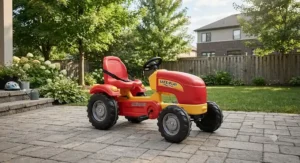
Metal Pedal Tractor vs Plastic Pedal Tractor: The Real Difference
This is the comparison that actually decides most purchases, so let’s be specific instead of generic. A metal pedal tractor vs plastic pedal tractor debate usually comes down to three practical factors: weight, weather resistance, and repairability.
Metal frames — like the John Deere 4440 Pedal Tractor and Tricam 22″ Steel Ride-On Tractor Tricycle — resist UV degradation and impact cracking far better than plastic. Steel doesn’t go brittle after a few summers of direct sun, which is a real failure mode for cheap plastic ride-ons left outdoors year-round. The trade-off is weight: a heavier metal tractor is harder for a small child to push-start on flat ground and can be genuinely tough for a parent to haul in and out of a garage each day.
Plastic-bodied models with a steel or metal chassis underneath — like the Rolly Toys John Deere Pedal Tractor with Front Loader and both Aosom entries — split the difference. You get the structural backbone in a load-bearing metal frame while keeping the exterior lightweight enough for a toddler to manage independently. The honest downside is that plastic panels are more vulnerable to cracking from sharp impacts, and once cracked, they’re rarely repairable the way a dented steel panel sometimes is.
Reviewers consistently note that full-metal models age better in outdoor storage, while plastic-hybrid models tend to be easier for younger kids to actually operate day-to-day. There’s no universally correct answer — it depends on your climate, your storage situation, and your child’s age and strength.
How to Choose a Pedal Tractor for Outdoor Play
Choosing the right pedal tractor for outdoor play comes down to seven practical criteria, in roughly this order of importance:
- Match the frame material to your terrain. Rough or gravelly ground favours steel; smooth lawns and patios work fine with lighter plastic-hybrid builds.
- Check the weight capacity against your child’s growth curve. A 77 lb-rated tractor buys you two to three extra years of use compared to a lower-capacity budget model.
- Confirm the seat is adjustable. A fixed seat position is the single fastest way a toy gets outgrown within a single season.
- Consider accessory compatibility if you want longevity. Hitch-based systems let you expand the toy over time instead of replacing it outright.
- Look for pedal-crank tensioning systems. These prevent the chain-skipping issue that’s a recurring complaint in budget-model reviews.
- Weigh assembly complexity honestly. A tractor that takes two hours to assemble is a real cost, even if the sticker price looks appealing.
- Verify Canadian toy safety certification. Products sold in Canada must meet the requirements set out under the Toys Regulations administered by Health Canada, covering mechanical, flammability, and toxicological hazards.
Common Mistakes When Buying a Pedal Tractor
The most common mistake is buying based on farm-styling nostalgia rather than the child’s actual age and coordination level — a tractor with a complex front loader lever can frustrate a two-year-old who just wants to pedal. Second, parents frequently skip checking weight capacity, then wonder why the tractor feels sluggish or squeaks under a growing seven-year-old. Third, plenty of buyers assume “outdoor toy” automatically means “leave it outdoors permanently,” when in reality even weather-resistant plastic and metal benefit from covered storage between rides, especially through wet Canadian shoulder seasons. Fourth, some shoppers overlook trailer and accessory compatibility entirely, then discover months later that the add-ons they want aren’t compatible with the base model they already own. Finally, a subtler mistake: ignoring assembly reviews. A tractor with excellent ride quality but a two-hour assembly process, missing hardware, or unclear instructions creates a frustrating first impression that colours how the whole purchase feels, even once it’s built correctly.
What to Expect: Real-World Performance on Backyard Terrain
Specs on a box rarely translate directly into how a tractor actually behaves once it hits real backyard terrain. On flat, mowed grass, nearly every model on this list performs comparably — pedal resistance is low, steering is predictable, and wheel size barely matters. Once you introduce texture — gravel, packed dirt with ruts, or a gentle slope — differences emerge quickly. Smaller plastic wheels tend to catch on loose gravel, requiring more pedal effort and occasionally stalling a smaller rider mid-turn. Larger, oversized resin tires, like those on the Rolly Toys John Deere 3-Wheel Trac, roll over minor debris more forgivingly.
Slopes are where frame rigidity earns its keep. A flexible plastic chassis can feel slightly unstable descending even a mild grade, while the reinforced steel builds hold their line with noticeably more confidence. And on hard surfaces like driveways or basement floors during rainy-day indoor sessions, nearly all seven tractors perform well, since hard flat ground is the easiest terrain any wheeled toy will face. The practical takeaway: if your child’s play zone is varied — lawn, driveway, a bit of garden path — prioritize wheel size and frame rigidity over cosmetic features every time.
Build Materials Explained: What’s Actually Holding Your Tractor Together
Peel back the paint and stickers, and every pedal tractor on this list is built from some combination of three core build materials: steel, high-density plastic, and rubber or resin for the wheels. Steel shows up most often in the axle and chassis, even on “plastic” tractors, because it bears the load and torque of pedaling far better than moulded plastic ever could — that’s why even budget-friendly models like the Aosom Kids Ride-On Farm Tractor advertise a metal frame underneath their plastic shell. Full-body steel construction, as seen on the John Deere 4440 Pedal Tractor, extends that durability to every visible panel, at the cost of extra weight and a higher manufacturing price that gets passed on to buyers.
High-density plastic, typically blow-moulded for weather resistance, handles the hood, fenders, and seat on most mid-range models. It’s lighter, cheaper to produce, and resists denting — but it’s more vulnerable to UV brittleness over years of direct sun exposure and to cracking on sharp, hard impacts. Wheel materials matter more than most buyers realize: oversized resin or rubberized tread tires roll more smoothly over mixed terrain than smaller hard-plastic wheels, directly affecting how much pedaling effort a small child needs to expend. Understanding these build materials up front lets you predict which failure mode you’re more likely to encounter — rust versus cracking — before you ever unbox the toy.
Features That Actually Matter (And Those That Don’t)
Cutting through the marketing noise: a working front loader or bucket matters because it extends imaginative play meaningfully, giving a tractor purpose beyond simply rolling forward. A tensioned pedal-crank system matters because it directly prevents one of the most common mechanical failures in this category. An adjustable seat matters enormously for value, since it’s the difference between two years of use and five.
What matters less than the packaging suggests: engine sound modules and horns are fun in the first week and are also, per aggregated review sentiment, among the first components to fail or wear out — treat them as a nice bonus, not a deciding factor. Elaborate paint detailing and brand licensing add cost without meaningfully improving durability or play value; a generic steel-framed tractor and a licensed John Deere model can perform identically on the actual mechanics that matter. And while trailer capacity claims sound impressive, most kids use trailers for stuffed animals and small toys rather than anything close to the rated weight limit, so treat that spec as a nice-to-have rather than a priority.
Safety, Regulations & Compliance for Canadian Backyards
Every toy sold, advertised, or imported in Canada — including pedal tractors — falls under the Canada Consumer Product Safety Act and the accompanying Toys Regulations, which set mechanical, flammability, and toxicological safety standards that manufacturers must meet before a product legally reaches store shelves. Look for a CPSIA or ASTM F963 certification listed in the product specifications, both of which several models on this list, including the Aosom Ride On Front Loader Tractor, explicitly carry.
Beyond certification, a few practical safety habits matter more than any spec sheet: supervise young riders near driveways or streets, check pedal-crank hardware periodically for loosening, and inspect trailer hitches before each hauling session since a detached trailer on a slope can create a tripping hazard for other kids playing nearby. For families wanting the full regulatory detail, Health Canada maintains a public FAQ on the Toys Regulations outlining exactly what manufacturers are required to test against.
It’s also worth zooming out to why active outdoor play matters enough to justify this whole category of toy in the first place. National physical activity data has repeatedly flagged low outdoor activity levels among Canadian kids, with CBC reporting on ParticipACTION’s findings that unstructured outdoor play meaningfully improves children’s physical and cognitive development — a pedal tractor is a small, low-tech tool that nudges a kid outside and moving instead of parked in front of a screen.
FAQ
❓ Is a pedal tractor good for outdoor play in winter climates?
❓ What age is best for a first pedal tractor?
❓ Do pedal tractors need regular maintenance?
❓ Can a pedal tractor handle a gravel driveway?
❓ Are trailers and accessories interchangeable between brands?
Conclusion
If there’s one thing this comparison makes clear, it’s that “best pedal tractor” isn’t a single answer — it’s a question of terrain, age, and how long you want the toy to last. Families dealing with gravel or sloped yards get real, measurable benefits from steel construction, even at a higher price point, while flat suburban lawns make room for lighter, more affordable plastic-hybrid builds without sacrificing much. The Rolly Toys John Deere Pedal Tractor with Front Loader remains the safest all-around pick for most Canadian backyards, the John Deere 4440 Pedal Tractor is the one to buy if durability and authenticity top your list, and the Tricam 22″ Steel Ride-On Tractor Tricycle is the smart, low-risk entry point for the youngest riders.
Whichever you choose, the bigger win is simple: a pedal tractor gets a kid outside, moving under their own power, for an activity that costs nothing to run and rarely runs out of charge. That’s a rare thing in a toy aisle full of screens and batteries, and it’s worth factoring into the decision alongside every spec sheet above.
Recommended for You
- Pedal Tractor With Trailer: 7 Top Picks for Canadian Kids
- Farm Pedal Tractors for Kids: 7 Real Picks for 2026
- Pedal Tractor for Toddlers: 7 Best Picks for 2026 (Ultimate Guide)
Disclaimer: This article contains affiliate links. As an Amazon Associate, I earn from qualifying purchases. If you purchase products through these links, we may earn a small commission at no additional cost to you.
✨ Found this helpful? Share it with your friends! 💬🤗
