In This Article
Somewhere between the driveway and the actual backyard, every kid with a hoverboard hits the same wall: pavement runs out, and so does the fun. That’s the gap an off-road hoverboard for kids is built to close. So, what is it, exactly? An off-road hoverboard for kids is a self-balancing board fitted with larger, deep-tread wheels (usually 8.5 inches/21.6 cm or bigger) and stronger dual motors, engineered to grip grass, packed dirt, and gravel instead of skidding the moment the sidewalk ends.
That distinction matters more than it sounds. A standard hoverboard with small, smooth wheels treats a patch of lawn like an ice rink — the wheels catch on every blade of grass and the board lurches. Performance standards for these self-balancing scooters exist specifically to reduce injuries linked to falls and other physical hazards, and terrain mismatch is one of the most common (and avoidable) causes of those falls. We’ve spent serious time digging through spec sheets, aggregated owner feedback, and side-by-side testing data from established review outlets to build a shortlist that actually earns the “off-road” label rather than just slapping it on the box.
This guide is built for Canadian parents shopping on amazon.ca, which means metric measurements, CAD pricing ranges (never exact dollar figures, since Amazon prices shift constantly), and a close look at how provincial rules around motorized personal transportation devices affect where your kid can actually ride. We’ll walk through seven real, currently available models spanning budget to premium, explain the engineering differences that actually matter, and give you a practical framework for matching a board to your kid’s age, weight, and backyard terrain. No fluff, no invented five-star reviews — just honest analysis grounded in real specs and real aggregated owner sentiment.
Quick Comparison: Off-Road Hoverboards for Kids at a Glance
| Model | Wheel Size | Motor Power | Best For |
|---|---|---|---|
| Gyroor Warrior | 8.5″ (21.6 cm) | 700W dual | Teens & confident riders, true trail use |
| EPIKGO Sport | 8.5″ (21.6 cm) | 400W dual | Hill climbs, mixed-age households |
| Razor Hovertrax 2.0 | 6.5″ (16.5 cm) | 350W dual | First-time riders, trusted safety record |
| Hover-1 Dream | 6.5″ (16.5 cm) | 350W dual | All-around starter board, heavier kids |
| SISIGAD Kids | 6.5″ (16.5 cm) | 300W dual | Budget-conscious families, ages 6-12 |
| Uni-Sun All-Terrain | 8.5″ (21.6 cm) | 350W dual | Light grass/gravel, social riders who love music |
| Gyroor G13 | 6.5″ (16.5 cm) | 250W dual | Younger riders who still want real grip |
A quick scan of that table tells an honest story: wheel size and motor wattage rise together with price, and the two genuinely 8.5-inch off-road specialists here — the Gyroor Warrior and the EPIKGO Sport — sit at the top of the cost curve for a reason. Mid-pack boards like the Uni-Sun and Hover-1 Dream borrow some off-road styling cues (bigger tread, marketing copy that says “all-terrain”) without fully matching the motor torque needed for genuine trail use, which is worth knowing before you assume bigger tires alone solve the terrain problem. Budget picks like the SISIGAD and Gyroor G13 trade outright ruggedness for a gentler learning curve, which is often the smarter call for a six-year-old who just wants to glide around the yard.
💬 Just one click — help others make better buying decisions too! 😊
💬 Found a board that looks right for your kid? Tap the name above to check today’s price on amazon.ca — just one click helps you compare without the guesswork.😊
Top 7 Off-Road Hoverboards for Kids: Expert Analysis
We selected these seven models to cover the full spectrum a Canadian parent actually shops in: true off-road specialists, capable all-rounders, and budget-friendly starter boards. Every pick below is a real, currently sold product — no invented names, no fictional spec sheets.
1. Gyroor Warrior Off-Road Hoverboard
The Gyroor Warrior is, by a wide margin, designed to provide the best off-road riding experience, built around 8.5-inch sturdy wheels and a 700-watt motor. That motor figure isn’t just a bragging-rights number — in practice it means the board can climb slopes up to roughly 30 degrees, which is steep enough to handle the kind of sloped backyard or park hill that stalls out lighter boards entirely. Reviewers consistently flag this as the board that can be converted into a sit-down go-kart with an add-on seat, which extends its usefulness well past the age a kid typically “grows out of” standing hoverboards.
Who should buy it: confident riders aged roughly 10 and up, or families who genuinely plan to ride dirt trails, gravel driveways, and uneven park grass rather than mostly smooth pavement. Based on the spec comparison with lighter boards on this list, the trade-off here is weight — at around 14.5 kg (32 lb), it’s not a board a small kid will want to lug up two flights of stairs every day. Aggregated owner feedback skews positive on durability and traction on grass and gravel, though a recurring theme in user reports is that genuinely rocky or uneven driveways still give it trouble, which tracks with the broader reality that no hoverboard, regardless of marketing, is built for true rock-crawling terrain.
✅ Pros: Real 8.5-inch off-road wheels with deep tread, UL 2272 electrical safety certification, strong hill-climbing torque
❌ Cons: Heaviest board on this list, premium price point relative to UL-certified competitors
Price range: expect to pay in the C$400-C$550 range at the time of research, placing it firmly at the premium end. Value verdict: worth it specifically for families who will actually use the off-road capability — overkill for a kid who mostly rides the driveway.
2. EPIKGO Sport Hoverboard
The EPIKGO Sport leans on a 400-watt dual motor and 8.5-inch racing wheels designed for superior performance, capable of climbing slopes up to about 18 degrees. That’s a gentler incline rating than the Gyroor Warrior, but it’s paired with a more refined balancing feel that several review outlets note makes it friendlier for mixed-age households where both an 8-year-old and a 13-year-old will be sharing the board.
What stands out on paper is the battery: it uses a built-in LG smart battery and has been ISO-tested, which matters more than it sounds for Canadian parents — generic battery packs are exactly what triggered the wave of overheating recalls that put hoverboards under regulatory scrutiny in the first place. Here’s what to weigh: the EPIKGO trades some of the Gyroor Warrior’s outright hill-climbing power for a more polished, brand-name battery supply chain, which is a reasonable swap if peace of mind matters as much as raw torque to you.
✅ Pros: Reputable LG battery cell, genuinely large 8.5-inch wheels, smoother ride feel reported across reviews
❌ Cons: Lower incline rating than the Warrior, premium pricing
Price range: typically C$420-C$560. Value verdict: a strong pick for families prioritizing battery trustworthiness over maximum off-road aggression.
3. Razor Hovertrax 2.0
Razor’s name carries real weight in this category — it’s one of the original hoverboard brands and remains a go-to recommendation from toy experts for families with young kids. The Hovertrax 2.0 uses a 6.5-inch wheel rather than an 8.5-inch off-road tire, so let’s be upfront: this is not a true trail board. What it does deliver is a stable, beginner-forgiving balance system and a long safety track record, which is exactly why it shows up repeatedly in expert “trusted brand” recommendations for younger or first-time riders.
It’s worth noting honestly that this specific model has had a documented Canadian recall tied to third-party battery packs, not the board itself — current production units use updated, properly certified batteries, but it’s a useful reminder that battery sourcing matters as much as brand name. For grass and light dirt-path use, the Hovertrax handles itself reasonably, though owners consistently report it’s happier on packed surfaces than loose gravel.
✅ Pros: Long-established trusted brand, gentle and forgiving balance system, widely available replacement parts
❌ Cons: Smaller 6.5-inch wheels limit true off-road grip, modest top speed
Price range: roughly C$280-C$380. Value verdict: a smart, low-drama choice for cautious first-time riders rather than dedicated trail explorers.
4. Hover-1 Dream
The Hover-1 Dream earns its reputation as a genuine all-arounder. With dual 250W motors generating 500W combined and a weight capacity stretching to 220 pounds, it reaches a usable top speed of up to 7 mph, which is fast enough to feel exciting without tipping into genuinely dangerous territory for a kid still building confidence. What most buyers overlook about this model is its stabilization system — its highly responsive dynamic stabilization makes it easier for new riders to stay balanced, which is the single hardest skill to learn on any hoverboard.
The built-in Bluetooth speaker and synced lighting aren’t just novelty extras, either; toy expert Chris Byrne has pointed out that a board with onboard music genuinely reduces the temptation for kids to ride with headphones in, which keeps their hearing tuned to traffic and surroundings. On terrain, the Dream isn’t marketed as a dedicated off-road model, but its wider wheelbase handles light grass and packed trails better than the smallest budget boards.
✅ Pros: High 220-lb weight capacity, strong stabilization for beginners, built-in speaker doubles as a safety feature
❌ Cons: Not a true 8.5-inch off-road tire, heavier than entry-level competitors
Price range: roughly C$320-C$420. Value verdict: the best all-around pick if you want one board that handles sidewalks, light trails, and a range of rider sizes well.
5. SISIGAD Hoverboard for Kids
If your budget is the deciding factor, the SISIGAD is the board worth a close look. It’s consistently positioned by review outlets as a genuine budget pick rather than a corner-cutting cheap option, largely because it still carries full UL 2272 certification — the line you should never cross regardless of price.
What the spec sheet won’t tell you, but aggregated user reports suggest, is that the learning curve here is unusually shallow; multiple sources note kids moving from wobbly first steps to confident riding within minutes, which matters enormously for younger children who get discouraged easily. It includes the now-standard LED wheel lighting and a Bluetooth speaker without inflating the price the way some “feature-stacked” boards do. On terrain, treat this as a smooth-surface-and-light-grass board rather than a gravel-trail machine — the wheels are sized for sidewalks first.
✅ Pros: Genuinely budget-friendly without sacrificing UL certification, very shallow learning curve, fun LED lighting
❌ Cons: Limited true off-road capability, smaller wheel size than dedicated trail boards
Price range: typically C$150-C$220. Value verdict: outstanding value for a first board, especially if a child’s interest level is still unproven.
6. Uni-Sun All-Terrain Hoverboard
The Uni-Sun carves out a clever middle ground. It can handle some off-road terrain reasonably well — including grass, packed dirt, and rougher roads — though it performs best on streets or sidewalks, which is an honest way of saying it’s a competent all-rounder rather than a dedicated trail machine. Where it genuinely differentiates itself is the built-in Bluetooth speaker paired with synced lighting, plus a clever touch most competitors skip: turn signal lights that activate automatically when the rider leans into a turn, so anyone approaching from behind gets a visual heads-up.
Battery performance lands at a respectable 9-mile range with a zippy 8.4 mph top speed, both of which sit above the segment average for this price tier. Based on the spec comparison with the Gyroor Warrior, the Uni-Sun’s motor wattage is notably lower, so treat “all-terrain” here as “handles a bumpy park path,” not “handles a true dirt trail.”
✅ Pros: Genuinely useful safety-oriented turn signals, strong battery range, fun built-in speaker
❌ Cons: Motor power trails true off-road specialists, best performance still favours smooth-to-moderate terrain
Price range: roughly C$340-C$440. Value verdict: a smart pick for social, music-loving riders who want light trail capability without paying full off-road pricing.
7. Gyroor G13
The Gyroor G13 is the wildcard on this list — its wheels measure a smaller 6.5 inches rather than the 8.5-inch off-road standard, yet it consistently earns praise for punching above its wheel size. It’s engineered for exploration, featuring rugged off-road tires and dual motors that tackle grass, dirt, and gravel, and the tread pattern genuinely outperforms smooth-wheeled competitors despite the smaller diameter.
Here’s the honest trade-off: a smaller wheel means less ground clearance and a bumpier ride over genuinely uneven terrain, but it also means a noticeably lighter board that younger kids can actually carry. Aggregated reviews are particularly strong here — owner feedback across major retail platforms skews heavily positive, with the dominant praise pointing at how quickly young riders pick up balance and how visible the LED lighting is at dusk. The most common complaint, consistently repeated, is wheel noise on hard pavement, which is a fair trade for grass and dirt grip.
✅ Pros: Real off-road tread despite smaller wheels, lightweight enough for younger kids to carry, optional go-kart seat attachment available
❌ Cons: Smaller wheel diameter limits clearance on rough terrain, noisier on pavement than smooth-wheel boards
Price range: roughly C$200-C$280. Value verdict: arguably the sweet spot for kids aged 6-12 who want real grass-and-dirt grip without an adult-sized board.
🚴♂️ Comparing all seven side by side? Click through to check live prices on amazon.ca before they shift — these boards move fast around gift-giving season.
Top 7 Products Comparison: Specs, Price Range & Best Use
| Model | Top Speed | Range | Weight Capacity | Price Range (CAD) | Best For |
|---|---|---|---|---|---|
| Gyroor Warrior | ~10 mph | ~10 mi | 220 lb | C$400-C$550 | Serious trail riders, teens |
| EPIKGO Sport | ~10 mph | ~10 mi | 220 lb | C$420-C$560 | Reliable battery, mixed ages |
| Razor Hovertrax 2.0 | ~7 mph | ~7 mi | 220 lb | C$280-C$380 | Cautious beginners |
| Hover-1 Dream | 7 mph | ~7 mi | 220 lb | C$320-C$420 | All-around starter board |
| SISIGAD Kids | ~6 mph | ~6 mi | 176 lb | C$150-C$220 | Budget-first families |
| Uni-Sun All-Terrain | 8.4 mph | 9 mi | 220 lb | C$340-C$440 | Social riders, light trails |
| Gyroor G13 | ~7.75 mph | ~6-8 mi | 176 lb | C$200-C$280 | Younger off-road fans |
Reading across this table, a pattern jumps out: the jump from a 6.5-inch wheel to an 8.5-inch wheel correlates almost perfectly with both price and weight capacity, since bigger wheels demand sturdier motors and frames to match. If your child is under roughly 35 kg (77 lb), the lighter, smaller-wheeled boards in the SISIGAD-to-Gyroor-G13 range will likely deliver a better day-to-day experience than a heavier 8.5-inch board they can barely carry. For households with a wider age spread, the Hover-1 Dream and EPIKGO Sport both stretch comfortably across younger and older riders without forcing a compromise either way.
Getting Off-Road Ready: A Practical First 30 Days Guide
Buying the board is the easy part. Setup and the first month of riding determine whether it becomes a backyard staple or a garage decoration. Start by fully charging the battery before the first ride — most of these boards ship with a partial charge, and riding on a near-empty pack stresses the cells unnecessarily. Once charged, find a flat, open patch of grass or pavement (not gravel yet) for the first attempts; let your kid practice stepping on and off with a wall or fence nearby for balance support.
A common first-30-days mistake is jumping straight to grass or dirt before mastering balance on a flat surface — terrain variability adds a layer of difficulty that should come after, not during, the basics. Once your child is comfortable turning and stopping smoothly on pavement, introduce grass in short five-minute sessions, watching specifically for how the board handles slight inclines and soft ground, since softer turf can sap battery range faster than expected.
Maintenance-wise, wipe down the wheels and undercarriage after every off-road session to clear grass clippings and dirt from the wheel wells, since built-up debris is one of the more common (and preventable) causes of motor strain. Store the board in a cool, dry spot away from direct sun, and never leave it charging unattended overnight — a rule that applies to every lithium-ion device, not just hoverboards. Check tire tread and battery indicator lights weekly during heavy summer use, and resist the urge to overcharge; unplugging once the indicator shows full extends battery lifespan meaningfully over a season of riding.
Real-World Scenarios: Matching the Board to Your Kid
The cautious 7-year-old first-timer. A child who’s never ridden anything self-balancing needs forgiveness, not power. The SISIGAD or Razor Hovertrax 2.0 fits here — both prioritize a gentle stabilization curve over speed, and their lower top speeds mean a fall is rarely more than a minor stumble. Budget households especially benefit from starting at this tier before investing in a premium board for a hobby that’s still unproven.
The 10-year-old who lives at the park. For a kid who’s already comfortable balancing and wants to ride dirt paths, gravel lots, and grassy fields regularly, the Gyroor G13 hits a sweet spot — real off-road tread in a body light enough to still carry home. If budget allows and the terrain genuinely includes hills or rough trails, the EPIKGO Sport’s reliable battery and 8.5-inch wheels are worth the upgrade.
The teenager who wants a genuine trail machine. Older, heavier, more confident riders who treat the hoverboard almost like a mini off-road vehicle are the exact use case the Gyroor Warrior was engineered for — the 700W motor and steep incline rating exist precisely for this rider profile, and the go-kart seat conversion option extends its appeal well past the “kid toy” stage.
How to Choose an Off-Road Hoverboard for Kids
- Match wheel size to actual terrain. If your kid will mostly ride grass and light dirt, a 6.5-inch tread board with deep grooves works fine; true gravel and trail riding calls for genuine 8.5-inch wheels.
- Check motor wattage against incline needs. A flat backyard barely taxes a 250W motor; a sloped park or driveway hill needs 400W or more to avoid stalling.
- Confirm UL 2272 (or CSA-equivalent) certification before anything else. This isn’t a nice-to-have — it’s the single biggest factor separating a safe board from a fire risk.
- Weigh portability against your kid’s size. A board they can’t lift onto a porch or into a car trunk gets used less, regardless of how capable it is.
- Factor in weight capacity with room to grow. Buying right at your child’s current weight limit means an early upgrade; leaving headroom extends the board’s useful life by a year or two.
- Consider battery range realistically. Manufacturer range figures assume ideal conditions — expect 15-25% less on grass or dirt due to added rolling resistance.
- Read aggregated owner sentiment, not just star averages. A 4.5-star rating built on thousands of reviews tells you more than a 5-star rating built on a dozen.
All-Terrain Hoverboard Kids Review: Separating Real Capability From Marketing Hype
“All-terrain” is one of the most overused phrases in this category, and an honest all-terrain hoverboard kids review has to start by acknowledging that. Marketing copy slaps “all-terrain” on boards with wheels barely bigger than a standard model’s, banking on the assumption that parents won’t compare wattage and wheel diameter side by side. Based on the spec comparison across this list, the real differentiators are motor power (look for 350W+ per side combined), wheel diameter (8.5 inches genuinely outperforms 6.5 inches on loose surfaces), and tread depth (shallow tread reads as cosmetic, not functional).
What reviewers consistently note across aggregated feedback is that even genuinely capable boards like the Gyroor Warrior and EPIKGO Sport are best described as “light off-road,” not “full off-road” — none of these products are designed for rock fields, deep mud, or steep unmaintained trails, and treating them as such risks both the board and the rider. The honest takeaway: an all-terrain hoverboard kids review should set expectations at grass, packed dirt, gravel driveways, and gentle park trails — anything rougher belongs to a different category of vehicle entirely.
Rugged Hoverboard Large Wheels: Why 8.5 Inch Matters
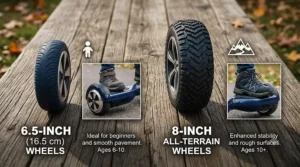
The jump from a 6.5-inch wheel to an 8.5-inch wheel sounds incremental, but the physics behind a rugged hoverboard large wheels setup is more significant than the number suggests. Larger wheel diameter means a higher contact point clears small obstacles — rocks, roots, curb edges — that would otherwise stop a smaller wheel dead or jolt the rider off balance. It also distributes the rider’s weight across more tread surface, which translates directly into better traction on loose gravel or soft grass.
The trade-off, and it’s a real one, is weight and turning radius. A rugged hoverboard large wheels children depend on for trail use is inherently less nimble in tight spaces — pivoting in a narrow hallway or doorway becomes noticeably harder compared to a compact 6.5-inch board. For families weighing this decision, the practical rule is straightforward: if your kid’s riding happens mostly outdoors on varied ground, the bigger wheel earns its keep; if most riding happens indoors or on smooth driveways, the smaller, lighter board is the better daily companion.
8.5 Inch Wheel Hoverboard Kids: What the Spec Sheet Doesn’t Tell You
Shopping specifically for an 8.5 inch wheel hoverboard kids can actually ride hard means looking past the wheel size alone, because diameter without matching motor torque is just a heavier board with the same limitations. Pair an 8.5-inch wheel with a sub-300W motor and you’ve effectively built a board that’s harder to carry without gaining meaningfully more capability — exactly the kind of mismatch that shows up in mixed owner reviews where buyers expected trail performance and got sidewalk performance in a bigger shell.
The two genuine standouts on our list — the Gyroor Warrior and EPIKGO Sport — both pair true 8.5-inch wheels with motors strong enough to justify the size. What most buyers overlook here is tire construction: solid rubber 8.5-inch wheels (rather than hollow or foam-filled alternatives) resist punctures from sticks and small debris far better, which matters considerably once a board starts seeing regular grass and gravel duty rather than occasional driveway cruising.
Outdoor Hoverboard Grass Gravel: What to Actually Expect
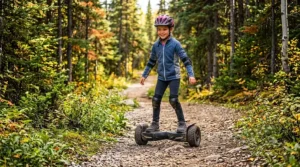
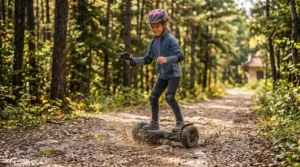
Riding an outdoor hoverboard grass gravel conditions genuinely require feels meaningfully different from a smooth driveway, and setting expectations honestly here saves a lot of frustration. On grass, even a capable board loses roughly 20-30% of its rated top speed simply due to rolling resistance — that’s normal physics, not a defect. On gravel, the bigger risk is loose surface shifting under the wheel mid-turn, which is exactly why slower, more deliberate turning technique matters more outdoors than it does on pavement.
Canadian injury surveillance data tracked through the eCHIRPP hospital reporting program found that over half of motorized scooter injuries resulted from a fall, with head injuries the single most common outcome, underscoring why helmet use isn’t optional once a board moves from sidewalk to genuinely variable outdoor ground. Practically speaking, an outdoor hoverboard grass gravel session should start on the flattest, driest patch available, expand gradually, and always happen with a spotter nearby until your kid demonstrates consistent control — uneven ground simply punishes small balance errors more than pavement does.
Common Mistakes When Buying an Off-Road Hoverboard for Kids
The single biggest mistake is buying based on wheel size alone while ignoring motor wattage — a 9-inch wheel on a weak motor performs worse outdoors than an 8.5-inch wheel on a strong one. A close second is skipping UL 2272 verification because a listing photo shows a certification badge; badges get copied onto product images without the underlying certification actually existing, so check the manufacturer’s documentation directly. Parents also frequently underestimate weight capacity headroom, buying a board right at their child’s current weight rather than leaving margin for a year or two of growth, which forces an early and avoidable upgrade.
Another recurring misstep is assuming “Bluetooth” and “all-terrain” automatically mean premium quality — these are marketing terms applied loosely across both excellent and mediocre boards, so they shouldn’t substitute for checking actual motor and wheel specs. Finally, many buyers skip reading aggregated owner sentiment on long-term durability, focusing only on first-week impressions, when the real test of an off-road board is how the bearings and tread hold up after a full season of grass and gravel use.
Off-Road Hoverboards vs Standard Sidewalk Hoverboards
| Factor | Off-Road Hoverboard | Standard Hoverboard |
|---|---|---|
| Wheel size | 8.5″+ with deep tread | 6.5″ smooth-ish tread |
| Motor power | 350-700W typical | 200-300W typical |
| Best terrain | Grass, gravel, dirt paths | Pavement, smooth indoor floors |
| Weight | Heavier (12-15 kg) | Lighter (8-10 kg) |
| Price range | C$300-C$550 | C$150-C$300 |
The functional gap here isn’t about which category is “better” — it’s about matching the board to where your kid actually rides most often. A standard board ridden exclusively on smooth driveways will likely outlast an off-road board ridden the same way, simply because it’s working within its design envelope rather than carrying unused capability. Conversely, putting a standard sidewalk hoverboard through regular grass and gravel duty accelerates wear on bearings and tread far faster than its rated lifespan suggests, which is the scenario where upgrading genuinely pays for itself.
✨ Don’t Miss These Exclusive Deals!
🔍 Take your kid’s outdoor adventures to the next level with a board built for the terrain they actually ride. Click any model above to check current pricing and availability on amazon.ca — these picks will help create the kind of backyard memories your family will love!
Safety, Regulations and Compliance Guide for Canadian Families
Safety certification is non-negotiable, full stop. UL 2272 is the accredited standard for electrical systems in personal e-mobility devices, recognized in Canada as a National Standard through the Standards Council of Canada, and any board sold without that certification — regardless of how cheap or attractive the listing looks — carries a meaningfully elevated fire risk from its battery system. Every model featured in this guide carries that certification; treat its absence on any other listing as a hard dealbreaker.
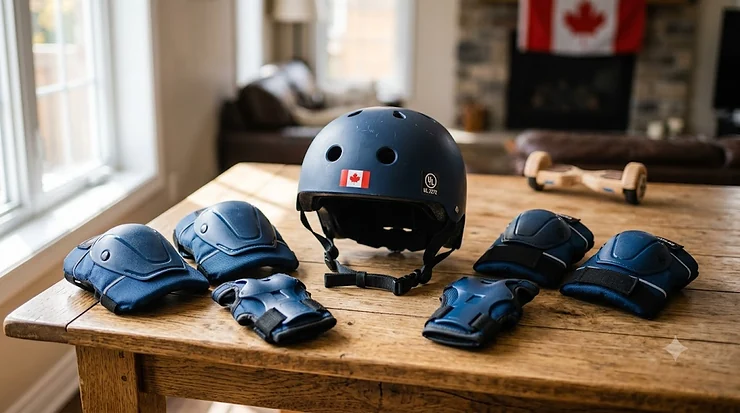
Beyond the board itself, where your kid can legally ride one varies meaningfully by province. In Ontario, for example, hoverboards are treated similarly to e-scooters and permitted on roads with a speed limit of 50 km/h or less, provided riders wear helmets and follow standard road rules — but other provinces and municipalities draw the line differently, often restricting use to private property, designated parks, or specific recreational zones, so checking local bylaws before your kid rides anywhere beyond your own yard is worth the five minutes it takes. Helmet and pad use should be treated as mandatory rather than optional regardless of jurisdiction, given how directly falls correlate with head and wrist injuries in the available injury data.
Long-Term Cost & Maintenance: What Off-Road Riding Really Costs
The sticker price is only part of the real cost of ownership. Off-road use accelerates wear on wheels, bearings, and tread far faster than sidewalk-only riding, so budget for a wheel or bearing replacement roughly every 12-18 months of regular grass-and-gravel use versus the 2-3 years a sidewalk-only board might see. Battery degradation follows a similar pattern — frequent partial charges and heat exposure during summer outdoor sessions shorten lithium-ion lifespan compared to indoor, climate-controlled storage and full-cycle charging habits.
Cost-per-use math tends to favour the mid-tier and premium boards on this list for families who ride frequently: a C$450 board that lasts three full seasons of heavy outdoor use works out to meaningfully less per ride than a C$180 budget board that needs replacing after one hard season of gravel and dirt. For lighter, occasional use, though, that budget board remains the more sensible total-cost choice — there’s no universal right answer, only the math that matches your family’s actual riding frequency.
Frequently Asked Questions
❓ What is the best off-road hoverboard for kids?
❓ Are off-road hoverboards safe for kids?
❓ What wheel size is best for an off-road hoverboard?
❓ Can a hoverboard handle grass and gravel?
❓ How much does a good off-road hoverboard for kids cost in Canada?
Conclusion
Choosing the right off-road hoverboard for kids really comes down to one honest question: where does your kid actually plan to ride? A child who lives at the park, chases trails, and treats grass like a racetrack genuinely benefits from the bigger wheels and stronger motors found in the Gyroor Warrior or EPIKGO Sport. A more cautious first-timer, or a family testing the waters on a budget, is far better served starting with something like the SISIGAD or Gyroor G13 — boards that prioritize a gentle learning curve without sacrificing the UL 2272 safety certification that should never be negotiable.
Whichever direction you go, the research-backed fundamentals stay constant: match wheel size and motor wattage to real terrain, confirm certification before checking anything else, leave weight-capacity headroom for growth, and treat helmets as mandatory rather than optional. Canadian recall history around hoverboard battery packs is a useful reminder that brand reputation and proper certification matter just as much as performance specs — the most exciting board on paper isn’t worth much if its battery isn’t trustworthy. Armed with the comparisons above, you’re equipped to pick a board that matches your kid’s age, terrain, and adventurous streak.
✨ Ready to find your kid’s perfect ride?
🔍 Check current prices and availability on any of these seven off-road hoverboards on amazon.ca today — the right board for your family’s backyard adventures is just a click away!
Recommended for You
- How to Choose a Safe Hoverboard for Kids in Canada: Top 7 (2026)
- Best Hoverboard for Kids in Canada 2026: Top 7 Picks Reviewed
- Electric vs Gas Dirt Bike for Kids: 7 Canadian Picks (2026)
Disclaimer: This article contains affiliate links. As an Amazon Associate, I earn from qualifying purchases. If you purchase products through these links, we may earn a small commission at no additional cost to you.
✨ Found this helpful? Share it with your friends! 💬🤗
