In This Article
If your kid has been begging for a hoverboard since the last birthday party where one showed up, you already know the appeal. What you might not know is how wildly different “safe” and “not safe” can look between two boards that seem almost identical online. Learning how to choose a safe hoverboard for kids in Canada really comes down to three things: a real UL2272 fire-safety certification, an honest match between your child’s weight and age and the board’s rated limits, and a bit of common sense about Canadian conditions — cold garages, salty sidewalks, and basements that double as charging stations.
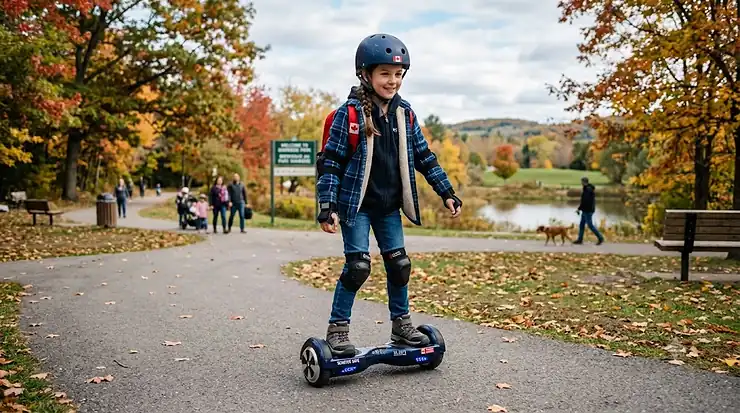
This guide walks through exactly that. 🇨🇦 We’ll compare seven hoverboards currently sold on Amazon.ca, explain what the UL2272 sticker actually tests for, and flag the mistakes that send too many of these boards back in a box. Whether you’re shopping for a cautious six-year-old or a tween who wants to do 360s in the driveway, there’s a model here that fits — and a few reasons why the cheapest option isn’t always the safest one.
One quick definition before we dive in: a hoverboard is a self-balancing, battery-powered platform with two wheels and no handlebars, steered entirely by shifting your weight. It doesn’t actually hover (despite the name), and in Canada, the boards worth buying carry a UL2272 safety listing — a standard that’s also formally recognized as a National Standard of Canada.
Quick Comparison Table: Best Hoverboards for Kids in Canada
| Hoverboard | Recommended Age | Top Speed | Weight Range | UL2272 | Best For |
|---|---|---|---|---|---|
| Jetson Dash | 6+ | 8 km/h | Smaller/lighter riders | ✅ | First-time youngest riders |
| Gotrax Edge | 8+ | 10 km/h | 20–80 kg (44–176 lb) | ✅ | Budget all-rounder |
| Razor Hovertrax Prizma | 8+ | ~13 km/h | Up to 80 kg (176 lb) | ✅ | Trusted brand, resale value |
| Hover-1 H1 | 8+ | 14 km/h | Kids/teens (check listing) | ✅ | App features on a budget |
| Jetson Litho X | 12+ | 16 km/h | Up to 100 kg (220 lb) | ✅ | Teens who want real speed |
| Gyroor G13 | 6–12 | 12.5 km/h | Up to 80 kg (176 lb) | ✅ | All-terrain family use |
| Gotrax NOVA PRO | 8+ | 10 km/h | 20–80 kg (44–176 lb) | ✅ | Mixed pavement + grass riding |
A quick read on this table: the spread in top speed (8–16 km/h) matters more than most parents assume, because it’s the single biggest factor in how hard a board is to control. The Jetson Dash’s slower 8 km/h ceiling isn’t a compromise — it’s the entire point for a six-year-old still learning to shift their weight without panicking. On the other end, the Jetson Litho X’s 16 km/h top speed and 100 kg capacity make it the only board here that genuinely fits a 14-year-old or a parent who wants to share. Notice, too, that every board on this list carries UL2272 certification — that wasn’t a coincidence; it’s a hard filter we applied before any board made the cut.
💬 Just one click — help others make better buying decisions too! 😊
Top 7 Hoverboards for Kids: Expert Analysis (Amazon.ca)
1. Jetson Dash Hoverboard
The Jetson Dash is built for the exact moment a younger sibling gets tired of watching everyone else ride. It’s scaled down in both size and speed, with a 120-watt motor capping out at roughly 8 km/h (5 mph) — slow enough that a wobble doesn’t turn into a real fall.
What that 120W motor actually means day-to-day: it’s enough to get a 6-to-8-year-old moving smoothly on a driveway or smooth basement floor, but it’ll bog down on grass or any kind of incline. That’s a feature here, not a flaw — it keeps younger riders on flat, predictable surfaces where they’re meant to be. The anti-slip standing pads sit directly over the motion sensors, which in practice means fewer of the “why did it lurch forward” moments that scare new riders off entirely.
What most Canadian parents overlook with entry-level boards like this one: battery efficiency drops noticeably once a garage dips below about 5°C, so a board that “worked fine in September” may feel sluggish by November. Bring it inside to a room-temperature spot before each ride in cooler months.
Customer feedback on this model consistently praises how quickly younger kids pick it up compared to adult-sized boards — the lower deck height and slower top speed seem to matter more than any single feature.
✅ Genuinely sized for small kids, not just marketed that way
✅ UL2272 certified
✅ Lower speed ceiling reduces fall severity
❌ Underpowered for hills, grass, or older siblings
❌ Limited resale interest once a child outgrows it
Price range: roughly $110–$160 CAD at the time of research — always confirm current pricing on Amazon.ca. For a true beginner board, this sits at the lower end of what’s worth buying; anything cheaper usually means skipping UL2272 entirely.
2. Gotrax Edge Hoverboard
The Gotrax Edge is the board we’d point most families toward as a default, and the spec sheet explains why: dual 200W motors, a 50.4Wh battery, and a 20–80 kg (44–176 lb) weight range that comfortably spans an 8-year-old through a full-grown adult.
In practice, dual 200W motors mean two independent wheels are doing the balancing work rather than one shared motor — that translates to noticeably steadier turns, which matters more than top speed for a first “real” hoverboard. The 50.4Wh battery is modest by hoverboard standards, so expect shorter range than the premium boards on this list; that’s the trade-off for the price.
What stands out for Canadian buyers specifically is the weight range. A 44–176 lb span means the same board can realistically serve an 8-year-old now and a young teen two years from now, which is the kind of detail that actually changes the math on cost-per-year.
Reviewers describe it as reliable for the price tier, with the LED headlight called out repeatedly as more useful than expected for early-evening rides during shorter winter daylight hours.
✅ Wide weight range extends usable years
✅ UL2272 certified with a visible certification label
✅ Dual motors improve low-speed stability
❌ Smaller battery means shorter range than premium options
❌ Headlight is functional but not bright enough for true low-light riding
Price range: approximately $150–$210 CAD — solidly mid-range and, in our view, the best value-to-safety ratio on this list.
3. Razor Hovertrax Prizma
Razor built its reputation as the first US brand to earn a UL2272 listing, and the Hovertrax Prizma trades on that history. It’s rated for ages 8 and up, supports riders up to 176 lb, and comes in three colour options (black, blue, pink).
The practical upside of buying into an established line like Hovertrax: parts, accessories, and customer support tend to be more predictable than with newer budget brands, and Razor explicitly states this product line is produced for sale in both the US and Canada — worth noting given how often imported hoverboards skip Canadian-specific support entirely.
What most buyers overlook about brand-name boards: you’re paying a premium that doesn’t always show up as extra speed or power, but does show up as parts availability three years from now when a tire or sensor pad needs replacing. For a family that’s planning to keep one board through multiple kids, that’s a real consideration — for a single-season gift, it’s less important.
One Canadian buyer review specifically mentioned replacing a “flood-damaged” older Razor board with this newer model and having no hesitation sticking with the brand, citing consistent reliability across multiple units over the years.
✅ Established brand with long-term parts/support track record
✅ UL2272 certified
✅ Sold and warrantied specifically for the US and Canada
❌ Costs more than comparably specced budget alternatives
❌ Fewer standout tech features (no app, no Bluetooth) than newer competitors
Price range: roughly $220–$290 CAD — the brand premium is real, but so is the track record behind it.
4. Hover-1 H1 Hoverboard
The Hover-1 H1 earns its spot as “the original” in the Hover-1 lineup, and it remains relevant because of what it bundles in at a mid-range price: Bluetooth app connectivity, colour-changing LED headlights, and a UL-certified battery with an IPX4 splash-resistant enclosure.
That IPX4 rating is worth pausing on. It means light rain or a damp sidewalk won’t immediately damage the board — useful in a country where “is the ground actually dry” is a real seasonal question for half the year. It is not a substitute for keeping the board out of puddles or slush; treat it as splash resistance, not waterproofing.
The companion app lets a parent dial in a beginner speed cap, which is the single most useful safety feature on a board this price — it effectively turns a 14 km/h top speed into something closer to 8 km/h until a child has proven they’re ready for more.
Customer feedback is mixed on long-term durability — several reviewers mention the board performing well initially before developing wheel or connectivity issues after extended use, and customer service response times drawing complaints. For a budget-conscious buyer, the core safety case is solid; the long-term ownership experience is less consistent.
✅ App-based speed limiting is genuinely useful for new riders
✅ UL2272 certified with IPX4 splash resistance
✅ Strong feature set (Bluetooth, app, LED) for the price tier
❌ Customer service and longevity reviews are inconsistent
❌ Real-world top speed (14 km/h) is fast for a first board without using the beginner mode
Price range: approximately $140–$190 CAD.
5. Jetson Litho X Hoverboard
The Jetson Litho X is the board on this list built for teens, not younger kids, and the spec sheet reflects that: a 500-watt motor, a 100 kg (220 lb) weight limit, three speed modes, and a top speed of roughly 16 km/h (10 mph).
A 500W motor at this price point isn’t just “more power” marketing — it’s the difference between a board that struggles on a 5° slope and one that handles light hills without losing momentum, which matters in plenty of Canadian neighbourhoods that aren’t flat. The three-speed-mode system is the real safety feature here: it lets a parent start a 12-year-old on the slowest setting and unlock full speed only once they’ve built confidence.
What the spec sheet won’t tell you: a 220 lb weight limit also quietly makes this the one board on the list that an average-sized adult can use without immediately maxing out the rating — useful if a parent wants to test-ride before handing it over, or if an older teen has already hit adult height and weight.
Reviews are largely positive on build quality, though as with most boards in this power range, riders accustomed to slower kids’ models should expect a real learning curve on the higher speed settings.
✅ Genuinely capable for teens and lighter adults
✅ Three speed modes double as a built-in training system
✅ UL certified, with a 220 lb weight ceiling that gives real headroom
❌ Too fast and too powerful for kids under 12
❌ Premium price relative to mid-range boards on this list
Price range: roughly $230–$300 CAD.
6. Gyroor G13 Hoverboard
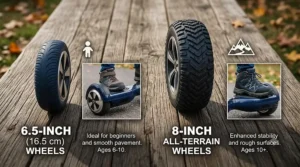
The Gyroor G13 is marketed specifically for “kids ages 6–12 and adults,” which sounds like a stretch until you look at the engineering behind it: dual 250W motors, 6.5-inch off-road tires, and the ability to climb 15° slopes.
That slope rating matters more than it sounds. Most budget boards quietly assume flat pavement; a 15° climb rating means the G13 can actually handle a sloped driveway or a slightly uneven backyard without the motor straining or the board losing balance mid-incline — a common cause of falls on cheaper all-terrain claims that don’t hold up.
The built-in music player and Bluetooth speaker are nice-to-haves, but the more relevant detail for Canadian buyers is the off-road tire profile, which copes noticeably better with the gravel, packed dirt, and transitional pavement-to-grass edges common in suburban Canadian neighbourhoods than the smooth tires on indoor-focused boards.
Reviewers frequently mention younger kids (around 6–7 years old) taking to it quickly, which tracks with the wide marketed age range — though as with any board, supervision for the youngest end of that range is still warranted.
✅ Genuine all-terrain capability, not just marketing language
✅ Wide stated age range (6–12) with adult capacity too
✅ UL2272 certified
❌ Higher weight and power than some 6-year-olds will be ready for
❌ Bluetooth speaker is a nice extra, not a safety feature — don’t let it sway the decision
Price range: approximately $180–$240 CAD.
7. Gotrax NOVA PRO Hoverboard
The Gotrax NOVA PRO rounds out the Gotrax family on this list with an off-road-leaning build: 6.5-inch LED tires, dual 200W motors, a 93.6Wh battery, and the same 44–176 lb weight range as its Gotrax Edge sibling.
That 93.6Wh battery is nearly double the Edge model’s capacity, which in practice means meaningfully more riding time per charge — useful for a kid who treats every after-school hour as hoverboard time. The “PRO” branding mostly reflects this larger battery and the off-road tire tread rather than any dramatic power increase over the standard Gotrax line.
For a Canadian buyer specifically, this is a sensible middle ground between the indoor-leaning Gotrax Edge and the heavier-duty Gyroor G13 — good tire grip for mixed surfaces without stepping up to a 12+ rated board.
✅ Longer battery life than the standard Gotrax Edge
✅ Off-road tire tread without GP13-level price or power
✅ UL2272 certified, same wide weight range as the Edge
❌ Speed and power are comparable to budget boards despite the “PRO” name
❌ LED tire lighting is decorative more than functional for visibility
Price range: roughly $190–$250 CAD.
✨ Don’t Miss These Exclusive Deals!
🔍 Take your search for the right hoverboard to the next level — click on any highlighted model above to check current pricing and availability on Amazon.ca. These picks will help your family find a board they’ll actually love riding. 🚴♂️
How to Choose a Safe Hoverboard for Kids in Canada
Cut through the marketing and there are really only five things that determine whether a hoverboard is safe for a specific child:
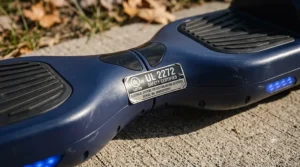
- UL2272 certification, confirmed — not implied. Look for the actual UL holographic sticker on the underside of the board, not just the words “UL-compliant” in the listing title.
- Weight limit with margin, not a perfect match. If your child weighs 70 lb, a board rated for exactly that is a worse choice than one rated up to 176 lb — extra headroom means the motor isn’t working at its limit on every ride.
- Age rating aligned with actual coordination, not just the calendar. An 8-year-old who skateboards confidently may be ready faster than a 10-year-old who isn’t.
- A speed ceiling matched to the riding surface. Driveway-only riding tolerates a slower board fine; a kid who’ll ride on sidewalks and parks benefits from a board with a beginner mode that caps speed electronically.
- A retailer and brand with actual Canadian support. Check whether the listing explicitly mentions Canadian warranty service — several budget import brands quietly don’t.
Hoverboard UL2272 Certification & Fire Safety Explained
UL2272 exists because of a very real, very public problem: in 2015–2016, poorly made hoverboard batteries caused dozens of house fires across North America, including units sold in Canada. In response, UL developed a dedicated safety standard for the entire electrical system of self-balancing scooters — not just the battery cells, but the charger, the circuit board, and how all three interact under stress.
That standard, formally ANSI/CAN/UL 2272, is also recognized as a National Standard of Canada by the Standards Council of Canada, which means it carries direct weight for Canadian consumer safety, not just a US-market label that happens to apply.
Certification testing covers overcharge and short-circuit scenarios, extreme temperature cycling, vibration and drop testing, and water exposure — the kind of abuse a board actually experiences in a kid’s hands over a few winters. Boards that pass carry a UL holographic sticker, typically on the underside near the battery compartment; vague phrases like “UL-tested components” without that sticker are a red flag, not a substitute.
Health Canada has issued recalls tied to this exact failure mode. As recently as a Hovertrax 2.0 battery pack recall, Health Canada flagged GLW-brand battery packs for a fire hazard and directed consumers to stop using affected units immediately. The lesson isn’t “avoid hoverboards” — it’s “register the product and check recalls.canada.ca before and after buying.”
Hoverboard Weight Limit and Age Recommendation Guide
Most reputable manufacturers — including several brands on this list — set a minimum recommended age of around 8 years old, tied less to an arbitrary number and more to the balance, core strength, and rule-following maturity that age tends to bring. Minimum weight requirements (commonly around 44 lb / 20 kg) exist because boards genuinely won’t balance properly under a lighter rider — the sensors need a baseline amount of weight to register properly.
A rough framework that holds up across the boards in this guide:
- Ages 6–8: Stick to lower-speed, lower-power boards like the Jetson Dash, used only with direct supervision.
- Ages 8–12: Mid-power boards (Gotrax Edge, Hover-1 H1, Gyroor G13, Gotrax NOVA PRO) with a beginner mode if available.
- Ages 12+: Higher-power boards like the Jetson Litho X become appropriate, assuming weight and coordination match.
Always check the maximum weight rating against your child’s actual weight with some margin — a board running near its ceiling performs worse, not just “fine but slower.”
Common Mistakes When Buying a Hoverboard for Kids
The same handful of mistakes show up across customer reviews, year after year:
- Buying on price alone and skipping the UL2272 check. This is the single most consequential mistake, given the fire-hazard history involved.
- Ignoring the minimum weight requirement. A board that needs 44 lb minimum genuinely won’t balance well under a lighter child, leading to frustration that looks like a “broken” board.
- Assuming all “kids” boards are interchangeable. A 6-year-old’s board and a 12-year-old’s board have meaningfully different power, speed, and weight ratings — don’t size up “for the future” without checking those specs.
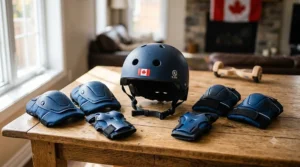
- Skipping safety gear because the box says “easy to learn.” Helmets, wrist guards, and knee pads matter most in the first week of ownership, not after a child is already confident.
- Not registering the product or checking Health Canada recalls. Several major hoverboard recalls have applied directly to Canadian-sold units, and registration is the only reliable way to be notified.
Practical Usage Guide: Setting Up and Riding Safely
Getting a new hoverboard right in the first 30 days sets the tone for years of safe use:
- Fully charge before first use, using only the charger included with the board — mismatched chargers are a common cause of overheating.
- Practice mounting and dismounting with the board switched off before powering it on, so the motion of stepping on doesn’t surprise a new rider.
- Start indoors on a hard, flat surface or a smooth driveway — carpet and grass make balancing noticeably harder for first-timers.
- Store the board at room temperature, not in an unheated garage, especially through a Canadian winter — charging a cold battery is harder on the cells and slows charge time.
- Wipe down wheels after riding through slush or road salt, since residue left on bearings and axles over a Canadian winter accelerates wear.
- Recharge fully after each significant ride, but avoid leaving the board on the charger for days at a time once it’s full.
The most common first-30-days mistake is skipping the indoor practice step entirely — kids who go straight to the driveway have noticeably more early falls than those who get a few minutes of low-stakes practice on carpet or a quiet hallway first.
Real-World Scenarios: Matching a Hoverboard to Your Child
A Toronto condo family with a 7-year-old: limited indoor space and an underground parkade for storage point toward the Jetson Dash — slow enough for hallway practice, small enough to store in a closet, and inexpensive enough that outgrowing it in a year or two isn’t a major loss.
A suburban Calgary family with a 10-year-old who already skateboards confidently: the Gyroor G13’s all-terrain tires and 15° slope handling suit a sloped driveway and unpaved cul-de-sac better than an indoor-focused board, and the wider age range gives room to grow.
An Ottawa household with a 13-year-old who wants real speed and a parent who’d ride it too: the Jetson Litho X’s 220 lb capacity and three speed modes let a teen start cautious and build up, while still being usable by an adult for testing or occasional fun.
Hoverboard vs Electric Scooter for Kids: Which Is Safer
This comparison comes up constantly, and the honest answer depends on the child. Electric scooters with handlebars provide a grip point that meaningfully reduces fall frequency for younger or less coordinated riders — there’s something to hold onto when balance wavers. Hoverboards, with no handlebars, demand more core control from the start but tend to produce lower-speed falls when they do happen, since most kids’ hoverboards top out well below a typical electric scooter’s speed.
For a first-time rider under 10, a handlebar scooter is often the gentler entry point. For a child who’s already comfortable balancing — from skateboarding, biking, or skating — a hoverboard’s learning curve is usually shorter than it looks, and several of the boards above (especially the Jetson Dash and Gotrax Edge) are specifically tuned to ease that transition.
What to Expect: Real-World Performance in Canadian Winters
Spec sheets are written assuming room-temperature conditions, and Canadian winters routinely aren’t that. Cold weather measurably reduces lithium-ion battery efficiency — riders can expect noticeably shorter range once temperatures drop toward freezing, even with a fully charged board. The fix isn’t complicated: store and charge the board indoors, and treat any outdoor winter ride as a shorter-range trip than the spec sheet promises.
Road salt and slush are the other under-discussed factor. Wheels, bearings, and exposed sensor pads on the boards in this guide aren’t designed for sustained exposure to salt brine, and a board ridden through slushy sidewalks without a wipe-down afterward will show wear faster than one used only on dry summer pavement. None of the boards reviewed here are rated for sustained winter outdoor use — treat winter riding as an occasional, supervised, indoor-or-driveway activity rather than a daily commute option.
Long-Term Cost & Maintenance in Canada
The purchase price is rarely the full cost of hoverboard ownership. Replacement chargers, tires, and battery packs are all available for the brands on this list, but availability and turnaround time vary — established brands like Razor and Jetson tend to have more predictable parts support in Canada than smaller import brands.
A rough way to think about total cost of ownership: a $150 CAD board that needs a $40 replacement charger after a year of heavy use isn’t necessarily worse value than a $250 CAD board that never needs a part — it depends entirely on usage and care. Budgeting roughly 15–20% of the purchase price annually for incidental parts (a charger, a tire, occasional accessories) is a realistic estimate across the boards reviewed here.
One Canada-specific note: cross-border warranty claims on hoverboards bought from US-only sellers can be genuinely frustrating, with shipping costs and customs delays for replacement parts. Sticking to listings that explicitly state Canadian warranty support — as several boards on this list do — avoids that headache entirely.
Canadian Regulations & Safety Standards
There’s no federal Canadian agency separate from the US process certifying hoverboards — instead, Canada formally recognizes the UL2272 standard itself as a National Standard of Canada through the Standards Council of Canada, giving it direct legal and consumer-protection relevance here, not just south of the border.
Health Canada’s Consumer Product Safety division actively monitors and issues recalls for hoverboards sold in Canada, as seen with past battery-related recalls affecting units distributed through Canadian retailers. Beyond certification, most provinces treat hoverboards similarly to skateboards or other wheeled recreational devices for the purposes of sidewalk and roadway use — meaning local bylaws, not a national hoverboard-specific law, typically govern where a child can legally ride. Always check municipal rules before assuming a sidewalk or bike path is fair game.
Bilingual product labelling is a legal requirement for consumer products sold in Canada — a detail worth checking on the box or listing for any board, since it’s a quick signal that a retailer is actually set up to sell compliantly here rather than simply forwarding a US listing.
Features That Actually Matter (And Those That Don’t)
After comparing seven boards, a clear pattern emerges between marketing and substance:
Actually matters: UL2272 certification, an accurate weight rating with margin, a speed cap or beginner mode, and tire type matched to where the child will actually ride.
Nice but secondary: Bluetooth speakers, app connectivity (useful mainly for parental speed limiting, less so for entertainment), and colour options.
Mostly marketing: LED wheel lighting beyond basic visibility, “PRO” or “Elite” naming that doesn’t correspond to a meaningful spec jump, and claimed top speeds that assume an ideal rider weight far below what the board is actually rated for.
If a listing leads with lights and Bluetooth before mentioning certification and weight limit, that’s worth treating as a signal to dig further before buying.
FAQ: Hoverboards for Kids in Canada
❓ What is the safest age to buy a hoverboard for kids?
❓ Is UL2272 certification required to sell hoverboards in Canada?
❓ Do hoverboards ship to all of Canada through Amazon.ca?
❓ How much does cold weather affect a kid's hoverboard battery?
❓ What should I do if my child's hoverboard overheats or smokes?
Conclusion
Choosing a safe hoverboard for kids in Canada isn’t complicated once you know what to filter for: a genuine UL2272 sticker, a weight and age rating with real margin for your child, and a brand that actually supports Canadian buyers rather than just shipping a US listing north. Of the seven boards compared here, the Jetson Dash makes the most sense for a cautious first-timer, the Gotrax Edge is the strongest all-around value, and the Jetson Litho X is the clear pick once a teen is ready for real speed.
None of that replaces good judgment in the moment — supervised first rides, proper protective gear, and a quick recall check before you buy will do more for your child’s safety than any single spec on a listing page. Whichever board you land on, the goal is the same one every kid has: get up, balance, and go without a second thought about what’s underfoot. 🇨🇦⚡
Recommended for You
- Best Hoverboard for Kids in Canada 2026: Top 7 Picks Reviewed
- Electric vs Gas Dirt Bike for Kids: 7 Canadian Picks (2026)
- Best Electric Dirt Bike for Kids Canada 2026: Top 7 Picks
Disclaimer: This article contains affiliate links. As an Amazon Associate, I earn from qualifying purchases. If you purchase products through these links, we may earn a small commission at no additional cost to you.
✨ Found this helpful? Share it with your friends! 💬🤗
